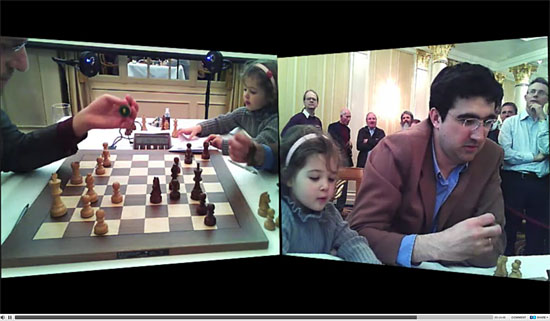
4/23/2012 – Levon Aronian surprised his opponent by playing 1.e4 instead of his customary d-pawn push. Vladimir Kramnik played in pet Ruy Lopez Berlin, and a moderately tense struggle ended after three hours and 37 moves in a draw. In the post mortem a spectator showed the players a devilishly clever win that both had overlooked. You will never guess who this super-talent was.
new: Fritz 20
Your personal chess trainer. Your toughest opponent. Your strongest ally. FRITZ 20 is more than just a chess engine – it is a training revolution for ambitious players and professionals. Whether you are taking your first steps into the world of serious chess training, or already playing at tournament level, FRITZ 20 will help you train more efficiently, intelligently and individually than ever before.
YOUR PERSONAL CHESS COACH - Whether you’re taking your first steps into the world of club chess, or already playing at a tournament level: with FRITZ, you can train more efficiently, intelligently and with a more personalised approach than ever before. FRITZ is more than just a chess engine – it’s a training revolution! Whether you’re taking your first steps into the world of club chess, or already playing at a tournament level: with FRITZ, you can train more efficiently, intelligently and with a more personalised approach than ever before.
GM Blohberger presents a complete two-part repertoire for Black: practical, clear, and flexible – instead of endless theory, you’ll get straightforward concepts and strategies that are easy to learn and apply.
€89.90
Zurich Chess Challenge: Kramnik vs. Aronian
The Zurich Chess Club announces a six-game chess match between Vladimir Kramnik
(Russia) and Levon Aronian (Armenia) from 21 to 28 April 2012. The numbers two
and three of the world ranking will meet in the time-honored Hotel Savoy Baur
en Ville at Paradeplatz, the venue of many a famous chess event in the past.
Kramnik and Aronian are the winners of the two most prestigious tournaments
of the last months. While the 36-year-old Kramnik gained a convincing victory
at the London Chess Classic in December, the 29-year-old Aronian won the famous
tournament in Wijk aan Zee with an outstanding score.
Swiss alpenhorns on Paradeplatz heralding the start of round two
Vladimir Kramnik and Levon Aronian wait for the clocks to be started
[Event "Zurich Chess challenge Kramnik vs Aroni"] [Site "Zurich"] [Date "2012.04.22"]
[Round "2.1"] [White "Aronian, Levon"] [Black "Kramnik, Vladimir"] [Result "1/2-1/2"]
[ECO "C67"] [WhiteElo "2820"] [BlackElo "2801"] [PlyCount "74"] [EventDate "2012.??.??"]
1. e4 {60 This is actually the biggest opening surprise of them all as Aronian
is a noted 1.d4 player. He explained that it was to try to surprise Kramnik,
an opponent whose preparation is so refined.} e5 {60} 2. Nf3 {0} Nc6 {0} 3.
Bb5 {0} Nf6 {0 Kramnik explained in the post-game conference that he considered
deviating from his pet Berlin, but decided to see what Aronian had prepared,
betting on his opponent's inexperience to weigh in his favor.} 4. O-O {0} Nxe4
{60} 5. d4 {0} Nd6 {0} 6. Bxc6 {0} dxc6 {0} 7. dxe5 {60} Nf5 {0} 8. Qxd8+ {0}
Kxd8 {0} 9. Nc3 {0} Be6 {180 This is the first deviation. Although the development
to e6 is nothing odd, this particular move-order plans to bring it back to c8
a few moves later. Owing to the nature of the endgame, he feels that the idea,
while exotic looking, has a good basis of logic behind it.} 10. Rd1+ {0} Ke8
{0} 11. Ng5 {60} Bc8 {0.21/0 0} 12. h3 {0.14/0 180} Be7 {0.14/0 60 Here 84 of
the 85 games on record continued with Nf3, but Aronian has a very different
idea.} 13. Bf4 {0.03/0 120 A theoretical novelty, but apparently not the result
of any deep preparation. Considering the unusual Be6-c8 played by Kramnik, this
is no surprise.} Nh4 {0.07/0 420 A deep thought, and a good reaction. Vladimir
felt that as a result of his unorthodox choice, he had succeeded in tripping
Levon and now stood at least equal.} 14. e6 {-0.02/0 1380 } f6 {0.00/0 1020}
15. Nf7 {0.15/0 0} Rg8 {0.08/0 60} 16. Bxc7 {0.00/0 0} Bxe6 {0.04/0 0} 17. Nd6+
{0.04/0 0} Bxd6 {0.00/0 120} 18. Bxd6 {0.06/0 240} Kf7 {0. 09/0 60} 19. f3 {0.15/0
0} Nf5 $6 {0.11/0 240 Here Kramnik played this rather quickly and offered a
draw. In hindsight, he agrees with Aronian's choice to decline as he felt this
was a very poor move that did not suit the position. There is a certain irony
that the engines place it as best or top two best.} 20. Bc5 {0.16/0 60} b6 {0.14/0
420} 21. Bf2 {0.15/0 0} Rgd8 {0.18/0 420} 22. a4 {0.31/0 60} Ne7 {0.16/0 540}
23. a5 {0.21/0 120} c5 {0.28/0 360 In spite of it all, the position is equal.}
24. Nb5 {0.31/0 480} ({There was considerable debate on the engine choice of}
24. g4 $5 {After examining it with the commentators IM Werner Zug and GM Yannick
Pelletier, the players conceded it was an option though it was merely a fork
in the road, and not a deal-changer. Aronian pointed out that he would reject
a move such as 24. g4 purely on principle, and the only way for it to enter
his list of candidates would be after analysing the position very deeply.})
24... Nc6 {0.30/0 360} 25. Rxd8 { 0.00/0 840} Rxd8 {0.00/0 0} 26. axb6 {0.02/0
0} axb6 {0.01/0 0} 27. Ra6 {0.00/ 0 60} Rd1+ {0.00/0 540} 28. Kh2 {0.00/0 0}
Rd2 {0.00/0 60} 29. Rxb6 {0.00/0 0 By now, there was the question of whether
they would be shaking hands soon and play a rapid game, as there was 20-25 minutes
left before the three-hour rule kicked in, or whether the spectators would be
deprived of the option. The players eventually played three hours and *five*
minutes, and did not play a rapid, but the Armenian said that the choice was
not related to the possible rapid game, but because he was under the impression
he still had the better chances. Kramnik joked that he was probably not enthusiastic
either of the idea of playing a rapid game with Black, since the colors would
be reversed. This actually brings up a psychological question. By winning the
first game as Black, and having put a bit of pressure as White, however little,
would he want to risk his mental edge by possibly losing a rapid, and facing
a refreshed Kramnik in game three?} Rxc2 {0.00/0 120} 30. Nd6+ {0.00/0 720}
Ke7 { 0.00/0 60} 31. Ne4 {0.00/0 60} Nd4 {0.00/0 420} 32. Rb7+ {0.00/0 60} Kf8
{0.00/ 0 120} 33. Rc7 {0.00/0 60} Rxb2 {0.00/0 180} 34. Rxc5 {0.00/0 0} Nf5
{0.00/0 120} 35. Ng3 {-0.02/0 420} Rxf2 {-0.03/0 25} 36. Nxf5 {-0.02/0 0} Bxf5
{5} 37. Rxf5 {0} Ra2 {4} 1/2-1/2
The games were broadcast live on the official web site, and naturally on Playchess.
In addition there was a video broadcast with commentary and images from the
playing hall. If you missed it you can follow the entire four hours of action
and the press conference in this video stream:
In the postgame analysis at the board Kramnik's super-cute three-year-old
daughter Daria joined in
At one stage – you can watch it at 03:15:20 into the video
stream on the match web site – she
suggests a devilishly clever move that both players had completely overlooked:
... reinsert the captured black queen on the square a8, with a winning advantage
for her daddy!
The press conference after game two (Game 2 - Part 4 in the video list above)
The games are being broadcast live on the official web site and on the
chess server Playchess.com.
If you are not a member you can download a free Playchess client there
and get immediate access. You can also use ChessBase
11 or any of our Fritz
compatible chess programs.
YOUR PERSONAL CHESS COACH - Whether you’re taking your first steps into the world of club chess, or already playing at a tournament level: with FRITZ, you can train more efficiently, intelligently and with a more personalised approach than ever before.
The Nimzo-Indian has stood the test of time for over a century: Still a top choice for elite players today, from Magnus Carlsen to Praggnanandhaa, it remains one of Black's most reliable ways to fight for real chances against 1.d4 2.c4 3.Nc3.
1.c4 e5 2.Nc3 Bb4!? is an opening idea well worth considering. Black immediately threatens to double the pawns on c3 in the style of the Trompowski or Sicilian Grand Prix attack.
Italian Game Powerbase 2026 is a database and contains 8571 top class games from Mega 2026 and the Correspondence Database 2026, of which 479 are annotated.
Videos: Nico Zwirs discusses the Sicilian with 2…e6 3.d4 cxd4 4.Qxd4 Nc6 5.Qe3 Nf6 6.Nc3. Mihail Marin examines Sindarov’s 6.Ne5 in the Queen’s Pawn Defence. Plus the ‘Lucky bag’ featuring 41 analyses by Berg, Ftacnik, Gupta and many others.
If you're looking for a dynamic alternative to the Slav, Queen's Gambit Declined, or other mainstream systems, the Chigorin Defence offers exactly what modern tournament players need.
€34.90
We use cookies and comparable technologies to provide certain functions, to improve the user experience and to offer interest-oriented content. Depending on their intended use, analysis cookies and marketing cookies may be used in addition to technically required cookies. Here you can make detailed settings or revoke your consent (if necessary partially) with effect for the future. Further information can be found in our data protection declaration.
Pop-up for detailed settings
We use cookies and comparable technologies to provide certain functions, to improve the user experience and to offer interest-oriented content. Depending on their intended use, cookies may be used in addition to technically required cookies, analysis cookies and marketing cookies. You can decide which cookies to use by selecting the appropriate options below. Please note that your selection may affect the functionality of the service. Further information can be found in our privacy policy.
Technically required cookies
Technically required cookies: so that you can navigate and use the basic functions and store preferences.
Analysis Cookies
To help us determine how visitors interact with our website to improve the user experience.
Marketing-Cookies
To help us offer and evaluate relevant content and interesting and appropriate advertisement.