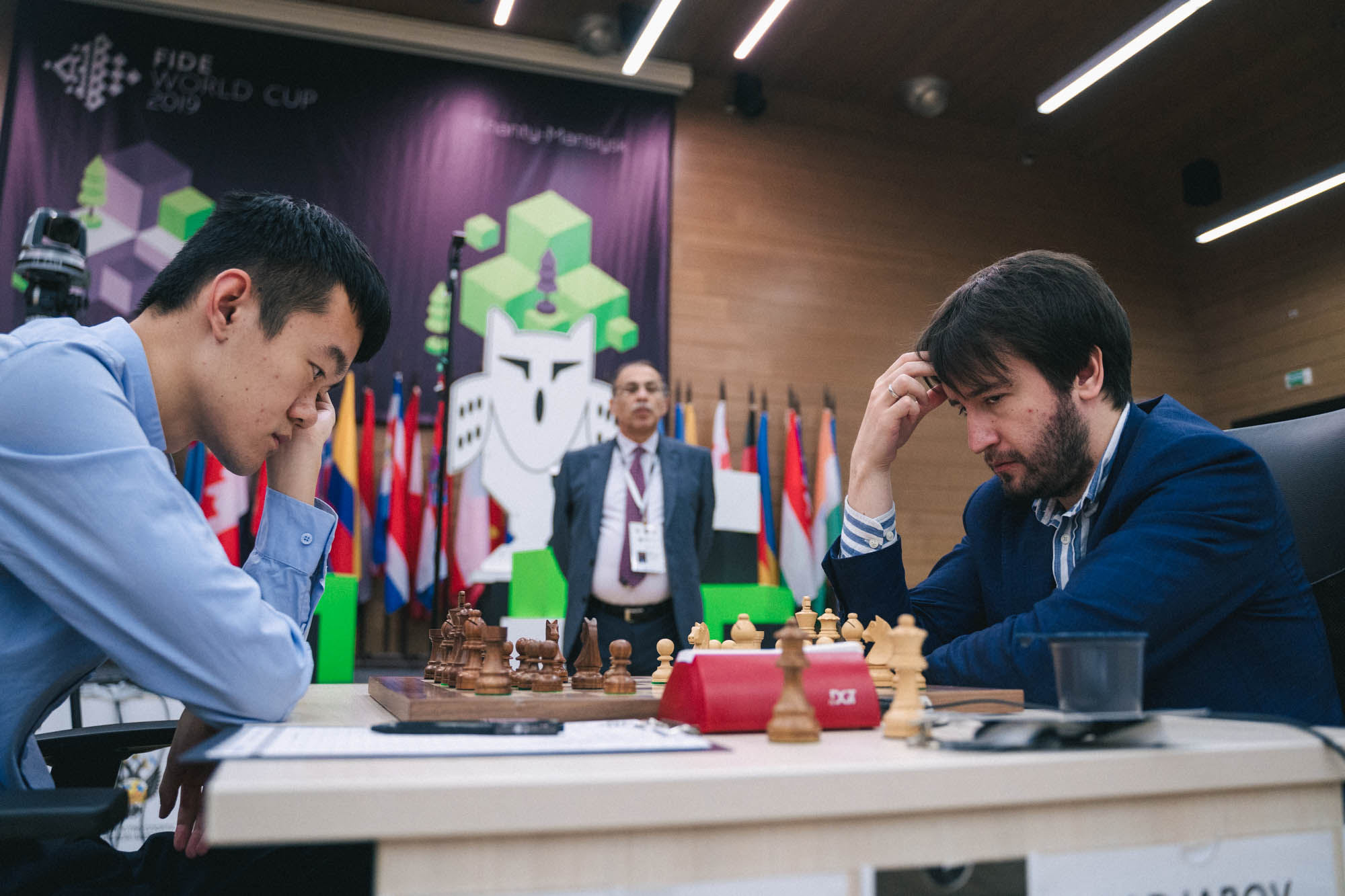
9/30/2019 – Teimour Radjabov and Ding Liren signed a 33-move draw as the final match of the FIDE World Cup kicked off Monday in Khanty-Mansiysk. The players blitzed out no less than 26 moves of theory before simplifying into a completely drawn rook endgame. Meanwhile, a similar story was seen in the match-up for third place, as Yu Yangyi had the white pieces against Maxime Vachier-Lagrave — they played 36 moves of a sharp Grünfeld before splitting the point. IM LAWRENCE TRENT reviewed the highlights of the day. | Photo: FIDE
new: ChessBase Magazine 225
Chess Festival Prague 2025 with analyses by Aravindh, Giri, Gurel, Navara and others. ‘Special’: 27 highly entertaining miniatures. Opening videos by Werle, King and Ris. 10 opening articles with new repertoire ideas and much more. ChessBase Magazine offers first-class training material for club players and professionals! World-class players analyse their brilliant games and explain the ideas behind the moves. Opening specialists present the latest trends in opening theory and exciting ideas for your repertoire. Master trainers in tactics, strategy and endgames show you the tricks and techniques you need to be a successful tournament player! Available as a direct download (incl. booklet as pdf file) or booklet with download key by post. Included in delivery: ChessBase Magazine #225 as “ChessBase Book” for iPad, tablet, Mac etc.!
YOUR PERSONAL CHESS COACH - Whether you’re taking your first steps into the world of club chess, or already playing at a tournament level: with FRITZ, you can train more efficiently, intelligently and with a more personalised approach than ever before. FRITZ is more than just a chess engine – it’s a training revolution! Whether you’re taking your first steps into the world of club chess, or already playing at a tournament level: with FRITZ, you can train more efficiently, intelligently and with a more personalised approach than ever before.
EXPAND YOUR CHESS HORIZONS
It doesn't get any better than this: the premium equipment perfect for tournament players and professionals: with ChessBase program '26, Mega Database, CORR-Database and much more.
€499.90
The Golden Week begins
The FIDE World Cup is taking place in Khanty-Mansiysk. It is a seven-round knock-out event for 128 players, with a total prize fund of US$ 1.6 million and a first prize of US$ 110,000. The matches consist of two classical games with a time control of 90 minutes for 40 moves plus 30 minutes for the rest of the game, with an increment of 30 seconds per move. The finals consist of four classical games. Full schedule.
Tomorrow, October 1st, China will celebrate its National Day, commemorating the establishment of the "People's Republic" in 1949. Traditionally, three or four days of paid holiday are added around this date, giving way to what is known as the "National Day Golden Week". Naturally, millions head out on vacation, thus creating one of the busiest periods both for tourism and the retail industry.
Coincidentally, this year's finals include two Chinese representatives, while calling this the "golden week" of the World Cup seems quite appropriate — the four-game match-ups started on Monday and the winner will be decided by Friday at the latest.
Both duels started with all four players showing the kind of first-rate home preparation that top grandmasters need to keep constantly updated to survive against their colleagues. Sharp variations of the Marshall Attack and the Grünfeld led to short draws, with Ding Liren repeating his result from the 2017 final, when he also started with Black and drew game one against Levon Aronian.
Let endgame expert Dr Karsten Müller show and explain the finesses of the world champions. Although they had different styles each and every one of them played the endgame exceptionally well, so take the opportunity to enjoy and learn from some of the best endgames in the history of chess.
Trying to recall a long theoretical line? — Yu Yangyi | Photo: FIDE
Radjabov ½:½ Ding Liren
Teimour Radjabov and Ding Liren already faced each other twice in 2019, signing draws both in Shamkir (the Azeri had White) and Wijk aan Zee (the Chinese had White). In their head-to-head record, Ding was the last one to get a win, as he beat Radjabov with the black pieces at the 2015 Tata Steel Masters. Back then, the Chinese ace had a 2732 rating and used the King's Indian Defence to defeat his 2734-rated colleague.
This time around, Ding opted for the Marshall Attack of the Ruy Lopez, repeating the line they had discussed this year in Shamkir. Incidentally, at the aforementioned edition of the Tata Steel Master (2015), Radjabov himself played this variation with White and was the one in the driver's seat before signing a draw with Aronian. The Azeri grandmaster was the first one to deviate from previous play...on move 27:
The Marshall Attack is one of the most dynamic replies Black has at his disposal against 1.e4. At the cost of a pawn, Black takes over the initiative from the get - go and goes after the white king. Wrongly considered to be mainly a drawing weapon by some, this DVD offers many new ideas for Black, showing how to keep the queens on the board and to play for a win in almost all cases.
Radjabov had played 27.f3 against both Ding and Aronian, but now opted for 27.a4. After 27...♜e2 28.axb5 axb5 29.♗xd5 cxd5 there was no doubt the game would finish peacefully. The players quickly traded a couple of pawns and signed the draw on move 33.
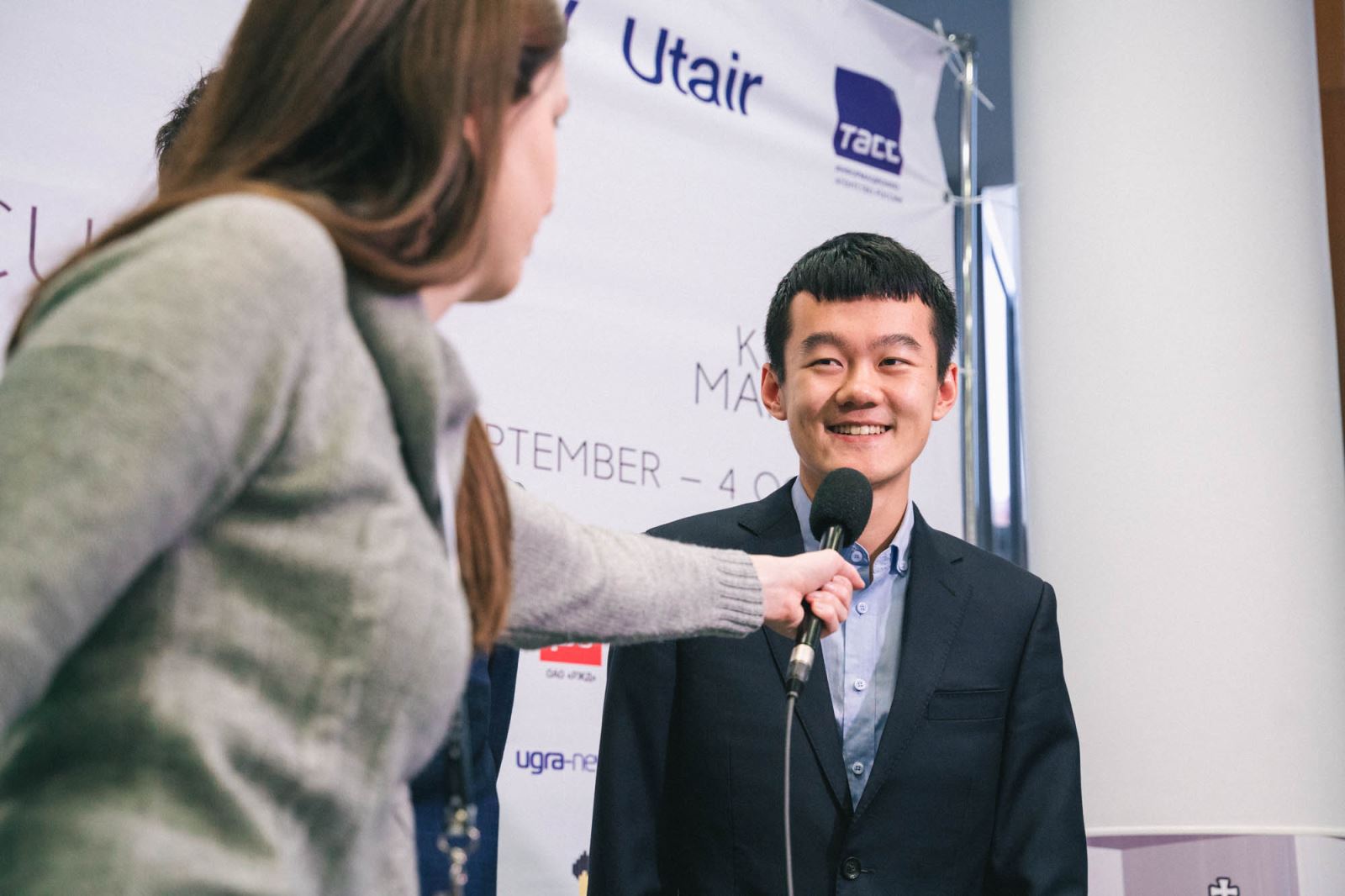
Ding Liren gladly speaks to the press | Photo: FIDE
Yu Yangyi ½:½ Vachier-Lagrave
The contenders for third place, Yu Yangyi and Maxime Vachier-Lagrave, have faced each other this year more often than the finalists, as they met at the Norway Chess Tournament and the Saint Louis Rapid & Blitz event, trading blows in their quick-time encounters. The players drew their classical match-up in Stavanger ('MVL' was Black), while both times Yu Yangyi had the white pieces in Saint Louis, the players unsurprisingly delved into Vachier-Lagrave's pet Grünfeld Defence.
Much like in the game between Radjabov and Ding, the players all but blitzed out their first 25 moves. At this point, Yu had a rook and two pawns against Vachier-Lagrave's knight and bishop:
The most effective, timeproven way to develop tactical abilities, imagination, and the ability to calculate variations, is practice. The 69 exercises on this DVD are taken from grandmaster games and show tactical ideas that are typical for the Grünfeld.
Only here did the players start taking their time. Yu spent over 11 minutes on 26.♖he1, while 'MVL' thought for over 21 before responding with 26...♝f7. The Chinese thought long and hard (24 minutes) for a last time before playing 27.c4, and apparently both contenders were already certain of the outcome, as they went back to playing quickly before splitting the point nine moves later.
Post-game interview with Yu Yangyi and Maxime Vachier-Lagrave
Make life difficult for the Sicilian! 2.b3 is a thoroughly venomous but still solid kind of "Anti-Sicilian". No matter what setup black chooses, the bishop on b2 will always be unpleasant for him.
IM Lawrence Trent reviewed the highlights of the day
Commentary webcast
Commentary by IM Anna Rudolf and GM Evgeny Miroshnichenko
Carlos Alberto ColodroCarlos Colodro is a Hispanic Philologist from Bolivia. He works as a freelance translator and writer since 2012. A lot of his work is done in chess-related texts, as the game is one of his biggest interests, along with literature and music.
YOUR PERSONAL CHESS COACH - Whether you’re taking your first steps into the world of club chess, or already playing at a tournament level: with FRITZ, you can train more efficiently, intelligently and with a more personalised approach than ever before.
Most players don’t lack the urge to attack, they just strike at the wrong moment, and GM Sipke Ernst shows you which signals tell you to go for the king and which tell you to choose another plan.
How grandmasters win without fireworks: GM Jan Markos shows you 11 very practical tips from "How to play in a lost position" to "Be patient like Carlsen" that will improve your tournament chess.
The Nimzo-Indian has stood the test of time for over a century: Still a top choice for elite players today, from Magnus Carlsen to Praggnanandhaa, it remains one of Black's most reliable ways to fight for real chances against 1.d4 2.c4 3.Nc3.
1.c4 e5 2.Nc3 Bb4!? is an opening idea well worth considering. Black immediately threatens to double the pawns on c3 in the style of the Trompowski or Sicilian Grand Prix attack.
Italian Game Powerbase 2026 is a database and contains 8571 top class games from Mega 2026 and the Correspondence Database 2026, of which 479 are annotated.
€9.90
We use cookies and comparable technologies to provide certain functions, to improve the user experience and to offer interest-oriented content. Depending on their intended use, analysis cookies and marketing cookies may be used in addition to technically required cookies. Here you can make detailed settings or revoke your consent (if necessary partially) with effect for the future. Further information can be found in our data protection declaration.
Pop-up for detailed settings
We use cookies and comparable technologies to provide certain functions, to improve the user experience and to offer interest-oriented content. Depending on their intended use, cookies may be used in addition to technically required cookies, analysis cookies and marketing cookies. You can decide which cookies to use by selecting the appropriate options below. Please note that your selection may affect the functionality of the service. Further information can be found in our privacy policy.
Technically required cookies
Technically required cookies: so that you can navigate and use the basic functions and store preferences.
Analysis Cookies
To help us determine how visitors interact with our website to improve the user experience.
Marketing-Cookies
To help us offer and evaluate relevant content and interesting and appropriate advertisement.











 The FIDE World Cup is taking place in Khanty-Mansiysk. It is a seven-round knock-out event for 128 players, with a total prize fund of US$ 1.6 million and a first prize of US$ 110,000. The matches consist of two classical games with a time control of 90 minutes for 40 moves plus 30 minutes for the rest of the game, with an increment of 30 seconds per move. The finals consist of four classical games.