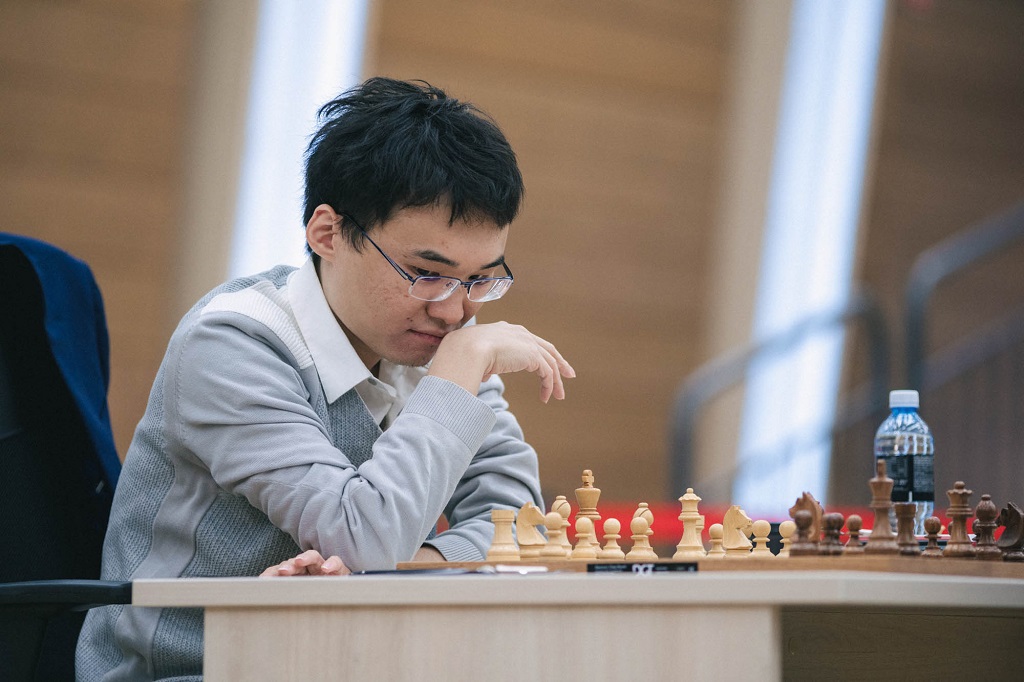
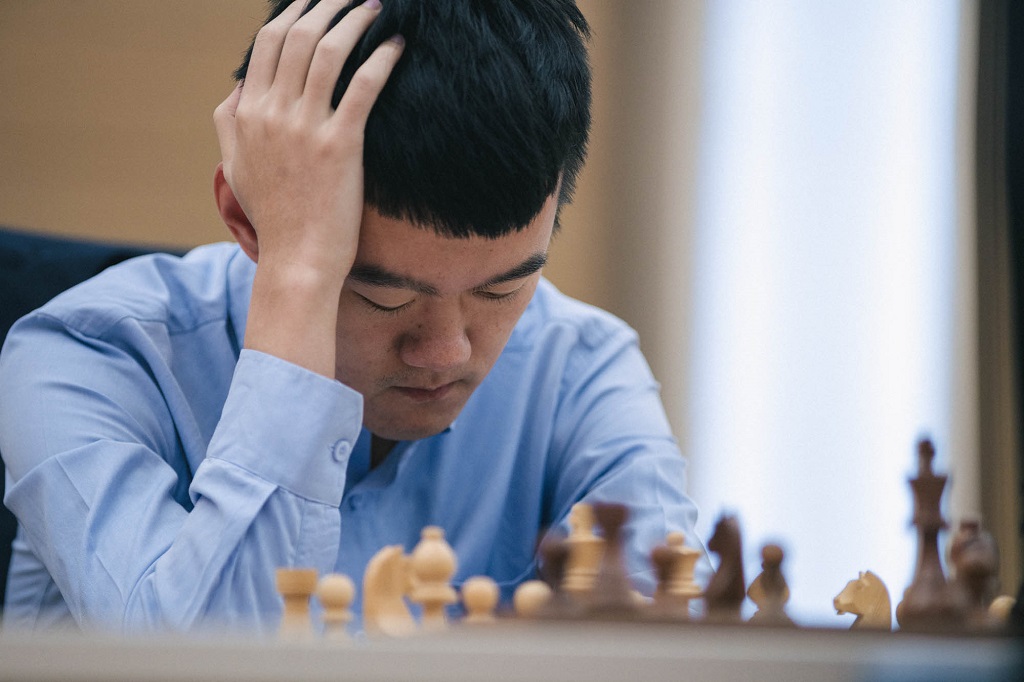
9/25/2019 – Ding Liren and Teimour Radjabov won with White on Tuesday to qualify to the FIDE World Cup semi-finals in Khanty-Mansiysk. The Chinese arrived in Siberia as the favourite and eliminated Alexander Grischuk, while Radjabov got the better of Jeffery Xiong, who came from getting impressive match victories over Giri and Duda. Yu Yangyi v Nikita Vitiugov and Maxime Vachier-Lagrave v Levon Aronian finished drawn and will be decided on tiebreaks. GM DANNY KING recapped the highlights of the day. | Photo: FIDE
new: Fritz 20
Your personal chess trainer. Your toughest opponent. Your strongest ally. FRITZ 20 is more than just a chess engine – it is a training revolution for ambitious players and professionals. Whether you are taking your first steps into the world of serious chess training, or already playing at tournament level, FRITZ 20 will help you train more efficiently, intelligently and individually than ever before.
YOUR PERSONAL CHESS COACH - Whether you’re taking your first steps into the world of club chess, or already playing at a tournament level: with FRITZ, you can train more efficiently, intelligently and with a more personalised approach than ever before. FRITZ is more than just a chess engine – it’s a training revolution! Whether you’re taking your first steps into the world of club chess, or already playing at a tournament level: with FRITZ, you can train more efficiently, intelligently and with a more personalised approach than ever before.
The Hyper-Accelerated Dragon is fast, from the very first moves, your bishop heads to g7, seizes the long diagonal, and turns into the most feared piece on the board.
It rewards players who love initiative and clear attacking plans.
€39.90
Time trouble
The FIDE World Cup is taking place in Khanty-Mansiysk. It is a seven-round knock-out event for 128 players, with a total prize fund of US$ 1.6 million and a first prize of US$ 110,000. The matches consist of two classical games with a time control of 90 minutes for 40 moves plus 30 minutes for the rest of the game, with an increment of 30 seconds per move. The finals consist of four classical games. Full schedule.
Time management was a crucial factor in the decisive games of the day. Teimour Radjabov played sharply against Jeffery Xiong's Grünfeld Defence, which led to both players needing to make their last moves before move 40 with only seconds on their clocks. Meanwhile, Alexander Grischuk was the one, unsurprisingly, having this problem in his game against Ding Liren — the Russian already had an inferior position but lost any remaining hopes while hurried by the clock.
This was the third time in the event that Radjabov advanced without needing tiebreaks, while Ding had only managed to do so once before, when he knocked out 1954-rated Shaun Press in the first round. The players will get a rest day before the all-important semi-finals.
Given Ding's presence amongst the final four, it is worth noting that him getting the ticket to the Candidates via the World Cup would be good news for Anish Giri, who would become the favourite to get the spot given to the player with the highest rating average between February 2019 and January 2020. Ding is currently leading this race, while Maxime Vachier-Lagrave and Ian Nepomniachtchi are in third and fourth places, behind Giri — Martin Bennedik is running the numbers.
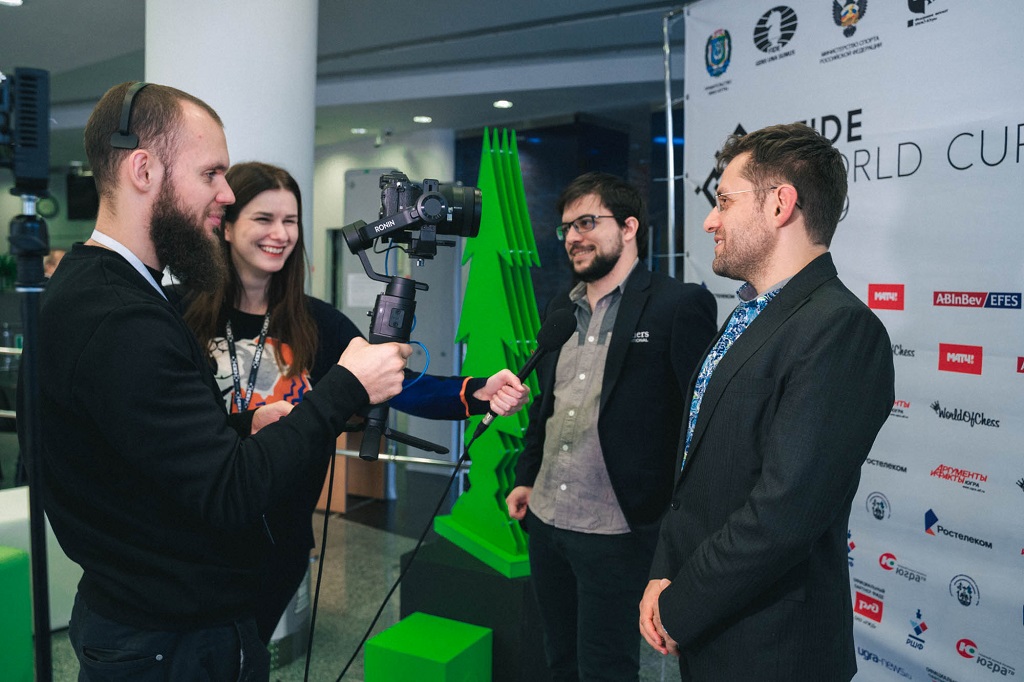
Will either of these two good friends become the next chess world champion? — Maxime Vachier-Lagrave and Levon Aornian | Photo: FIDE
Ding Liren 1:0 Grischuk
The Chinese number one Ding Liren is one of three players in the world with a 2800+ rating. Despite his quiet demeanour, the 26-year-old has gained the respect of both the public and his colleagues. Already a couple of years ago, Carlsen chose him as rival for the Champions Showdown tournament in Saint Louis. Back then, the world champion got a whopping victory, but Ding has come a long way since — less than a month ago, the Chinese star won the Sinquefield Cup, after beating Carlsen in rapid play-offs.
Also, Ding often gets quiet positional victories against first-rate players. In his game with White versus Alexander Grischuk on Tuesday, he got a slight edge out of an English Opening, after the Russian chose a passive setup with his light-squared bishop on d7 instead of f5. Furthermore, Grischuk mishandled his clock and was in time trouble in the middlegame. Both contenders thought Black's critical mistake came on move 29:
The aim of these Dvd's is to build a repertoire after 1.c4 and 2.g3 for White. The first DVD includes the systems 1...e5, the Dutch and Indian setups. The second DVD includes the systems with 1...c5, 1...c6 and 1...e6.
Black played 29...♝e6, and Ding did not take long to execute the bishop trade with 30.♗xe6, as after 30...fxe6 31.♕e4 he managed to centralize his queen while keeping an eye on the c4 and e6 weaknesses.
White increased his advantage slowly but surely, combining small threats which led to the eventual capture of the c4-pawn. When the time control had passed, Grischuk realized it would have been hopeless to continue and resigned. The Russian still has good chances of getting into the Candidates via the Grand Prix, as he is currently in second place in the overall standings table.
Game analysis with Anna Rudolf and Ding Liren
Radjabov 1:0 Xiong
Jeffery Xiong played some of the most enterprising chess in Khanty-Mansiysk and his rematch game against Teimour Radjabov was not the exception. However, the youngster went for the Grünfeld Defence against a well-known theoretician, and soon found himself out of book. The Azeri grandmaster played a line not often seen amongst elite players, which prompted Xiong to start taking his time as early as move 8. Not long after, he made a critical mistake:
The Grünfeld Defence was invented by the famous Austrian Grandmaster Ernst Grünfeld in the early twenties of the last century. One of the first reactions to it came from the great Akiba Rubinstein - the g3 system, fianchettoing the bishop to g2. After that many systems were tried to refute the Grünfeld and nothing really worked. So, Rubinstein's recipe remains a very important positional approach against this dynamic opening.
14...♜d8 seems natural enough, but precision was already essential at this point and 14...♝g5 was the correct way to go. The problem is that after the text White can go 15.f5 and the f-pawn will soon reach f6, leaving Black permanently threatened by a potential mate on g7.
The sharp position led to both players getting in time trouble, but Radjabov was clearly in the driver's seat all throughout. He had the sort of advantage that prompts the engines to give White a +2 advantage with equal material on the board:
Here 34.♕h6 was the most precise, but after 34.♖e7 Xiong did not play the best defence, 34...♜c2, and opted for 34...♜c1+ instead. Resignation came after 35.♔h2 ♜c3 36.♕h6.
Post-game interview with Teimour Radjabov
The draws of the day
With Xiong eliminated, the biggest 'underdogs' still in contention are Yu Yangyi and Nikita Vitiugov — the 12th and 20th seeds respectively. After giving up an exchange and getting a draw with Black in game one, the Chinese handled the opening better than his opponent on Tuesday. He got the upper hand positionally but had his king still in the centre:
This DVD provides everything you need to know to be able to play one of the most classical openings with Black, the Nimzo-Indian, arising after 1.d4 Nf6 2.c4 e6 3.Nc3 Bb4. Nearly every World Championship and top tournament features the Nimzo-Indian.
Yu captured the a-pawn with 24.♖xa7, perhaps discarding the more poignant 24.♕xa7 due to 24...♝b3, with the threat of mate on d1. After the text, Black took control over the c-file with 24...♜c8 and went on to get a comfortable 40-move draw.
Vitiugov and Yu will decide their match-up on Wednesday's tiebreaks, much like Maxime Vachier-Lagrave and Levon Aronian, who needed about an hour to sign a 31-move draw out of an Italian Opening. Will we see another thrilling play-off between the French and the Armenian? Their 2017 match was one of the most exciting duels ever seen in a knock-out event.
A repertoire of attacking lines against the four major defences to 1.e4 – that is, 1...e5, the Sicilian, the French, and the Caro Kann. These systems will put your opponent under pressure, and when players are under pressure, mistakes occur. This is a practical repertoire – if we study openings we want to be sure to use them in our games.
GM Danny King reviewed the highlights of the day's action
Commentary webcast
Commentary by IM Anna Rudolf and GM Evgeny Miroshnichenko
Carlos Alberto ColodroCarlos Colodro is a Hispanic Philologist from Bolivia. He works as a freelance translator and writer since 2012. A lot of his work is done in chess-related texts, as the game is one of his biggest interests, along with literature and music.
YOUR PERSONAL CHESS COACH - Whether you’re taking your first steps into the world of club chess, or already playing at a tournament level: with FRITZ, you can train more efficiently, intelligently and with a more personalised approach than ever before.
The Nimzo-Indian has stood the test of time for over a century: Still a top choice for elite players today, from Magnus Carlsen to Praggnanandhaa, it remains one of Black's most reliable ways to fight for real chances against 1.d4 2.c4 3.Nc3.
1.c4 e5 2.Nc3 Bb4!? is an opening idea well worth considering. Black immediately threatens to double the pawns on c3 in the style of the Trompowski or Sicilian Grand Prix attack.
Italian Game Powerbase 2026 is a database and contains 8571 top class games from Mega 2026 and the Correspondence Database 2026, of which 479 are annotated.
Videos: Nico Zwirs discusses the Sicilian with 2…e6 3.d4 cxd4 4.Qxd4 Nc6 5.Qe3 Nf6 6.Nc3. Mihail Marin examines Sindarov’s 6.Ne5 in the Queen’s Pawn Defence. Plus the ‘Lucky bag’ featuring 41 analyses by Berg, Ftacnik, Gupta and many others.
If you're looking for a dynamic alternative to the Slav, Queen's Gambit Declined, or other mainstream systems, the Chigorin Defence offers exactly what modern tournament players need.
€34.90
We use cookies and comparable technologies to provide certain functions, to improve the user experience and to offer interest-oriented content. Depending on their intended use, analysis cookies and marketing cookies may be used in addition to technically required cookies. Here you can make detailed settings or revoke your consent (if necessary partially) with effect for the future. Further information can be found in our data protection declaration.
Pop-up for detailed settings
We use cookies and comparable technologies to provide certain functions, to improve the user experience and to offer interest-oriented content. Depending on their intended use, cookies may be used in addition to technically required cookies, analysis cookies and marketing cookies. You can decide which cookies to use by selecting the appropriate options below. Please note that your selection may affect the functionality of the service. Further information can be found in our privacy policy.
Technically required cookies
Technically required cookies: so that you can navigate and use the basic functions and store preferences.
Analysis Cookies
To help us determine how visitors interact with our website to improve the user experience.
Marketing-Cookies
To help us offer and evaluate relevant content and interesting and appropriate advertisement.











 The FIDE World Cup is taking place in Khanty-Mansiysk. It is a seven-round knock-out event for 128 players, with a total prize fund of US$ 1.6 million and a first prize of US$ 110,000. The matches consist of two classical games with a time control of 90 minutes for 40 moves plus 30 minutes for the rest of the game, with an increment of 30 seconds per move. The finals consist of four classical games.