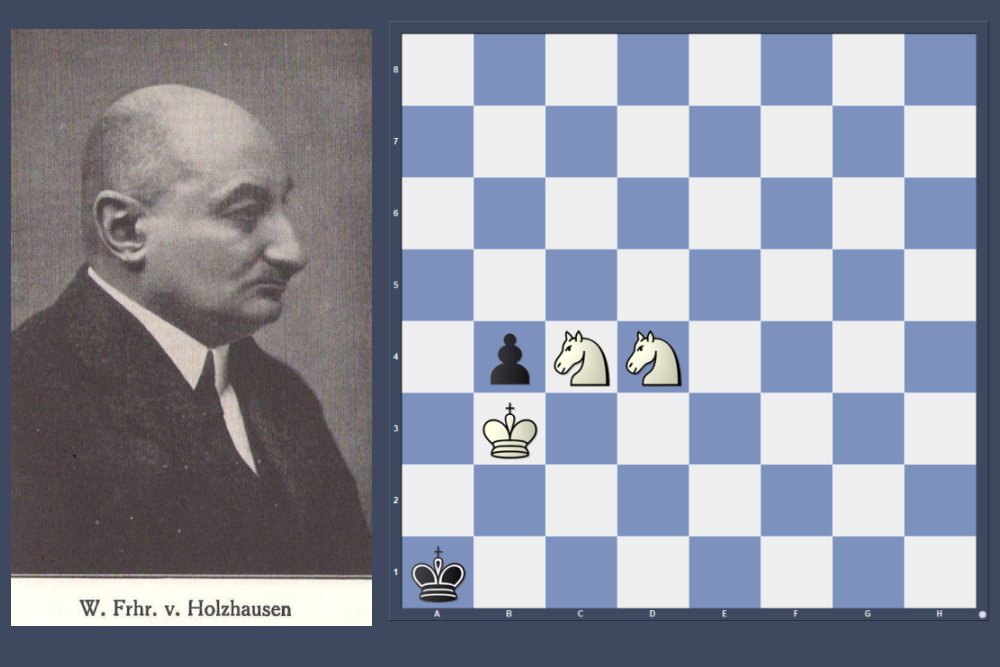
Walther Freiherr von Holzhausen
 This interactive video course of over 8 hours, provides an in-depth exploration of the Pirc Defence, a favoured opening for people looking to play for the win with the black pieces.
This interactive video course of over 8 hours, provides an in-depth exploration of the Pirc Defence, a favoured opening for people looking to play for the win with the black pieces. Through a combination of key reference games and the analysis of a complete repertoire, this ChessBase Training video course helps you understand the essential themes, ideas, and resources needed to master this opening.
Free Video sample: Introduction
Free Video sample: Attacking like in the King's Indian Defence
The name of Walther Freiherr von Holzhausen will probably not be familiar to most chess enthusiasts, even those interested in history, although he was certainly a strong player. He gained greater significance, however, less through his successes over the board than through his work as a problem composer.
Walther Freiherr von Holzhausen was born in 1876 in Troppau, in Moravian Silesia, today Opava, close to the Czech border with Austria. At the time of his birth, this was part of Austria-Hungary.
The Von Holzhausen family was an old noble family that originally came from southern Hesse. Since the 13th century, descendants of the family had played an important role as patricians in Frankfurt. From Frankfurt, the family branched out into several lines, reaching as far as Austria.
The usual sources give no precise information about Walther von Holzhausen's origins ("son of an Austrian officer"), but there is much to suggest that he was the son of Friedrich Carl Anton Freiherr von Holzhausen (1829-1907). He came from Hanau, was in Austrian service and, from 1857, was stationed in Troppau as a first lieutenant in Infantry Regiment No. 1 "Kaiser". At the end of his service career, Friedrich von Holzhausen held the rank of captain. He was married twice. His son Walther came from his second marriage, to Luise Schrom. The two marriages produced a total of eight children. Until 1890, the family lived in Troppau, and then they returned to Frankfurt.
First encounters with chess problems
In Frankfurt, Von Holzhausen began to spend time with chess problems while still at grammar school. After passing his Abitur, as an Austrian citizen, he completed his military service in Graz, Austria, in 1895/96, and was discharged as a reserve officer in 1898. Two years later, he enlisted in the Prussian army in Hanau and served as a lieutenant in the Hessen-Homburg Infantry Regiment No. 166. For a time, he was assigned to the Naumburg Cadet School as an educator and mathematics teacher.
In 1893, Von Holzhausen published his first chess composition. He also took part in chess tournaments and won the winter tournament of the Leipzig chess club Augustea in both 1898 and 1899. However, only a few of his games from before the First World War have survived.
In 1912, however, he achieved a very attractive combinational win in a simultaneous exhibition given by Siegbert Tarrasch in Frankfurt am Main.
Von Holzhausen's view of the composition of chess problems was shaped to a great extent by Johannes Kohtz and Carl Kockelkorn and their 1903 work Das indische Problem – eine Schachstudie. The book advocated a particularly aesthetic form of chess problem and founded a school of thought, the so-called "New German School" or "Logical School".
 In a total of 6 chapters, we look at the following aspects: the right decision based on tactical factors, decisions in exchanges and moves, complex and psychological decisions in longer games and in defence.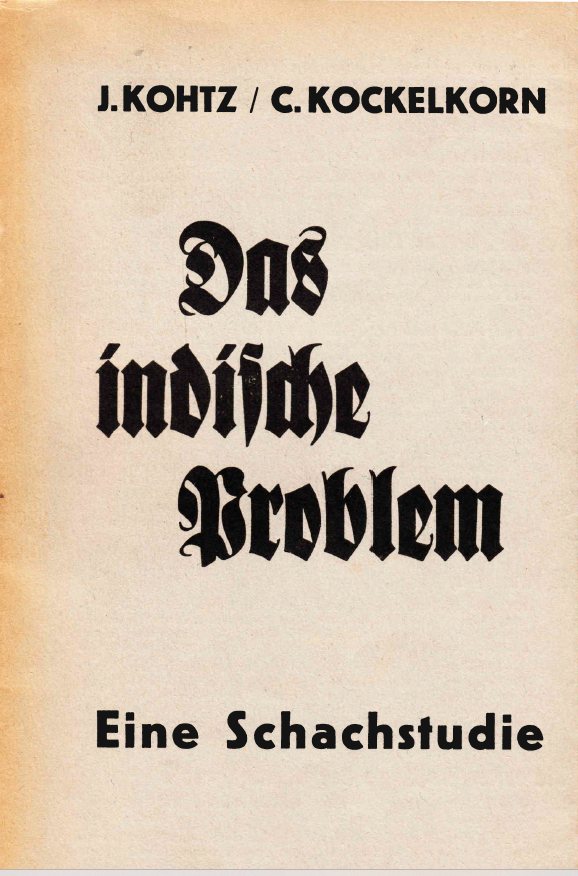
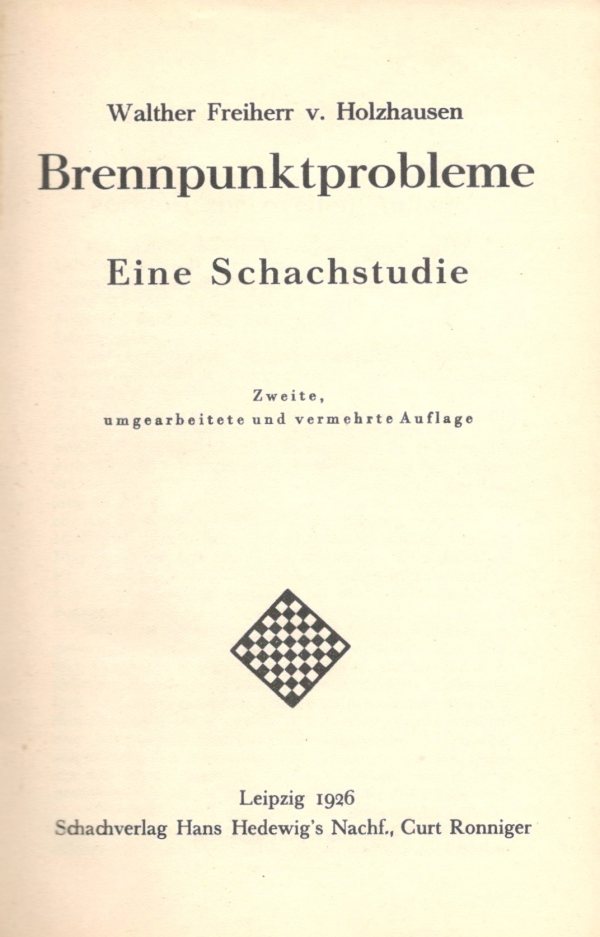
Von Holzhausen was a great adherent of this direction, maintained a close friendship with Johannes Kohtz and published a 45-page monograph on "focal-point problems" in Deutsches Wochenschach in 1908/09, which he later expanded into a book that he published in 1926.
As a battalion commander in the war
The First World War interrupted Von Holzhausen's chess work. At the beginning of the war, he was a battalion commander, presumably with the rank of major or lieutenant colonel. His unit was initially deployed on the Western Front and later transferred to the Eastern Front. After entering the Prussian army, Von Holzhausen was not transferred to another unit but commanded one of the three battalions of the Hessen-Homburg Infantry Regiment No. 166. Then, in 1914/15, he and his unit were involved in the battles in Lorraine (August 1914), at Nancy-Épinal (August/September) and later on the Somme (September/October). At the beginning of 1915, the Hessen-Homburg Infantry Regiment No. 166 was transferred to the Eastern Front, where it fought in Masuria, on the Bobr, near Sejny, Krasnopol and Krasne, and in the Augustow-Mariampol area. The regiment also took part in the siege of Kaunas (Kovno) and the battles of the Njemen and Vilna, before the fighting in parts of Lithuania and Belarus also turned into trench warfare.
Von Holzhausen had already been wounded on the Western Front, and was wounded again on the Eastern Front. There he was also taken prisoner by the Russians and brought to a prisoner-of-war camp in Khabarovsk, eastern Siberia, on the Amur. During the monotony of camp life, he taught chess to other prisoners and even produced a chess newspaper with problems. He also continued to work on the composition of chess problems and prepared a manuscript for a book. Together with another prisoner, he managed to escape from the camp in 1918 and returned to the German Reich via Finland. His manuscript, however, was lost during the escape. After his return, Von Holzhausen was deployed once more on the Western Front.
Chess work after the war
In 1920, Walther von Holzhausen married, but his wife died young. In 1924, he married a second time. In 1921, Von Holzhausen, as a retired major, took up a post at the Reich Archives in Magdeburg. In the following years, Von Holzhausen was particularly active in the fields of problem chess and tournament chess.
He played in the main tournament at the 23rd DSB Congress in Frankfurt in 1923, was joint winner of a tournament in Eisenach in 1924, and won the main tournament at the 24th DSB Congress in Breslau in 1925. At the 1926 anniversary tournament of the Dresden Chess Club, he finished in an excellent midfield place behind world-class players such as Nimzowitsch, Alekhine, Rubinstein and Tartakower.
He drew against both Alekhine and Tartakower.
Nimzowitsch included his game against Von Holzhausen in one of his textbooks, which is also a distinction, even though Von Holzhausen lost the game.
In July 1926, Von Holzhausen played in the master tournament of the Vienna Chess Congress, though with less success. In August, however, he finished third behind Nimzowitsch and Rubinstein at the anniversary tournament in Hanover.
 Grandmaster Dr. Karsten Müller, one of the world’s leading endgame experts, guides you step by step through everything you need to know in this second volume.
Picture this: you’ve outplayed your opponent move by move, you’re clearly better – and then the endgame slips into a draw, simply because you lacked the crucial theoretical knowledge. That is exactly where this course comes in. Without solid endgame skills, there’s no way forward. Rook endgames are most essential: they occur more often than any other type of endgame, and often make the difference between victory and half a point. If you master them, you’ll confidently convert your advantages into wins!
Free video sample: Introduction
Free video sample: Bodycheck
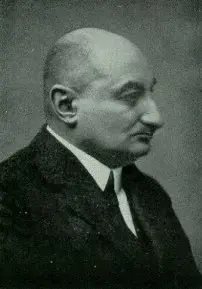 In the following years, Walther von Holzhausen was also very active in tournaments, though with very mixed results. In the master tournament of the 25th DSB Congress in Magdeburg in 1927, he took a very good shared third place behind Spielmann and Bogoljubow, but in several other tournaments he finished last, for example in Giessen and in the master tournament of the Berlin Chess Federation in 1928. These large fluctuations in performance may have been due to the consequences of his war wounds. Thus, in 1931, Von Holzhausen had to cancel a planned tournament appearance in Swinemünde because he had to undergo an operation for a leg injury from the war.
Together with Adolf Kramer, Von Holzhausen published the tournament book Der 24. und 25. Kongreß des Deutschen Schachbundes Breslau 1925, Magdeburg 1927 in 1927.
Von Holzhausen was also very active in the world of problem chess during these years and also published two books in this field: Brennpunktprobleme: Eine Schachstudie (Leipzig, 1926) and Logik und Zweckreinheit im neudeutschen Schachproblem: Eine Denkschrift zum 25jährigen Jubiläum des 'Indischen Problems' von Kohtz und Kockelkorn. Nebst zwei anderen problemschachlichen Abhandlungen (Berlin and Leipzig, 1928). Both books were long regarded as standard works in the field of chess problems.
Some examples from his work:
From 1931 until his death, Walther von Holzhausen edited the problem chess column of the Deutsche Schachblätter.
Walther Freiherr von Holzhausen died in 1935 in Magdeburg after a short, serious illness, at the age of 59. The Wiener Schachzeitung published a rather pathetic obituary in its September 1935 issue, but it does document the importance of the deceased.
 The name Emanuel Lasker will always be linked with his incredible 27 years reign on the throne of world chess. In 1894, at the age of 25, he had already won the world title from Wilhelm Steinitz and his record number of years on the throne did not end till 1921 when Lasker had to accept the superiority of Jose Raul Capablanca. But not only had the only German world champion so far seen off all challengers for many years, he had also won the greatest tournaments of his age, sometimes with an enormous lead. The fascinating question is, how did he manage that?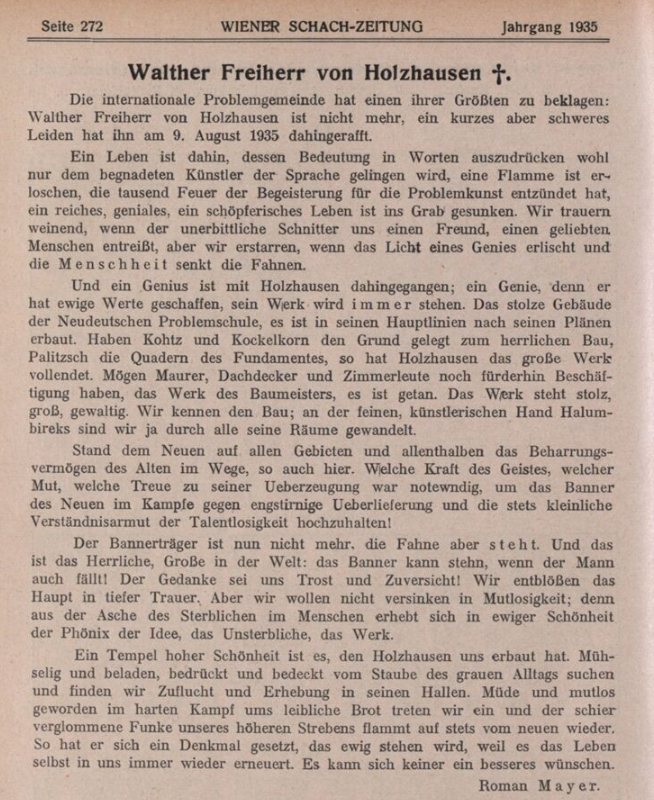
Walther von Holzhausen's grave is located in the Südfriedhof cemetery in Magdeburg.
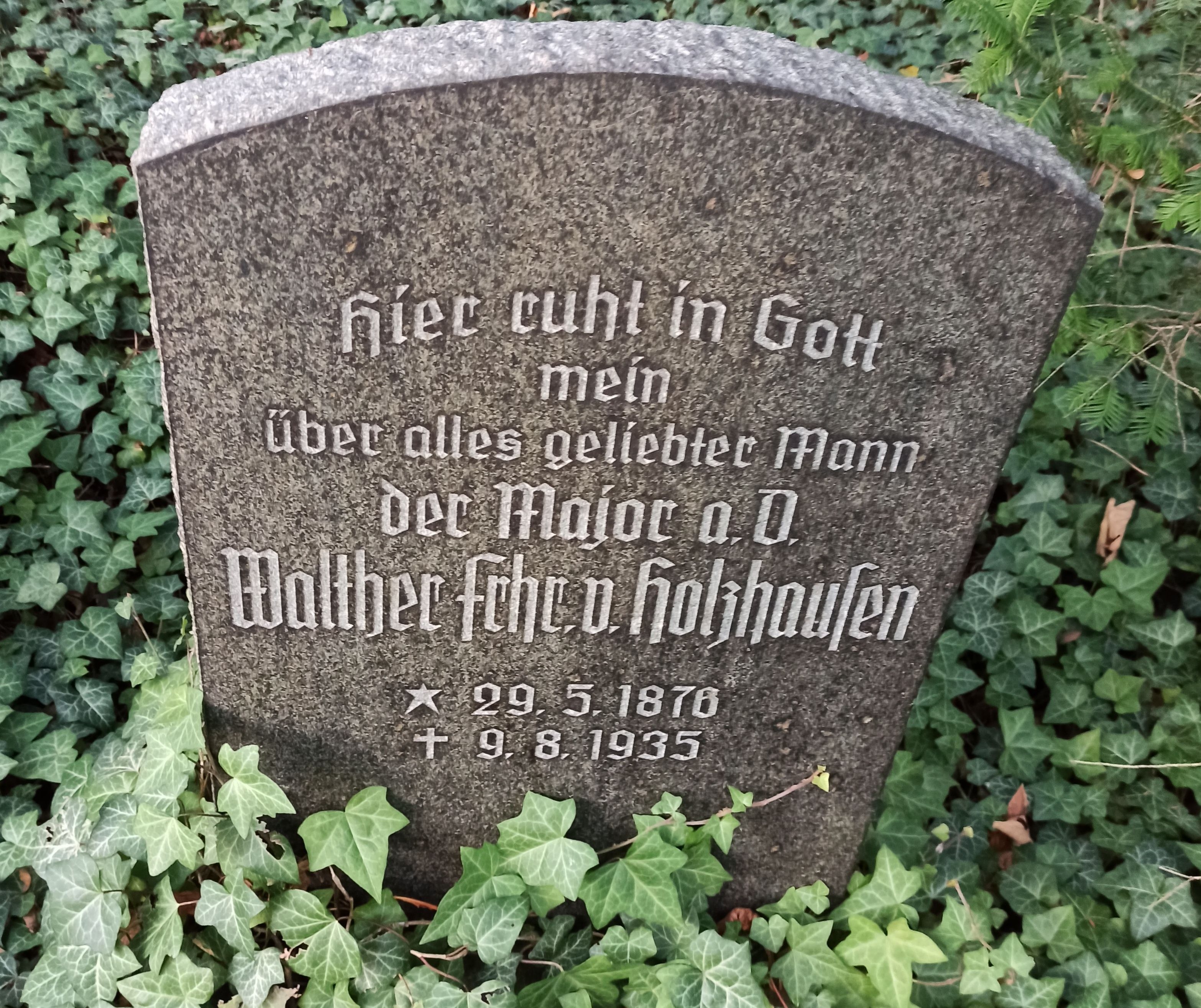
Photo: Matkue