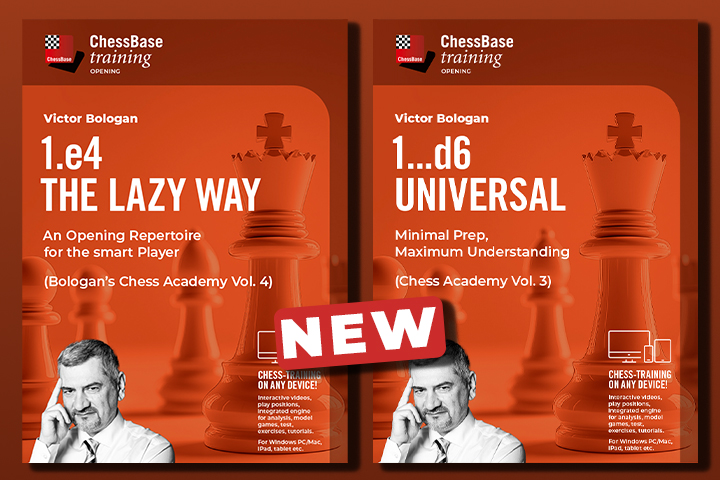
9/18/2025 – Victor Bologan’s Chess Academy Vol. 3 & 4 offers a complete, low-maintenance repertoire for both White and Black, built on the philosophy of his legendary coach Chebanenko: focus on understanding typical pawn structures and recurring piece setups rather than memorising endless theory. For Black, Bologan recommends the universal 1…d6 system, leading to flexible Philidor-style positions against 1.e4 and solid setups against 1.d4, emphasizing resilience and strategic clarity. For White, the repertoire begins with 1.e4 followed by d3, using quiet but powerful systems like the King’s Indian Attack, Closed Sicilian ideas, and anti-Caro-Kann setups—practical approaches that avoid heavy theory while still being played successfully at the highest level.
new: Fritz 20
Your personal chess trainer. Your toughest opponent. Your strongest ally. FRITZ 20 is more than just a chess engine – it is a training revolution for ambitious players and professionals. Whether you are taking your first steps into the world of serious chess training, or already playing at tournament level, FRITZ 20 will help you train more efficiently, intelligently and individually than ever before.
Why memorising endless theory might not be the best path - and how an idea-based repertoire can change your game. In today’s fast-paced chess world, especially online, where blitz and rapid games dominate, the traditional approach of grinding through lines of opening theory can feel overwhelming, and even unnecessary. The real challenge? Striking the right balance in your opening preparation. How deep should you go? Where do you stop? This course is built on the timeless wisdom of my legendary coach, Chebanenko, who designed opening repertoires for his “lazy” students - not lazy in attitude, but smart in approach. His philosophy? Don’t memorise. Understand.
In this video course, Grandmaster Ivan Sokolov explores the fascinating world of King’s Indian and Pirc structures with colours reversed, often arising from the French or Sicilian.
€39.90
Chess Academy Vol. 3 & 4
by Victor Bologan
1...d6 universal - Minimal Prep, Maximum Understanding
In today’s fast-paced chess world, especially online, where blitz and rapid games dominate, the traditional approach of grinding through lines of opening theory can feel overwhelming, and even unnecessary. The real challenge? Striking the right balance in your opening preparation. How deep should you go? Where do you stop? This course is built on the timeless wisdom of my legendary coach, Chebanenko, who designed opening repertoires for his “lazy” students - not lazy in attitude, but smart in approach. His philosophy? Don’t memorise. Understand.
The concept is simple but powerful: choose systems for both White and Black that revolve around typical pawn structures and recurring piece setups. That way, you’re not learning dozens of different openings - you’re learning one flexible idea that applies across many positions.
In this course focused on Black, we build our repertoire around the solid and compact d6–e5 structure:
Against 1.e4: We play the Philidor setup, offering rich positional play and quick piece development.
Against 1.d4 and other closed systems: We aim for flexible development, with our dark-squared bishop either on e7 or g7, while keeping our eyes on the central break with ...e5.
This setup is not only effective but easy to learn, highly resilient, and surprisingly tricky for opponents unfamiliar with its subtleties. I’ve played it my whole life - in blitz, rapid, and even classical tournaments - and it has served me well.
In fact, my recent success in a Fischer Random tournament was largely due to my comfort with pawn structures and strategic flexibility - not memorised lines.
With this course (and the companion repertoire for White), you won’t just get a practical, low maintenance opening solution. You’ll build a deeper understanding of chess that helps you:
React confidently in unfamiliar positions
Make better decisions based on ideas, not memorised moves
Save time while still staying competitive
Learn smart. Play smart. Let’s build your opening repertoire the lazy way - with lasting understanding, not short-term memory.
Why memorising endless theory might not be the best path - and how an idea-based repertoire can change your game. In today’s fast-paced chess world, especially online, where blitz and rapid games dominate, the traditional approach of grinding through lines of opening theory can feel overwhelming, and even unnecessary. The real challenge? Striking the right balance in your opening preparation. How deep should you go? Where do you stop? This course is built on the timeless wisdom of my legendary coach, Chebanenko, who designed opening repertoires for his “lazy” students - not lazy in attitude, but smart in approach. His philosophy? Don’t memorise. Understand.
Free sample video: Introduction
Free sample video: 1.d4 d6 2.Nf3 Nf6 3.c4 g6 4.Nc3 Bf5 5.Nh4 Bd7
1.e4 the lazy way - An Opening Repertoire for the smart Player
How much time should we really spend memorising long opening lines? Especially in today’s world of rapid and blitz games, it’s become more important to build a repertoire that’s practical, flexible, and easy to remember—yet still powerful and rich in ideas. That’s exactly the concept behind this series: a repertoire for the “lazy” (but smart) chess player, inspired by the legendary coach Chebanenko, who believed in teaching his students openings with typical ideas and repeatable patterns rather than endless theory.
In this video course, we look at a repertoire for White after 1.e4. I’ve moved away from traditional lines like 1.e4 e5 2.Nf3 Nc6 3.Bc4 and instead recommend a modern, strategic approach centred around an early d3. These quiet systems avoid heavy theory and allow you to steer the game into familiar territory. Against the Caro-Kann, the modest setup with Nf3 and d3 is surprisingly unpleasant for your opponent - and it's one I personally use, often with great results.
In the Sicilian, we focus on Closed-style positions, where understanding trumps memorisation. Against the French, the ever-reliable King’s Indian Attack (with Nbd2) gives us a harmonious and thematic way to meet 1...e6. These ideas have all been played at the highest level - including by Magnus Carlsen himself - proving they are not only practical, but also deeply sound.
I recently had great success using these types of setups in a Fischer Random tournament. What helped me most was not memorised theory, but a deep understanding of pawn structures, flexibility, and making the right decisions in unfamiliar positions. That’s the real value of this repertoire: it helps you develop positional feel, not just rote recall.
By the end of this second course, you’ll have a full, idea-based repertoire with 1.e4 - ready to use in any time control and against any opponent. Combine this with the Volume on 1...d6 as Black, and you’ll have a universal system for both colours that is effective, low-maintenance, and surprisingly powerful.
How much opening prep is really necessary - especially in blitz and rapid games? The idea of a “lazy” but smart repertoire: minimal theory, rich ideas, and easy-to-remember structures. How much time should we really spend memorising long opening lines? Especially in today’s world of rapid and blitz games, it’s become more important to build a repertoire that’s practical, flexible, and easy to remember - yet still powerful and rich in ideas. That’s exactly the concept behind this series: a repertoire for the “lazy” (but smart) chess player, inspired by the legendary coach Chebanenko, who believed in teaching his students openings with typical ideas and repeatable patterns rather than endless theory.
Free sample video: Introduction
Free sample video: 2...d5 3.Nd2 c5 4.Ngf3 Nc6 5.g3 Bd6
Both ChessBase Training Courses together in a bundle:
Why memorising endless theory might not be the best path - and how an idea-based repertoire can change your game. In today’s fast-paced chess world, especially online, where blitz and rapid games dominate, the traditional approach of grinding through lines of opening theory can feel overwhelming, and even unnecessary. The real challenge? Striking the right balance in your opening preparation. How deep should you go? Where do you stop? This course is built on the timeless wisdom of my legendary coach, Chebanenko, who designed opening repertoires for his “lazy” students - not lazy in attitude, but smart in approach. His philosophy? Don’t memorise. Understand.
YOUR PERSONAL CHESS COACH - Whether you’re taking your first steps into the world of club chess, or already playing at a tournament level: with FRITZ, you can train more efficiently, intelligently and with a more personalised approach than ever before.
1.c4 e5 2.Nc3 Bb4!? is an opening idea well worth considering. Black immediately threatens to double the pawns on c3 in the style of the Trompowski or Sicilian Grand Prix attack.
Italian Game Powerbase 2026 is a database and contains 8571 top class games from Mega 2026 and the Correspondence Database 2026, of which 479 are annotated.
Videos: Nico Zwirs discusses the Sicilian with 2…e6 3.d4 cxd4 4.Qxd4 Nc6 5.Qe3 Nf6 6.Nc3. Mihail Marin examines Sindarov’s 6.Ne5 in the Queen’s Pawn Defence. Plus the ‘Lucky bag’ featuring 41 analyses by Berg, Ftacnik, Gupta and many others.
If you're looking for a dynamic alternative to the Slav, Queen's Gambit Declined, or other mainstream systems, the Chigorin Defence offers exactly what modern tournament players need.
Michael Kotyk presents a complete repertoire after 1.e4 e5, built around creative ideas, surprising move orders, and practical weapons designed to catch your opponents off guard.
€69.80
€59.90
We use cookies and comparable technologies to provide certain functions, to improve the user experience and to offer interest-oriented content. Depending on their intended use, analysis cookies and marketing cookies may be used in addition to technically required cookies. Here you can make detailed settings or revoke your consent (if necessary partially) with effect for the future. Further information can be found in our data protection declaration.
Pop-up for detailed settings
We use cookies and comparable technologies to provide certain functions, to improve the user experience and to offer interest-oriented content. Depending on their intended use, cookies may be used in addition to technically required cookies, analysis cookies and marketing cookies. You can decide which cookies to use by selecting the appropriate options below. Please note that your selection may affect the functionality of the service. Further information can be found in our privacy policy.
Technically required cookies
Technically required cookies: so that you can navigate and use the basic functions and store preferences.
Analysis Cookies
To help us determine how visitors interact with our website to improve the user experience.
Marketing-Cookies
To help us offer and evaluate relevant content and interesting and appropriate advertisement.