Vasily Nikolayevich Panov was born on 1 November 1906 in Kozelsk, a town in the Kaluga region, south-west of Moscow. His father, Nikolai Alexandrovich Panov, was a finance official, while his mother, Yevgenia Vasilyevna Panova (née Assonova), was the daughter of a well-known local historian and worked as a teacher. Vasily Panov grew up in Kaluga. In 1916, the family moved to Moscow.
Vasily Panov as a player
Vasily Panov learned to play chess from his father at the age of seven. At fifteen, he played in his first tournaments in Moscow.
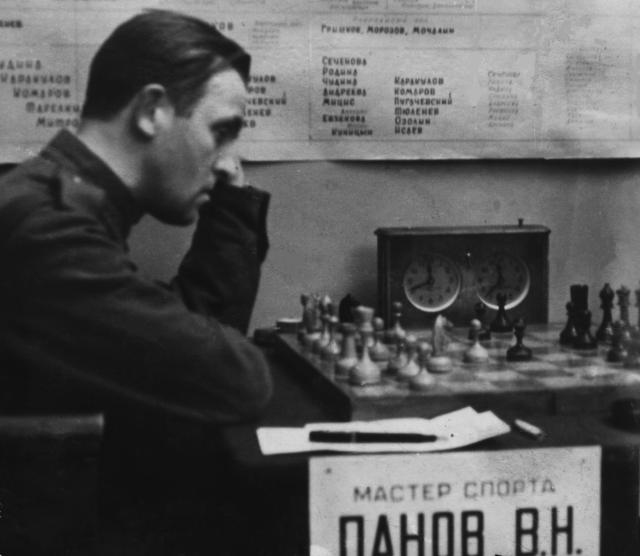
As a young man, he scored a victory in a simultaneous exhibition given by world champion José Raúl Capablanca.
In 1929, Panov became Moscow champion, while in 1935 and 1939 he finished runner-up. He won bronze in 1941 and 1946.
Panov's greatest tournament success was his victory in the semifinal of the USSR Championship in Kyiv in 1938. In total, Panov qualified for the final of the USSR Championship five times between 1935 and 1948. His best finish was eleventh place in 1939.
In 1950, FIDE awarded Panov the title of international master (IM).
After 1957, Panov took part in tournaments only rarely because of poor health. He played his last tournament in 1963. After that he retired from tournament chess, although he made one final tournament appearance in Skopje in 1970.
During the 1920s, Panov at times followed the example of his older brother N.N. Panov, a poet and author of seafaring stories, and published several poems and feuilleton pieces, often related to chess, in the newspaper Rabochaya Moskva under the pseudonym "Pila". He even wrote a play during this period.
During the Second World War, Panov gave simultaneous exhibitions and lectures for patients in Moscow hospitals.
Vasily Panov as an author and theoretician
 Our experts show, using the games of Botvinnik, how to employ specific openings successfully, which model strategies are present in specific structures, how to find tactical solutions and rules for how to bring endings to a successful conclusion
As a chess author, Panov published instructional books as well as biographies of well-known masters such as Chigorin, Capablanca and Alekhine. From 1942 to 1965, he was the chess correspondent for the newspaper Izvestia. He also published articles in the youth magazine Pionerskaya Pravda.
In his articles and lessons, Panov was an uncompromising and at times caustic dogmatist. Contemporaries described him as quarrelsome, but also quite humorous. He produced his articles and theoretical studies with great diligence and thoroughness. He had considerable difficulty dealing with defeats in his own games, however.
In his time, every form of journalism, even chess reporting, was closely shaped by the ideological and political aims of the state leadership. Thus, the articles of Panov, who was a party member, including even his book reviews, were permeated by the communist ideology of the period.
As only became known later, however, Panov went even further in his political dogmatism. He was an informer. Gennadi Sosonko reported for New in Chess (2014/3), in his article "The Panov Attack", that in 1950, while reviewing a book on the Open Games by Paul Keres, Panov accused the author of spreading "bourgeois-Western" and "anti-Marxist" theories. A corresponding letter was found in the KGB archives after the collapse of the USSR. Besides political dogmatism, resentment and envy were probably also motives behind Vasily Panov's actions in this case.
Keres had played tournaments in the German Reich during the Nazi era and, when Estonia was occupied by the Red Army in 1945, attempted to flee to Finland. He was arrested, however, and narrowly escaped deportation to Siberia. Keres had to come to terms with the new rulers.
In his newspaper articles, Panov also frequently presented himself as a kind of "chess inquisitor", denouncing "anti-Marxist tendencies" and "rootless cosmopolitanism" and calling for a political cleansing of chess literature.
The attack had no immediate consequences for Keres. As a world-class player, he was too valuable to Soviet propaganda. The Estonian answered over the board: he won the USSR Championship in 1950.

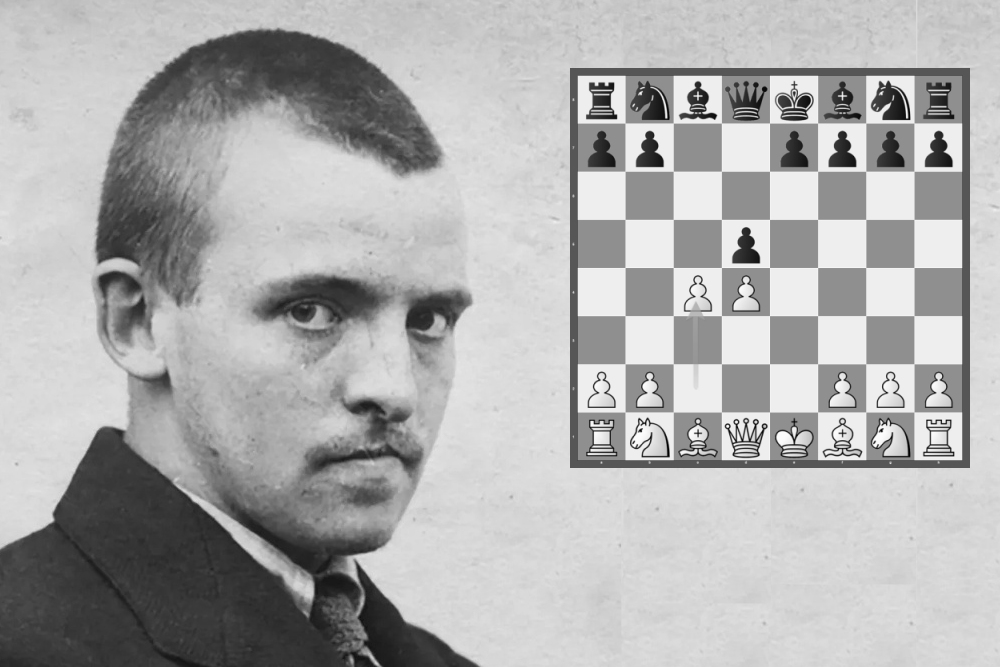
Vasily Panov achieved major success with his publications and theoretical investigations into the openings. Here, Panov developed many new ideas. The best-known opening named after him is the variation of the Caro-Kann Defence arising after 1.e4 c6 2.d4 d5 3.cxd5 cxd5 4.c4, the so-called Panov Attack.
Against the Scheveningen Variation of the Sicilian Defence, Panov investigated a set-up for White with 6.g3 followed by a bishop fianchetto. The attacking idea with 6.g4 against the Scheveningen also originated with Panov before it was adopted by Paul Keres in the 1940s and named after the Estonian. Perhaps Panov's dislike of Keres even stemmed from this.
Panov also investigated plans for White in the Modern Variation against the Alekhine Defence (4.Nf3 followed by h3) and a set-up with ...Bb7 in the Chigorin Variation of the Ruy Lopez.
After 1.d4, Panov advocated the defence for Black with 1…c5 2.d5 e5 3.e4 d6 4.c4 Nf6 5.Nc3 Be7 (or, by transposition, 1…Nf6 2.c4 c5 3.d5 e5 4.Nc3 d6 5.e4 Be7), which later became known as the Czech Benoni.
 This DVD allows you to learn from the example of one of the best players in the history of chess and from the explanations of the authors (Pelletier, Marin, Müller and Reeh) how to successfully organise your games strategically, consequently how to keep y
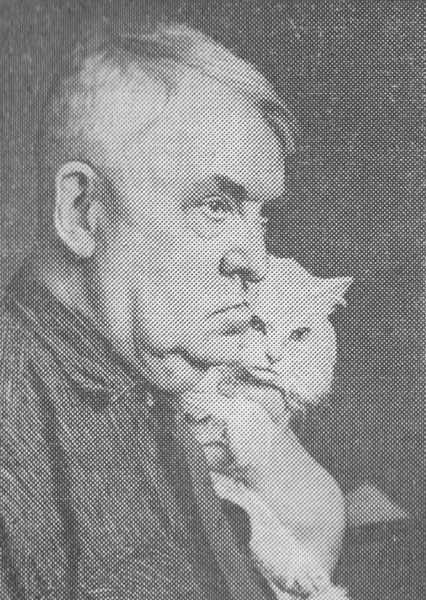
Panov, a cat lover
Vasily Panov died on 18 January 1973 in Moscow. He was buried at Moscow's Vostryakovskoye Cemetery (Central Cemetery), section 32, in the family grave.
In the Flexible Panov Dutch IM Nico Zwirs will show you how to test Black to the limit in the Caro-Kann. 8 hours of video lessons included!













.jpeg)

.jpeg)