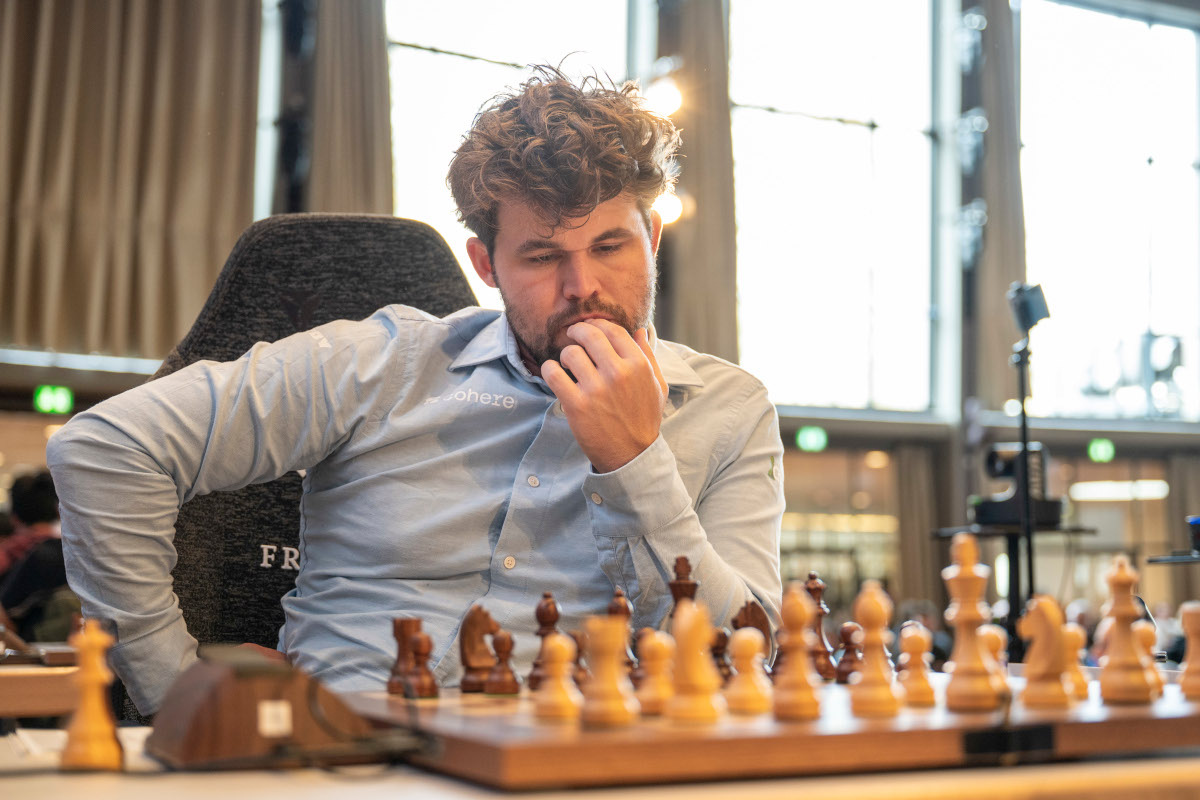
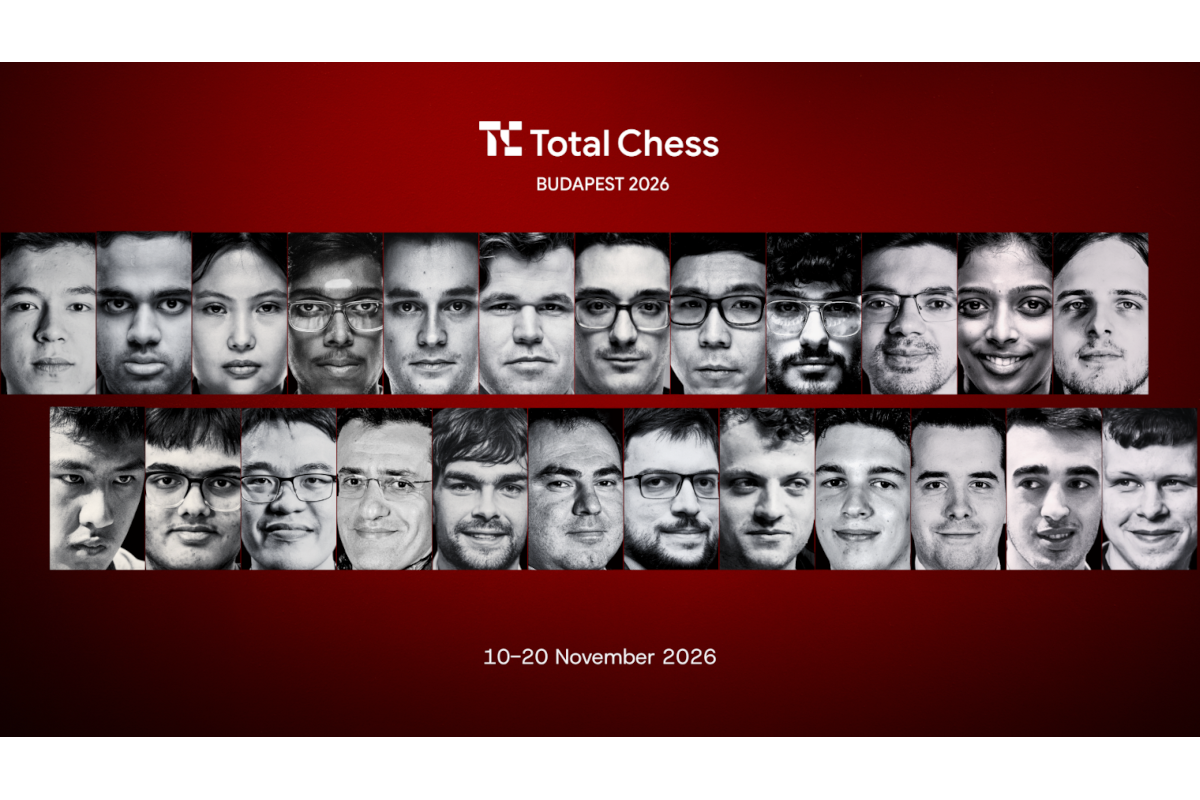
11/6/2026 – The Total Chess World Championship series is a new tournament format combining three different time controls: fast classic, rapid and blitz. The winner of the series will be crowned the FIDE World Combined Champion. Both the winner and the runner-up will then qualify for the Candidates Tournament for the classical World Championship. How did this format come about? | Photo: Michal Walusza / Norway Chess
new: ChessBase Magazine 225
Chess Festival Prague 2025 with analyses by Aravindh, Giri, Gurel, Navara and others. ‘Special’: 27 highly entertaining miniatures. Opening videos by Werle, King and Ris. 10 opening articles with new repertoire ideas and much more. ChessBase Magazine offers first-class training material for club players and professionals! World-class players analyse their brilliant games and explain the ideas behind the moves. Opening specialists present the latest trends in opening theory and exciting ideas for your repertoire. Master trainers in tactics, strategy and endgames show you the tricks and techniques you need to be a successful tournament player! Available as a direct download (incl. booklet as pdf file) or booklet with download key by post. Included in delivery: ChessBase Magazine #225 as “ChessBase Book” for iPad, tablet, Mac etc.!
YOUR PERSONAL CHESS COACH - Whether you’re taking your first steps into the world of club chess, or already playing at a tournament level: with FRITZ, you can train more efficiently, intelligently and with a more personalised approach than ever before. FRITZ is more than just a chess engine – it’s a training revolution! Whether you’re taking your first steps into the world of club chess, or already playing at a tournament level: with FRITZ, you can train more efficiently, intelligently and with a more personalised approach than ever before.
The premiere chess database with over 11.7 million games
€229.90
The FIDE World Combined Champion
In sporting competition, the aim is always to find out who is better. And at the next level, of course, people also want to know who is the very best in a particular sport or discipline.
In this Fritztrainer: “Attack like a Super GM” with Gukesh we touch upon all aspects of his play, with special emphasis on how you can become a better attacking player.
Even before the "invention" of World Championships, there was always one chess player who was regarded as the best. Philidor, Anderssen and Morphy, for example. From Steinitz onwards, there was a certain formalisation of the contests for the World Championship. The world champion was the player who had defeated the previous world champion in a match for the title. After Alekhine's death, FIDE took over responsibility for awarding the title and introduced fixed rules for organising the World Championships. They were well-thought-out rules: Zonal and Interzonal tournaments in the first year, Candidates Tournaments or Candidates matches in the second, and the World Championship match in the third. Some rules, however, were complete nonsense – the right to a rematch, for example.
Before Elo ratings were introduced, it was largely a matter of perception whether the world champion was also the world's best player. Elo ratings provided a second criterion. The succession of world champions Fischer, Karpov, Kasparov, Kramnik, Anand and Carlsen more or less represented the best players in the world in their respective eras.
There can be only one
The dispute between FIDE president Campomanes and Kasparov led Kasparov and Short to play their 1993 World Championship match outside FIDE. For many years afterwards, there were two chess world champions, which was not good for the standing of chess in the sporting world or elsewhere. Campomanes' successor also dismantled the old World Championship format by introducing annual knockout World Championships, which likewise damaged the prestige of the world title.
In 2006, the two World Championships were finally reunified. The match between Kramnik and Topalov, however, went down in history as a particularly scandal-ridden affair. After years of criticism, FIDE finally abandoned the knockout format for the World Championship and returned to a match format in 2008.
Instead of the former three-year cycle, however, FIDE now introduced a two-year cycle and also changed the qualification paths for finding a challenger several times.
Too many World Championship matches
With the two-year cycle, the world champion now had to defend the title every two years rather than every three years as before. The patient Anand dutifully went along with this, but his successor Carlsen lost his enthusiasm for the exercise after four title defences in seven years and stepped away in 2023. It is not as if Carlsen no longer enjoys chess - quite the opposite. With well over 8,000 games across all kinds of disciplines, the 16th world champion is among the players with the most games in the Mega Database and, by a wide margin, the world champion with the most recorded games. By comparison, only 1,024 games by Fischer are known. The vast majority of Carlsen's games, however, were played online at short and very short time controls.
Carlsen's departure as world champion created a legitimacy problem for FIDE's flagship World Chess Championship. Carlsen continued playing in all kinds of formats, won one online tournament after another and collected titles at the World Rapid and Blitz Championships. He also continued to lead the world rankings by a substantial margin.
The less imposing successors
For Carlsen's successors on the World Championship throne, however, the world champion's mantle proved far too large. The 17th world champion, Ding Liren, struggled with mental health problems after winning the title and fell sharply in the Elo rankings. It was similar with the 18th world champion, Gukesh Dommaraju. Kramnik had already faced criticism after winning his title because he was only second or third in the world rankings. Now the chess world champions were ranked somewhere among the also-rans.
This DVD allows you to learn from the example of one of the best players in the history of chess and from the explanations of the authors (Pelletier, Marin, Müller and Reeh) how to successfully organise your games strategically, consequently how to keep y
In his talks with FIDE, Carlsen had already proposed other formats. The Norwegian was frustrated by matches lasting several weeks, the endless preparation and the possibility – or necessity – of preparing openings with extreme precision using engines. In his view, the actual playing of chess, where the better player could demonstrate his strengths, was being lost. Carlsen put forward alternative formats, and FIDE has now accepted the idea of a format combining different time controls, apparently not coincidentally proposed by the Norway Chess organisers, featuring the disciplines of Fast Classic, Rapid and Blitz.
New formats wanted
The format is not entirely new, of course, as a tournament of this kind has been played in Biel for several years. The Swiss call it a "triathlon", which describes it quite well. Under FIDE, the format is called "Total Chess". Presumably the Norwegians came up with that name too. The whole thing is the "Total Chess World Championship Tour".
FIDE has not always had the happiest touch when it comes to naming things. "Grand Swiss" is another example – the "big Swiss", or what exactly? Who outside the chess world is supposed to understand that? Is the Total Chess World Championship now somehow more than the World Championship? And is the Total Chess world title worth more than the world title?
Of course, the Total Chess World Championship Tour is not supposed to have a higher status than the (absolute? classical? normal?) World Championship. FIDE is nevertheless giving the format considerable importance by making the Total Chess World Championship Tour a qualification path for the Candidates Tournament. The two best players in the Total Chess series will be able to play in the next Candidates Tournament.
In Total Chess, the three disciplines are Fast Classic (45 minutes + 30 seconds), Rapid (15+10) and Blitz (3+2). A match consists of one Fast Classic game, two Rapid games and four Blitz games. Naturally, the scoring is weighted differently, with eight points for the Fast Classic game, four points for a Rapid game and two points for a Blitz game. Please memorise that before next time.
The whole competition is conceived as a series of three tournaments in different locations. Twenty-four players take part in the events. Tour points are awarded according to finishing position. The top four in the overall standings then meet in the Grand Final.
How grandmasters win without fireworks: GM Jan Markos shows you 11 very practical tips from "How to play in a lost position" to "Be patient like Carlsen" that will improve your tournament chess. Most chess books teach you what to think about. This series teaches you what to actually do when the clock is running and the result is on the line. Compiled from GM Jan Markos's acclaimed "Practical Tips for the Tournament Player" column in ChessBase Magazine, Volume 1 covers the decisions every tournament player faces before the position ever gets complicated: how you use your time, how you handle pressure, and how you think when the stakes are real.
Free Video Sample: How to use your time effectively
The winner of the Grand Final at the end is not, in fact, the Total Chess World Champion, but the FIDE World Combined Champion. There may have been discussions behind the scenes about what to call the title, but having two names (Total Chess and Combined Chess) for the same thing is not really ideal either.
Next Tuesday, things get under way in Budapest with a pilot event. The event begins with the opening ceremony and a Blitz tournament, as is familiar from Norway Chess events. The result of the Blitz tournament will later serve as a tiebreak in the event of players finishing level on points. A group stage with four groups of six players then follows. The four group winners advance to the knockout stage, with semifinals and a final.
Not all, but many of the current top players will be competing in Budapest, along with several other strong players. Magnus Carlsen is among them, and from a German perspective, it is particularly pleasing that Vincent Keymer is also taking part.
The Total Chess organisers have also already created a combined world ranking based on FIDE's Classical, Rapid and Blitz ratings. Magnus Carlsen's lead over the rest is even larger there than usual.
An interesting question: if Magnus Carlsen wins the Total Chess World Championship Tour, will he then also play in the Candidates Tournament for the classical World Championship? Or will he be content with the title of FIDE World Combined Champion?
Let our authors show you how Carlsen tailored his openings to be able to outplay his opponents strategically in the middlegame or to obtain an enduring advantage into the endgame.
10/19/2026 – Total Chess has proposed a new rating system that combines players' classical, rapid and blitz ratings into a single figure. Developed by researcher Mehmet Mars Seven in collaboration with Norway Chess, the formula uses existing FIDE ratings to assess overall playing strength across the three formats. Magnus Carlsen (pictured) tops the inaugural ranking, followed by Hikaru Nakamura and Nodirbek Abdusattorov. The system will undergo testing and public consultation before potential revisions. | Photo: Nils Rohde / ChessBase
9/23/2026 – The 24-player field for the Total Chess World Championship Tour Pilot in Budapest is now complete, with Levon Aronian, Le Quang Liem, Jorden van Foreest, Abhimanyu Mishra, Shakhriyar Mamedyarov and Andrew Hong joining the lineup. The FIDE-approved event, scheduled for 10–20 November, will combine Fast Classic, Rapid and Blitz in a single competition and serve as the pilot for the global Total Chess World Championship Tour launching in 2027.
This entry into the 60 minutes series concentrates on the Modern variation of the Italian game where White opens the centre early : 1 e4 e5 2 Nf3 Nc6 3 Bc4 Nf6 4 d4 exd4 5 e5!. This line can be reached by various move orders, most frequently from the Scotch 3 d4 exd4 4 Bc4. It's a sharp variation and Grandmasters such as Evgeny Sveshnikov have used it frequently,with very good results. It's a perfect line for club players to adopt which is relatively easy to learn and which contains many traps. All the main responses are covered here, including 5...d5, 5...Ng4 and 5...Ne4 and the conclusion is that is is difficult for Black to equalize in a straightforward way. Problems are being posed, which over the board might prove tough to solve.
YOUR PERSONAL CHESS COACH - Whether you’re taking your first steps into the world of club chess, or already playing at a tournament level: with FRITZ, you can train more efficiently, intelligently and with a more personalised approach than ever before.
Keep it simple. Stay objective. Watch the clock. Sometimes take the risk. GM Loek van Wely explains the ten principles that decide real games. They aren’t about theory. They’re about what you do at the board when it counts.
2026 Chess Olympiad with analyses by Abdusattorov, Donchenko, Duda, So and many more – ‘Rooks love open files’: Tactics training with Oliver Reeh – ‘Don’t underestimate it’: Caruana’s blitz weapon 1.e4 e5 2.d3 – Total Video playing time: over 6 hours!
Most players don’t lack the urge to attack, they just strike at the wrong moment, and GM Sipke Ernst shows you which signals tell you to go for the king and which tell you to choose another plan.
How grandmasters win without fireworks: GM Jan Markos shows you 11 very practical tips from "How to play in a lost position" to "Be patient like Carlsen" that will improve your tournament chess.
The Nimzo-Indian has stood the test of time for over a century: Still a top choice for elite players today, from Magnus Carlsen to Praggnanandhaa, it remains one of Black's most reliable ways to fight for real chances against 1.d4 2.c4 3.Nc3.
1.c4 e5 2.Nc3 Bb4!? is an opening idea well worth considering. Black immediately threatens to double the pawns on c3 in the style of the Trompowski or Sicilian Grand Prix attack.
In this 60-minute video course you’ll learn how to use the Austrian Defence as a practical weapon for Black!
€9.90
We use cookies and comparable technologies to provide certain functions, to improve the user experience and to offer interest-oriented content. Depending on their intended use, analysis cookies and marketing cookies may be used in addition to technically required cookies. Here you can make detailed settings or revoke your consent (if necessary partially) with effect for the future. Further information can be found in our data protection declaration.
Pop-up for detailed settings
We use cookies and comparable technologies to provide certain functions, to improve the user experience and to offer interest-oriented content. Depending on their intended use, cookies may be used in addition to technically required cookies, analysis cookies and marketing cookies. You can decide which cookies to use by selecting the appropriate options below. Please note that your selection may affect the functionality of the service. Further information can be found in our privacy policy.
Technically required cookies
Technically required cookies: so that you can navigate and use the basic functions and store preferences.
Analysis Cookies
To help us determine how visitors interact with our website to improve the user experience.
Marketing-Cookies
To help us offer and evaluate relevant content and interesting and appropriate advertisement.




.jpeg)