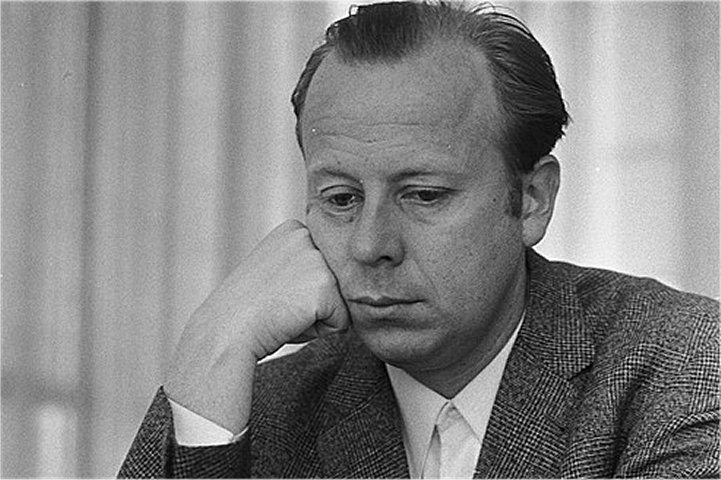
9/15/2026 – The first major international tournament after the end of the Second World War took place in Groningen in August and September. It was the anniversary tournament of the Staunton Chess Club, founded in 1871. For the first time ever, a group of Soviet players also took part in a tournament outside the Soviet Union. Before the tournament began, they inadvertently caused a number of organizational problems. Report with video... | Photos: Dutch National Archives (Anefo), unless otherwise indicated.
new: ChessBase Magazine 225
Chess Festival Prague 2025 with analyses by Aravindh, Giri, Gurel, Navara and others. ‘Special’: 27 highly entertaining miniatures. Opening videos by Werle, King and Ris. 10 opening articles with new repertoire ideas and much more. ChessBase Magazine offers first-class training material for club players and professionals! World-class players analyse their brilliant games and explain the ideas behind the moves. Opening specialists present the latest trends in opening theory and exciting ideas for your repertoire. Master trainers in tactics, strategy and endgames show you the tricks and techniques you need to be a successful tournament player! Available as a direct download (incl. booklet as pdf file) or booklet with download key by post. Included in delivery: ChessBase Magazine #225 as “ChessBase Book” for iPad, tablet, Mac etc.!
YOUR PERSONAL CHESS COACH - Whether you’re taking your first steps into the world of club chess, or already playing at a tournament level: with FRITZ, you can train more efficiently, intelligently and with a more personalised approach than ever before. FRITZ is more than just a chess engine – it’s a training revolution! Whether you’re taking your first steps into the world of club chess, or already playing at a tournament level: with FRITZ, you can train more efficiently, intelligently and with a more personalised approach than ever before.
GM Blohberger presents a complete two-part repertoire for Black: practical, clear, and flexible – instead of endless theory, you’ll get straightforward concepts and strategies that are easy to learn and apply.
€49.90
In August/September 1946 (13 August–7 September), just a few months after the end of the Second World War, a major international chess tournament was held in Groningen, the Netherlands: the Staunton Memorial Tournament. Some may wonder why a memorial tournament honouring the great English player and organizer was held in Groningen of all places. The reason lies with Groningen's venerable chess club, the Staunton Chess Society, which was founded in November 1871 and named after Howard Staunton. Incidentally, the club's namesake was still alive when it was founded. He died three years later, at the age of 63.
The Background
During the war, a small five-player chess tournament was held in Groningen in March 1941. The participants were Salomon (Salo) Landau, at the time the strongest player in the Netherlands after Max Euwe, Hans Kmoch, J.H. Kruit and two members of the Staunton club, Chr. Scholtens and A.H. Roose. Salo Landau won the tournament. It was his last. In 1942, he and his family were deported; in 1944, they were all murdered by the Nazis.
Salo Landau, left, playing Johannes van den Bosch, c. 1930 | Photo source: Chess Club Utrecht
During the course of this five-player tournament, the club's approaching 75th anniversary in 1946 was discussed, and the idea of holding an anniversary tournament was born – provided external circumstances would allow it. During the war and the German occupation, staging such a tournament was out of the question, but after Nazi Germany capitulated in May 1945 and the Netherlands had been liberated, the idea was taken up again.
The tournament was then organized jointly by members of the Staunton Club and the NOSBO (Noordelijke Schaakbond, Groningen en Drenthe). Max Euwe helped with the selection of participants. He had excellent international contacts and was able to provide addresses.
The Field Takes Shape
The organizers wanted the anniversary tournament in Groningen to feature a broad international mix of world-class players. Their first choices were the players from the 1938 AVRO tournament, the last major tournament before the war. Capablanca and Alekhine, however, had since died. Max Euwe was certain to take part.
Experts examine the games of Max Euwe. Let them show you which openings Euwe chose to play, where his strength in middlegames were, which tactical abilities he had or how he outplayed his opponents in the endgame. Max Euwe became the fifth World Chess Champion after beating Alexander Alekhine in the 1935 World Championship match. A maths teacher by profession, Euwe remained an amateur throughout his life, but was still the best chess player in the Netherlands, and one of the world's best players. Euwe holds the record for the most Dutch national championships, with twelve. After winning the World Championship, Euwe was also the world's best player for a while. He lost the title again in 1937 in the rematch against Alexander Alekhine.
Free video sample: Openings
Some of the invitations were sent directly to the players, while others were issued through the national federations. The Soviet Union, which shortly before had decisively defeated the USA in a radio match and was already preparing to assume supremacy in chess, sent no fewer than five of its leading players. It was the first time that a substantial number of Soviet players had taken part in a tournament outside the Soviet Union. Mikhail Botvinnik and Salo Flohr were two more of the desired participants from the AVRO tournament. Alexander Kotov, Vassily Smyslov and Isaak Boleslavsky also made the journey to Groningen.
The Soviet players on their way to Groningen, stopping over in Berlin | Photo: chess.gpntb.ru via Douglas Griffin
Paul Keres, who had played in tournaments in German-controlled territory during the Second World War, was not allowed to leave the Soviet Union.
Our experts show, using the games of Botvinnik, how to employ specific openings successfully, which model strategies are present in specific structures, how to find tactical solutions and rules for how to bring endings to a successful conclusion
Botvinnik's results in the last major tournaments before the war had marked him out for greater things. In fact, he had arranged a match for the World Championship with Alexander Alekhine, which was due to take place in Nottingham in August 1946. Alekhine's somewhat mysterious death on 24 March 1946 in exile in Estoril meant that the match was no longer possible, leaving Botvinnik free to play in other tournaments.
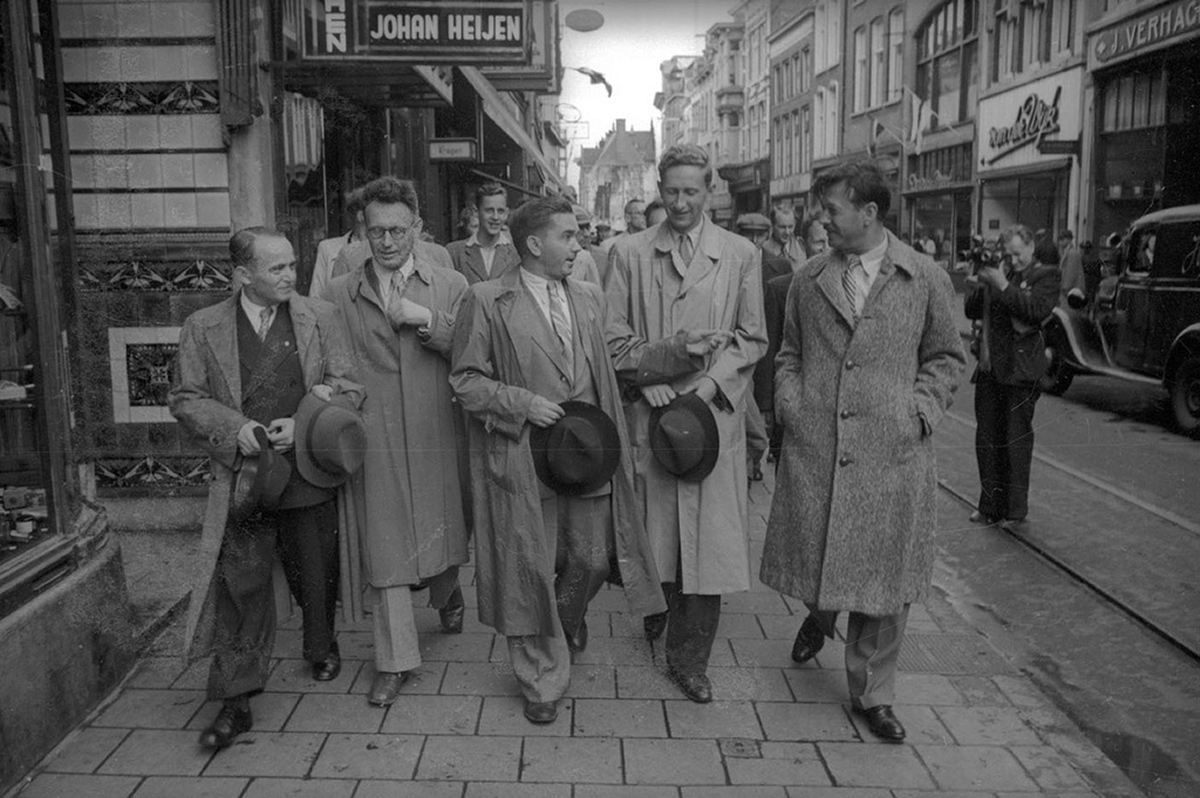
Flohr, Botvinnik, Kotov and Boleslavsky strolling through Groningen with Steiner.
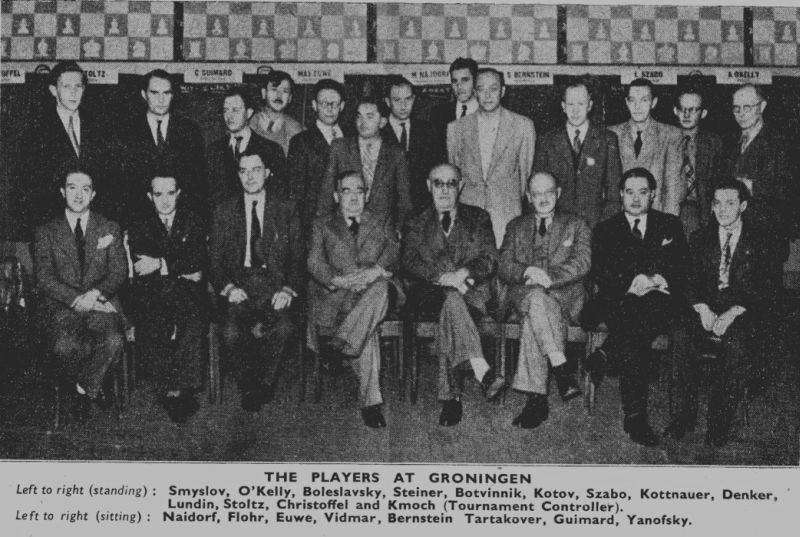
Cenek Kottnauer took part from Czechoslovakia, Laszlo Szabo from Hungary and Milan Vidmar from Yugoslavia. In the new political landscape of post-war Europe, the home countries of these three players now belonged to the Soviet sphere of influence. Kottnauer moved to England in 1953.
Alberic O’Kelly de Galway had made the short journey from Belgium to Groningen. France was represented by the two great “characters” Savielly Tartakover and Ossip Bernstein, both of whom had originally come from Eastern Europe. Martin Christoffel took part from Switzerland, while Gösta Stoltz and Erik Lundin represented Sweden.
Reuben Fine and Samuel Reshevsky were unable or unwilling to take part from the USA, but reigning US champion Arnold Denker and Herman Steiner made the journey. The young Daniel Yanofsky from Canada was another interesting participant from North America.
The Polish-born Mieczyslaw (later Miguel) Najdorf, who had been stranded in Argentina after the 1939 Chess Olympiad, had already taken Argentine citizenship in 1944 and now represented his new home country, as did Carlos Guimard.
There were no players from England, as the British Championships were being held there at the same time. German and Italian players were not wanted in the tournament.
In the end, the organizers had assembled a select and highly international field of 20 players, including several legends from an earlier era and a number of promising young players. Max Euwe was a former World Champion, while Mikhail Botvinnik and Vassily Smyslov were two future World Champions.
Smyslov cultivated a clear positional style and even in sharp tactical positions often relied more on his intuition than on concrete calculation of variations. Let our authors introduce you into the world of Vasily Smyslov.
The players
One Player Too Many – What Now?
The organization of the tournament under the leadership of the highly energetic Johann Hollander seems to have been rather chaotic. Communication was, of course, cumbersome and time-consuming in those days, and particularly with regard to the Soviet players, there was considerable uncertainty for a long time as to whether they would take part and, if so, how many of them would come. Eventually, the field appeared to be complete with 20 players. But then the organizers were surprised when five Soviet players arrived instead of the expected four. They now had one player too many.
Lodewijk Prins had originally been scheduled as the second Dutch participant. Since there was no question of withdrawing the invitation of a player who had travelled from abroad, the local player Prins was asked to give up his place. He refused. Euwe and Botvinnik then both offered to withdraw, but the organizers were unwilling to do without either of these top players.
Lodewijk Prins was offered compensation of 1,000 guilders for withdrawing, as well as free board and lodging in Groningen for the duration of the tournament. When Prins rejected the offer, however, he was simply removed from the tournament. Prins subsequently sued the organizing Staunton club for 2,500 guilders.
A further problem arose when Johann Hollander, who was also treasurer of the Staunton Chess Society, went bankrupt. This had serious consequences for the club as well, since Hollander had kept the club's funds in his private account. And because the Staunton Chess Club was not regarded as a legal entity, its members – at least those involved in organizing the tournament – had to bear personal responsibility for the financial losses.
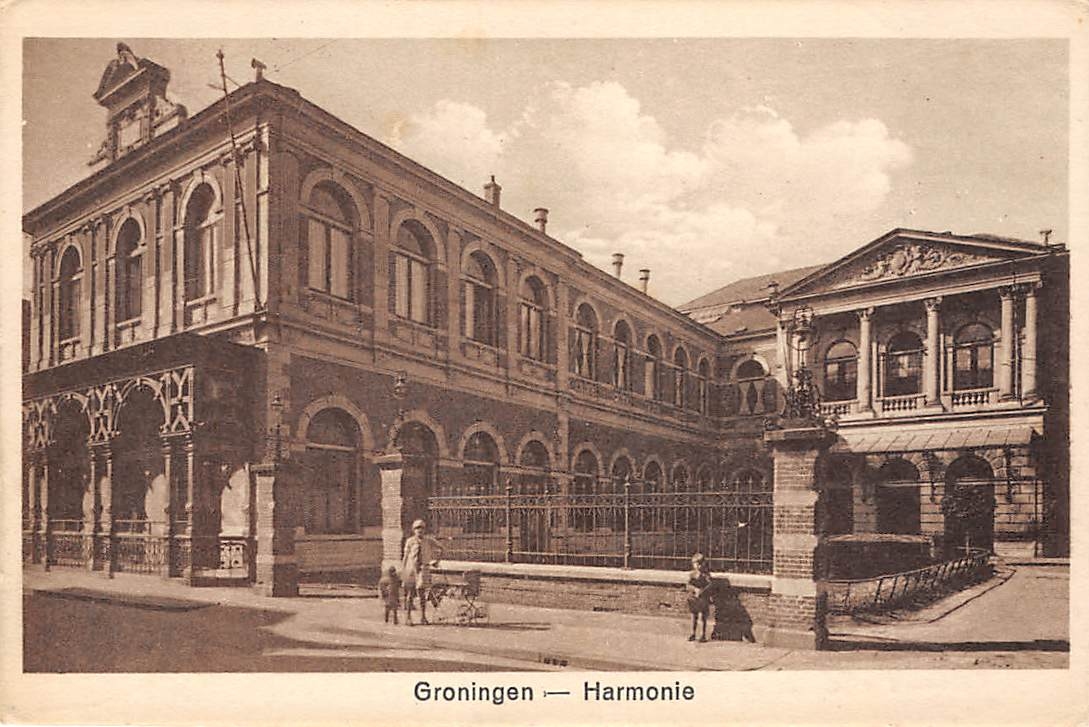
The Harmonie in Groningen
But now to chess ...
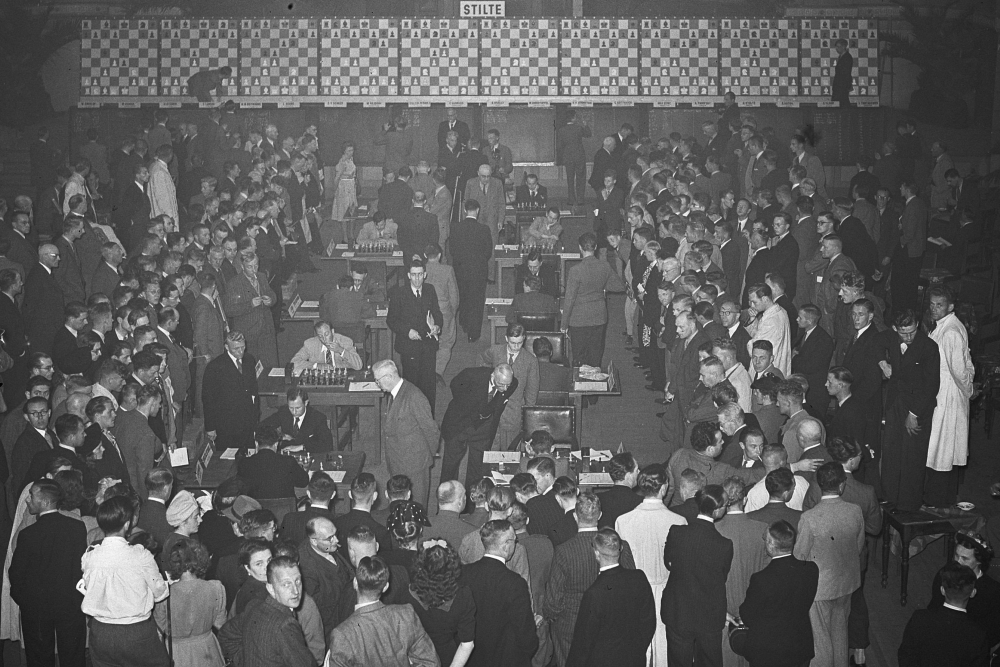
The tournament was played in the Great Hall of the Harmoniegebouw. The building was demolished in 1973. Only the façade was preserved and is now part of the University of Groningen. The opening and closing ceremonies were held at the Hotel Frigge.
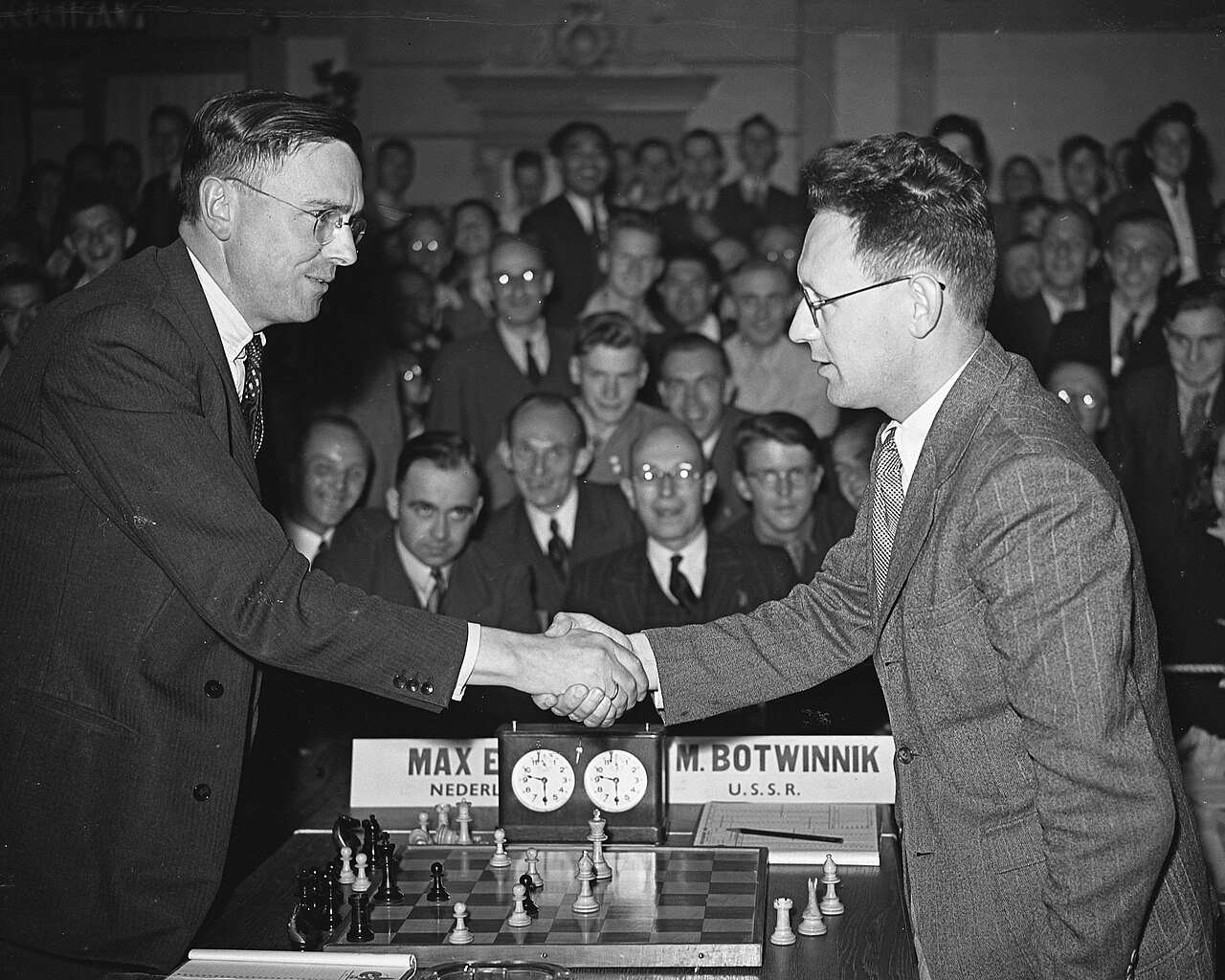
The tournament attracted enormous public interest in Groningen. The game between Max Euwe and Mikhail Botvinnik in round 10 drew an audience of 1,000 spectators. The game ended in a draw.
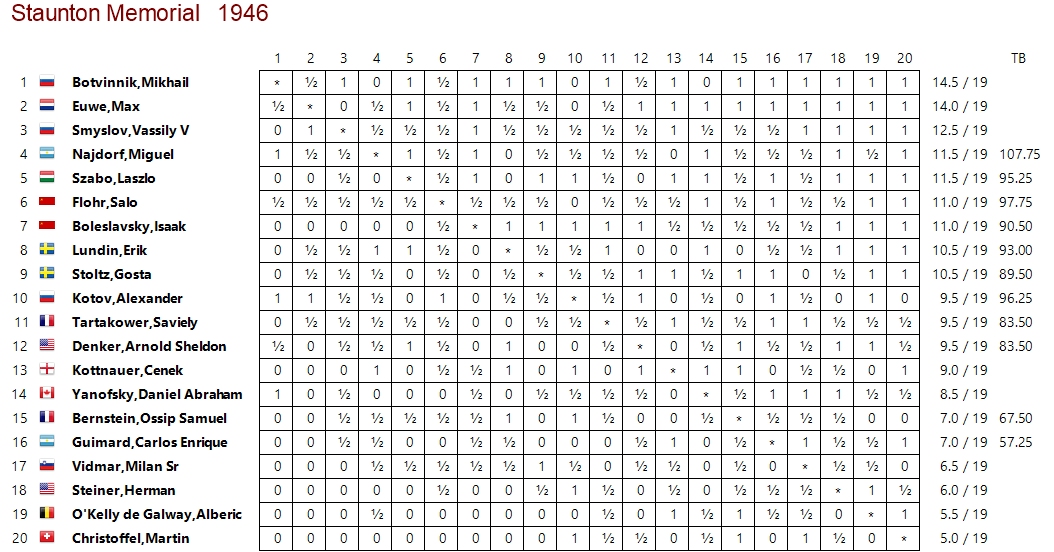
The tournament quickly developed into a two-horse race between Max Euwe and Mikhail Botvinnik. Both had started with four wins from the first four rounds. In round five, Euwe conceded his first draw against Najdorf, while Botvinnik continued his winning streak against Vidmar. In round six, Botvinnik drew with Denker, while Euwe defeated Szabo.
The race for first place thus continued neck and neck. Before the final two rounds, i.e. after round 17, Botvinnik and Euwe were tied on an impressive 13½ points. Up to that point, Botvinnik had lost only to Kotov and Yanofsky, while Euwe had lost only to Smyslov.
In the penultimate round, Euwe dropped half a point against Tartakower, while Botvinnik defeated Guimard and thus went into the final round with a half-point lead. There, however, Botvinnik lost his game against Najdorf.
Euwe, however, also lost – to Kotov.
And so Mikhail Botvinnik did, after all, emerge as the tournament winner.
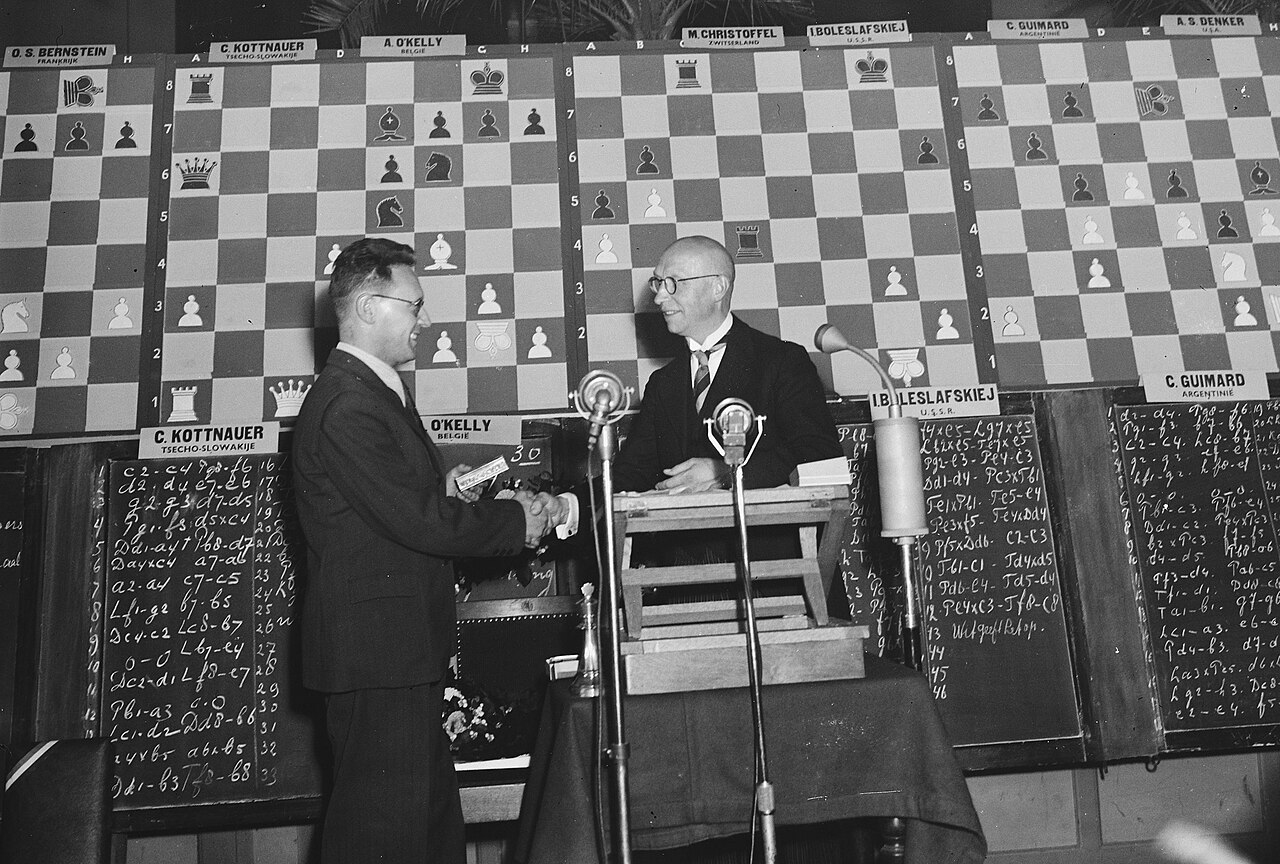
The prizegiving
Smyslov, Najdorf and Szabo took the next places. Alexander Kotov had beaten both of the tournament leaders, but lost too many games against other players and finished in the middle of the field.
5/23/2026 – The second event of the 2026 Grand Chess Tour is the Super Chess Classic Romania, which is taking place on 14-23 May in Bucharest. Vincent Keymer and Fabiano Caruana enter the final round tied for first place, while Javokhir Sindarov, Wesley So and Jorden van Foreest stand a half point back and still have chances of taking the title. | Follow the action live with expert commentary starting two hours earlier than usual, at 13.00 CEST (7.00 ET, 16.30 IST) | Photo: Lennart Ootes
5/9/2026 – Winning against the reigning world champion is always difficult. The first German player to achieve this feat after the Second World War was Wolfgang Unzicker, for many years the number one player in the Federal Republic of Germany. At the 1961 European Team Championship, he <a href="https://de.chessbase.com/post/aussenseitersiege-w-unzicker-vs-m-botvinnik-oberhausen-1961">outplayed</a> the then world champion Mikhail Botvinnik. Wolfgang Uhlmann, for many years the number one player in the GDR, was not to be outdone. In 1962, at the Chess Olympiad in Varna, he defeated Botvinnik - though not quite as convincingly as Unzicker had done a year earlier. | Image: Wolfgang Uhlmann in 1970 | Photo: <a href="https://commons.wikimedia.org/wiki/File:IBM-schaaktoernooi,_Bestanddeelnr_923-6899.jpg?uselang=de">Rob Mieremet, Anefo</a>
On this 60 mins video we are going to concentrate on a simple, very solid idea in the main line Scandinavian, which even Magnus Carlsen has used to win games. Black focusses on making his life easy in the opening and forces White to work very hard to get advantage – but it is doubtful if White can get an advantage. Club players are always on the lookout for effective, time-saving solutions and here we have just that. Accompany FIDE Senior Trainer and IM Andrew Martin on this 60 mins video. You can learn a new opening system in 60 mins and start to play it with confidence on the very same day!
YOUR PERSONAL CHESS COACH - Whether you’re taking your first steps into the world of club chess, or already playing at a tournament level: with FRITZ, you can train more efficiently, intelligently and with a more personalised approach than ever before.
Michael Kotyk presents a complete repertoire after 1.e4 e5, built around creative ideas, surprising move orders, and practical weapons designed to catch your opponents off guard.
Michael Kotyk presents a complete repertoire after 1.e4 e5, built around creative ideas, surprising move orders, and practical weapons designed to catch your opponents off guard.
Michael Kotyk presents a complete repertoire after 1.e4 e5, built around creative ideas, surprising move orders, and practical weapons designed to catch your opponents off guard.
“Attack with Qh5!!” – Tactical training with Oliver Reeh, “6…g5 – nothing ventured, nothing …” – Le Quang Liem comments on one of his victories in Biel, “Grischuk’s stroke of genius” – Petra Papp reveals a surprise in the Sicilian Kan Variation, and much
YOUR PERSONAL CHESS COACH - Whether you’re taking your first steps into the world of club chess, or already playing at a tournament level: with FRITZ, you can train more efficiently, intelligently and with a more personalised approach than ever before.
While tactics decide the game in concrete moments, strategy guides the entire battle. Understanding how to improve your pieces, create weaknesses, execute maneuvers, and steer the game toward favorable structures is what defines strong players.
The Italian Four Knights is the ideal choice. It combines the solid foundation of classical openings like the Ruy Lopez or the Italian Game with an active, initiative-driven style of play.
€24.90
We use cookies and comparable technologies to provide certain functions, to improve the user experience and to offer interest-oriented content. Depending on their intended use, analysis cookies and marketing cookies may be used in addition to technically required cookies. Here you can make detailed settings or revoke your consent (if necessary partially) with effect for the future. Further information can be found in our data protection declaration.
Pop-up for detailed settings
We use cookies and comparable technologies to provide certain functions, to improve the user experience and to offer interest-oriented content. Depending on their intended use, cookies may be used in addition to technically required cookies, analysis cookies and marketing cookies. You can decide which cookies to use by selecting the appropriate options below. Please note that your selection may affect the functionality of the service. Further information can be found in our privacy policy.
Technically required cookies
Technically required cookies: so that you can navigate and use the basic functions and store preferences.
Analysis Cookies
To help us determine how visitors interact with our website to improve the user experience.
Marketing-Cookies
To help us offer and evaluate relevant content and interesting and appropriate advertisement.











%20vs%20count%20johannes%20van%20den%20bosch%201930.%20left%20chessclub%20utrecht.jpg)
.jpg)





.jpeg)