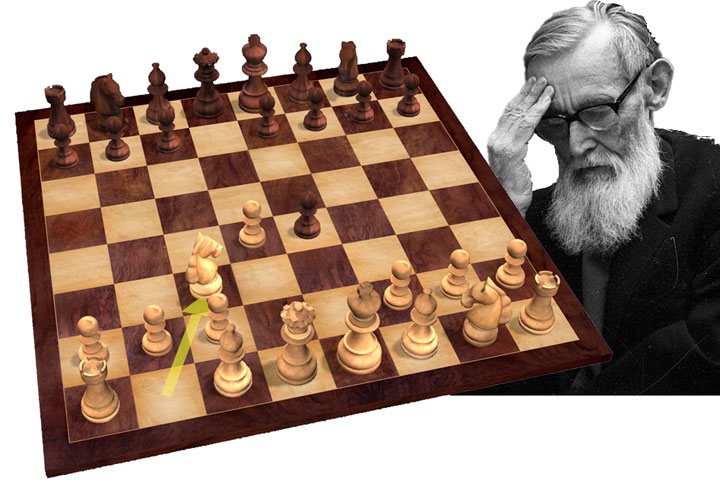
In my early chess career I spent half a season experimenting with this aggressive gambit, which yielded a few dramatic successes, but many more unmitigated disasters. The latter was especially the case against strong players who could refute the attacking plans. In the end I abandoned the BD, as I called it, never to play it again. My conclusion: the gambit was interesting and sound, but I was not strong enough (just below 2000 Elo) to carry it off.
The Blackmar-Diemer is now not common in elite play, where it is considered it too risky. White gains a lead in development and can threaten dangerous initiatives if Black is unprepared. But with accurate play Black can retain the extra pawn and grind down the opponent.
Originally it was Armand Blackmar who introduced the basic idea of the gambit, in the 19th century. But his advocacy of 1.d4 d5 2.e4 dxe4 3.f3 turned out to be unsound, as it allowed Black to equalize quite easily. Diemer refined the opening by introducing an important move-order twist: he recommended playing 3.Nc3 before offering the pawn with f3 on move four, which made the gambit far more playable. In ChessBase you can use the Report tab and run an "Overview" to learn everything about history, the strong grandmasters and other notable players who used the gambit, statistics, moves and plans:
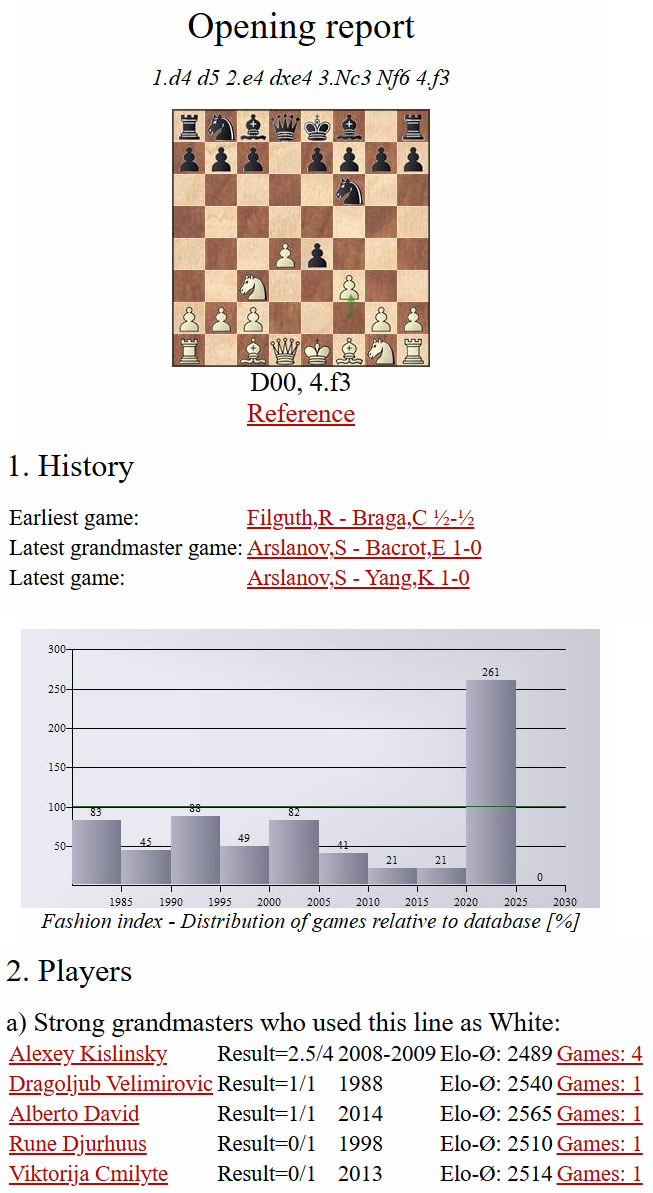
etc. All the links can be clicked in the ChessBase report to retieve the game, many annotated.
So who was Emil Joseph Diemer?
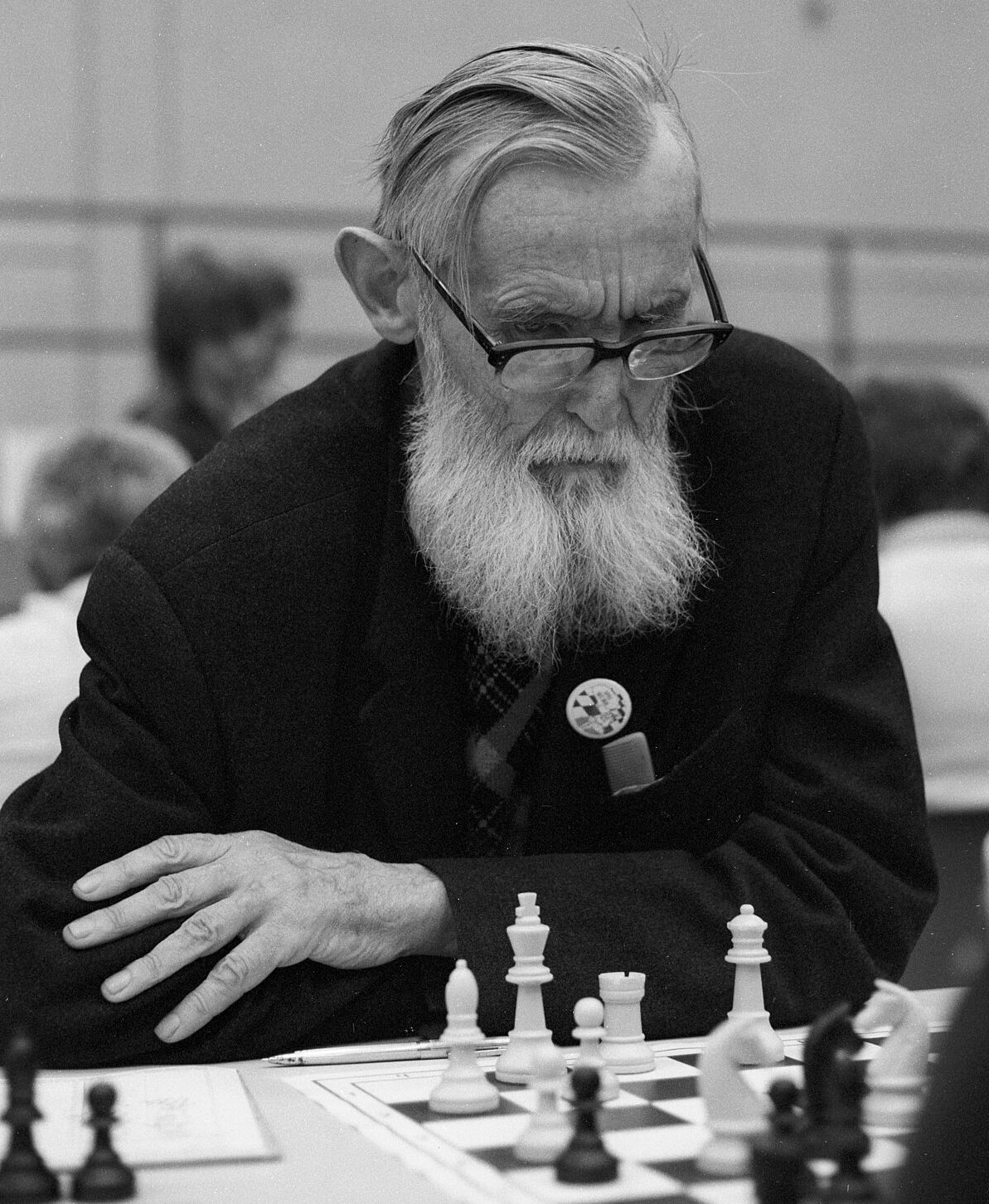 He was born in 1908, in Radolfzell, Germany, and showed an early passion for chess, learning the game at age nine. He completed an apprenticeship as a bookseller in Freiburg, but unemployed in his early twenties he joined the Nazi Party and became “chess reporter of the Great German Reich”. After WWII, Diemer continued as a chess journalist and organizer of simuls but faced professional barriers due to his past, and struggled financially. Diemer achieved some chess successes abroad: winning the reserves group at the 1956 Hoogovens tournament and the 1956 Open Championship of the Netherlands, and placing highly in the Swiss International Chess Championship.
This photo (Wiki) shows Diemer at 75 at the Badischen Schachkongress in Bühl.
Then came the eccentricities: Diemer became obsessed with biorhythms and with the writings of Nostradamus, writing copiously about the French astrologer, apothecary, physician, and seer. In 1965, he was admitted to a psychiatric clinic and was banned from playing chess, which was deemed too stressful for him. He never fully recovered a stable personal life and lived as a semi-residential patient until his death on October 10, 1990.
Despite average top-level results, his influence on chess openings and his dramatic life story ensure his fame in chess history. And it is definitely worthwhile to try his gambit, at least in inconsequential club games. Perhaps you might take a liking?!