8/3/2026 – In his latest column, Jon Speelman moves from Hatfield House and Queen Elizabeth’s Oak to a series of chess puzzles, with rook endings, defensive choices and a spoof opening line among the themes. He also introduces the idea of a "Fluffy Duck" opening, inspired by an advocaat-based cocktail, and invites readers to suggest a suitable variation! | Photo: Puredrinkology
new: ChessBase Magazine 225
Chess Festival Prague 2025 with analyses by Aravindh, Giri, Gurel, Navara and others. ‘Special’: 27 highly entertaining miniatures. Opening videos by Werle, King and Ris. 10 opening articles with new repertoire ideas and much more. ChessBase Magazine offers first-class training material for club players and professionals! World-class players analyse their brilliant games and explain the ideas behind the moves. Opening specialists present the latest trends in opening theory and exciting ideas for your repertoire. Master trainers in tactics, strategy and endgames show you the tricks and techniques you need to be a successful tournament player! Available as a direct download (incl. booklet as pdf file) or booklet with download key by post. Included in delivery: ChessBase Magazine #225 as “ChessBase Book” for iPad, tablet, Mac etc.!
YOUR PERSONAL CHESS COACH - Whether you’re taking your first steps into the world of club chess, or already playing at a tournament level: with FRITZ, you can train more efficiently, intelligently and with a more personalised approach than ever before. FRITZ is more than just a chess engine – it’s a training revolution! Whether you’re taking your first steps into the world of club chess, or already playing at a tournament level: with FRITZ, you can train more efficiently, intelligently and with a more personalised approach than ever before.
In this video course, Grandmaster Ivan Sokolov explores the fascinating world of King’s Indian and Pirc structures with colours reversed, often arising from the French or Sicilian.
€39.90
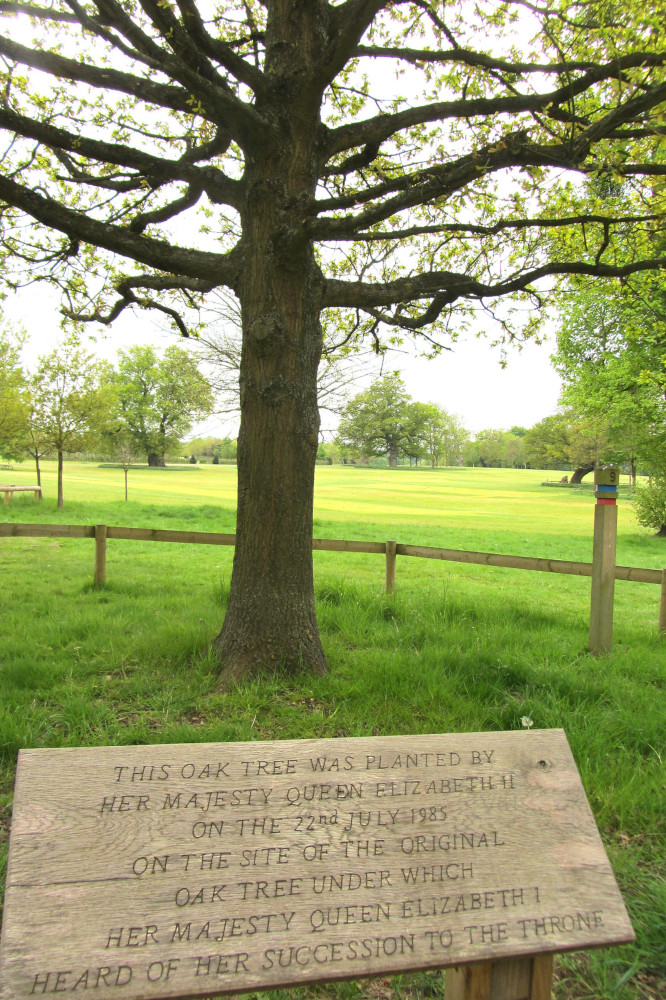
Queen Elizabeth's Oak
[Note that Jon Speelman also looks at the content of the article in video format, here embedded at the end of the article.]
I'm starting today with a position which Jonathan Mastel showed me a fortnight ago. This was at "Folk by the Oak", the annual one-day folk festival at Hatfield House a few miles north of London, which is named after the oak tree which Queen Elizabeth was supposedly sitting by when she was informed that Queen Mary had died - and so she had ascended to the throne.
That oak has died but been replaced by another which my wife and I were sitting quite near to, seeking shade on the very hot Sunday of the World Cup final.
Jonathan often goes there separately, and we met up for some of the time and chatted during the many intervals. He had seen this diagram on another site where it wasn't flagged up as being especially surprising, though there is a lovely sting in the tail.
Jonathan left me with the position and wandered off for a while, and I got some of the solution but not all of it. To begin with, I thought that White must be in trouble since Rb4 certainly doesn't help, but then I realised that White can set up a mating threat. I wasn't immediately sure whether the rook should go to d7 or e7 since I did then find the defence which almost draws. But of course, if Re7, then Black can immediately draw with checks.
You will learn how Black's dynamic piece activity and structural counterplay more than compensate for White's extra tempo in the colour-reversed setups. The Benoni family of openings has toppled world champions, decided match games under the highest pressure, and rewarded those brave enough to play them with some of the most electrifying chess imaginable. In this Fritztrainer, Grandmaster Ivan Sokolov - continuing his successful series "Understanding Middlegame Structures" - takes you deep inside the complexities of the Colour-Reversed Benoni, the Colour-Reversed Benko Gambit, and the Colour-Reversed Blumenfeld Gambit.
Free sample video: Introduction
Free sample video: Colour Reversed Banoni - Game 1
So I'm giving you the first move, which is 1.Rd7. See what you can do with it, and the complete answer is in the .pgn below.
This new, young tree stands on the spot where tradition says Elizabeth I learned of her accession as Queen on 17 November 1558 | Photo: Alex-David Baldi
Continuing with rook endings, I don't think I've shown this here before. It's White to play - he must deal with the back rank in some way since the passive 1.Rb1 will surely lose. The obvious choice is between 1.g3 and 1.h3. What is your first reaction, and which one do you think actually is correct? (Obviously this is far too complicated to be analysed remotely accurately from the diagram, but you may realise why one of these two moves might fail.)
This is from the Bundesliga a couple of years ago. Black's most obvious choices are ...Ke5 or ...Kg5. Which would you play?
The glorious Fluffy Duck
Decades ago, when he was proprietor of the British Chess Magazine, Murray Chandler produced a one-off spoof - not the BCM. Sadly I can't find my copy at the moment, but it included articles such as "Blunder of the year" and this wittily insulting diagram.
This compact course is designed specifically for practical play. Instead of overwhelming you with endless theory, it focuses on the critical lines, typical plans, and recurring tactical ideas. Looking for an opening that gets your opponents thinking on move one? Grandmaster Andy Woodward has relied on 1.b3 for years in blitz and bullet, using it to defeat strong masters and grandmasters who underestimated its hidden venom. While many players dismiss the opening as harmless, they often find themselves caught in unfamiliar positions, tactical traps, and uncomfortable middlegames. This compact course is designed specifically for practical play. Instead of overwhelming you with endless theory, it focuses on the critical lines, typical plans, and recurring tactical ideas that matter most when the clock is ticking.
Free video sample: Introduction
Free video sample: King's Indian Setup
This was an opening line purportedly played in games between vegetarians such as Mastel and myself.
A couple of months ago, my son and his wife went to Amsterdam for a weekend and very kindly brought me back a bottle of Advocaat. Half a century ago at the European Junior in Groningen (one of the worst tournaments of my life) we sometimes used to drink snowballs – advocaat and lemonade - at a time when, if memory serves, the lemonade cost more than the booze. When I opened the bottle, bereft of lemonade, I found some orange juice in the fridge and added it later to discover that this cocktail, sometimes with the addition of gin and/or vermouth, is a "Fluffy Duck".
We already of course have the Dragon and the Monkey's Bum - and the Fluffy Duck is self-evidently a terrific name for a chess opening which ideally should look wimbly but carry a hefty potential (alcohol fuelled) punch.
My first thought was 1.e4 e5 2.Nf3 Nc6 3.Nc3 Nf6 4.a3, which has been tried by many top players, but regrettably this is apparently the Gunsberg Variation. So I wondered about 4.h3 instead which has also been tried by many of the top guys and I think may not yet have been named, though apparently it was popularised by Anish Giri (who appropriately is Dutch).
Anyway, I wonder whether readers have other suggestions for the glorious Fluffy Duck, so I am opening up the comments below for your suggestions.
Select an entry from the list to switch between games
In this video course experts examine the games of Bent Larsen. Let them show you which openings Larsen chose, where his strength in middlegames were, how he outplayed his opponents in the endgame & you’ll get a glimpse of his tactical abilities! Bent Larsen (1935–2010) was the greatest chess player in Danish history, and for a time, the second-strongest player in the Western world behind Bobby Fischer. Between 1954 and 1971, he won the Danish Championship six times, and achieved numerous international tournament victories throughout his career.
Free video sample: Introduction to Bent Larsen by Peter Heine Nielsen
Free video sample: Introduction to the Opening Section
Jonathan SpeelmanJonathan Speelman, born in 1956, studied mathematics but became a professional chess player in 1977. He was a member of the English Olympic team from 1980–2006 and three times British Champion. He played twice in Candidates Tournaments, reaching the semi-final in 1989. He twice seconded a World Championship challenger: Nigel Short and then Viswanathan Anand against Garry Kasparov in London 1993 and New York 1995.
YOUR PERSONAL CHESS COACH - Whether you’re taking your first steps into the world of club chess, or already playing at a tournament level: with FRITZ, you can train more efficiently, intelligently and with a more personalised approach than ever before.
How grandmasters win without fireworks: GM Jan Markos shows you 11 very practical tips from "How to play in a lost position" to "Be patient like Carlsen" that will improve your tournament chess.
The Nimzo-Indian has stood the test of time for over a century: Still a top choice for elite players today, from Magnus Carlsen to Praggnanandhaa, it remains one of Black's most reliable ways to fight for real chances against 1.d4 2.c4 3.Nc3.
1.c4 e5 2.Nc3 Bb4!? is an opening idea well worth considering. Black immediately threatens to double the pawns on c3 in the style of the Trompowski or Sicilian Grand Prix attack.
Italian Game Powerbase 2026 is a database and contains 8571 top class games from Mega 2026 and the Correspondence Database 2026, of which 479 are annotated.
Videos: Nico Zwirs discusses the Sicilian with 2…e6 3.d4 cxd4 4.Qxd4 Nc6 5.Qe3 Nf6 6.Nc3. Mihail Marin examines Sindarov’s 6.Ne5 in the Queen’s Pawn Defence. Plus the ‘Lucky bag’ featuring 41 analyses by Berg, Ftacnik, Gupta and many others.
€14.90
We use cookies and comparable technologies to provide certain functions, to improve the user experience and to offer interest-oriented content. Depending on their intended use, analysis cookies and marketing cookies may be used in addition to technically required cookies. Here you can make detailed settings or revoke your consent (if necessary partially) with effect for the future. Further information can be found in our data protection declaration.
Pop-up for detailed settings
We use cookies and comparable technologies to provide certain functions, to improve the user experience and to offer interest-oriented content. Depending on their intended use, cookies may be used in addition to technically required cookies, analysis cookies and marketing cookies. You can decide which cookies to use by selecting the appropriate options below. Please note that your selection may affect the functionality of the service. Further information can be found in our privacy policy.
Technically required cookies
Technically required cookies: so that you can navigate and use the basic functions and store preferences.
Analysis Cookies
To help us determine how visitors interact with our website to improve the user experience.
Marketing-Cookies
To help us offer and evaluate relevant content and interesting and appropriate advertisement.




.jpeg)