6/11/2026 – Jon Speelman returns to the importance of seeing the whole board when calculating, using a series of positions in which small changes far from the main action transform the evaluation. Examples include back-rank motifs, a double bishop sacrifice inspired by Emanuel Lasker v. Johann Bauer and an adjourned game involving Alexander Kotov and Glenn Lambert. The focus is on tactical awareness, pawn moves, quiet resources and the need to continue variations until the position becomes stable.
new: Fritz 20
Your personal chess trainer. Your toughest opponent. Your strongest ally. FRITZ 20 is more than just a chess engine – it is a training revolution for ambitious players and professionals. Whether you are taking your first steps into the world of serious chess training, or already playing at tournament level, FRITZ 20 will help you train more efficiently, intelligently and individually than ever before.
YOUR PERSONAL CHESS COACH - Whether you’re taking your first steps into the world of club chess, or already playing at a tournament level: with FRITZ, you can train more efficiently, intelligently and with a more personalised approach than ever before. FRITZ is more than just a chess engine – it’s a training revolution! Whether you’re taking your first steps into the world of club chess, or already playing at a tournament level: with FRITZ, you can train more efficiently, intelligently and with a more personalised approach than ever before.
From the 2026 Candidates Tournament, featuring a video review by Dorian Rogozenco, to Jan Werle’s opening video on the French Tarrasch Defence, and Oliver Reeh’s tactical column ‘Top Grandmasters at Work’. Analyses by Giri, So, Wei Yi and many others.
€21.90
Tiny twiddles with massive effects
[Note that Jon Speelman also looks at the content of the article in video format, here embedded at the end of the article.]
The premiere chess database with over 11.7 million games The ChessBase Mega Database 2026 is the premiere chess database with over 11.7 million games from 1475 to 2025 in high quality.
White to play and win.
Why is the position quite different if White's h-pawn is on h3?
I thought this time that we'd return to a topic which I've certainly covered before here and, indeed, two of the examples have appeared at some stage, though quite a while ago, I think. This is the importance of understanding that you need to survey the whole board rather than compartmentalising.
Of course, in many positions the main action will be more or less independent of what is going on elsewhere. But there are others in which apparently tiny twiddles far away across the board may have massive effects, and Diagram 1, which I tend to show to new students to try to gauge their tactical acuity, is very much one of them. It's a back rank problem in which White has to work out how to seize control of c8 in order to deliver mate and if you've seen things like this before, then it's not too difficult, though if you haven't it may be surprising.
The small twiddle of moving White's h-pawn up a single square to h3 completely changes the position, and I might make the general point that when you advance a pawn the move by its very nature weakens some squares and reinforces others, and that you can't move pawns backwards.
Sentient glasses?
I decided on the topic apropos of a somewhat lame segue from vision in the real world, since in the last few weeks I've been having quite a to-do with my eyes. I've been going to the wonderful Moorfields Eye Hospital in London - one of the very best in the world - for four and a half decades now and had a couple of appointments last month at Ophthalmology (checking for problems and an eye test), and then a couple of weeks later at a clinic which looks at the back of the eye and now boasts a snazzy new machine costing over a hundred grand which uses infrared light to check the veins at the back of your eye in detail.
In this volume, we dive into core aspects of chess technique. Smyslov taught the principle of tactical hierarchy, “checks, double attacks, and unprotected pieces”, and Mikhalchishin demonstrates how this method of calculation is vital. After mastering positional play in Volume 1 and learning how to convert small advantages in Volume 2 of the Master Your Technique series, GM Mikhalchishin now presents Essential Techniques, covering topics from playing on the flank versus the center to maintaining tactical vigilance. In this volume, we dive into core aspects of chess technique. Smyslov taught the principle of tactical hierarchy, “checks, double attacks, and unprotected pieces”, and Mikhalchishin demonstrates how this method of calculation is vital. He shows how top players apply it, but also how even grandmasters sometimes miss critical resources, highlighting the necessity of developing a strong “tactical sense.” This approach encompasses tactical vigilance and scanning for sacrifices, but is also highly relevant to the second part of the course, which focuses on more strategic elements such as the use of heavy pieces and endgame technique.
Free Video Sample: Simple Tactics
Free Video Sample: Mating Net: Ne7+ Qxh7 Rh5+
Both visits were more or less as expected, but apparently my glasses were upset because the very next day they got the vapours and the frame cracked (okay, I do know that glasses aren't really sentient). My local optician is just a couple of minutes away, and they were wonderful finding a frame for the lenses within half an hour after looking, he said, at about a hundred different ones. But they're not quite right and after a couple of visits back to them, I returned to Moorfields who explained that you need exactly the right frames for the lenses and proscribed new ones after an exhaustive process - rather like what happened to your feet at an old-fashioned shoe shop as the optician measured every millimetre of the frames we agreed on and my head.
Anyway, I'm therefore waiting for the next week or two till the new pair arrives, and my vision is slightly fuzzier than normal - though, obviously, I can still function since I'm writing this.
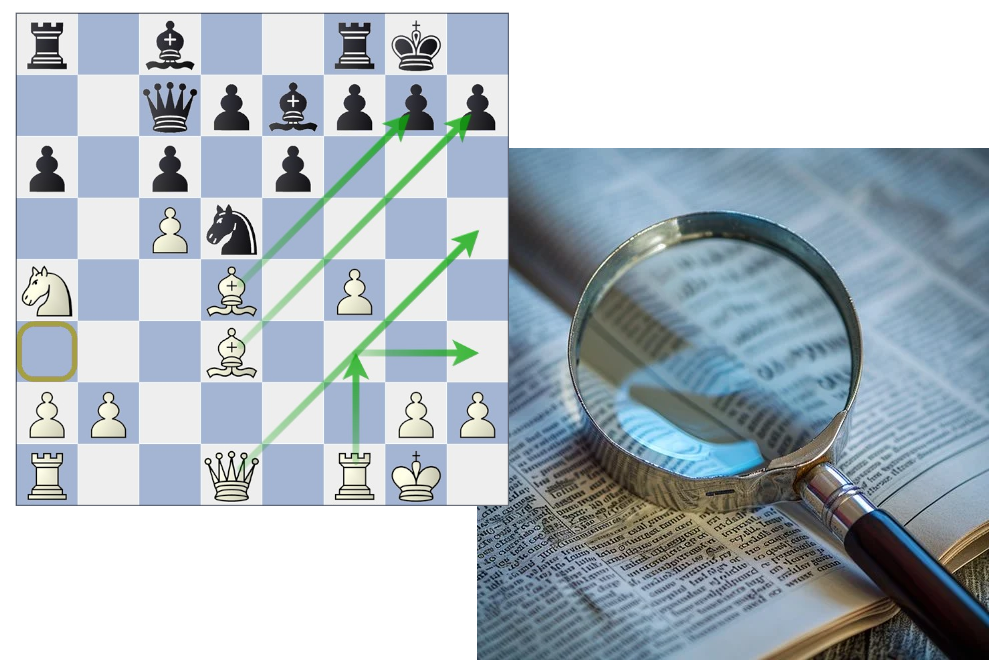
What is the obvious thing to look at first, given the white bishops on d3 and d4? And why doesn't it work?
How can White prepare the above continuation with an introductory move?
(Very difficult) Why in the world would it make a difference if the a-pawn were on a3 rather than a2?
(Much easier) What happens if we take the a2-pawn off the board?
I also used this position before at some stage. It's from a game in Moscow 1973, but there have been other instances since it arises naturally - if unfortunately for Black - from a line of the Taimanov Sicilian. White has a lot of firepower aimed at the enemy monarch and if you know your classics - and in particular the famous game Lasker v. Bauer which was apparently played in Amsterdam 1889 - it will be clear that White must at least think about the double bishop sacrifice.
As it happens, this doesn't work in the diagram because Black's knight on d5 is too close to the action, but you might look for a move which deflects the knight so that White can implement his evil scheme.
Once you find it, this works like clockwork but looking at the position at some point I started to wonder if twiddling the queenside would have any effect, and it turns out that if White's pawn is on a3 then the evaluation is very different - you might try to work out or more likely guess why weakening b3 would have such a profound effect. In the third version, the a-pawn is removed entirely which, when you think about it, could easily make White's a1-rook extremely happy...
The stem game Lasker v. Bauer is next in the pgn file, and it's sufficiently important for chess history that my version in the Mega Database is annotated by Garry Kasparov. Having seen the previous examples, you'll know how Lasker continued after Black played 14...Nf6xh5, but it is worth thinking about why the sacrifice works if Black arranges to jettison his queen.
Another important aspect of calculation is continuing variations until the position is quiescent (using singular extensions in chess computer terms). After White wins the queen, Black has a rook and two bishops for her, but there is a move which restores the material balance in White's favour.
In this video course, experts (Pelletier, Marin, Müller and Reeh) examine the games of Viktor Korchnoi. Let them show you which openings Korchnoi chose to play, where his strength in middlegames were, or how he outplayed his opponents in the endgame.
White sealed 42.Re6+. How should Black respond?
What happens after 42.Rg7+? And why is the position completely different if White's a-pawn is on a2?
What are White's two best moves (which are more or less identical)?
I'm greatly indebted for today's final position to Jonathan Mestel and Britbase Supremo John Saunders (www.saund.co.uk/britbase/).
Jonathan was in London on Saturday and dropped in to visit us. At some stage, I told him about today's theme and asked if he could think of a position which fitted. He had a vague memory of sending a letter to the BCM (British Chess Magazine) "about 30 years ago" and had a look on his laptop before firming the game up in his memory to "Kotov v. Gary Lane".
I couldn't find this anywhere and so turned to John Saunders, who very kindly looked through his collection of past BCMs until he unearthed Jonathan's letter not regarding the fictional Kotov v. Lane but Alexander Kotov v. Glenn Lambert from the "Lord John Cup" in 1977, which was held - though I didn't play in it myself - at a hotel about a 15-minute bus ride from me.
In those far-off days, games were still adjourned, and apparently Kotov sealed 42.Re6+ and proceeded to explain to his opponent that he should resign since after 42...Kd7 (I wonder whether Kotov put the black king on d8, so that it was check) 43.Rxe8 Kxe8, 44.Re6+ decides.
This is all very true and, incredibly, Lambert resigned on the spot, but had he thought calmly for 3.6 micro seconds, he would surely have seen that you don't have to recapture the rook but can play 43...g3!, which turns the position through 180°.
If 42.Rg7+ Kd8 43.Rxa6 Re7! wins, but were the a-pawn on a2 (or a3) then 44.Ra8+ Kd7 45.Rxe7+ Kxe7 46.Ra4! would win!
Since both Re6+ and Rg7+ lose (with the pawn on a4), White should play either 42.Rd6 or 42.Rc6, after which he can force perpetual check with the other rook.
Select an entry from the list to switch between games
In this video course experts examine the games of Bent Larsen. Let them show you which openings Larsen chose, where his strength in middlegames were, how he outplayed his opponents in the endgame & you’ll get a glimpse of his tactical abilities! Bent Larsen (1935–2010) was the greatest chess player in Danish history, and for a time, the second-strongest player in the Western world behind Bobby Fischer. Between 1954 and 1971, he won the Danish Championship six times, and achieved numerous international tournament victories throughout his career.
Free video sample: Introduction to Bent Larsen by Peter Heine Nielsen
Free video sample: Introduction to the Opening Section
Jonathan SpeelmanJonathan Speelman, born in 1956, studied mathematics but became a professional chess player in 1977. He was a member of the English Olympic team from 1980–2006 and three times British Champion. He played twice in Candidates Tournaments, reaching the semi-final in 1989. He twice seconded a World Championship challenger: Nigel Short and then Viswanathan Anand against Garry Kasparov in London 1993 and New York 1995.
YOUR PERSONAL CHESS COACH - Whether you’re taking your first steps into the world of club chess, or already playing at a tournament level: with FRITZ, you can train more efficiently, intelligently and with a more personalised approach than ever before.
Most players don’t lack the urge to attack, they just strike at the wrong moment, and GM Sipke Ernst shows you which signals tell you to go for the king and which tell you to choose another plan.
How grandmasters win without fireworks: GM Jan Markos shows you 11 very practical tips from "How to play in a lost position" to "Be patient like Carlsen" that will improve your tournament chess.
The Nimzo-Indian has stood the test of time for over a century: Still a top choice for elite players today, from Magnus Carlsen to Praggnanandhaa, it remains one of Black's most reliable ways to fight for real chances against 1.d4 2.c4 3.Nc3.
1.c4 e5 2.Nc3 Bb4!? is an opening idea well worth considering. Black immediately threatens to double the pawns on c3 in the style of the Trompowski or Sicilian Grand Prix attack.
Italian Game Powerbase 2026 is a database and contains 8571 top class games from Mega 2026 and the Correspondence Database 2026, of which 479 are annotated.
€9.90
We use cookies and comparable technologies to provide certain functions, to improve the user experience and to offer interest-oriented content. Depending on their intended use, analysis cookies and marketing cookies may be used in addition to technically required cookies. Here you can make detailed settings or revoke your consent (if necessary partially) with effect for the future. Further information can be found in our data protection declaration.
Pop-up for detailed settings
We use cookies and comparable technologies to provide certain functions, to improve the user experience and to offer interest-oriented content. Depending on their intended use, cookies may be used in addition to technically required cookies, analysis cookies and marketing cookies. You can decide which cookies to use by selecting the appropriate options below. Please note that your selection may affect the functionality of the service. Further information can be found in our privacy policy.
Technically required cookies
Technically required cookies: so that you can navigate and use the basic functions and store preferences.
Analysis Cookies
To help us determine how visitors interact with our website to improve the user experience.
Marketing-Cookies
To help us offer and evaluate relevant content and interesting and appropriate advertisement.