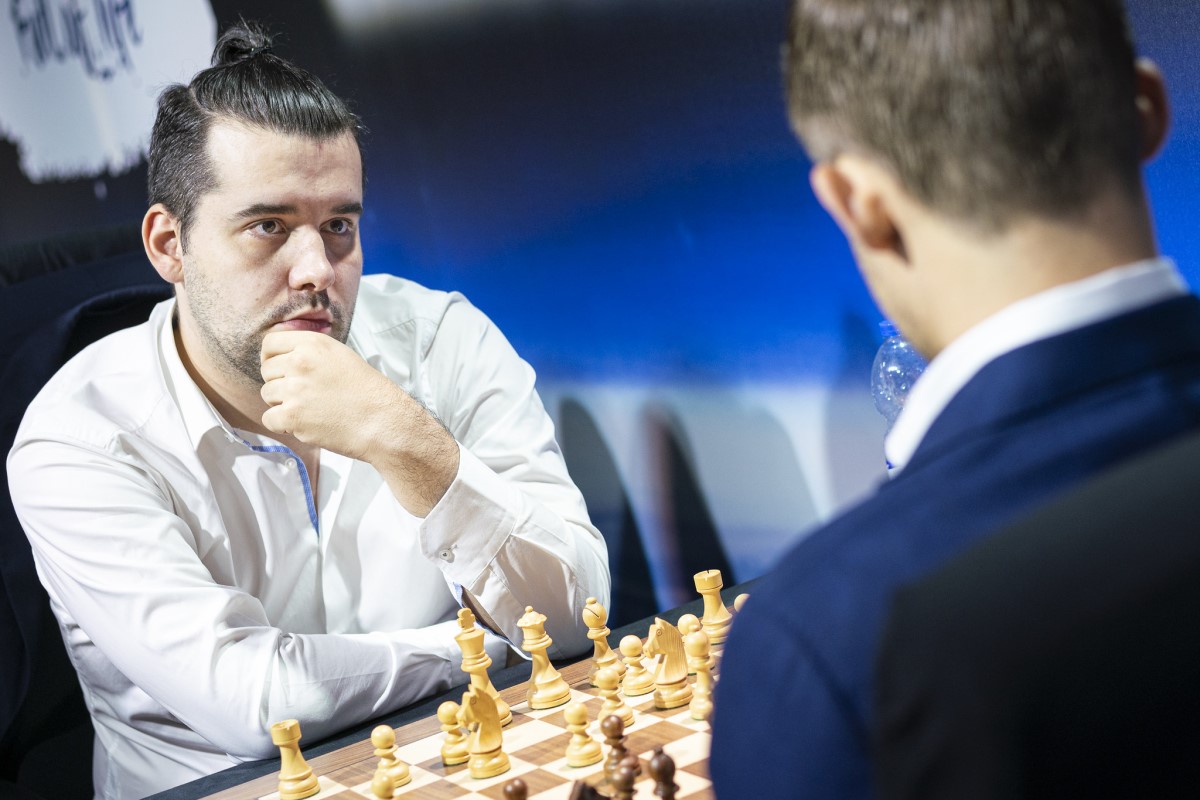
5/2/2021 – Now that we know that Ian Nepomniachtchi will be Magnus Carlsen’s next challenger for the World Championship title, it’s time to start getting ready for the big match. Star columnist Jon Speelman has another go at prediction, claiming that “Carlsen is surely the favourite, but not, I think, by that much: no more than 60-40, and perhaps just 55-45”. | Photo: Lennart Ootes / Grand Chess Tour
new: ChessBase Magazine 225
Chess Festival Prague 2025 with analyses by Aravindh, Giri, Gurel, Navara and others. ‘Special’: 27 highly entertaining miniatures. Opening videos by Werle, King and Ris. 10 opening articles with new repertoire ideas and much more. ChessBase Magazine offers first-class training material for club players and professionals! World-class players analyse their brilliant games and explain the ideas behind the moves. Opening specialists present the latest trends in opening theory and exciting ideas for your repertoire. Master trainers in tactics, strategy and endgames show you the tricks and techniques you need to be a successful tournament player! Available as a direct download (incl. booklet as pdf file) or booklet with download key by post. Included in delivery: ChessBase Magazine #225 as “ChessBase Book” for iPad, tablet, Mac etc.!
YOUR PERSONAL CHESS COACH - Whether you’re taking your first steps into the world of club chess, or already playing at a tournament level: with FRITZ, you can train more efficiently, intelligently and with a more personalised approach than ever before. FRITZ is more than just a chess engine – it’s a training revolution! Whether you’re taking your first steps into the world of club chess, or already playing at a tournament level: with FRITZ, you can train more efficiently, intelligently and with a more personalised approach than ever before.
GM Blohberger presents a complete two-part repertoire for Black: practical, clear, and flexible – instead of endless theory, you’ll get straightforward concepts and strategies that are easy to learn and apply.
€49.90
The World Championship Match 2021 - Thoughts about a possible winner
[Note that Jon Speelman also looks at the content of the article in video format, here embedded at the end of the article.]
The 2020-21 Candidates tournament was, presumably, the most protracted over-the-board tournament in chess history (though correspondence events have gone on for many years, and there must also have been longer league seasons).
With famous classical examples from the works of the giants, the author talks in detail about principles of chess and methods of play that we can use during every stage of the game.
Now that it’s finally over, we have almost seven months until Ian Nepomniachtchi begins his challenge against Magnus Carlsen, supposedly starting in Dubai on November 24th. And with my face relatively egg-free following the last column about the Candidates I thought I’d have another go at prediction — or at least discussion — today.
Carlsen and Nepo have been playing each other for over 18 years now since they first met in under-12 tournaments in 2002. Nepo won both the European and World under-12s that year, beating Carlsen in the European event in Spain and drawing with him in Greece. A year later, in the world under-14s neither won — that honour went to Sergei Zhigalko — but Nepo did beat Carlsen in their individual game.
Nepo also beat Carlsen the first time they played as adults in Wijk aan Zee 2011 and, overall, I believe that he leads Carlsen by 4-1 with 6 draws at classical chess, though when you include rapidplay and blitz, much of it over the internet in 2020 and 2021, Carlsen has the edge with +21 =37 –14 over 72 games. Of course the exact numbers aren’t that important and two of Nepo’s wins at classical chess were when they were kids, but the trend is definitely interesting: Nepo has more than matched Magnus at classical time limits but lost out as things get quicker.
Spot the future world title challengers! World U12 C'ship, 2002 #classof1990
(R to L: Nepo, Carlsen, some English patzer, Andreikin, Nguyen, Wei Chenpeng. Also participating were MVL, Le Quang Liem, Saric, Kuzubov, and many other super-GMs)
Following his confirmation as challenger after the penultimate round in Yekaterinburg, Nepo gave a bilingual interview (in English and Russian — he talked in English except for answering Russian questions in Russian). Understandably, he didn’t say very much, though when asked if he’d like to “send Magnus a message”, he pointed out that his actions already had done so. He was, of course, completely frazzled after expending such an effort and I, for one, was completely unsurprised that he got splatted by Ding Liren in the final round: not only had he presumably celebrated to some extent the previous evening, but more importantly he must have been totally out of balance adrenalin-wise.
In the press conference after that final round, Nepo looked fairly unobjective about the game itself. Ding was asked what he thought about Nepo’s chances, and noted that the two (Nepo and Magnus) are very different players and that much will depend on what sort of positions they can impose on each other. Nepo himself rightly discounted the games they played when they were kids, but was fairly bullish about his chances saying that the champion is always the favourite, although he thought that such matches were close to 50-50.
On this DVD a team of experts looks closely at the secrets of Karpov's games. In more than 7 hours of video, the authors examine four essential aspects of Karpov's superb play.
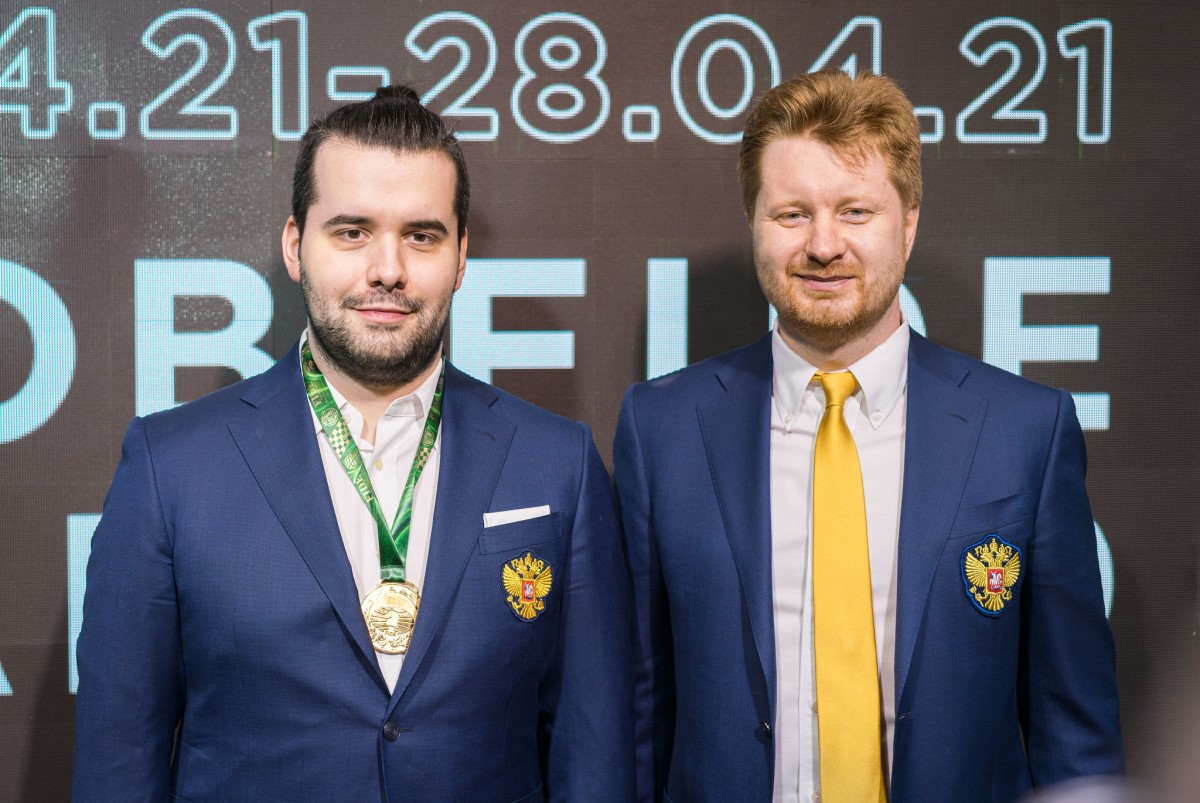
Ian Nepomniachtchi with second Vladimir Potkin during the closing ceremony of the Candidates Tournament | Photo: Lennart Ootes / FIDE
Carlsen himself has also been interviewed, of course, and in one (which, I believe, was a few days before the end of the Candidates — when it was already clear that Nepo was almost certain to win) he made some very revealing remarks. He had played some training games against Nepo at one stage and when the latter was on form the results were very close, maybe even slightly in Nepo’s favour, but when the Russian dropped off Carlsen used to slaughter him “winning seven or eight games in a row”.
World-class players (and indeed all grandmasters) are normally able to maintain a pretty ineffable mask when playing weaker opponents and may even seem not to blunder (or rather seemed not to before the era of the engines). But like everybody else their inner selves are exposed when they come under pressure, and blunders in games between top class players are perfectly normal. Nepo’s variability points to an emotional man inside, and his greatest task during the world championship will perhaps be not to elevate his top level of play — he’s already shown that it’s enough to beat Carlsen fairly often — but to avoid too many days when he’s off colour. During the interview mentioned, David Howell picked this up from Carlsen and put it very well: Nepo needs to “raise his floor”.
If he can do so, or at least only drop into the depths very occasionally, then I think he has a real chance against Carlsen. His last games against the champion were only internet rapidplay and blitz in the Carlsen Invitational, but they showcased his mettle — and in particular his “Karpovian” ability to recover from a worse position and then, even against Carlsen, not be relieved but determined to go on further and try to win. Their overall score also points to this trait in both players. In a battle between two pyrotechnic attacking players you might expect White to have a plus score, but in fact it’s 18-17 to Black with 37 draws.
The Ruy Lopez is one of the oldest openings which continues to enjoy high popularity from club level to the absolute world top. In this video series, American super GM Fabiano Caruana, talking to IM Oliver Reeh, presents a complete repertoire for White.
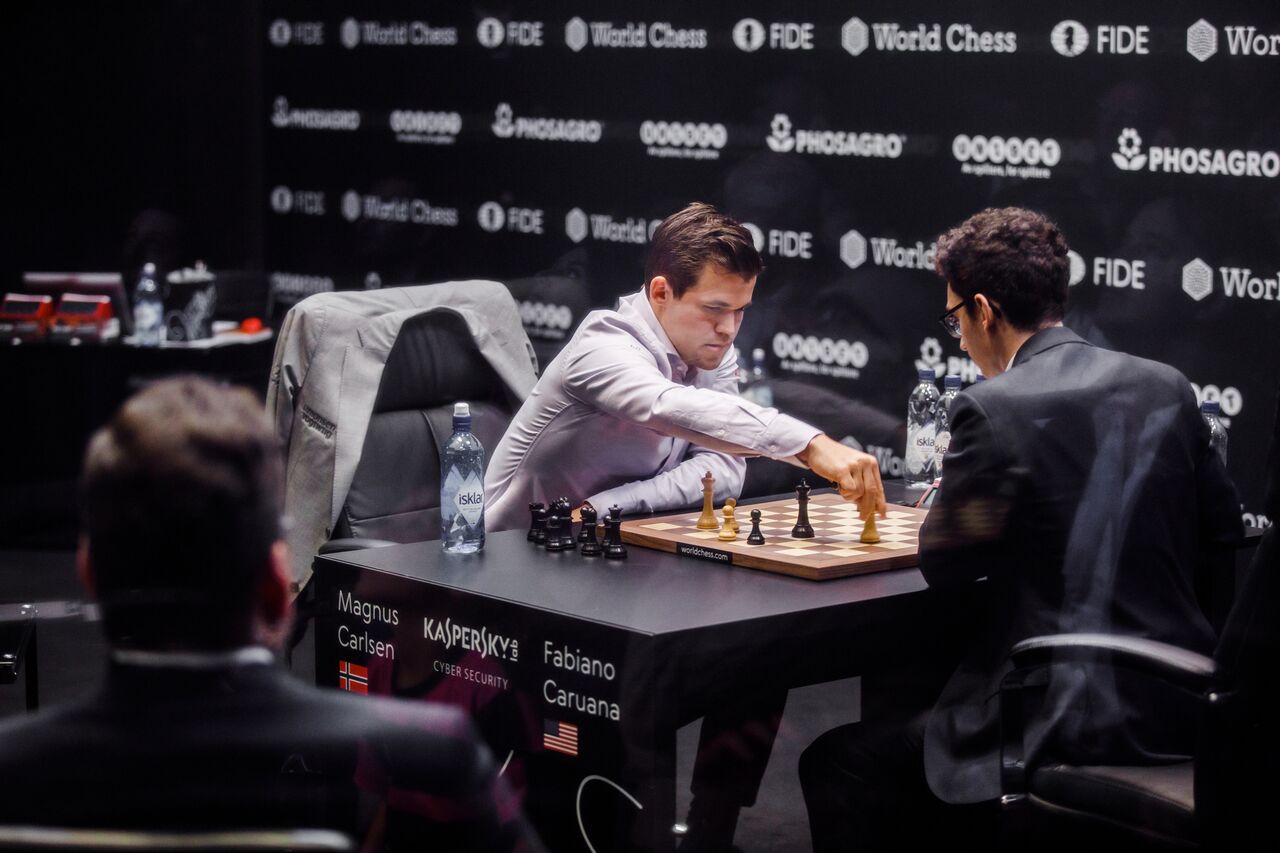
Magnus Carlsen during the rapid tiebreaks of the 2018 World Championship match against Fabiano Caruana | Photo: World Chess
Over the next seven months the two warriors will have to get ready for the showdown, while also maintaining more routine chess life.
The preparation for a world championship is a huge undertaking and Carlsen has a clear advantage in that he’s done it before. But the main question is how they cope with the extreme tension during the match itself. Carlsen is surely the favourite, but not, I think, by that much: no more than 60-40, and perhaps just 55-45.
It was only after I assembled this selection of possibly relevant games that I realized that Black had won every single one! I’ve annotated a couple and put in some lightish notes at the critical moments in the others.
Select an entry from the list to switch between games
Scarcely any world champion has managed to captivate chess lovers to the extent Carlsen has. The enormously talented Norwegian hasn't been systematically trained within the structures of a major chess-playing nation such as Russia, the Ukraine or China.
Jonathan SpeelmanJonathan Speelman, born in 1956, studied mathematics but became a professional chess player in 1977. He was a member of the English Olympic team from 1980–2006 and three times British Champion. He played twice in Candidates Tournaments, reaching the semi-final in 1989. He twice seconded a World Championship challenger: Nigel Short and then Viswanathan Anand against Garry Kasparov in London 1993 and New York 1995.
YOUR PERSONAL CHESS COACH - Whether you’re taking your first steps into the world of club chess, or already playing at a tournament level: with FRITZ, you can train more efficiently, intelligently and with a more personalised approach than ever before.
The Nimzo-Indian has stood the test of time for over a century: Still a top choice for elite players today, from Magnus Carlsen to Praggnanandhaa, it remains one of Black's most reliable ways to fight for real chances against 1.d4 2.c4 3.Nc3.
1.c4 e5 2.Nc3 Bb4!? is an opening idea well worth considering. Black immediately threatens to double the pawns on c3 in the style of the Trompowski or Sicilian Grand Prix attack.
Italian Game Powerbase 2026 is a database and contains 8571 top class games from Mega 2026 and the Correspondence Database 2026, of which 479 are annotated.
Videos: Nico Zwirs discusses the Sicilian with 2…e6 3.d4 cxd4 4.Qxd4 Nc6 5.Qe3 Nf6 6.Nc3. Mihail Marin examines Sindarov’s 6.Ne5 in the Queen’s Pawn Defence. Plus the ‘Lucky bag’ featuring 41 analyses by Berg, Ftacnik, Gupta and many others.
If you're looking for a dynamic alternative to the Slav, Queen's Gambit Declined, or other mainstream systems, the Chigorin Defence offers exactly what modern tournament players need.
€34.90
We use cookies and comparable technologies to provide certain functions, to improve the user experience and to offer interest-oriented content. Depending on their intended use, analysis cookies and marketing cookies may be used in addition to technically required cookies. Here you can make detailed settings or revoke your consent (if necessary partially) with effect for the future. Further information can be found in our data protection declaration.
Pop-up for detailed settings
We use cookies and comparable technologies to provide certain functions, to improve the user experience and to offer interest-oriented content. Depending on their intended use, cookies may be used in addition to technically required cookies, analysis cookies and marketing cookies. You can decide which cookies to use by selecting the appropriate options below. Please note that your selection may affect the functionality of the service. Further information can be found in our privacy policy.
Technically required cookies
Technically required cookies: so that you can navigate and use the basic functions and store preferences.
Analysis Cookies
To help us determine how visitors interact with our website to improve the user experience.
Marketing-Cookies
To help us offer and evaluate relevant content and interesting and appropriate advertisement.