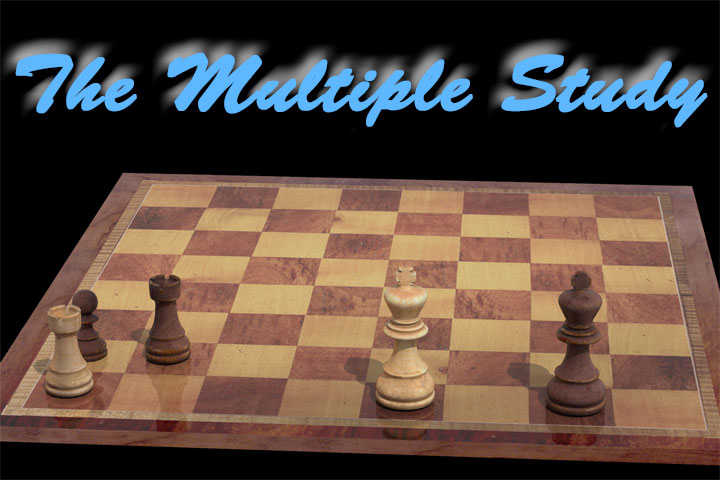
In an ordinary endgame study there is a starting position (a diagram), a stipulation (Win or Draw), unsuccessful tries and a correct solution without duals. For several years the correctness of studies with at most seven pieces can be proved by the tablebases. This is a major step forward for the endgame theory. Which human brain would have thought that two bishops defeat one knight?
Werner Keym published a study in Die Schwalbe 2024, one that was not ordinary: the starting position was missing, and the stipulation was very special. It came in the form of a challenge:
With as few pieces as possible compose a study in which White is winning. This winning position can be shifted and mirrored vertically and horizontally. All vertically shifted and mirrored positions are drawing positions, all horizontally shifted and mirrored positions are losing positions.
This is in some ways similar to one of the most famous challenges in problem chess, the Babson Task. That entails composing a mate in four with four main lines, each consisting of a defensive black promotion to queen, rook, bishop or knight, which forces White to promote to the same piece type in each case. The French problem composer Pierre Drumare spent 22 years of his life unsuccessfully attempting to compose a valid example. Then, in 1983 a 26-year-old soccer and chess trainer from Kazan named Leonid Vladimirovich Yarosh presented the first “Echo-Babson” – after which he published another, and another, with other composers following suit. In fact Werner Keym composed an impeccable Babson himself, one with dual-free main lines:
The key move is 1.g4! After that:
1…d1Q 2.g8Q! Qxd4+ 3.c4 Qxb2 4.Qg6#
1…d1R 2.g8R! Rxd4+ 3.c4 Kxf7 4.Rdf8#
1…d1B 2.g8B! Kg7 3.c4 Kf6 4.d5#
1…d1N 2.g8N+! Kg7 3.f6+ Kh7 4.Bxc2#
You can switch on the chess engine (fan button below the board), and see how it recognises that reciprocal promotions are necessary for each black promotion on move one. All this is described in this article: The Everest of chess problems.
But back to the Werner Keym challenge above. The stipulation is very general, but surprisingly there is only one solution. It is not so difficult to find, when you think about which possible moves can be modified by shifting and mirroring: pawn moves and castling.
The diagram shows the position you are looking for. White wins by 1.0-0-0+ any 2.Kxb2.
If you vertically shift (left) or mirror (right) the position, then it will be a draw.
If you horizontally shift (left) or mirror (right) the position, then it will be a loss. So this study is about several positions – and it was therefore called a ‘multiple study’.
As to the tries the positions with bKd8 or bKh1 are not permitted since they cannot be shifted vertically and horizontally. The position with bKd7 seems to be correct, but the vertically mirrored position (wKe8 Ra8 bKd2 Rb7 a7) is a loss. The position with bKd7 g2, too, seems to be correct, but the horizontally shifted position (wKf1 Rb1 bKe7 Rc2 h2) is a draw.
The tablebases are very useful in almost all cases, but they have a shortcoming: they do not take the castling convention into account. This states that in chess problems castling is permitted unless it can be proved that it is not permissible. According to the tablebases the starting position (wKe1/bKg1) is a loss. In this case, however, the human brain knows better!
About the author
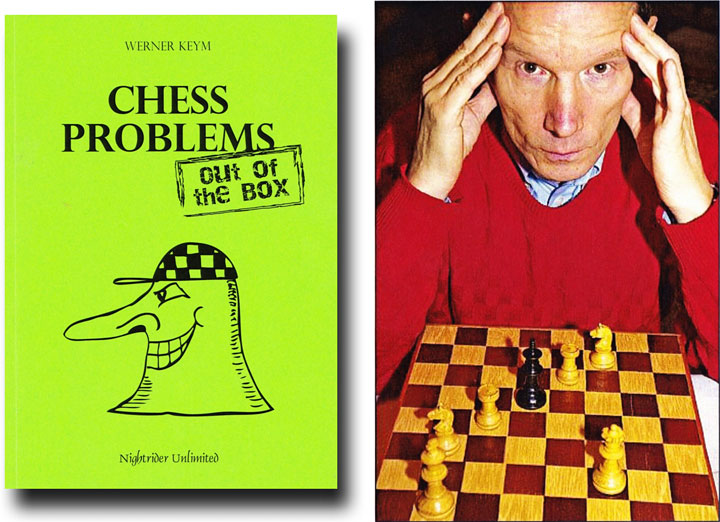 Octogenarian puzzle master -Werner Keym is a teacher (of French and Latin) and a musician who has organised more than 400 concerts in his town. In 2010, he ran for Mayor of Meisenheim and won in a landslide. Now in retirement he devotes his time to the family — he has six grandchildren — and to his hobbies. The foremost of them is problem chess, where he is the is one of the most creative problemists we know. He specializes in puzzles involving castling, en passant captures and pawn promotion. Here are articles by or about Werner Keym.
You can get free access to Werner's eBook Problem Chess Art (link at the bottom of the article). It is the first problem chess book in which the solutions can be replayed interactively.