4/14/2013 – We are sad to inform you that grandmaster Robert Byrne has died, just days before his 85th birthday, after a long battle with Parkinson's Disease. Byrne beat Bobby Fischer in the 1965 US Championship, which he himself won in 1972. He worked as a university professor, author and long-time New York Times chess columnist. Our eulogy includes video commentary in a
tribute by Andrew Martin.
new: Fritz 20
Your personal chess trainer. Your toughest opponent. Your strongest ally. FRITZ 20 is more than just a chess engine – it is a training revolution for ambitious players and professionals. Whether you are taking your first steps into the world of serious chess training, or already playing at tournament level, FRITZ 20 will help you train more efficiently, intelligently and individually than ever before.
YOUR PERSONAL CHESS COACH - Whether you’re taking your first steps into the world of club chess, or already playing at a tournament level: with FRITZ, you can train more efficiently, intelligently and with a more personalised approach than ever before. FRITZ is more than just a chess engine – it’s a training revolution! Whether you’re taking your first steps into the world of club chess, or already playing at a tournament level: with FRITZ, you can train more efficiently, intelligently and with a more personalised approach than ever before.
This is a full repertoire after 1.e4 e5 2.Nf3 focussing on the Evans Gambit as the main weapon.
€59.90
GM Robert Byrne, April 20, 1928 – April 12, 2013
Robert Eugene Byrne was born on April 20, 1928, was a grandmaster, author
and long-time New York Times chess columnist from 1972 to 2006.
He won the US Chess Champion in 1972 and represented the United States nine
times in Chess Olympiads from 1952 to 1976, winning seven medals. He was
a World Chess Championship Candidate in 1974. Byrne worked as a university
professor for many years, before becoming a chess professional in the early
1970s.
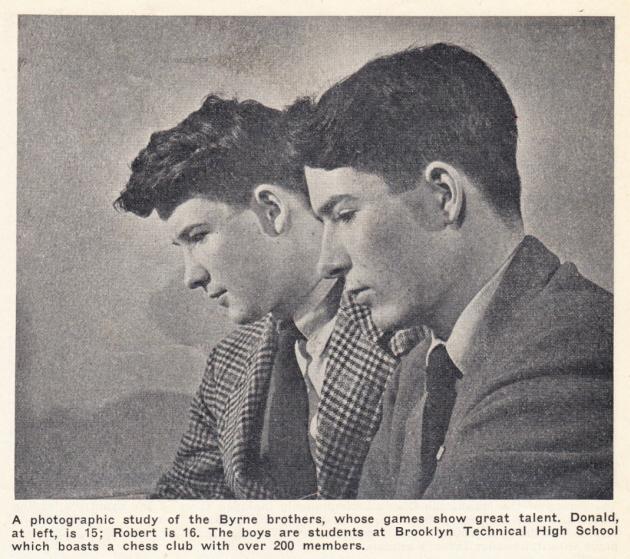
Robert Byrne and his younger brother Donald grew up in New York City and
were among the "Collins Kids", promising young players who benefited
from the instruction and encouragement of John W. Collins. Both ultimately
became college professors and among the leading chess players in the country.
They were part of a talented new generation of young American masters, which
also included Larry Evans, Arthur Bisguier, and George Kramer.
In Chess
Notes 8033 historian Edward Winter published the above picture
of the Byrne brothers. It is a scan of an early photograph published on
page 5 of the February 1945 Chess Review. There are other pictures and documents
to be found in Mr Winter's eulogy.
Byrne became an International Master based on his results at the 1952 Chess
Olympiad at Helsinki (bronze medal on third board). In that same year he
graduated from Yale University. He went on to become a professor of philosophy
at Indiana University, and his academic career left him little time for
chess. He did represent the U.S. in team matches against the Soviet Union
at New York 1954 (losing 1.5–2.5 to Alexander Kotov), and Moscow 1955
(losing 0.5–3.5 to Paul Keres). In 1965 Byrne defeated Bobby Fischer
in the US Chess Championship (Fischer of course went on to win the championship).
Finally, in 1972, Byrne earned the championship himself, tying with two
other players, Samuel Reshevsky and Lubomir Kavalek, and then winning a
playoff. Lubos Kavalek will be writing a separate eulogy on Monday.
Robert Byrne died on April 12, 2013 at 84 years old after a long battle
with Parkinson's. A memorial service will be on Sat., April 20, at 1 PM
at Dorsey Funeral Home, 15 M Wilton Place, Ossining, NY 10562. Attendees
are welcome. RSVP to ursula1732@aol.com. You can also send a message to
be read aloud.
A humble tribute to a very memorable grandmaster and gentleman
Our Icelandic friend Einar S. Einarsson sent us some photos of GM Robert
Byrne, who participated in five Reykjavik tournaments between 1968 and 1986,
apart from covering the Fischer vs. Spassky Match in 1972. "He will
always be remembered for his most decourous and academic attitude and fine
play," writes Einarsson. "The chess world has lost a lot."
Here are the pictures:
Robert Byrne covering the 1972 Spassky-Fischer
match for the New York Times
At the Eleventh Reykjavik International in
1984
At the 22nd Chess Olympiad in Haifa, 1976
Andrew Martin: a tribute to Robert Byrne 1928-2013
YOUR PERSONAL CHESS COACH - Whether you’re taking your first steps into the world of club chess, or already playing at a tournament level: with FRITZ, you can train more efficiently, intelligently and with a more personalised approach than ever before.
2026 Chess Olympiad with analyses by Abdusattorov, Donchenko, Duda, So and many more – ‘Rooks love open files’: Tactics training with Oliver Reeh – ‘Don’t underestimate it’: Caruana’s blitz weapon 1.e4 e5 2.d3 – Total Video playing time: over 6 hours!
Most players don’t lack the urge to attack, they just strike at the wrong moment, and GM Sipke Ernst shows you which signals tell you to go for the king and which tell you to choose another plan.
How grandmasters win without fireworks: GM Jan Markos shows you 11 very practical tips from "How to play in a lost position" to "Be patient like Carlsen" that will improve your tournament chess.
The Nimzo-Indian has stood the test of time for over a century: Still a top choice for elite players today, from Magnus Carlsen to Praggnanandhaa, it remains one of Black's most reliable ways to fight for real chances against 1.d4 2.c4 3.Nc3.
Italian Game Powerbase 2026 is a database and contains 8571 top class games from Mega 2026 and the Correspondence Database 2026, of which 479 are annotated.
1.c4 e5 2.Nc3 Bb4!? is an opening idea well worth considering. Black immediately threatens to double the pawns on c3 in the style of the Trompowski or Sicilian Grand Prix attack.
€9.90
We use cookies and comparable technologies to provide certain functions, to improve the user experience and to offer interest-oriented content. Depending on their intended use, analysis cookies and marketing cookies may be used in addition to technically required cookies. Here you can make detailed settings or revoke your consent (if necessary partially) with effect for the future. Further information can be found in our data protection declaration.
Pop-up for detailed settings
We use cookies and comparable technologies to provide certain functions, to improve the user experience and to offer interest-oriented content. Depending on their intended use, cookies may be used in addition to technically required cookies, analysis cookies and marketing cookies. You can decide which cookies to use by selecting the appropriate options below. Please note that your selection may affect the functionality of the service. Further information can be found in our privacy policy.
Technically required cookies
Technically required cookies: so that you can navigate and use the basic functions and store preferences.
Analysis Cookies
To help us determine how visitors interact with our website to improve the user experience.
Marketing-Cookies
To help us offer and evaluate relevant content and interesting and appropriate advertisement.