1. Author and series
Grandmaster Jan Werle is a professional chess trainer and author. For years, he has produced various contributions to opening theory, and in his latest publication he turns his attention to the Advance Variation of the French Defence.
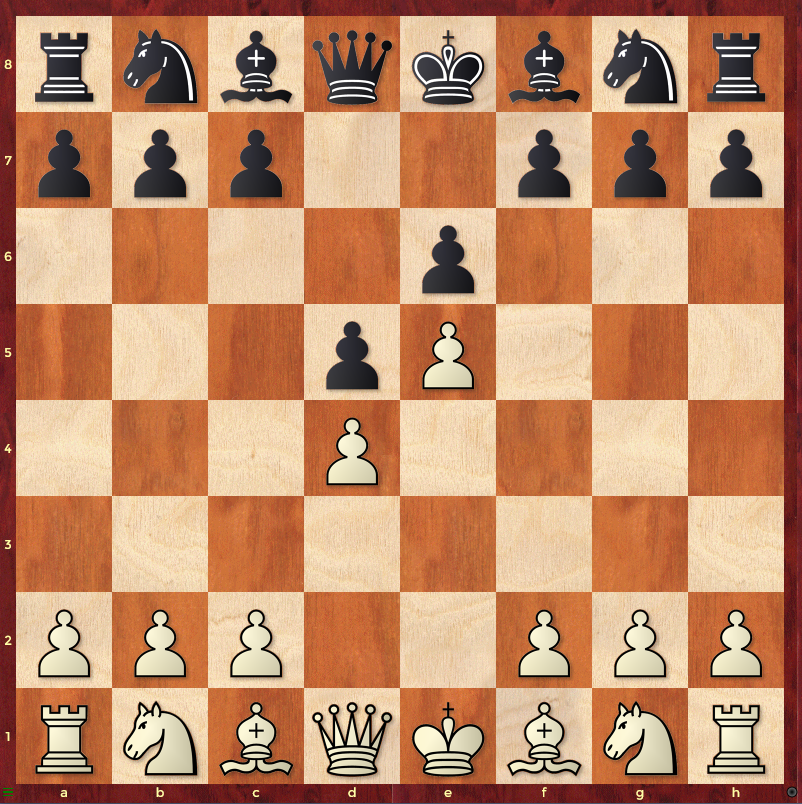
1.e4 e6 2.d4 d5 3.e5
His course "Mastering the French Advance Main Line: 3.e5 c5 4.c3 Nc6 5.Nf3" was published in the established "60 minutes" product series, in which concepts or opening ideas are presented within more or less an hour. Due to the format, authors are typically obliged to make some concessions regarding the scope of the content. The following review examines what is included in Jan Werle's new course and for whom it is a worthwhile purchase.
2. Structure and didactic approach
 In this course, Dutch Grandmaster Jan Werle presents a modern and practical repertoire in the French Advance Variation, focusing on the critical line 1.e4 e6 2.d4 d5 3.e5 c5 4.c3 Nc6 5.Nf3.
In this course, Dutch Grandmaster Jan Werle presents a modern and practical repertoire in the French Advance Variation, focusing on the critical line 1.e4 e6 2.d4 d5 3.e5 c5 4.c3 Nc6 5.Nf3. From this key position, Werle tackles Black’s two most popular and ambitious responses: 5…Bd7 and 5…Qb6. You will learn how to handle Black’s pressure against the centre, especially ideas targeting d4 and e5, and how to exploit typical structural weaknesses. The course goes far beyond theory. Werle explains strategic concepts, attacking plans, and concrete tactical motifs, including powerful knight manoeuvres (Na3–b5, Nc2–d4), dynamic pawn breaks, rook lifts, and kingside attacking schemes. Special attention is given to modern developments and practical improvements in sharp positions. The result is a clear, aggressive, and well-structured system that gives White long-term pressure and dangerous attacking chances - ideal for ambitious tournament players looking for a reliable weapon against the French Defence.
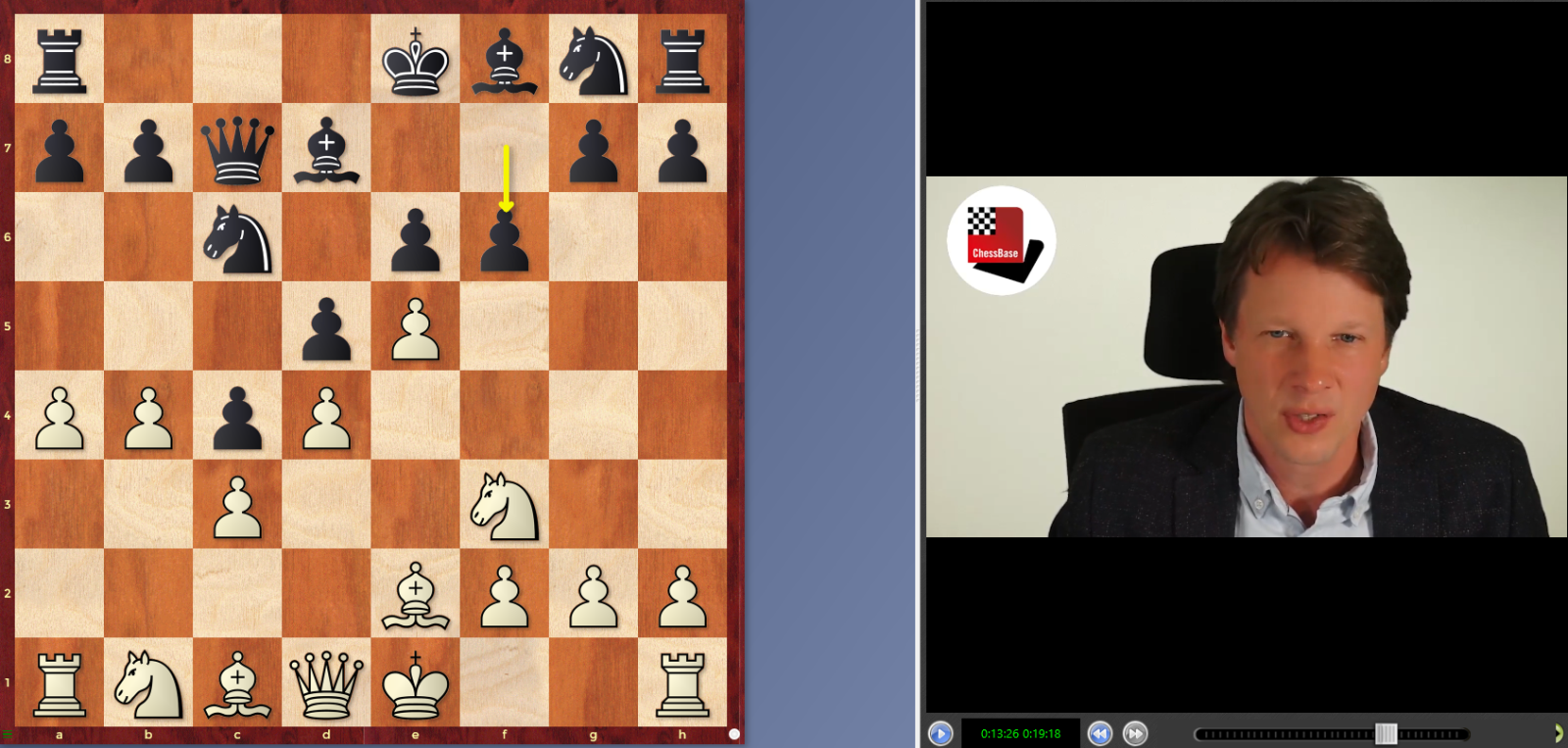
Free video sample: 5...Qb6 6.a3 Part 2: Sidelines, Tactics and Endgame Edges
At its core, the course provides an opening recommendation for White and is accordingly divided into the common lines available to Black. Here is a brief excursus on the first moves, in order to place the various lines and the course structure in context.
1.e4 e6 2.d4 d5 3.e5
Starting from the basic position of the Advance Variation, the counterattack against the pawn chain d4-e5 is a core strategy for Black. To this end, Black typically has attacks against the spearhead of the chain, the e5-pawn, and against its base, the d4-pawn, at his disposal. This is necessary before White can fully consolidate and maintain the space advantage with harmonious development.
Following the natural development of Black's minor pieces, Black begins here with the direct attack against the base of the pawn chain with
3...c5 4.c3
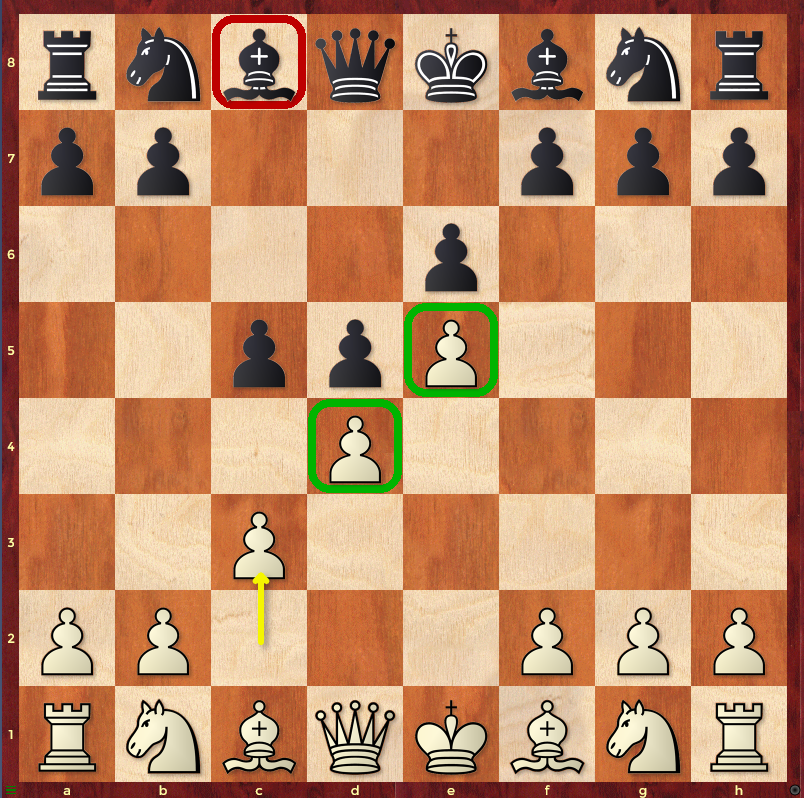
White supports the pawn on d4 so that, in the event of an exchange with ...cxd4, he can recapture with the c-pawn. In this way, White would maintain a pawn on d4, which supports the spearhead of the white pawn chain, the pawn on e5.
Black now has various plans available. In principle, Black has two opening problems to solve:
- lack of space
- bad bishop on c8
The lack of space is caused by White's central pawns on d4 and e5, which also explains the plan against these pawns with the setup ...c5, ...Nc6, ...Qb6 and later ...Nge7-f5 or later ...f6. If Black can break or dissolve the pawn chain, White's space advantage will generally disappear as well. This has been the main line for years, and Werle intends to meet it with White's classical main line, 6.a3.
In order to solve the second opening problem, the French bishop - strategically also referred to as the "bad bishop" - Black can also play the plan with ...Qb6 and ...Bd7, either to exchange the bishop with ...Bd7-b5 or to activate it by bringing it outside the pawn chain.
Thus, based on the opening-strategic ideas for Black described above, the following chapter structure can be derived:
Chapter 1 – 5...Bd7 6.Be2
a) 6...Nge7
b) 6...f6
c) 6...Bb5
Chapter 2 – 5...Qb6 6.a3 c4 – main line
Chapter 3 – 5...Qb6 6.a3 – sidelines on move 6
It should be particularly emphasised that, in his explanations within the chapters, Werle consistently supports concrete analyses with structural explanations instead of relying on variation trees, thereby enabling a strategic understanding of this pawn structure:
- typical pawn structures based on d4-e5 and e6-d5
- thematic pawn breaks (...f6, ...c5-cxd4)
- long-term middlegame manoeuvres
 Beat the King’s Indian and Benoni structures with the impenetrable pawn phalanx g2-f3-e4-d5. Encounter your opponent with sound and fresh ideas in this classical rebooted line of the Saemisch!
In doing so, the author follows the current trend of increasingly presenting opening theory in the context of strategic ideas.
3. Choice of variations: extensive and highly up to date
What stands out in an extremely positive way is the scope of the accompanying database. While other works usually limit themselves to the author's own recommendation and subdivide it according to the opponent's sidelines and main lines, Jan Werle takes a quite different approach.
Alongside his main recommendation, he provides numerous options for White - some of them analysed in depth. As a result, the course does not offer a narrow path to be followed according to the author's recommendation. Rather, it provides an entire opening overview that will form an essential basis for further opening work.
Especially because of the enormous scope of this overview, the course is aimed at a target group beyond the ordinary club player, since many ideas, from White's perspective, have not yet been covered in the standard opening literature.
4. Additional material
The course does not include separate additional material such as practice positions or a repertoire trainer, but the individual databases are analysed in such depth that they can be dissected independently according to tactical, strategic and positional elements and prepared for one's own training. The content therefore also offers trainers many ideas for independent lessons on middlegame treatment in this line.
5. Target audience
Given the scope of the individual databases, experienced tournament players can certainly be regarded as the target audience. However, thanks to the extensive explanations and the presentation of fundamental tactical and positional elements, the author also makes an effort to bring the line closer to beginners and club players. For this, however, some additional independent work - or work by a trainer - is still needed in order to prepare the information properly.
6. Conclusion
A valuable contribution in which the player or trainer receives a great deal for their money. The analyses are convincing and provide a foundation for one's own opening work. For a fully comprehensive repertoire, one will need to fill one or two gaps independently, due to the 60-minute format. Nevertheless, the critical lines are covered and can already be used in one’s own practice after a brief study.
Overall rating: ★★★★★ 5/5
Positive:
✔ Very extensive content despite belonging to a short-format series
✔ Logical structure of the material
✔ Highly up-to-date opening-theoretical overview
✔ Very extensive explanations
✔ Numerous tactical, positional and strategic motifs within the analyses
Negative:
– Some content needs to be filtered out from the analyses independently
In this course, Dutch Grandmaster Jan Werle presents a modern and practical repertoire in the French Advance Variation, focusing on the critical line 1.e4 e6 2.d4 d5 3.e5 c5 4.c3 Nc6 5.Nf3.
In this course, Dutch Grandmaster Jan Werle presents a modern and practical repertoire in the French Advance Variation, focusing on the critical line 1.e4 e6 2.d4 d5 3.e5 c5 4.c3 Nc6 5.Nf3. From this key position, Werle tackles Black’s two most popular and ambitious responses: 5…Bd7 and 5…Qb6. You will learn how to handle Black’s pressure against the centre, especially ideas targeting d4 and e5, and how to exploit typical structural weaknesses. The course goes far beyond theory. Werle explains strategic concepts, attacking plans, and concrete tactical motifs, including powerful knight manoeuvres (Na3–b5, Nc2–d4), dynamic pawn breaks, rook lifts, and kingside attacking schemes. Special attention is given to modern developments and practical improvements in sharp positions. The result is a clear, aggressive, and well-structured system that gives White long-term pressure and dangerous attacking chances - ideal for ambitious tournament players looking for a reliable weapon against the French Defence.
Free video sample: 5...Qb6 6.a3 Part 2: Sidelines, Tactics and Endgame Edges
About the author
 GM Jan Werle is a professional chess trainer and chess author. In 2008, he became European champion in Liverpool, where he also reached his highest Elo rating of 2607. He then completed his law studies with two master’s degrees in civil and commercial law and began working at a law firm. His passion, however, remained chess. He gives online training and also teaches in schools. He combines chess training with playing tournaments in order to maintain his own level.
More products by the author are available in the ChessBase Shop




.jpeg)