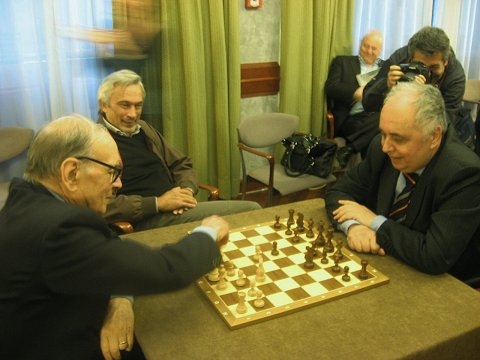
7/6/2020 – Initially, Ennio Morricone wanted to become a chess professional. But then he realized that his musical talent was much greater than his talent for chess and he became a composer, whose music added a special touch to many famous films. But Morricone was always passionate about chess. On July 6, 2020, he died in Rome at the age of 91. | Photo: Comune Turin
new: ChessBase Magazine 225
Chess Festival Prague 2025 with analyses by Aravindh, Giri, Gurel, Navara and others. ‘Special’: 27 highly entertaining miniatures. Opening videos by Werle, King and Ris. 10 opening articles with new repertoire ideas and much more. ChessBase Magazine offers first-class training material for club players and professionals! World-class players analyse their brilliant games and explain the ideas behind the moves. Opening specialists present the latest trends in opening theory and exciting ideas for your repertoire. Master trainers in tactics, strategy and endgames show you the tricks and techniques you need to be a successful tournament player! Available as a direct download (incl. booklet as pdf file) or booklet with download key by post. Included in delivery: ChessBase Magazine #225 as “ChessBase Book” for iPad, tablet, Mac etc.!
YOUR PERSONAL CHESS COACH - Whether you’re taking your first steps into the world of club chess, or already playing at a tournament level: with FRITZ, you can train more efficiently, intelligently and with a more personalised approach than ever before. FRITZ is more than just a chess engine – it’s a training revolution! Whether you’re taking your first steps into the world of club chess, or already playing at a tournament level: with FRITZ, you can train more efficiently, intelligently and with a more personalised approach than ever before.
In this video course, Grandmaster Ivan Sokolov explores the fascinating world of Dutch and Grünfelkd structures with colours reversed.
€39.90
Ennio Morricone
In "Ennio Morricone Plays Chess", an interview from 2019 with the Paris Review, Morricone spoke at length about his passion:
"Well, I would say that chess is the best game precisely because it’s not a mere game. Everything is put at stake—the rules of morality, of life, the wariness and the determination to fight without bloodshed, the resolution to win and do so correctly—with talent, rather than sheer luck. In fact, when you hold these tiny wooden statuettes in your hands, they become powerful as they absorb the energy you are willing to transfer to them. In chess, there is life and there are struggles, too. It’s the most violent sport one could think of, it can be compared to boxing, although it is much more chivalrous and sophisticated."
When he was eleven years old Morricone learned to play chess but at the age of 18 he gave up his efforts to become a professional chess player. Instead, he studied choral music and trumpet at the Santa Cecilia Conservatory where he graduated in 1946. He then worked as a theatre composer and for a radio station. Further training followed at the Conservatory, which Morricone successfully completed in 1953 with a diploma in composition.
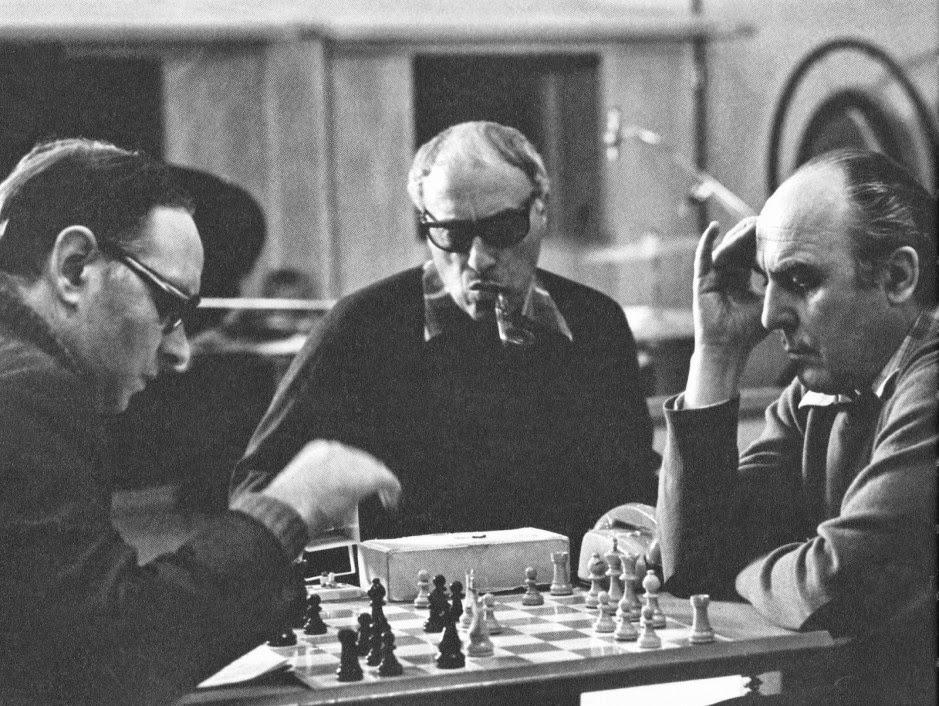
Ennio Morricone, Franco Evangelisti and Egisto Macchi (1959)
In 1961 Morricone composed his first film scores and in 1964 he was approached by director Sergio Leone, a former classmate, to write the music for Sergio Leone's western "A Fistful of Dollars".
Morricone's music for Leone's westerns became famous and very influential. In the course of his career Morricone created the music for more than 500 films, and his compositions for films such as "A Fistful of Dollars", "For a Few Dollars More", "The Good, the Bad, and the Ugly" or "Once Upon a Time in the West", have long been absolute classics of film music.
Morricone has been nominated more than once for the Oscar, and in 2007 he received it for his life's work. Clint Eastwood, who played the main role in some of the films that made Morricone famous, presented the trophy to the composer.
Masterpieces by Morricone
With his western "The Hateful Eight" director Quentin Tarantino revived the genre and he asked Morricone to compose the music.
"I must confess that, when I was composing the music for Tarantino’s latest movie, The Hateful Eight, as I went through the script, I recognized the tension that silently grows among the characters, and I thought of that like the feelings one develops over the course of a chess game. Unlike what happens in Tarantino’s films, neither bloodshed nor physical harm is part of this sport. Still, there is nothing aloof about chess. Quite the opposite, this game is dominated by a spasmodic and silent tension. Some even say that chess is silent music, and playing is a bit like composing for me", Morricone revealed in his interview with The Paris Review.
For "The Hateful Eight" Morricone received his second Oscar but over the years the composer has received countless awards for his music.
During his long career as a composer and conductor, Ennio Morricone has always cultivated his love of chess. Morricone followed the national and international tournament scene with the help of chess magazines, gladly accepted invitations to simultaneous performances and occasionally played in tournaments. He even took chess training, among others from IM Stefano Tatai. Morricone reached a playing strength of about 1800. "If I had trained more consistently, I would certainly have become better than Kasparov," he once said with a wink in an interview.
Morricone was particularly proud of a draw he once played in a simul against Boris Spassky. Two of Morricone's games, one against GM Sergio Mariotti and one against GM Judit Polgar, have been preserved.
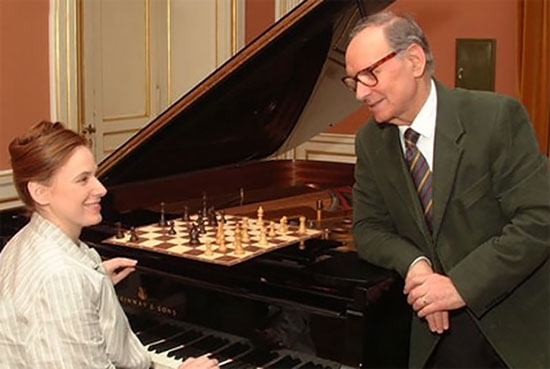
The game against Judit Polgar was played in 2004, when Polgar was in Rome as her country's ambassador on the occasion of Hungary's entry to the EU. Judit Polgar is an avid lover of Morricone's music and was delighted to meet the star composer.
Judit Polgar and Ennio Morricone
Morricone regularly attended tournaments in Italy as a prominent chess lover and guest of honour and he composed the "Inno degli scacchisti", the "Chess Players’ Anthem" for the Chess Olympiad in Turin in 2006.
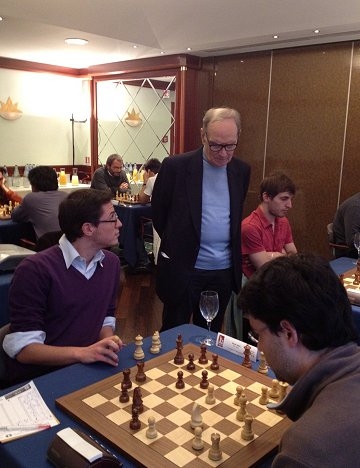
A prominent spectator
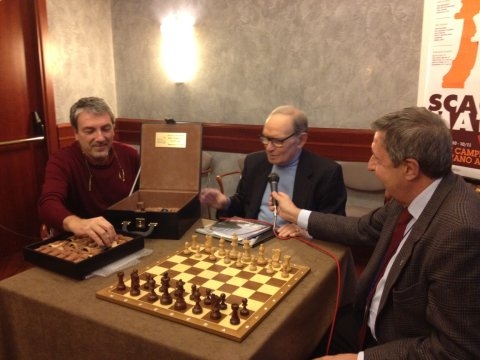
Morricone is interviewed by Adolivio Capece. Left: Michele Cordara, Presidente de Società Scacchistica Torinese
Ennio Morricone plays against Mario Fabbri, a master from Turin
Ennio Morricone died on 6 July 2020 in a hospital in Rome as a result of a fracture of the neck of his femur which he had suffered a few days earlier in a fall.
YOUR PERSONAL CHESS COACH - Whether you’re taking your first steps into the world of club chess, or already playing at a tournament level: with FRITZ, you can train more efficiently, intelligently and with a more personalised approach than ever before.
Michael Kotyk presents a complete repertoire after 1.e4 e5, built around creative ideas, surprising move orders, and practical weapons designed to catch your opponents off guard.
YOUR PERSONAL CHESS COACH - Whether you’re taking your first steps into the world of club chess, or already playing at a tournament level: with FRITZ, you can train more efficiently, intelligently and with a more personalised approach than ever before.
Michael Kotyk presents a complete repertoire after 1.e4 e5, built around creative ideas, surprising move orders, and practical weapons designed to catch your opponents off guard.
Michael Kotyk presents a complete repertoire after 1.e4 e5, built around creative ideas, surprising move orders, and practical weapons designed to catch your opponents off guard.
“Attack with Qh5!!” – Tactical training with Oliver Reeh, “6…g5 – nothing ventured, nothing …” – Le Quang Liem comments on one of his victories in Biel, “Grischuk’s stroke of genius” – Petra Papp reveals a surprise in the Sicilian Kan Variation, and much
YOUR PERSONAL CHESS COACH - Whether you’re taking your first steps into the world of club chess, or already playing at a tournament level: with FRITZ, you can train more efficiently, intelligently and with a more personalised approach than ever before.
While tactics decide the game in concrete moments, strategy guides the entire battle. Understanding how to improve your pieces, create weaknesses, execute maneuvers, and steer the game toward favorable structures is what defines strong players.
€39.90
We use cookies and comparable technologies to provide certain functions, to improve the user experience and to offer interest-oriented content. Depending on their intended use, analysis cookies and marketing cookies may be used in addition to technically required cookies. Here you can make detailed settings or revoke your consent (if necessary partially) with effect for the future. Further information can be found in our data protection declaration.
Pop-up for detailed settings
We use cookies and comparable technologies to provide certain functions, to improve the user experience and to offer interest-oriented content. Depending on their intended use, cookies may be used in addition to technically required cookies, analysis cookies and marketing cookies. You can decide which cookies to use by selecting the appropriate options below. Please note that your selection may affect the functionality of the service. Further information can be found in our privacy policy.
Technically required cookies
Technically required cookies: so that you can navigate and use the basic functions and store preferences.
Analysis Cookies
To help us determine how visitors interact with our website to improve the user experience.
Marketing-Cookies
To help us offer and evaluate relevant content and interesting and appropriate advertisement.