Christian Hesse suggested that I take this theme a step further by complementing it with stories and experiences from the intensely human world of chess.
 In doing so, I naturally think of the book Chess Stories, which he wrote together with Frederic Friedel, where mathematical puzzles and chess curiosities are woven together with fascinating encounters with some of the great masters of the game. Garry Kasparov writes in his foreword:
“Chess Stories shows just how profoundly human the world of chess is. It reveals the passion and beauty that chess offers everyone, from amateur to world champion.”
And indeed, amateurs and world champions alike are often left in awe by the beauty of a combination, a problem, or a study. Such beauty may emerge from the intense concentration of a tournament game played against the clock; from the painstaking yet wonderfully creative ingenuity of a celebrated problem composer such as Werner Keym; or from the seemingly inexhaustible imagination of Jan Timman, world-class grandmaster and gifted composer of studies.
I shall never forget one evening in Nordhorn, on the eve of a rapid tournament, when Timman showed Viktor Kortschnoi and me some of his studies. He took mischievous delight in watching us sit there, speechless, in front of them, only to reward us at the end with his explanations. Even those required remarkably few words: the meaning unfolded almost entirely through the mysterious moves and interactions of the pieces on that strictly circumscribed universe of sixty-four squares.
 In this video course, experts (Pelletier, Marin, Müller and Reeh) examine the games of Viktor Korchnoi. Let them show you which openings Korchnoi chose to play, where his strength in middlegames were, or how he outplayed his opponents in the endgame.
A microcosm that reaches far beyond itself. For some people, such an experience may even become a kind of revelation — an awakening that draws them into the wonderland of chess.
Often, this apparently rigorous and logical game — “the only game that belongs to all peoples and all ages, and of which nobody knows which god brought it to earth,” as Stefan Zweig put it — reveals its meaning in much the same way as so many other forms of human experience, and not the least through art: on a level beyond words, inaccessible to our everyday habits of thought, yet capable of touching something deeper within us
Friedrich Schiller, for whom chess became a great source of consolation toward the end of his life, once wrote: “Man is only completely human when he plays.
And it is said that the Swiss writer Max Frisch valued chess precisely because one need not speak while playing it.
Many chess players know from experience the healing and health-giving power of the game. At the Menninger Clinic in the United States, for example, chess was used with young people who had great difficulty relating to others. Through the harmless and reassuring medium of chess, they were encouraged to reach out to other people again.
In this “silent” game, a connection can arise — close enough to make contact possible, yet not so close as to be threatening, because the chessboard creates a natural space between the players. And yet they are not so far apart that no connection can be made at all.
In this spirit, may chess continue to work its often beneficial magic.
About the author
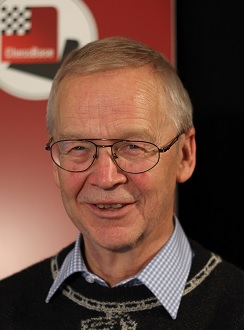 Helmut Pfleger (born 6 August 1943) is a German chess grandmaster, physician, author, and prominent chess commentator who has significantly influenced chess promotion and broadcasting in Germany. He pursued medical studies in Munich while rising to become one of West Germany's strongest players during the 1960s and 1970s. Helmut represented West Germany in seven Chess Olympiads, between 1964 and 1982, contributing to a team bronze medal at the 1964 Tel Aviv Olympiad where he won an individual gold medal on board four with a score of 12.5/15.
From 1977 to 2005, Pfleger gained widespread popularity as a chess commentator on German television, often co-hosting with grandmasters like Vlastimil Hort and making the game accessible to a broad audience. He authored numerous chess books, and wrote entertaining columns for major newspapers such as Die Zeit and Welt am Sonntag. He has also recorded a number of ChessBase DVDs.
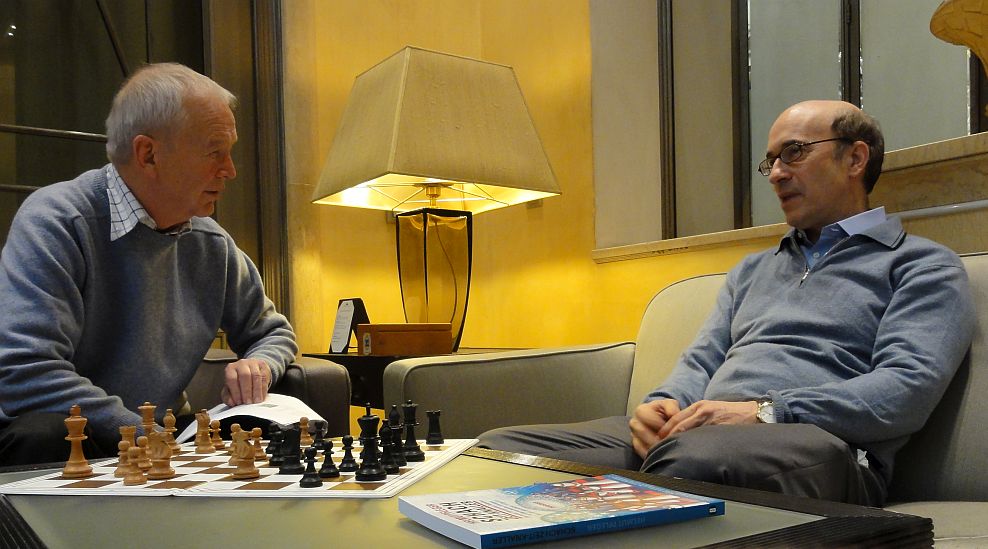
Discussion with Harvard economist and chess grandmaster Ken Rogoff, Chief Economist of the International Monetary Fund, who held a lecture on "The Curse of Cash" in Munich 2016.
Balancing his chess career with medicine, Helmut specialized in internal medicine and psychotherapy, conducting research on physiological and psychological aspects of chess, including blood pressure measurements and eye movement tracking during play.
Smyslov cultivated a clear positional style and even in sharp tactical positions often relied more on his intuition than on concrete calculation of variations. Let our authors introduce you into the world of Vasily Smyslov.




.jpeg)














.jpeg)