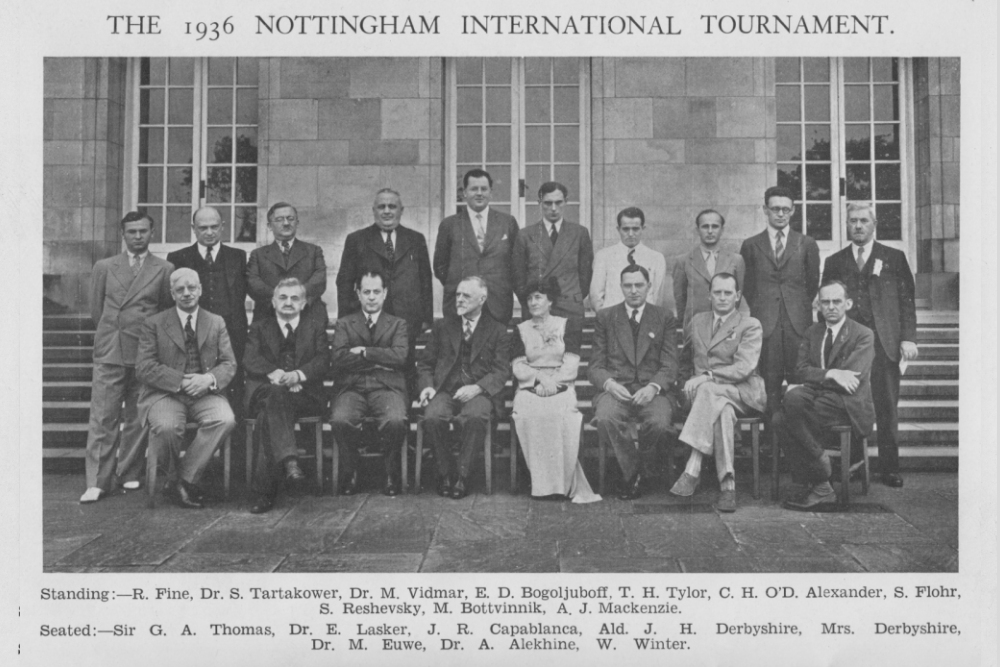
8/29/2026 – The Nottingham 1936 tournament, played almost exactly 90 years ago, is regarded as one of the greatest tournaments in chess history. Five world champions took part. With many young players in the field, a changing of the guard was already beginning to take shape. And for the first time since their 1927 World Championship match, Alexander Alekhine and José Raúl Capablanca faced each other again. Alongside the games and a number of photographs, film footage from the event has also survived as a valuable historical record.
new: ChessBase Magazine 225
Chess Festival Prague 2025 with analyses by Aravindh, Giri, Gurel, Navara and others. ‘Special’: 27 highly entertaining miniatures. Opening videos by Werle, King and Ris. 10 opening articles with new repertoire ideas and much more. ChessBase Magazine offers first-class training material for club players and professionals! World-class players analyse their brilliant games and explain the ideas behind the moves. Opening specialists present the latest trends in opening theory and exciting ideas for your repertoire. Master trainers in tactics, strategy and endgames show you the tricks and techniques you need to be a successful tournament player! Available as a direct download (incl. booklet as pdf file) or booklet with download key by post. Included in delivery: ChessBase Magazine #225 as “ChessBase Book” for iPad, tablet, Mac etc.!
YOUR PERSONAL CHESS COACH - Whether you’re taking your first steps into the world of club chess, or already playing at a tournament level: with FRITZ, you can train more efficiently, intelligently and with a more personalised approach than ever before. FRITZ is more than just a chess engine – it’s a training revolution! Whether you’re taking your first steps into the world of club chess, or already playing at a tournament level: with FRITZ, you can train more efficiently, intelligently and with a more personalised approach than ever before.
In this volume, we dive into core aspects of chess technique. Smyslov taught the principle of tactical hierarchy, “checks, double attacks, and unprotected pieces”, and Mikhalchishin demonstrates how this method of calculation is vital.
€34.90
Five world champions in the mix
The 1936 Nottingham Tournament was a very special event in several respects. For that reason, it ranks highly in the history of great chess tournaments. The 15-player field included five world champions, either former or future. In addition, Alexander Alekhine, who had temporarily lost his world title the previous year, and his predecessor José Raúl Capablanca played in the same tournament for the first time since their 1927 World Championship match. Nottingham was also Emanuel Lasker's final appearance on the international tournament stage. Leading players of the older generation, such as Lasker, Alekhine, Capablanca, Tartakower and Vidmar, faced rising stars including Fine, Flohr, Reshevsky and Botvinnik. A generational change was beginning to take shape.
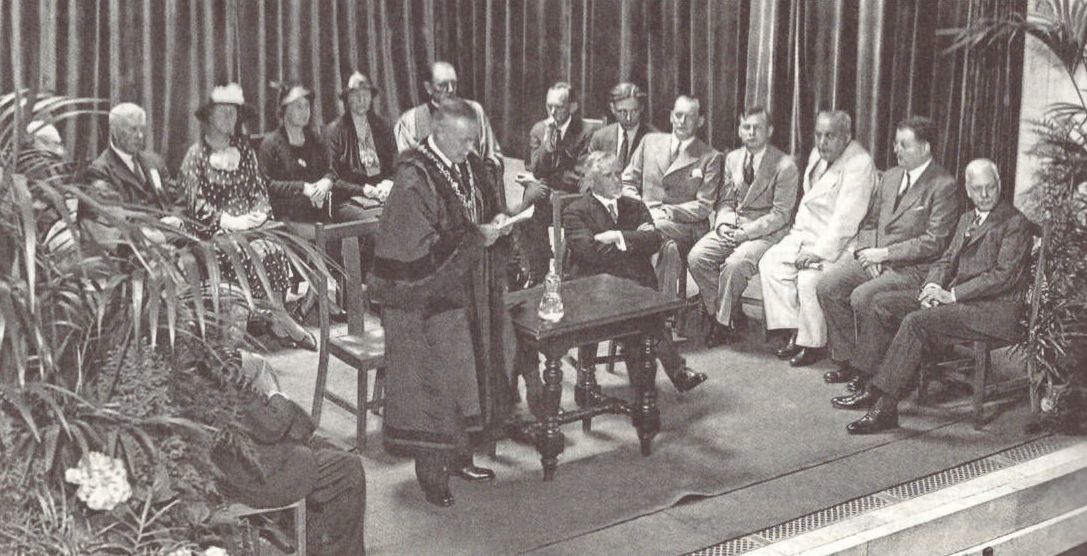
The opening ceremony conducted by the Sheriff of Nottingham, Councillor Frederick Mitchell | Source: Emanuel Lasker, Vol. 1 Struggle and Victories / L. Schmid Collection
Smoking allowed
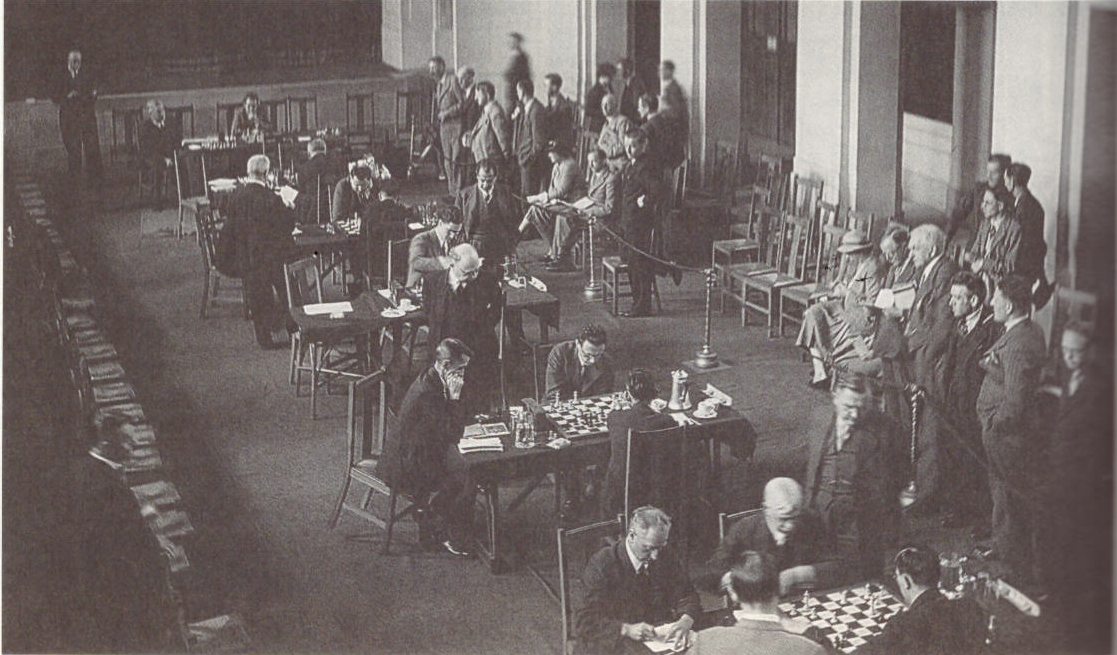
The tournament was held from 10 to 28 August 1936 at the University of Nottingham. At first, play took place in a room by the terrace overlooking the garden. As spectator interest grew, however, the tournament was moved from round eight onwards to a large reception hall. In both rooms, the tables were arranged so that spectators could get very close to the players. Cigarette and cigar smoking was a widespread habit at the time. Not only could spectators smoke freely in the playing hall, but a number of players were also dependent on nicotine. Mikhail Botvinnik, by contrast, was a non-smoker and was not accustomed to playing chess under such conditions. He therefore asked his second, Ragozin, to blow cigarette smoke into his face during training sessions.
About £750 was available in prize money. First prize was £200. The British pound was worth considerably more at the time, roughly 50 times as much as today. Justice of the Peace J. N. Derbyshire and Sir George Alan Thomas each provided half of the prize fund and organisational costs. Sir Thomas had raised the money over the course of the year with the help of 50 simultaneous exhibitions.
The time control was 2 hours for 36 moves, followed by 1 hour for a further 18 moves. The rounds were played from 14:00 to 18:00, with adjourned games resumed from 20:00 to 22:00.
Several side events were also held from the second week of the tournament onwards.
Four English players with very different biographies
On this DVD GMs Rogozenco, Marin, Müller, and IM Reeh present outstanding games, stunning combinations and exemplary endgames by Alekhine. And they invite you to improve your knowledge with the help of video lectures, annotated games and interactive tests
Alongside the international elite, four English players took part: George Alan Thomas (54 years old), Theodor Henry Tylor (36), William Winter (38) and Conel Hugh O'Donel Alexander (27).
Sir George Alan Thomas was a well-known figure in England, less because of his chess achievements than because of his numerous successes in badminton. Sir Thomas was also a very strong tennis player and competed at Wimbledon.
CHO'D Alexander became particularly important a few years after the tournament as one of the leading figures at the British codebreaking centre at Bletchley Park. After the war, he headed the cryptography department of MI5 and was no longer allowed to play in communist countries. Officially, he was an employee of the Foreign Office.
William Winter was an especially colourful character. He was capable of outstanding performances and was at times one of the best English players, but he was inconsistent, perhaps partly because of his alcoholism. He was also a bohemian, a committed communist and at the same time a patriot. Because of his political activities, Winter had to spend several months in prison in the early 1920s. His uncle J. M. Barrie created the character Peter Pan.
Sir Theodor Henry Tylor had a very different biography. Tylor was almost blind and had learned to play chess at the age of seven. During his university years, he reached master strength and took part in the British Championship twelve times. His best result was second place. In his games, he used a special chessboard for blind players. He was also very active in correspondence chess. Tylor was a lecturer in law and was knighted in 1965 for his services to various organisations for the blind.
Future world champion Botvinnik makes his mark
It was not only the older generation of players who were particularly impressed by Mikhail Botvinnik's strength. Capablanca may still have remembered the young Soviet master. Eleven years earlier, Botvinnik had been one of his opponents in a simultaneous exhibition that Capablanca gave in Leningrad while taking part in the major international tournament in Moscow. The then 13-year-old Botvinnik won his game against Capablanca, who was still the reigning world champion at the time. After further successes in strong tournaments in Russia, the Soviet sporting authorities hoped, above all through Botvinnik, to close the gap on the international elite. They sent him to the Christmas Congress in Hastings at the end of 1934, but the young Soviet master finished disappointingly in mid-table.
Botvinnik soon recovered with his result at the second major Moscow tournament in 1935. Sharing first place with Salo Flohr, he finished ahead of players such as Lasker and Capablanca. Another international tournament followed in Moscow in May 1936, where Botvinnik finished second, one point behind Capablanca. Nottingham was Botvinnik's second tournament outside the Soviet Union.
Capablanca against Alekhine
After his defeat against Alekhine in the World Championship match, which had been particularly unexpected from his own point of view, Capablanca spent the rest of his life seeking an opportunity for a return match - without success. Alekhine always demanded the same conditions from Capablanca that he himself had been required to meet in order to challenge him in 1927. These included raising a prize fund of 10,000 dollars in gold, something Capablanca never managed to do.
Alekhine was less uncompromising with other challengers. In 1929 and 1934, he faced Bogoljubow twice and defended his title on both occasions. In 1935, however, the world champion lost his title in a memorable match against Max Euwe, with Alekhine's poor condition due to excessive alcohol consumption also playing a role. Thus, it was Euwe, not Alekhine, who came to Nottingham as the reigning world champion. Alekhine had, however, negotiated a return match with the Dutchman, which took place in 1937 and in which Alekhine regained the title.
Our experts show, using the games of Botvinnik, how to employ specific openings successfully, which model strategies are present in specific structures, how to find tactical solutions and rules for how to bring endings to a successful conclusion
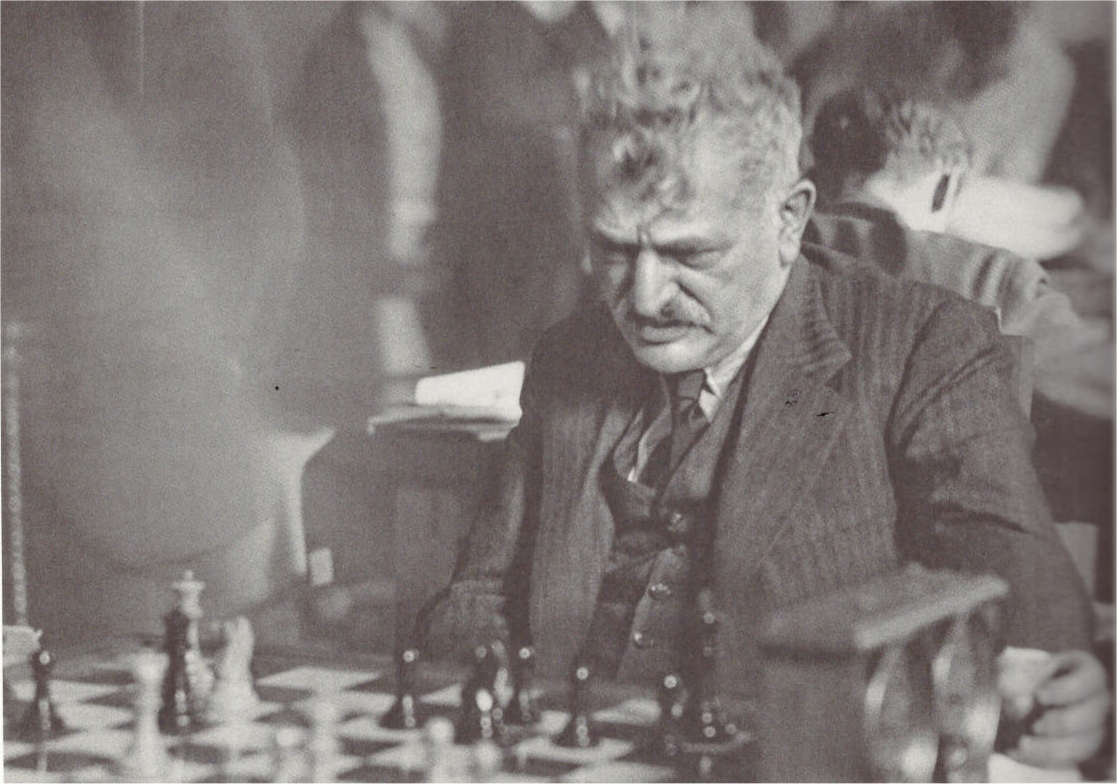
Alongside Capablanca and Alekhine, Emanuel Lasker was the third former world champion in the field. Lasker, who as a Jew had been driven from his German homeland, had found a new home in Russia. While Lasker was playing his final tournament in Nottingham, the Moscow show trials were beginning in Russia, with Stalin having veterans of the October Revolution eliminated. The Great Terror had already begun in 1935, and perhaps for that reason too Lasker was not in good condition in Nottingham. Botvinnik recalled that Lasker looked unwell and had difficulty moving. After the tournament, the second world champion in chess history returned once more to Moscow, but secretly prepared to leave for relatives in the United States. In August 1937, Lasker and his wife left Moscow for good.
Emanuel Lasker in Nottingham | Source: Emanuel Lasker, Vol. 1 Struggle and Victories / L. Schmid Collection
The course of the tournament
Euwe made the best start to the tournament with 2/2 after victories over Reshevsky and Vidmar. Alekhine began with a lively win over Flohr.
The explosive encounter between former world champions Capablanca and Alekhine came as early as round two. In his tournament book, Alekhine comments on his defeat against Capablanca in a fairly openly bad-tempered manner.
In summary, his account went something like this:
Alekhine played an interesting opening with black which, undeservedly, does not bear his name.
Capablanca made a few useless moves.
Alekhine miscalculated in an inexplicable way and somehow ended up in a lost endgame.
If one follows the game with an engine running, however, it becomes apparent that Alekhine was, broadly speaking, quite right in his assessment.
In round three, the reigning world champion had a bye because of the odd number of participants, and Botvinnik took the lead.
Until round eight, Botvinnik and Euwe were engaged in a neck-and-neck race and were level on points for much of the event, although Botvinnik still had his bye to come. In round nine, Euwe then lost to Alekhine, while Botvinnik drew with Lasker. Botvinnik had his bye in round ten and therefore could not add to his score. That gave the chasers Capablanca and Fine the opportunity to join him at the top with victories over Vidmar and Bogoljubow.
In round eleven, only Botvinnik among the leading group scored a full point, against Thomas, and he consequently took the outright lead. Capablanca caught the young Soviet master in round twelve, however.
The two leaders also scored in round thirteen, while Euwe lost further ground after a defeat against Lasker.
In the penultimate round, Botvinnik could manage only half a point against Euwe, while Capablanca likewise drew with Fine. Thus, before the fifteenth and final round, Capablanca and Botvinnik led by half a point over Alekhine, who had defeated Tartakower. Alekhine, however, still had his bye in the final round and was therefore out of contention for first place.
The name Emanuel Lasker will always be linked with his incredible 27 years reign on the throne of world chess. In 1894, at the age of 25, he had already won the world title from Wilhelm Steinitz and his record number of years on the throne did not end till 1921 when Lasker had to accept the superiority of Jose Raul Capablanca. But not only had the only German world champion so far seen off all challengers for many years, he had also won the greatest tournaments of his age, sometimes with an enormous lead. The fascinating question is, how did he manage that?
In the final round, Capablanca drew with Bogoljubow and Botvinnik also had to settle for half a point against Winter, which meant that Capablanca and Botvinnik shared first place. Fine, Reshevsky and Euwe all scored wins, overtook Alekhine and finished level on points in third to fifth place.
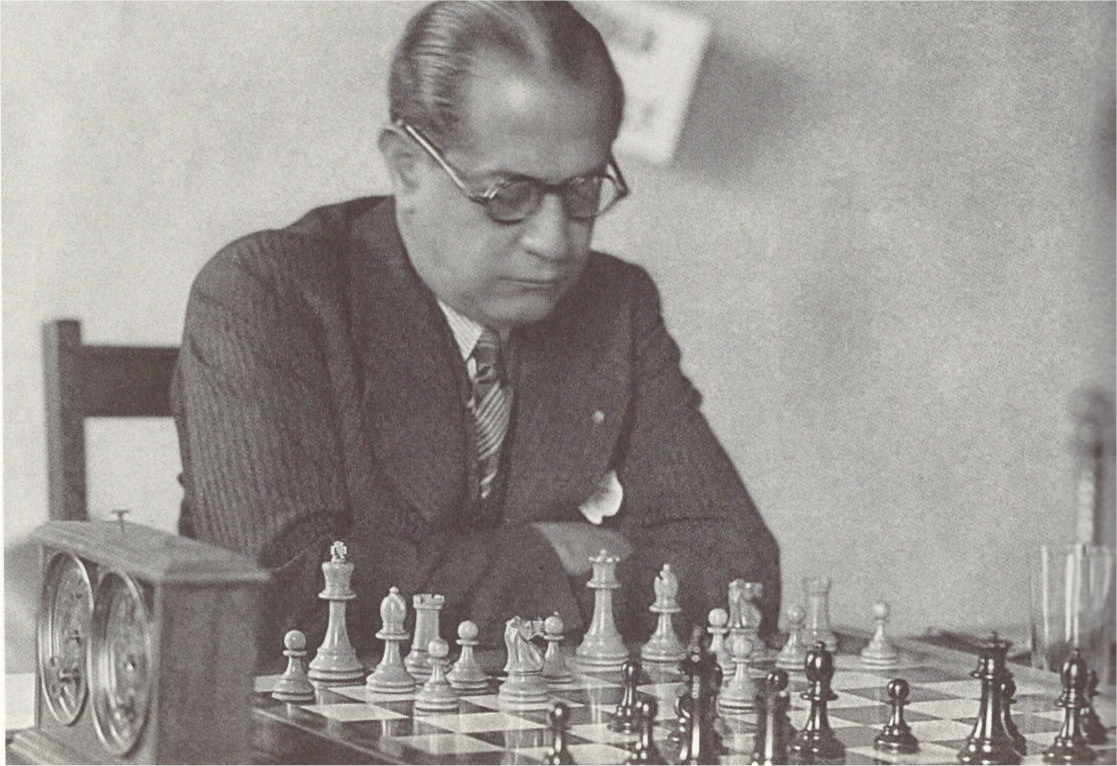
José Raúl Capablanca in Nottingham | Source: Emanuel Lasker, Vol. 1 Struggle and Victories
For Capablanca, beating Alekhine and finishing well ahead of him must surely have been satisfying. It did not, however, help his ambitions of securing a return match. At the AVRO tournament in 1938 and again at the 1939 Chess Olympiad, Capablanca tried once more to reach an agreement with Alekhine over a World Championship match.
Botvinnik, by contrast, established himself as a potential challenger, returned home as a hero to the workers' and peasants' paradise, and is said to have been gifted a car for his success.
The younger generation, led by Botvinnik, Reshevsky and Fine, performed strongly overall. Of the four English players, Tylor, who played on a Braille board, was the best with 4½ points. The home players managed only four wins between them, all against Lasker and Tartakower, and occupied the bottom places in the standings.
YOUR PERSONAL CHESS COACH - Whether you’re taking your first steps into the world of club chess, or already playing at a tournament level: with FRITZ, you can train more efficiently, intelligently and with a more personalised approach than ever before. FRITZ is more than just a chess engine – it’s a training revolution! Whether you’re taking your first steps into the world of club chess, or already playing at a tournament level: with FRITZ, you can train more efficiently, intelligently and with a more personalised approach than ever before.
* COMPETE AGAINST LEGENDS
* FRITZ is fun! BETTER CALCULATIONS – EVEN UNDER TIME PRESSURE!
* STYLE SIMULATION AT THE HIGHEST LEVEL
* EVEN STRONGER. EVEN MORE BEAUTIFUL. EVEN MORE DIRECT.
He was a child prodigy and he is surrounded by legends. In his best times he was considered to be unbeatable and by many he was reckoned to be the greatest chess talent of all time: Jose Raul Capablanca, born 1888 in Havana.
8/21/2026 – Vincent Keymer played an absolutely phenomenal Sinquefield Cup: judging from the chances he created with his trademark opening play, he should have finished clear first. In times where 1.e4 and 1.d4 main lines are analysed to a draw, Keymer manages to create hyper flexible positions from the Reti, English, Neo London and Accelerated (!) Neo London. While the original plan was to talk you through Keymer-Caruana, this video talks you through the opening stages of all five Keymer games with White. Merijn's show is available on-demand with a ChessBase Premium Account. You can <a href="https://account.chessbase.com/en/create-account" target="_blank">register a Premium account here</a>.
8/21/2026 – For twenty years, Harika Dronavalli was a fixture of every Indian team that walked into an Olympiad hall. Board one, board two, whatever the assignment, she was there, absorbing the pressure that comes with playing for a country rather than just for herself. So when the Indian squad for the Chess Olympiad 2026 was announced without her name on it, the news read, on the surface, like a changing of the guard: Humpy Koneru returning to the team and Savitha Shri B stepping in as a new addition along with a new captain: Swayams Mishra. Read Harika's thoughts on the decision. | Photo: Nils Rohde / ChessBase
On this 60 mins video we are going to concentrate on a simple, very solid idea in the main line Scandinavian, which even Magnus Carlsen has used to win games. Black focusses on making his life easy in the opening and forces White to work very hard to get advantage – but it is doubtful if White can get an advantage. Club players are always on the lookout for effective, time-saving solutions and here we have just that. Accompany FIDE Senior Trainer and IM Andrew Martin on this 60 mins video. You can learn a new opening system in 60 mins and start to play it with confidence on the very same day!
YOUR PERSONAL CHESS COACH - Whether you’re taking your first steps into the world of club chess, or already playing at a tournament level: with FRITZ, you can train more efficiently, intelligently and with a more personalised approach than ever before.
The Nimzo-Indian has stood the test of time for over a century: Still a top choice for elite players today, from Magnus Carlsen to Praggnanandhaa, it remains one of Black's most reliable ways to fight for real chances against 1.d4 2.c4 3.Nc3.
1.c4 e5 2.Nc3 Bb4!? is an opening idea well worth considering. Black immediately threatens to double the pawns on c3 in the style of the Trompowski or Sicilian Grand Prix attack.
Italian Game Powerbase 2026 is a database and contains 8571 top class games from Mega 2026 and the Correspondence Database 2026, of which 479 are annotated.
Videos: Nico Zwirs discusses the Sicilian with 2…e6 3.d4 cxd4 4.Qxd4 Nc6 5.Qe3 Nf6 6.Nc3. Mihail Marin examines Sindarov’s 6.Ne5 in the Queen’s Pawn Defence. Plus the ‘Lucky bag’ featuring 41 analyses by Berg, Ftacnik, Gupta and many others.
If you're looking for a dynamic alternative to the Slav, Queen's Gambit Declined, or other mainstream systems, the Chigorin Defence offers exactly what modern tournament players need.
€34.90
We use cookies and comparable technologies to provide certain functions, to improve the user experience and to offer interest-oriented content. Depending on their intended use, analysis cookies and marketing cookies may be used in addition to technically required cookies. Here you can make detailed settings or revoke your consent (if necessary partially) with effect for the future. Further information can be found in our data protection declaration.
Pop-up for detailed settings
We use cookies and comparable technologies to provide certain functions, to improve the user experience and to offer interest-oriented content. Depending on their intended use, cookies may be used in addition to technically required cookies, analysis cookies and marketing cookies. You can decide which cookies to use by selecting the appropriate options below. Please note that your selection may affect the functionality of the service. Further information can be found in our privacy policy.
Technically required cookies
Technically required cookies: so that you can navigate and use the basic functions and store preferences.
Analysis Cookies
To help us determine how visitors interact with our website to improve the user experience.
Marketing-Cookies
To help us offer and evaluate relevant content and interesting and appropriate advertisement.















.jpeg)