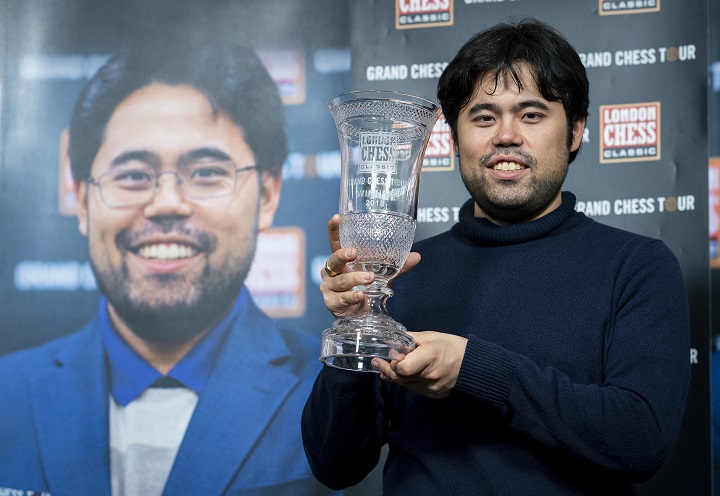
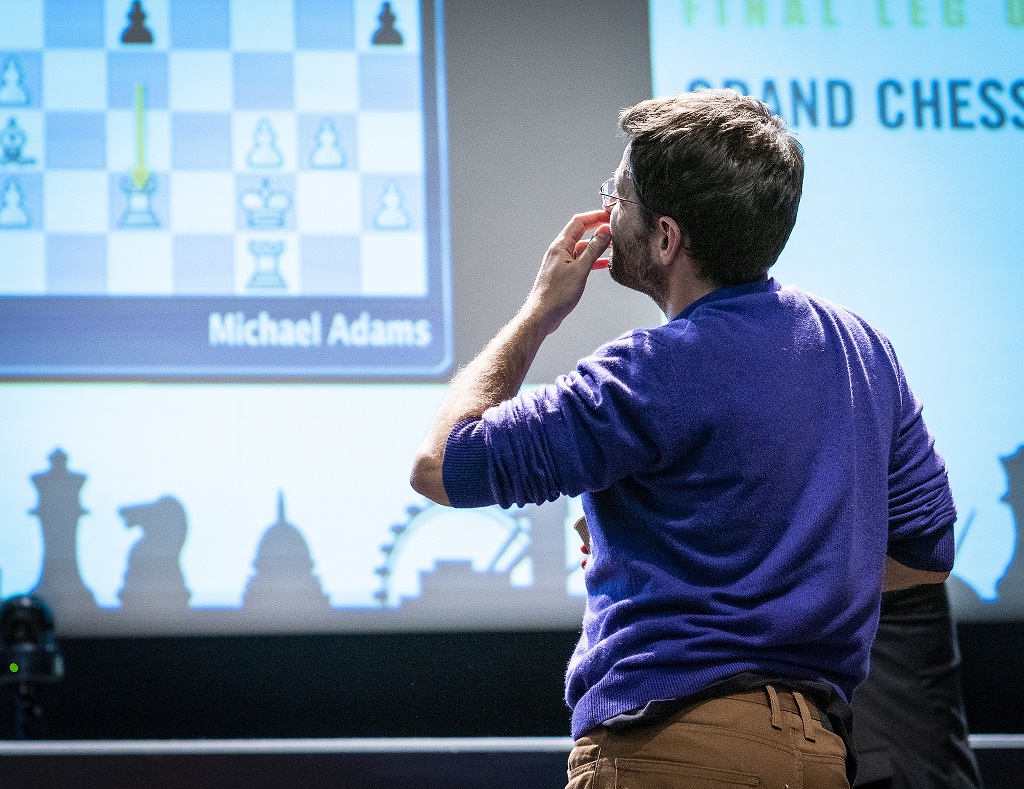
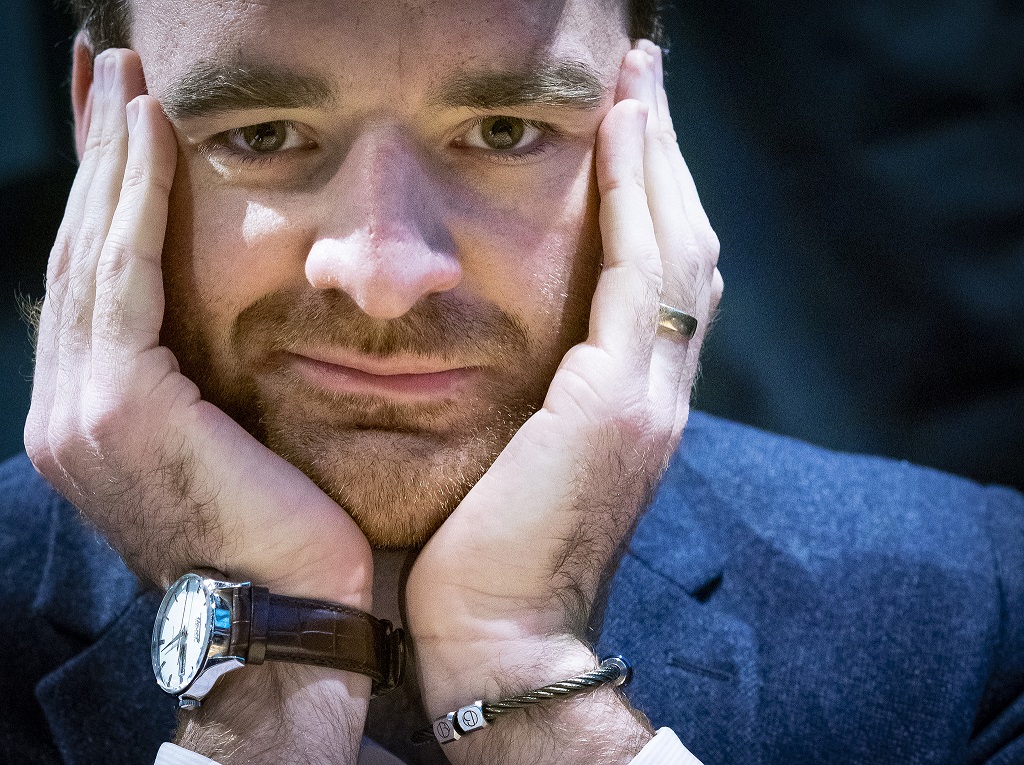
12/17/2018 – After drawing the first seven games of the final match against Maxime Vachier-Lagrave, Hikaru Nakamura pulled off a very nice win to secure first place at the London Classic — given this year's format, this meant Nakamura also won the overall Grand Chess Tour. Third place went to Fabiano Caruana, who obtained three victories on Monday to take down Levon Aronian. Meanwhile, Gawain Jones showed a more than convincing performance to beat Luke McShane and become the champion of the 2018 British Knockout Championship. | Photos: Lennart Ootes / Grand Chess Tour
new: Fritz 20
Your personal chess trainer. Your toughest opponent. Your strongest ally. FRITZ 20 is more than just a chess engine – it is a training revolution for ambitious players and professionals. Whether you are taking your first steps into the world of serious chess training, or already playing at tournament level, FRITZ 20 will help you train more efficiently, intelligently and individually than ever before.
YOUR PERSONAL CHESS COACH - Whether you’re taking your first steps into the world of club chess, or already playing at a tournament level: with FRITZ, you can train more efficiently, intelligently and with a more personalised approach than ever before. FRITZ is more than just a chess engine – it’s a training revolution! Whether you’re taking your first steps into the world of club chess, or already playing at a tournament level: with FRITZ, you can train more efficiently, intelligently and with a more personalised approach than ever before.
In this course, you will learn the foundations and key ideas of the Vienna Game and discover a variety of systems that make you extremely difficult to prepare for.
€39.90
A stunning final move
This year's edition of the Grand Chess Tour included three rapid and blitz tournaments and a single classical event before the grand finale in London. Hikaru Nakamura won two out of the three stages with accelerated time controls to arrive as seeded number one to London's final event, despite having had a disappointing performance in the Sinquefield Cup. The last hurdle in his path to first place was Maxime Vachier-Lagrave, the player who had the most regular performance throughout the year — he did not finish below fifth place in any of the events.
The players arrived in the final day with a tied score after signing two draws in the classical section. The previous trend continued as Nakamura held a draw with Black using the Berlin Defence in the first rapid encounter. In the next game, however, the American achieved a clear positional advantage, although he could not find a path to the victory:
This is one of the many positions where White could have put more pressure on his rival. Hikaru centralised the king with 51.Ke2, when 51.Rd5 could have been tried. Nonetheless, there was not a markedly clear plan for White, and credit should be given to Vachier-Lagrave’s stubborn resistance. A threefold repetition sealed the draw on move 61.
During the post-game interview, Nakamura declared: "I was a little bit annoyed because I probably should have won this rapid game with White".
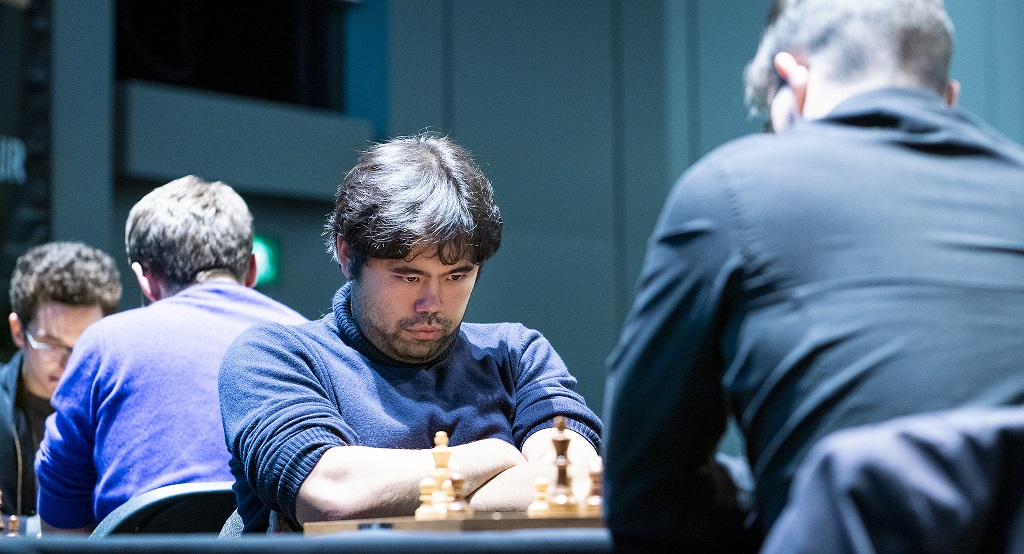
Nakamura showed great control | Photo: Lennart Ootes / Grand Chess Tour
Perhaps Naka's annoyance was a factor in the next game, in which MVL had an edge after the middlegame. The position was simplified to a bishop endgame with the same number of pawns, but White still had some hopes:
"Occupy the centre!" Let GM Bologan show you move by move why 1...e5 against English (1.c4) is a rock solid and excellent choice.
Black has all his pawns on dark squares, so there is always the chance to find some kind of zugzwang in the technical phase. Perhaps a better try for Maxime would have been to go for 41...bxc5 instead of 41...b5, as pointed out during the live commentary. The Frenchman went back and forth expecting some mistake by Nakamura, but Hikaru showed great confidence and speed to hold the balance.
Two more draws followed and there was only one game left "in regulation" —Armageddon certainly seemed like a real possibility. Nakamura had White and faced MVL's Grünfeld. Quickly, White got the upper hand, especially after a strange queen manoeuvre by Maxime:
The black queen could have gone to b6 or a4 instead of f5 — its awkward placement was the deciding factor in the end. Nakamura started to create a web to trap the queen and managed to end the game with an astounding move:
The Grunfeld Defence is a very dynamic opening with an excellent reputation and the list of players ready to defend it reads like a who's who in chess. It is rather remarkable, that one variation still retains the position of 'main line' and that after hundreds of games played with it some questions still remain open. GM Lubomir Ftacnik explains.
Maxime resigned after 29.Bg4!, as Black cannot save his queen with 29...Qxg4 due to 30.Nh6+. It was a fitting final move to concede the first place to a player that demonstrated confidence and a steady hand in all the rapid and blitz tournaments of this year's tour. In fact, Hikaru did not win a single classical game in the 2018 GCT — he played nine in Saint Louis and four in London. Nonetheless, the commentary team, Fabiano Caruana and Maxime Vachier-Lagrave all agreed that he was a deserving winner.
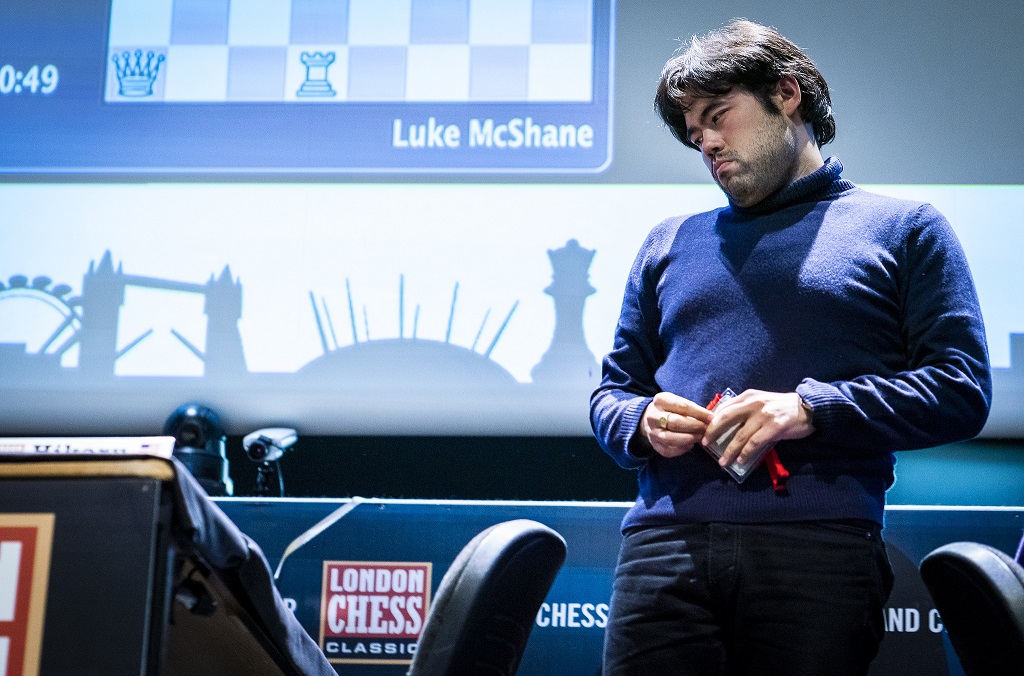
Looks good? | Photo: Lennart Ootes / Grand Chess Tour
Hikaru was happy with his final move:
Considering how stressful it was throughout the day, to finish like that feels great.
Nakamura took home the winner's trophy and accumulated $225,000 in this year's GCT. Vachier-Lagrave finished the year with $160,000 in winnings. The Frenchman lost his number one spot in the live blitz ratings list and explained: "Today I didn't pay nearly well enough. [...] In the blitz I definitely wasn't playing up to my standards, I felt".
Caruana's rapid skills
World Championship challenger Fabiano Caruana came from losing two rapid play-offs in London after drawing all the classical games he played at England’s capital. Furthermore, Levon Aronian did not fight to get an advantage with White in the second classical encounter of their match, trusting he would be able to take down Fabiano in rapid and blitz, like Carlsen and Nakamura had done before.
However, in their second rapid game, after having drawn the first one, Caruana took the lead after showing great strategical skills to convert his positional advantage with the white pieces. Aronian defended with precise moves until he faltered on move 37:
Pavel Eljanov explains in depth what Gyula Breyer already saw in 1911 and what became an opening choice of the likes of Kasparov, Kramnik, Anand or Carlsen. The Breyer Variation, which is characterised by the knight retreat to b8.
Black needed to invite a rook exchange with 37...Rf7 to reach a bishop endgame that was holdable with best play. That is the verdict of the computers, but to take such a decision with a few minutes on the clock is undoubtedly difficult. Levon played 37...f3 instead, trusting that after 38.gxf3 g3 the passed g-pawn would offer enough counterplay. Fabiano, however, showed good technique to convert his extra pawn into a 53-move win that put him four points ahead in the match.
Caruana showed he is also dangerous in rapid and blitz | Photo: Lennart Ootes / Grand Chess Tour
Aronian needed to hit back, and he needed to do it quickly. And that is precisely what he did! He won the first two blitz games to even the score before the final two games.
Game three of the blitz section saw both players going for a line that left theory on move 5. Caruana, with Black, played confidently and handled the singular position effectively until achieving a clear edge on the queenside. He pushed in an opposite-coloured bishops middlegame until a capture sealed the deal in his favour:
The Fantasy Variation (1.e4 c6 2.d4 d5 3.f3) is a tricky try by White to steer the game into muddy waters right from the off and take Black away from the solid positions he is accustomed to in the main line variations of the Caro-Kann. Traditionally the opening never gained too much credibility amongst top players, since White's attempt to preserve his pawn centre at the cost of weakening his kingside was hardly seen as a major threat to the super-reliable Caro. However, thanks to a wave of news ideas and innovations first introduced at the 2010 European Individual Championships and many more thereafter, the variation has made a major comeback and can now be found in the repertoires of some of the world's best. In this 60 minute video, IM Lawrence Trent will discuss the 5 main variations Black has at his disposal but how with each one White has a number of ways to keep the position full of play and dynamic possibilities, leading to games which loyal Caro players will have difficulty dealing with.
Black took with 48...Nxd4 and the passed c-pawn decided the game in his favour after 49.cxd4 c3 50.Nf3 Rb2+.
Levon was once again in need of a win, but this time he could not recover from the previous blow and ended up losing the last blitz game for a final score of 16:12. Aronian will be hoping for a better 2019, as he stated:
"Well, it was a terrible year, but being here is good. I hope next year will treat me better".
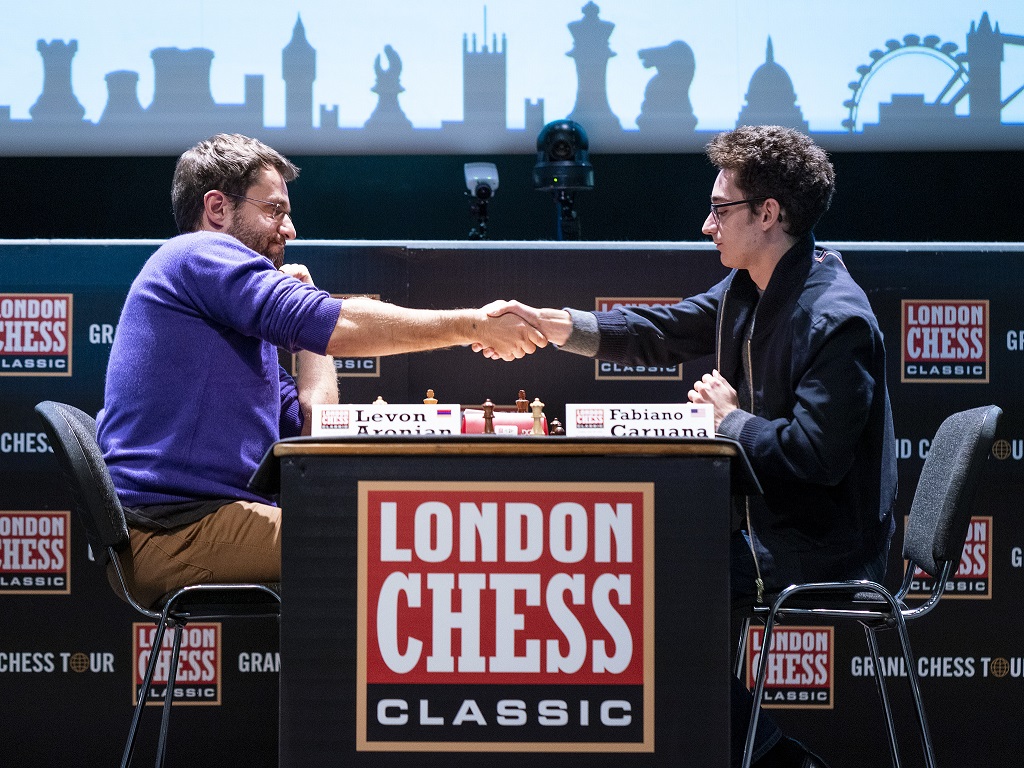
Levon had a great 2017 but was disappointed with how 2018 went | Photo: Lennart Ootes / Grand Chess Tour
Caruana, on the other hand, showed he can compete in rapid and blitz at the top level. He was happy with his victory, but would have preferred to fight for first place:
"I'm not too proud of third place, but I beat a very strong player. Winning against Levon is always an accomplishment, so I'm very proud of that. But when we're not fighting for first it doesn't feel the same".
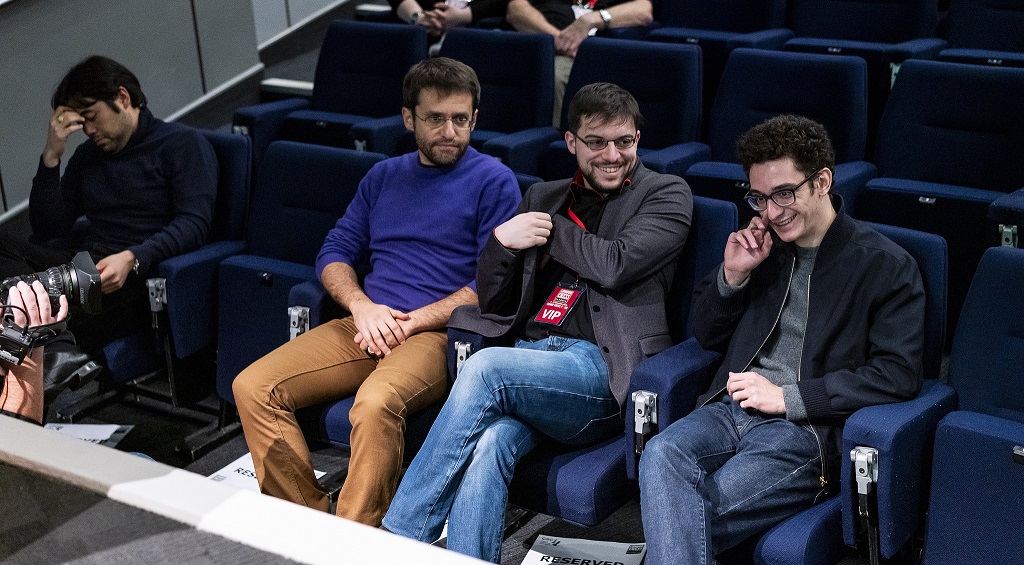
Colleagues and friends | Photo: Lennart Ootes / Grand Chess Tour
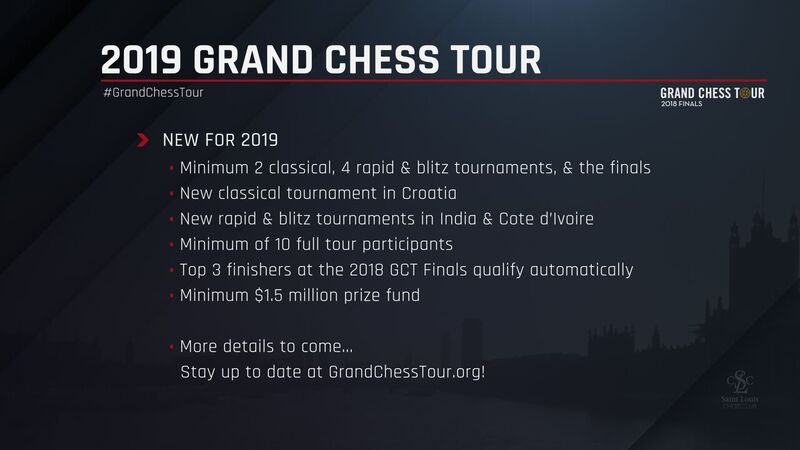
The GCT gets bigger
In the final day of this year's tour, the organisers announced that the Grand Chess Tour will expand its reach in 2019. A new classical tournament will be played in Croatia, while Asia and Africa will receive the tour for the first time, as rapid and blitz events will be organised both in India and Cote d'Ivoire. Also, it was announced that the prize fund will reach at least 1.5 million dollars and that the minimum number of regular tour participants will be ten. In a year without Olympiad nor a World Championship match, more elite action will be kindly welcomed by the chess community.
Live commentary webcast
Yasser Seirawan, Jennifer Shahade, Maurice Ashley and Alejandro Ramirez
All games - GCT London Classic
Gawain Jones impressive in British KO
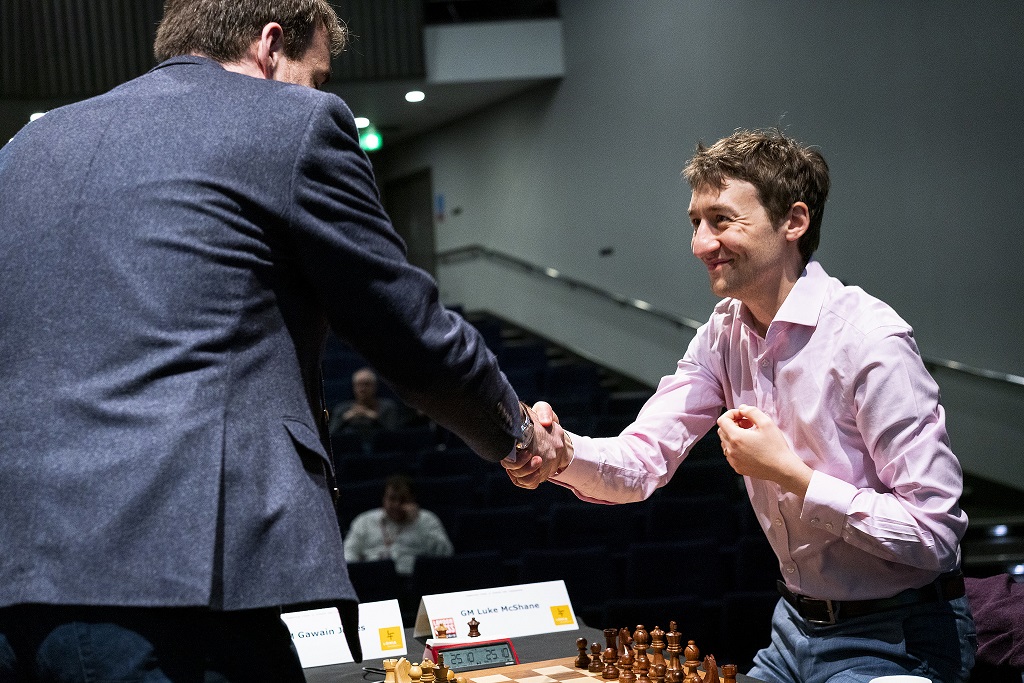
After winning the second classical game in the final match against Luke McShane, getting a six-point lead before the final day, Gawain Jones impressed by showing great nerves to take advantage of McShane's adventurous play and win the British Knockout Championship with a swashbuckling 21:7 score.
Gawain secured first place with two consecutive wins in the rapid games. In the first one, his rival played a speculative sacrifice that did not quite work:
The Italian Game is considered a sound but quiet opening without early trades, giving rise to rich positions where plans are more important than forced variations. So shows black's plans on this DVD.
McShane has his pieces concentrated on the kingside, so understandably went for 19...Ngf4 trying to open some lines against the king and take advantage of the dark-squared bishop’s awkward placement. Jones thought for seven minutes before taking with 20.gxf4 and put his bishop in the only safe square available after 20...exf4 21.Ba7.
Luke kept trying to create something against the white king, but Gawain showed remarkable defensive skills and eventually used his piece advantage to force his opponent's resignation.
A friendly handshake before the start | Photo: Lennart Ootes
Already ten points behind in the score, McShane could only afford one draw in a blitz game to tie the match. Therefore, he needed to win the second rapid game. That explains his approach — he played 1.b3 and looked for imbalances at all costs all throughout the game. Nevertheless, Jones played pragmatically and simplified to a position where White's best chance was to go for a perpetual:
White could have forced a repetition with 47.Nh7+ Kg8 48.Nf6+ — the black king cannot go to g7 due to the discovered check with d5, nor to the e-file where the rook would pin the queen from e1. That was Luke's only saving line, but he tried to play for more with 47.Qa3+?, only to resign two moves later after 47...Kg7 48.Qb4 Bd7.
The finalists traded two wins apiece in the blitz games. Jones received a £15,000 prize, while McShane took home £10,000.
The champion | Photo: Lennart Ootes
In the duel for third place, Mickey Adams overpowered David Howell by a 16:12 score, after winning the first two blitz games of the match — the rest of the games finished drawn. The veteran received £6,000 for his efforts; Howell was left with £4,000.
Antonio PereiraAntonio is a freelance writer and a philologist. He is mainly interested in the links between chess and culture, primarily literature. In chess games, he skews towards endgames and positional play.
YOUR PERSONAL CHESS COACH - Whether you’re taking your first steps into the world of club chess, or already playing at a tournament level: with FRITZ, you can train more efficiently, intelligently and with a more personalised approach than ever before.
The Nimzo-Indian has stood the test of time for over a century: Still a top choice for elite players today, from Magnus Carlsen to Praggnanandhaa, it remains one of Black's most reliable ways to fight for real chances against 1.d4 2.c4 3.Nc3.
1.c4 e5 2.Nc3 Bb4!? is an opening idea well worth considering. Black immediately threatens to double the pawns on c3 in the style of the Trompowski or Sicilian Grand Prix attack.
Italian Game Powerbase 2026 is a database and contains 8571 top class games from Mega 2026 and the Correspondence Database 2026, of which 479 are annotated.
Videos: Nico Zwirs discusses the Sicilian with 2…e6 3.d4 cxd4 4.Qxd4 Nc6 5.Qe3 Nf6 6.Nc3. Mihail Marin examines Sindarov’s 6.Ne5 in the Queen’s Pawn Defence. Plus the ‘Lucky bag’ featuring 41 analyses by Berg, Ftacnik, Gupta and many others.
If you're looking for a dynamic alternative to the Slav, Queen's Gambit Declined, or other mainstream systems, the Chigorin Defence offers exactly what modern tournament players need.
€34.90
We use cookies and comparable technologies to provide certain functions, to improve the user experience and to offer interest-oriented content. Depending on their intended use, analysis cookies and marketing cookies may be used in addition to technically required cookies. Here you can make detailed settings or revoke your consent (if necessary partially) with effect for the future. Further information can be found in our data protection declaration.
Pop-up for detailed settings
We use cookies and comparable technologies to provide certain functions, to improve the user experience and to offer interest-oriented content. Depending on their intended use, cookies may be used in addition to technically required cookies, analysis cookies and marketing cookies. You can decide which cookies to use by selecting the appropriate options below. Please note that your selection may affect the functionality of the service. Further information can be found in our privacy policy.
Technically required cookies
Technically required cookies: so that you can navigate and use the basic functions and store preferences.
Analysis Cookies
To help us determine how visitors interact with our website to improve the user experience.
Marketing-Cookies
To help us offer and evaluate relevant content and interesting and appropriate advertisement.