10/5/2026 – Bent Larsen combined an unconventional approach to the opening with a strong understanding of dynamic positions. In the 20th volume of the ChessBase Master Class series, several experts examine different aspects of the Danish star's play. The strategy section includes his 1968 win over Florin Gheorghiu in Monte Carlo, a game in which Larsen used active piece play and structural imbalances to make the most of a lasting initiative.
new: Fritz 20
Your personal chess trainer. Your toughest opponent. Your strongest ally. FRITZ 20 is more than just a chess engine – it is a training revolution for ambitious players and professionals. Whether you are taking your first steps into the world of serious chess training, or already playing at tournament level, FRITZ 20 will help you train more efficiently, intelligently and individually than ever before.
YOUR PERSONAL CHESS COACH - Whether you’re taking your first steps into the world of club chess, or already playing at a tournament level: with FRITZ, you can train more efficiently, intelligently and with a more personalised approach than ever before. FRITZ is more than just a chess engine – it’s a training revolution! Whether you’re taking your first steps into the world of club chess, or already playing at a tournament level: with FRITZ, you can train more efficiently, intelligently and with a more personalised approach than ever before.
Michael Kotyk presents a complete repertoire after 1.e4 e5, built around creative ideas, surprising move orders, and practical weapons designed to catch your opponents off guard.
€69.80
€59.90
Turning structural imbalances into active play
Bent Larsen was one of the strongest players outside the Soviet Union during the 1960s and 1970s, combining an adventurous approach to the openings with an ability to handle unusual middlegame structures. The Danish grandmaster was rarely content merely to follow established paths. His games frequently featured early deviations from theory, ambitious pawn advances and positions in which long-term strategic considerations were closely connected with concrete tactical possibilities.
In this video course experts examine the games of Bent Larsen. Let them show you which openings Larsen chose, where his strength in middlegames were, how he outplayed his opponents in the endgame & you’ll get a glimpse of his tactical abilities! Bent Larsen (1935–2010) was the greatest chess player in Danish history, and for a time, the second-strongest player in the Western world behind Bobby Fischer. Between 1954 and 1971, he won the Danish Championship six times, and achieved numerous international tournament victories throughout his career.
Free video sample: Introduction to Bent Larsen by Peter Heine Nielsen
Free video sample: Introduction to the Opening Section
The 20th volume of the ChessBase Master Class series examines these different aspects of his play. Dorian Rogozenco, Mihail Marin, Karsten Müller and Oliver Reeh cover Larsen's openings, strategic play, endgames and tactical ability, while Peter Heine Nielsen contributes a separate chapter devoted to memories and impressions of Denmark's most celebrated chess player. The course also contains collections of Larsen's games and additional training material.
Born in 1935, Larsen emerged as Denmark's strongest player while still in his teens. He won the national championship six times and earned the GM title following his performance at the 1956 Chess Olympiad in Moscow, where he took the individual gold medal on first board.
His most successful period came during the 1960s. Larsen won the Interzonal tournaments of Amsterdam 1964 and Sousse 1967 and qualified repeatedly for the Candidates matches. For several years he and Bobby Fischer were generally regarded as the leading Western challengers to the Soviet players who dominated elite chess at the time.
Larsen's reputation for originality was well-earned. He was prepared to employ openings that other leading grandmasters considered unconventional, with 1.b3 becoming particularly closely associated with his name. Yet reducing his chess to eccentric opening choices would give an incomplete picture. Much of his success came from his understanding of imbalanced positions and his willingness to accept structural concessions when they provided useful squares, active pieces or attacking prospects.
These elements form an important part of the strategy section of the Master Class volume. Rather than presenting Larsen simply as an attacking player, the course looks at the positional ideas that allowed him to create the conditions for later tactical play.
In this video course experts examine the games of Bent Larsen. Let them show you which openings Larsen chose, where his strength in middlegames were, how he outplayed his opponents in the endgame & you’ll get a glimpse of his tactical abilities! Bent Larsen (1935–2010) was the greatest chess player in Danish history, and for a time, the second-strongest player in the Western world behind Bobby Fischer. Between 1954 and 1971, he won the Danish Championship six times, and achieved numerous international tournament victories throughout his career.
Free video sample: Introduction to Bent Larsen by Peter Heine Nielsen
Free video sample: Introduction to the Opening Section
A lesson from Monte Carlo
One of the games featured in the strategy material is Larsen's encounter with Romanian grandmaster Florin Gheorghiu at Monte Carlo 1968. The tournament came during one of Larsen’s strongest periods: he finished first with 9½/13, half a point ahead of former world champion Mikhail Botvinnik, while Vasily Smyslov (also a former world champion) and Vlastimil Hort shared third place on 8½ points.
In a position with all six major pieces still on the board, Larsen repeatedly improved the coordination of his pieces, first demonstrating why his superior structure was a bigger trump than Gheorghiu's extra pawn and then creating decisive activity on the kingside.
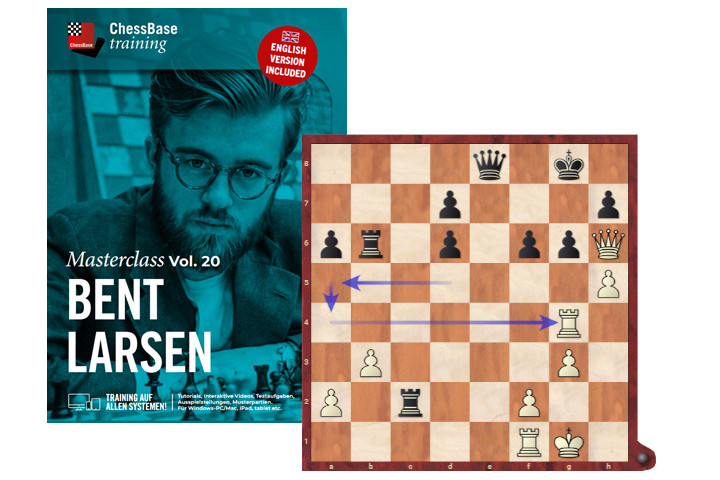
Larsen v. Gheorghiu
White has the better structure and piece coordination, but Black's extra pawn at least partly compensates for these aspects. As a general evaluation, White's position is preferable, but he needs to play accurately in order to convert it into a win.
Larsen here played the strong 23.h4!, attempting gaining the initiative on the kingside. Going for 23.Rxd6 would have been premature due to 23...Rxd6 24.Rxd6 Qb1+ 25.Kg2 Qe4+, with good drawing chances for Black.
There followed 23...Qe5! 24.b3 Rc8?! (a bit slow; better is to go for counterplay with 24...a4!, intending to double the rooks on the b-file) 25.Rd5!
Once again, Larsen focuses on piece coordination and activity. Keeping the pawn with 25.e3?! allows Black to regroup in time with 25...Rc5.
25...Qxe2 26.h5! Rc2 27.Rf1
Black's 27...Qe4? here was a crucial mistake. Instead, he should have defended g6 with the rather unexpected 27...Qe8, intending to transfer one of his rooks to g4 in order to get counterplay (with the queen on e4, this is not possible).
Larsen duly made the most of his opponent's inaccuracy: 28.Rxa5 a6 29.Ra4! (gaining a tempo by attacking the badly placed queen on e4) Qe8 30.Rg4
The white rook has been transferred from d5 to g4, increasing the pressure on the kingside. Had Black played ...Qe8 at the right moment, the g4-square could have been occupied by a black rook instead, with good drawing chances.
30...Qf8 31.Qe3?! Placing the queen on e3 keeps White's clear advantage, but he could have broken through at once with 31.Rxg6+ hxg6 32.Qxg6+ Kh8 33.Qxc2, and Black is doomed.
31...Rbc6 32.hxg6 hxg6 33.Rxg6 Kf7
With the queen on the open e-file and the rook on f1 ready to join the attack, the rest was simple for Larsen: 34.Rg4 R2c5 35.Qd3 Re5 36.f4 Re8 37.Qd5+ Ke7 38.Re1+ 1-0
In this video course experts examine the games of Bent Larsen. Let them show you which openings Larsen chose, where his strength in middlegames were, how he outplayed his opponents in the endgame & you’ll get a glimpse of his tactical abilities! Bent Larsen (1935–2010) was the greatest chess player in Danish history, and for a time, the second-strongest player in the Western world behind Bobby Fischer. Between 1954 and 1971, he won the Danish Championship six times, and achieved numerous international tournament victories throughout his career.
Free video sample: Introduction to Bent Larsen by Peter Heine Nielsen
Free video sample: Introduction to the Opening Section
Carlos Alberto ColodroCarlos Colodro is a Hispanic Philologist from Bolivia. He works as a freelance translator and writer since 2012. A lot of his work is done in chess-related texts, as the game is one of his biggest interests, along with literature and music.
9/19/2026 – The Master Class series combines biography, a collection of games and Fritz Trainer material on a chess legend in a multimedia format. Several authors contribute to each volume, presenting the master in their respective areas of expertise. Jochen Schwarz, a club player from Bremen, has followed the Master Class series since its first volume and has taken a look at the latest edition, devoted to Danish grandmaster Bent Larsen. He also compares it with earlier volumes in the series.
5/8/2026 – Bent Larsen was the strongest chess player in Danish history and, for many years, the leading Western challenger behind Bobby Fischer, winning the Danish Championship six times and achieving major international successes. This ChessBase training course explores his brilliant attacking style, creative positional ideas, and opening innovations such as 1.b3 and his contributions to the Accelerated Dragon, while also examining his middlegame, endgame, and tactical mastery. Renowned experts including Peter Heine Nielsen, Dorian Rogozenco, Mihail Marin, Karsten Müller, and Oliver Reeh provide deep analysis, personal stories, and insights into Larsen’s unique chess legacy.
King’s Indian fans who choose the Mar del Plata attack (7...Nc6) against White’s classical system (1.d4 Nf6 2.c4 g6 3.Nc3 Bg7 4.e4 d6 5.Nf3 0-0 6.Be2 e5 7.0-0) usually aim for a complex position with mutual attacks on open wings, requiring long-term strategic planning and tactical sharpness in critical moments. Computers often do not know how to handle the arising complex strategic positions, which suits players who like to think on their own instead of memorizing long variations. However, the fashionable Bayonet Attack (9.b4) interferes with Black’s ideas. After Black’s main move 9...Nh5 the positions opens, the lines get forced and computer analysis is important again. But this DVD offers an antidote against White’s Bayonet Attack, namely 9...a5! This move leads to sound positions with very few concrete lines, in which the focus is on strategy not on tactics. Objectively chances are equal but if Black knows what to do things might quickly become dangerous for White.
YOUR PERSONAL CHESS COACH - Whether you’re taking your first steps into the world of club chess, or already playing at a tournament level: with FRITZ, you can train more efficiently, intelligently and with a more personalised approach than ever before.
How grandmasters win without fireworks: GM Jan Markos shows you 11 very practical tips from "How to play in a lost position" to "Be patient like Carlsen" that will improve your tournament chess.
The Nimzo-Indian has stood the test of time for over a century: Still a top choice for elite players today, from Magnus Carlsen to Praggnanandhaa, it remains one of Black's most reliable ways to fight for real chances against 1.d4 2.c4 3.Nc3.
1.c4 e5 2.Nc3 Bb4!? is an opening idea well worth considering. Black immediately threatens to double the pawns on c3 in the style of the Trompowski or Sicilian Grand Prix attack.
Italian Game Powerbase 2026 is a database and contains 8571 top class games from Mega 2026 and the Correspondence Database 2026, of which 479 are annotated.
Videos: Nico Zwirs discusses the Sicilian with 2…e6 3.d4 cxd4 4.Qxd4 Nc6 5.Qe3 Nf6 6.Nc3. Mihail Marin examines Sindarov’s 6.Ne5 in the Queen’s Pawn Defence. Plus the ‘Lucky bag’ featuring 41 analyses by Berg, Ftacnik, Gupta and many others.
€14.90
We use cookies and comparable technologies to provide certain functions, to improve the user experience and to offer interest-oriented content. Depending on their intended use, analysis cookies and marketing cookies may be used in addition to technically required cookies. Here you can make detailed settings or revoke your consent (if necessary partially) with effect for the future. Further information can be found in our data protection declaration.
Pop-up for detailed settings
We use cookies and comparable technologies to provide certain functions, to improve the user experience and to offer interest-oriented content. Depending on their intended use, cookies may be used in addition to technically required cookies, analysis cookies and marketing cookies. You can decide which cookies to use by selecting the appropriate options below. Please note that your selection may affect the functionality of the service. Further information can be found in our privacy policy.
Technically required cookies
Technically required cookies: so that you can navigate and use the basic functions and store preferences.
Analysis Cookies
To help us determine how visitors interact with our website to improve the user experience.
Marketing-Cookies
To help us offer and evaluate relevant content and interesting and appropriate advertisement.
















.jpeg)