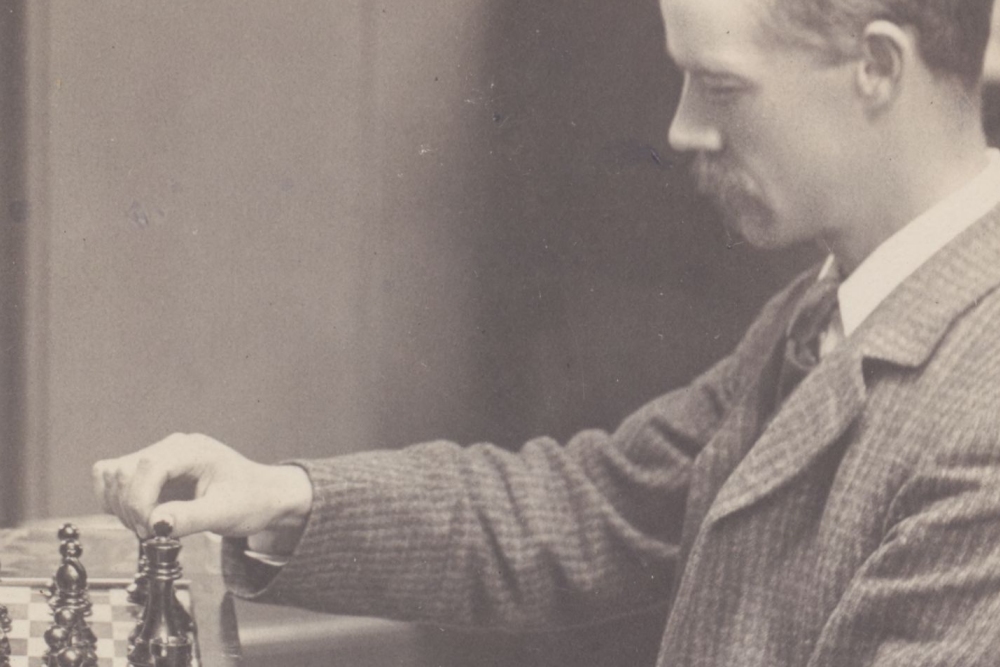
The English Chess Federation is currently holding its national championships in numerous categories and groups, and is celebrating them as the "strongest British Championship for 122 years". In doing so, the federation is referring to the start of the event in 1904. At the first British Championship, held in Hastings, William Ewart Napier, an American of English origin, was the winner. The British long interpreted their empire very generously and, until recently, still admitted participants from the colonies.
But as early as the following year, the era of Henry Ernest Atkins began. He won the British Championship in 1905, again in 1906 and also in 1907; in short, he won every British Championship from 1905 to 1911, and then those in 1924 and 1925 as well. Atkins was thus Britain's record champion for a long time, until Jonathan Penrose overtook him in the 1960s. What was special about these successes was that, strictly speaking, Henry Atkins was only an amateur player. Nevertheless, because of his playing strength, he was counted among the best players of his time. For the period from 1902 to 1905, the statistician Jeff Sonas (www.chessmetriccs.de) ranks Henry Atkins among the world's top ten in his list of retrospectively calculated historical Elo ratings - Atkins had a rating peak of 2700.
 In this video course experts examine the games of Steinitz. Let them show you which openings Steinitz chose, where his strength in middlegames were, how he outplayed his opponents in the endgame & you’ll get a glimpse of his tactical abilities!
Williams Steinitz, 1st World Chess Champion (1886-1894) The match between William Steinitz and Johannes Zukertort in 1886 was the first chess match for the ‘World Chess Championship’. Steinitz won, and has since been considered the first official world champion in chess history.
Free video sample: The Steinitzian method of restriction
Free video sample: Strategy Introduction
Henry Atkins was born on 20 August 1872 in Leicester. His father was a teacher at Wyggeston Boys School.
Henry Atkins learned chess from his brother at the age of ten. The great international tournament in London in 1883, held as a double round-robin with 14 participants, excited and inspired the young Henry Atkins, as he later recounted. Atkins followed the tournament in the newspapers and hoped for a victory by Johannes Zukertort, with every defeat of his idol disappointing him. In the end, however, Zukertort finished three points ahead of Steinitz. At the age of ten, Atkins joined the chess group at Wyggeston School. His sister gave him Howard Staunton's The Chessplayer's Handbook for his first theoretical study of the game. Atkins took Wilhelm Steinitz as his model and adopted his style, which later earned him the nickname "the little Steinitz" in England.
At the age of 15, Atkins joined the Leicester chess club. Two years later, he was already the strongest player in the club and played on board one for the club team. After finishing school, Atkins studied mathematics at Peterhouse College, Cambridge. He was one of the best students, played for the college chess team and was the strongest player ever to have represented that team. During his entire period of study, he lost only one game. Besides chess, Atkins also played cricket and was part of the university's team.
The year 1895 saw the first great international tournament in Hastings. The entire world elite, including players such as Wilhelm Steinitz, Emanuel Lasker, Siegbert Tarrasch, Harry Pillsbury and Mikhail Chigorin, took part and competed with the best English players, foremost among them Henry Bird and Amos Burn, 22 players in all.
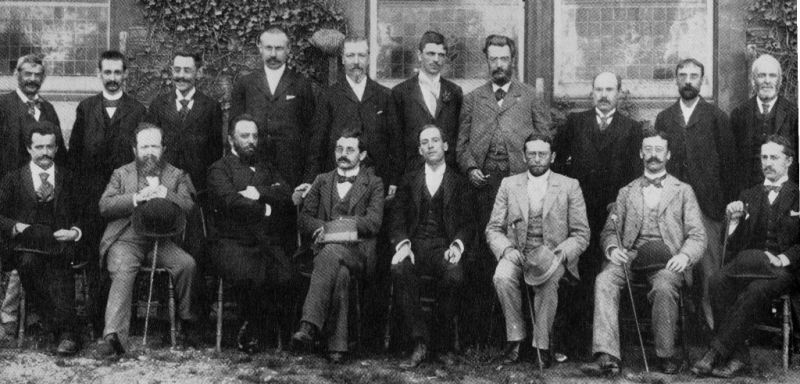
The chess tournament in Hastings was a competition of global significance, established a long tradition and became one of the classics of chess history. Thanks to his successes during his student years, Henry Atkins received an invitation to the parallel Candidates Tournament, in which Hungary's Geza Maroczy, Dutchman Rudolf Loman, Germany's Wilhelm Cohn and England's John Owen (Owen's Defence, 1…b6), among others, took part - all well-known masters of the time. Atkins finished second behind Maroczy, thereby becoming the best British player and being awarded the title of "Amateur Champion of Great Britain".
In 1896, Atkins was selected for the British team for a cable match against the USA. The match was played on ten boards via the transatlantic cable. England won 4:3 on wins. Atkins was among the winners. The match was held annually until 1911, and Atkins played in all of these encounters except one, in 1909.
At the end of the 1890s, Atkins took part in a number of smaller tournaments, with very good results. He achieved a major success in 1899 at an amateur tournament in Amsterdam, where, in a field of 16 participants, he won every game and the tournament by a margin of four points. In 1902, Henry Atkins also took part in the master tournament at the 13th DSB Congress in Hanover. There he faced many world-elite players and finished third with 11½ points from 17 games, behind Janowski and Pillsbury.
It is above all these two tournaments, in Amsterdam and Hanover, that are reflected in Jeff Sonas' statistical evaluation, which sees Atkins as world number six at the time.
 You will learn how Black's dynamic piece activity and structural counterplay more than compensate for White's extra tempo in the colour-reversed setups.
The Benoni family of openings has toppled world champions, decided match games under the highest pressure, and rewarded those brave enough to play them with some of the most electrifying chess imaginable. In this Fritztrainer, Grandmaster Ivan Sokolov - continuing his successful series "Understanding Middlegame Structures" - takes you deep inside the complexities of the Colour-Reversed Benoni, the Colour-Reversed Benko Gambit, and the Colour-Reversed Blumenfeld Gambit.
Free sample video: Introduction
Free sample video: Colour Reversed Banoni - Game 1
Henry Atkins had already taken up a post as a mathematics lecturer at Northampton College in 1898. In 1902, he moved to Wyggeston School, before going to Huddersfield College in 1909, where he became headmaster. He remained there until his retirement in 1936. Atkins' professional obligations increasingly left him with less time for lengthy tournament appearances, especially abroad. From 1904, he therefore limited himself to tournaments in England, essentially to the national championships, which took place during the summer holidays.
The English Chess Federation was founded in 1904 and has since organised the British Championships, the first of them in that same year. On his debut, Atkins shared first place with William Ewart Napier, but then narrowly lost the subsequent playoff, which consisted of four games and was not held until January of the following year.
In the summer of 1905, Atkins made matters clear at the second British Championship and won by a margin of 1½ points. The following year, Henry Atkins won the championship 1 point ahead of Reginald Pryce Michell. In 1907, Atkins took his third title, again 1 point ahead of Michell. In his title defence in 1908, Atkins again won by 1½ points, this time ahead of William Ward.
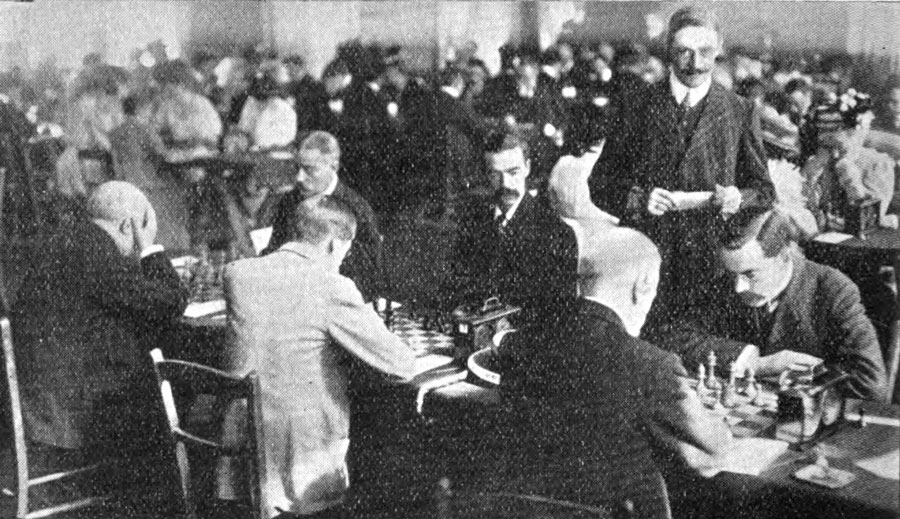
Photo: Tunbridge Wells Chess Club
Apart from the British Championships, Atkins played no other tournaments. His performances in the national championships were therefore all the more remarkable. In 1909, Atkins had to share first place with Joseph Henry Blake, but won the playoff. At his sixth title win in 1910, Atkins was again the sole tournament winner, 1 point ahead of Frederick Yates.
For his seventh consecutive title win, Atkins once again needed victory in a playoff, this time against Yates, who had finished level with him on points.
In 1912 and 1914, Henry Atkins also played in two international matches against the Netherlands, each in April. Atkins won three of the four games and drew one.
The start of the First World War then effectively brought all major chess activity in Europe to an end. After the war, chess life in England resumed in August 1919 with a Victory Congress in Hastings. It was a larger chess festival with several tournaments. The star of the Masters tournament was José Raúl Capablanca, who won the event convincingly with 10½ points from 11 games. Atkins was due to take part in this tournament, but withdrew at short notice for health reasons.
In July 1922, the British Chess Federation then organised an important international tournament in London, to which many world-class players were invited. Capablanca also won this tournament, by a margin of 1½ points. Among the 16 participants was Henry Atkins, who had rediscovered his interest in chess after a long absence from tournament play. Atkins finished 10th with 6 points, between Yates and Euwe.
 The aim of these Dvd's is to build a repertoire after 1.c4 and 2.g3 for White. The first DVD includes the systems 1...e5, the Dutch and Indian setups. The second DVD includes the systems with 1...c5, 1...c6 and 1...e6.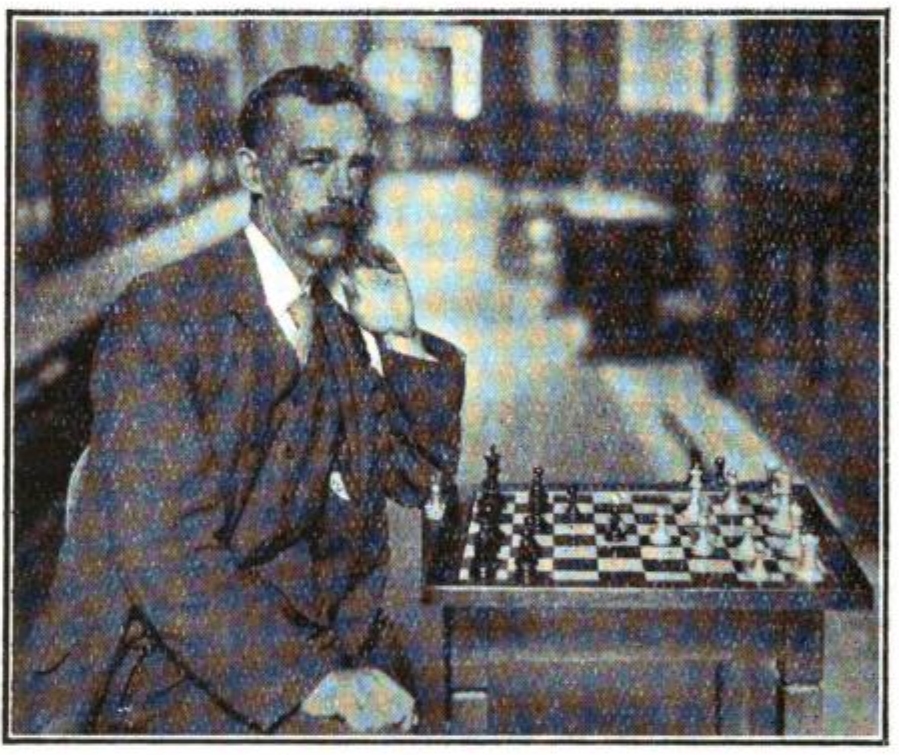
Photo: BCM, October 1924
Two years later, in August 1924, Atkins again took part in the British Championships and won by half a point ahead of his old rival Yates. Of his eleven games, Atkins won seven, drew three and also suffered a defeat against Reginald Michell. In 1925, Atkins successfully defended the title; this time he remained unbeaten, won eight games and again drew three. Yates was again runner-up. It was Atkins's ninth national title, but also his last participation - for the time being.
Two years later, in July 1927, London was the venue for the first official Chess Olympiad, although it was not yet called that at the time.
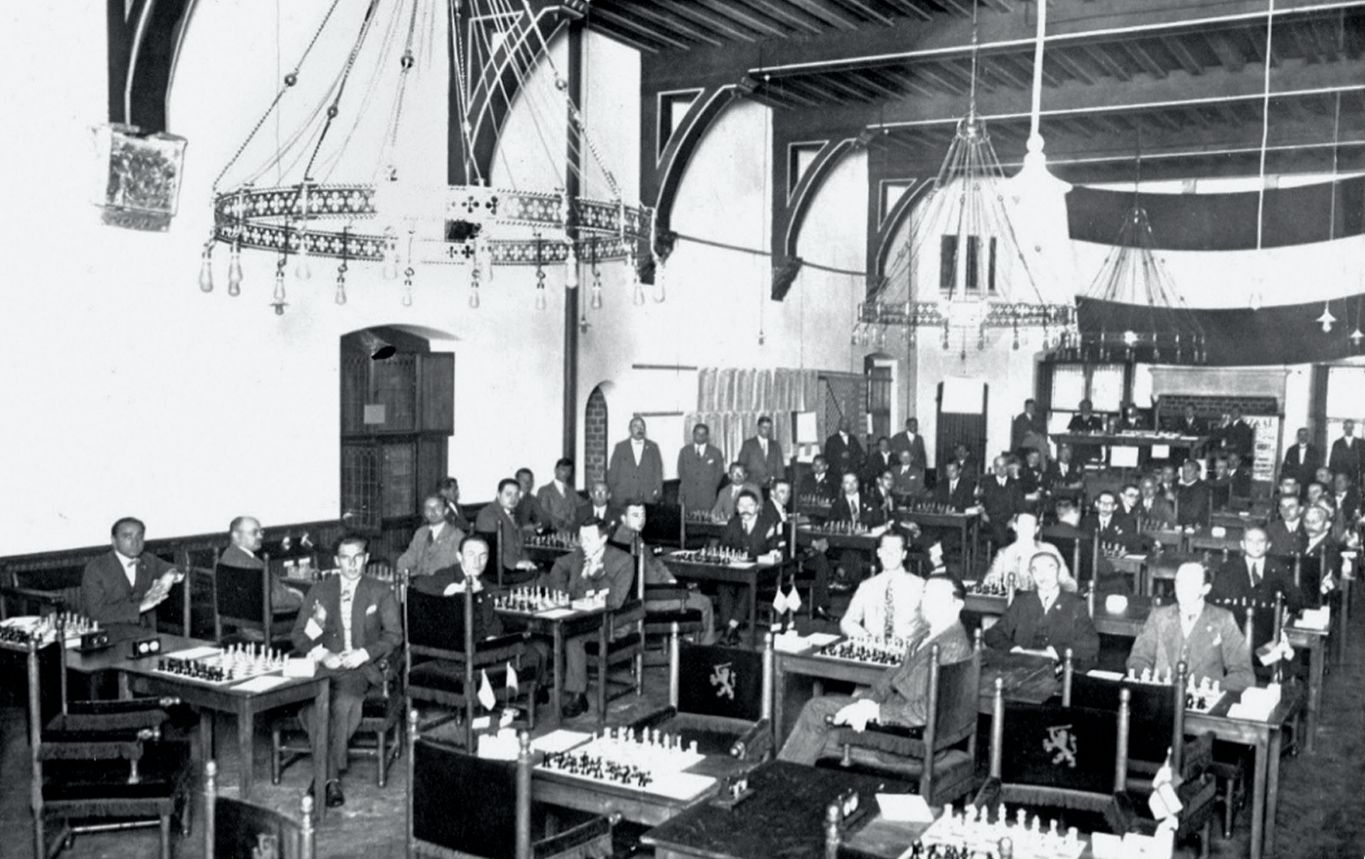
London 1927
The nine-time British Champion Henry Atkins was placed on first board for the English team, followed by Frederick Yates, George Alan Thomas, Reginald Michell and Edmund Spencer. Sixteen four-player teams competed for the medals. The format was all-play-all.
 In this insightful video course, Grandmaster David Navara shares practical advice on when to calculate deeply in a position — and just as importantly, when not to.
In this insightful video course, Grandmaster David Navara shares practical advice on when to calculate deeply in a position — and just as importantly, when not to.
Free sample video: Introduction
Free sample video: Invisible moves
The federations certainly took the competition seriously and sent strong players. However, FIDE had stipulated that only amateurs, not professional players, should take part, although the boundaries were drawn rather vaguely. Hungary came with Maroczy on top board, Austria with Ernst Grünfeld, Germany with Siegbert Tarrasch, and Richard Reti played for Czechoslovakia, which had been newly created after the war. Hungary won the gold medal, ahead of Denmark. The names of the Danish players are no longer so well known outside Denmark today, but the Danish team was very strong. Holger Norman-Hansen on board two was, together with George Alan Thomas, the best player of the tournament with 12 points from 15 games. Thanks to George Alan Thomas' performance, England took bronze. Atkins scored 7 points from 12 games on top board, a solid result.
Before the 1928 Chess Olympiad in The Hague, there was a dispute over the amateur status of the players demanded by FIDE. The US entered a team with players whose amateur status was at least questionable. England therefore did not take part in protest. Gold again went to Hungary. The US team finished second, ahead of Poland.
In 1930, England placed their new star, Sultan Khan, on first board. He had come to London from British India together with Sir Umar Hayat Khan as early as 1928, and was already the best player in India, where, however, chess was played by somewhat different rules. Sultan Khan needed some time to adapt to European rules and soon became the best player in Great Britain as well. At the Chess Olympiads in Hamburg in 1930, Prague in 1931 and Folkestone in 1933, Sultan Khan represented England on first board. In 1933, he returned to his homeland with Sir Umar. For the 1935 Chess Olympiad in Warsaw, the English Chess Federation reactivated its record national champion Henry Atkins, who by then was already 63 years old. Atkins played on board four and again achieved a solid result with 6 points from 13 games. As in the previous Chess Olympiads, however, England did not reach the medal places.
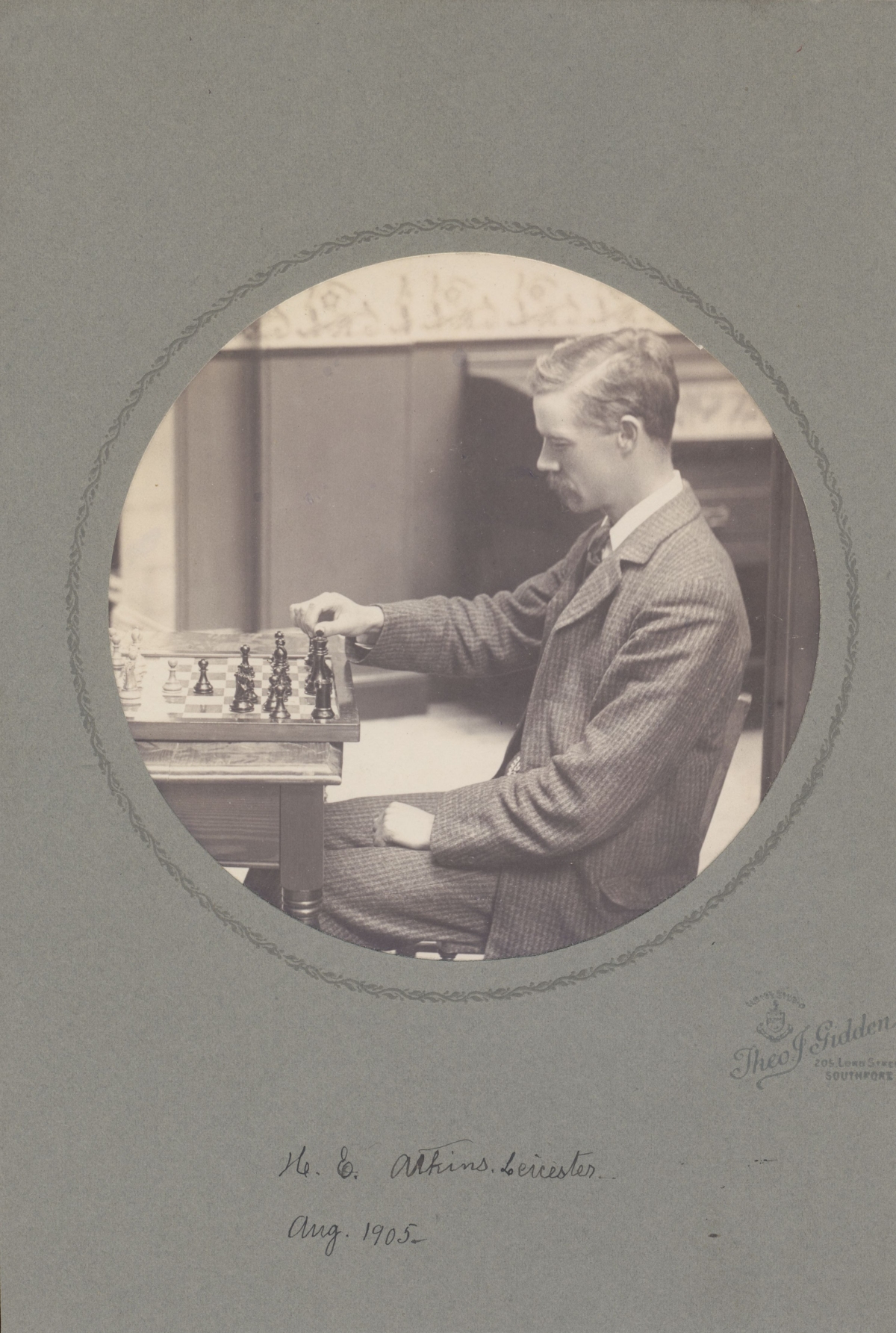
Photo: Theo F Gidden, Wikipedia
Henry Atkins's final entry in the tournament annals dates from 1937. He took part in the British Championships for the eleventh time. A tenth title was no longer within reach, but Atkins still finished in a good shared 3rd-5th place.
In 1950, FIDE awarded Henry Atkins the title of International Master.
Henry Edward Atkins died on 31 January 1955 in Huddersfield, at the age of 82.
Smyslov cultivated a clear positional style and even in sharp tactical positions often relied more on his intuition than on concrete calculation of variations. Let our authors introduce you into the world of Vasily Smyslov.