Bobby Fischer on Ken Rogoff
In our previous article Ken
Rogoff: economist and chess player we told you how Rogoff, at sixteen,
was the youngest player ever to win the United States Junior, an event in
which the eight highest rated players under twenty years of age competed.
Among the interested spectators and analysts was Grandmaster Robert Fischer,
who felt that Rogoff had great future potential. Fischer wrote the following
article for a popular youth magazine.

The October 1969 issue of Boys' Life ("For
all boys") cost 40 cents
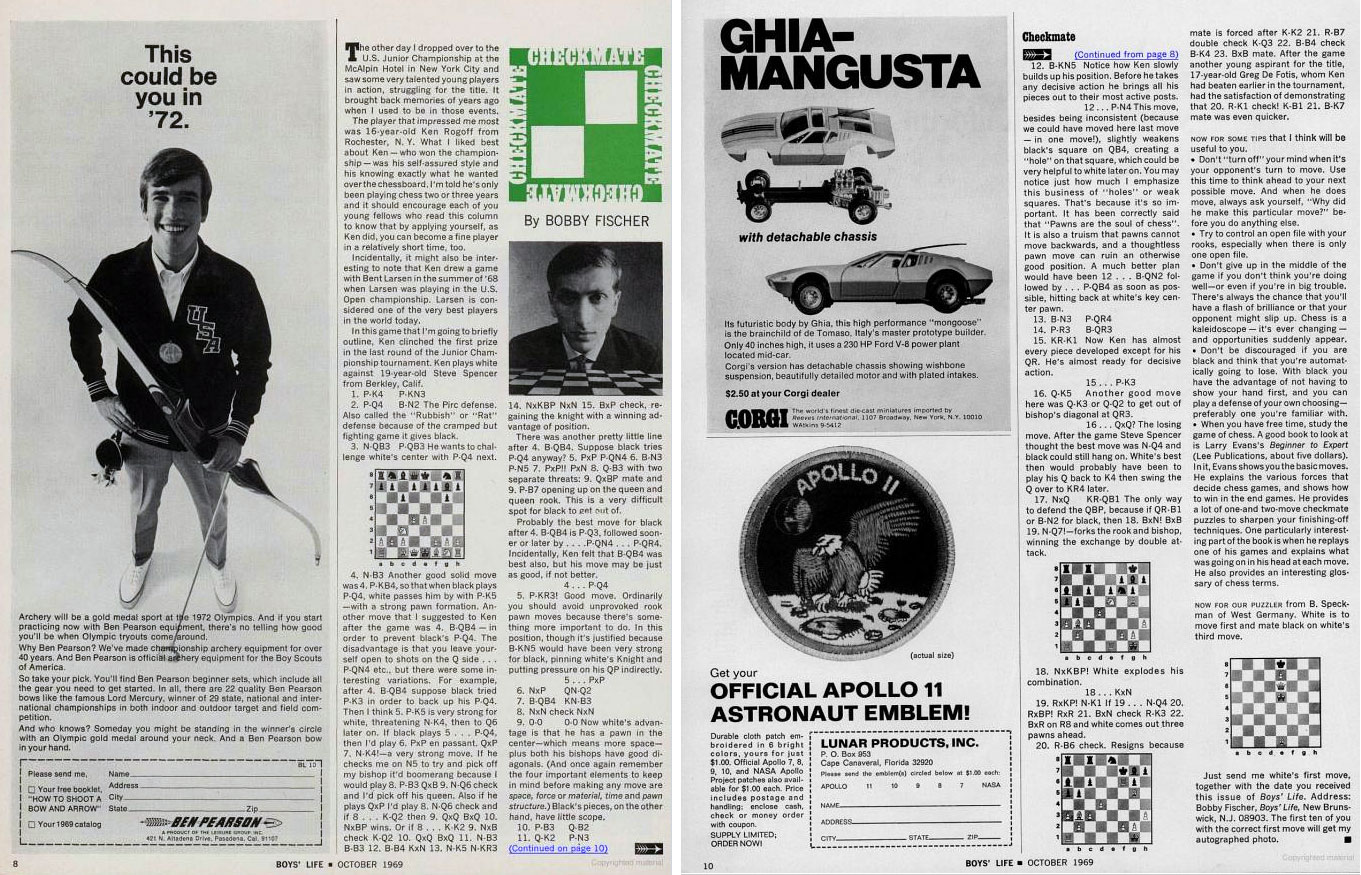
Pages 8 + 10 contained an article by Bobby
Fischer on the US Junior Championship 1969 [Click
to enlarge]
By Bobby Fischer
The other day I dropped over to the U.S. Junior Championship at the McAlpin
Hotel in New York City and saw some very talented young players in action,
struggling for the title. It brought back memories of years ago when I used
to be in those events. The player that impressed me most was 16-year-old
Ken Rogoff from Rochester, N.Y. What I liked best about Ken – who
won the championship – was his self-assured style and his knowing
exactly what he wanted over the chessboard. I'm told he's only been playing
chess two or three years and it should encourage each of you young fellows
who read this column to know that by applying yourself, as Ken did, you
can become a fine player in a relatively short time, too.
Incidentally, it might also be interesting to note that Ken drew a game
with Bent Larsen in the summer of '68 when Larsen was playing in the U.S.
Open championship. Larsen is considered one of the very best players in
the world today.
In this game that I'm going to briefly outline, Ken clinched the first
prize in the last round of the Junior Championship tournament. Ken plays
white against 19-year-old Steve Spencer from Berkley, Calif.
[Event "U.S Junior Championship"] [Site "?"] [Date "1969.??.??"] [Round
"?"] [White "Rogoff, Ken"] [Black "Spencer, Steve"] [Result "1-0"] [ECO
"B15"] [Annotator "Fischer,Bobby"] [PlyCount "39"] 1. e4 g6 2. d4 Bg7
{The Pirc defense. Also called the "Rubbish" or "Rat" defense because
of the cramped but fighting game it gives black.} 3. Nc3 c6 { He wants
to challenge white's center with ...d5 next.} 4. Nf3 ({Another move
that I suggested to Ken after the game was} 4. Bc4 {in order to prevent
black's ...d5. The disadvantage is that you leave yourself open to shots
on the Q side: ...b5 etc., but there were some interesting variations.}
e6 {In order to back up his d4 pawn.} (4... b5) ({There was another pretty
little line after 4.Bc4. Suppose black tries} 4... d5 {anyway?} 5. exd5
b5 6. Bb3 b4 7. dxc6 $3 bxc3 8. Qf3 {[%cal Rf3f7,Rc6c7,Gc7d8,Gf3a8] with
two separate threats: 9.Qxf7 mate and 9.c7, opening up on the queen and
queen rook. This is a very difficult spot for black to get out of.}) ({Probably
the best move for black after 4.Bc4 is} 4... d6 {[%cal Gb7b5,Ga7a5] followed
sooner or later by ...b5 and a5.}) {then I think} 5. e5 {[%cal Gc3e4,Ge4d6]
is very strong for white, threatening N-e4, then to d6 later on.} {If
black plays} d5 {then I'd play} 6. exd6 Qxd6 7. Ne4 $1 {a very strong
move.} {If he checks me with} Qb4+ {to try and pick off my bishop it'd
boomerang because I would play} ({Also if he plays} 7... Qxd4 {I's play}
8. Nd6+ {and if} Kd7 ({Or if} 8... Ke7 9. Nxc8+ Kd7 10. Qxd4+ Bxd4 11.
Nf3 Bf6 12. Bf4 Kxc8 13. Ne5 Nh6 14. Nxf7 Nxf7 15. Bxe6+ {regaining the
knight with a winning advantage of position.}) 9. Qxd4 Bxd4 10. Nxf7
{wins.}) 8. c3 Qxc4 9. Nd6+ {and I'd pick off his queen. -- Incidentally,
Ken felt that 4.Bc4 was best also, but his move may be just as good, if
not better.}) ({Another good solid move was} 4. f4 {so that when black
plays} d5 {white passes him by with} 5. e5 {with a strong pawn formation.
}) 4... d5 5. h3 $1 {Good move. Ordinarily you should avoid unprovoked
rook pawn moves because there's something more important to do. In this
position, though it's justified because ...Bg4 would have been very strong
for black, pinning white's Knight and putting pressure on his QP indirectly.}
dxe4 6. Nxe4 Nd7 7. Bc4 Ngf6 8. Nxf6+ Nxf6 9. O-O O-O {Now white's advantage
is that he has a pawn in the center – which means more space – plus both
his bishops have good diagonals. (And once again remember the four important
elements to keep in mind before making any move are space, force or material,
time and pawn structure.) Black's pieces, on the other hand, have little
scope.} 10. c3 Qc7 11. Qe2 b6 12. Bg5 {Notice how Ken slowly builds up
his position. Before he takes any decisive action he brings all his pieces
out to their most active posts.} b5 {This move, besides being inconsistent
(because we could have moved here last move - in one move!), slightly
weakens black's square on c5, creating a "hole" on that square, which
could be very helpful to white later on. You may notice just how much
I emphasize this business of "holes" or weak squares. That's because it's
so important. It has been correctly said that "Pawns are the soul of
chess". It is also a truism that pawns cannot move backwards, and a thoughtless
pawn move can ruin an otherwise good position.} ({ A much better plan
would have been} 12... Bb7 {followed by ...c5 as soon as possible, hitting
back at white's key center pawn.}) 13. Bb3 a5 14. a3 Ba6 15. Rfe1 {Now
Ken has almost every piece developed except for his QR. He's almost ready
for decisive action.} e6 16. Qe5 ({Another good move here was} 16. Qe3)
({or} 16. Qd2 {to get out of bishop's diagonal at a6.}) 16... Qxe5 $2
{ The losing move.} ({After the game Steve Spencer thought the best move
was} 16... Nd5 {and black could still hang on. White's best then would
probably have been to play his Q back to e4:} 17. Qe4 {[%cal Ge4h4] then
swing the Q over to h4 later.}) 17. Nxe5 Rfc8 {The only way to defend
the c6-pawn} ({ because if} 17... Rac8 {(or 17...Bb7)} 18. Bxf6 Bxf6 19.
Nd7 $1 {forks the rook and bishop, winning the exchange by double attack.})
{[#]} 18. Nxf7 $1 { 18. White explodes his combination.} Kxf7 19. Rxe6
$1 Ne8 ({If} 19... Nd5 20. Rxc6 Rxc6 21. Bxd5+ Re6 22. Bxa8 {and white
comes out three pawns ahead.}) 20. Rf6+ (20. Rf6+ {mate is forced after}
Ke7 21. Rf7+ {[%cal Rf7e7,Rg5e7]} Kd6 22. Bf4+ Be5 23. Bxe5#) ({After
the game another young aspirant for the title, 17-year-old Greg De Fotis,
whom Ken had beaten earlier in the tournament, had the satisfaction of
demonstrating that} 20. Ree1+ Kf8 21. Be7# {was even quicker.}) 1-0
Now for some tips that I think will be useful to you.
-
Don't "turn off" your mind when it's your opponent's turn
to move. Use this time to think ahead to your next possible move. And
when he does move, always ask yourself, "Why did he make this particular
move?" before you do anything else.
-
Try to control an open file with your rooks, especially when there
is only one open file.
-
Don't give up in the middle of the game if you don't think you're
doing well – or even if you're in big trouble. There's always
the chance that you'll have a flash of brilliance or that your opponent
might slip up. Chess is a kaleidoscope – it's ever changing –
and opportunities suddenly appear.
-
Don't be discouraged if you are black and think that you're automatically
going to lose. With black you have the advantage of not having to show
your hand first, and you can play a defense of your own choosing –
preferably one you're familiar with.
-
When you have free time, study the game of chess. A good book to look
at is Larry Evans's Beginner to Expert (Lee Publications, about five
dollars). In it, Evans showsyou the basic moves. He explains the various
forces that decide chess games, and shows how to win in the end games.
He provides a lot of one-and two-move checkmate puzzles to sharpen your
finishing-off techniques. One particularly interesting part of the book
is when he replays one of his games and explains what was going on in
his head at each move. He also provides an interesting glossary of chess
terms.
You
can read the full October 1969 issue of Boys' Life at Google Books.
It contains lovely adverts like this:
|
|
Kenneth Rogoff is a professor public policy and economics
at Harvard University and a chess grandmaster. He recently wrote a
favourable
review on the new Fischer movie "Pawn Sacrifice". More
on Rogoff’s research, opinion pieces, and bio can be found here.
He is currently working on an interesting subject: phasing out
paper currency, which he began writing about 20 years ago.
|