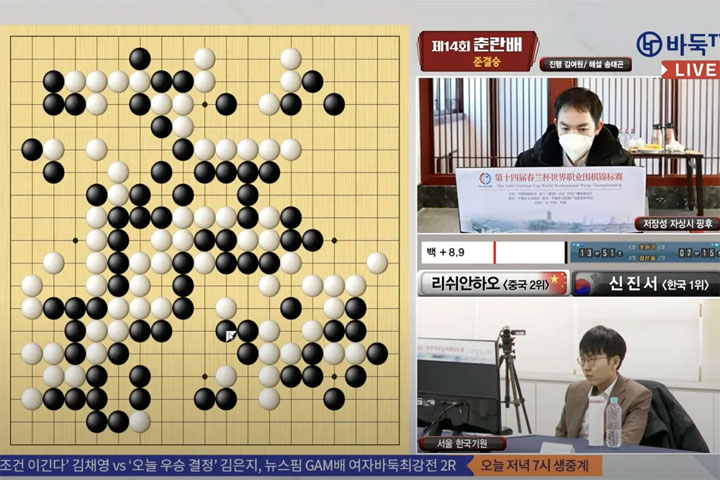
4/24/2023 – An international Go tournament, the Chunlan Cup, with a $200,000 prize fund, has been wrapped in controversy. In the semifinal round, newcomer Li Xuanhao (China) managed to defeat the reigning world champion Shin Jin-seo (South Korea). Li’s own teammate accused him of receiving AI support during the game.
new: Fritz 20
Your personal chess trainer. Your toughest opponent. Your strongest ally. FRITZ 20 is more than just a chess engine – it is a training revolution for ambitious players and professionals. Whether you are taking your first steps into the world of serious chess training, or already playing at tournament level, FRITZ 20 will help you train more efficiently, intelligently and individually than ever before.
YOUR PERSONAL CHESS COACH - Whether you’re taking your first steps into the world of club chess, or already playing at a tournament level: with FRITZ, you can train more efficiently, intelligently and with a more personalised approach than ever before. FRITZ is more than just a chess engine – it’s a training revolution! Whether you’re taking your first steps into the world of club chess, or already playing at a tournament level: with FRITZ, you can train more efficiently, intelligently and with a more personalised approach than ever before.
In this video course, Grandmaster Ivan Sokolov explores the fascinating world of King’s Indian and Pirc structures with colours reversed, often arising from the French or Sicilian.
€39.90
The story was reported in multiple news outlets, including CNN, where we first learned about the scandal. The Chinese Weiqi (Go) Association spent weeks investigating the matter, but found no evidence of cheating. However, the scandal does raise questions about the future of the game, with many parallels to the problem that chess faces.
You can watch the entire annotated game – if you have five hours for it
Jiuheng He, who researches AI at Cornell University and is an avid Go player, said to CNN: “Human experts used to dominate the whole realm. Now we have to accept a non-human actor who has expertise, maybe even has exceeded the human experts. So how are we going to deal with it?”
The game of Go is played on a 19 x 19 board and has only one piece type (similar to checkers) and simple rules. But it is profoundly complex. There are an astonishing 10170 possible board configurations, making the game immeasurably more complex than chess. Go was completely out of the scope of computer intelligence.
But then Google’s AI lab, DeepMind, developed AlphaGo, which was trained on thousands of human amateur and professional games. In 2016 it beat the 18-time world champion Lee Se-dol of South Korea in a widely-publicized match. Lee announced his retirement three years later, citing the match as the reason. The next iteration, AlphaGo Zero, learnt by simply playing games against itself. In doing so, it quickly surpassed human level of play and defeated the first AlphaGo version by 100 games to zero.
Since 2016 there have been a number of Go cheating scandals. In 2020 a South Korean court sentenced two people to a year in prison after they were caught using AI in an official competition, using a camera and earphones and receiving computer moves from an accomplice outside. Players fears the sport will lose its relevance if Go organizations cannot guarantee clean games. The situation is especially precarious in online Go leagues, where it is estimated that top players frequently use AI to enhance their game.
Players generally also use computers to train, and AI has also succeeded in setting a new, higher bar for them, even as it disrupted the game. Professor Nam Chi-hyung, who had been teaching Go for more than 20 years, told CNN that AI had became essential in her lessons. “AI can pick the right moves but cannot explain why. People still need me to interpret AI,” she said. And fans use AI viewers to understand who is winning or losing during a match broadcast.
Doesn't all of the above sound very familiar, chess lovers?
Frederic FriedelEditor-in-Chief emeritus of the ChessBase News page. Studied Philosophy and Linguistics at the University of Hamburg and Oxford, graduating with a thesis on speech act theory and moral language. He started a university career but switched to science journalism, producing documentaries for German TV. In 1986 he co-founded ChessBase.
YOUR PERSONAL CHESS COACH - Whether you’re taking your first steps into the world of club chess, or already playing at a tournament level: with FRITZ, you can train more efficiently, intelligently and with a more personalised approach than ever before.
How grandmasters win without fireworks: GM Jan Markos shows you 11 very practical tips from "How to play in a lost position" to "Be patient like Carlsen" that will improve your tournament chess.
The Nimzo-Indian has stood the test of time for over a century: Still a top choice for elite players today, from Magnus Carlsen to Praggnanandhaa, it remains one of Black's most reliable ways to fight for real chances against 1.d4 2.c4 3.Nc3.
1.c4 e5 2.Nc3 Bb4!? is an opening idea well worth considering. Black immediately threatens to double the pawns on c3 in the style of the Trompowski or Sicilian Grand Prix attack.
Italian Game Powerbase 2026 is a database and contains 8571 top class games from Mega 2026 and the Correspondence Database 2026, of which 479 are annotated.
Videos: Nico Zwirs discusses the Sicilian with 2…e6 3.d4 cxd4 4.Qxd4 Nc6 5.Qe3 Nf6 6.Nc3. Mihail Marin examines Sindarov’s 6.Ne5 in the Queen’s Pawn Defence. Plus the ‘Lucky bag’ featuring 41 analyses by Berg, Ftacnik, Gupta and many others.
€14.90
We use cookies and comparable technologies to provide certain functions, to improve the user experience and to offer interest-oriented content. Depending on their intended use, analysis cookies and marketing cookies may be used in addition to technically required cookies. Here you can make detailed settings or revoke your consent (if necessary partially) with effect for the future. Further information can be found in our data protection declaration.
Pop-up for detailed settings
We use cookies and comparable technologies to provide certain functions, to improve the user experience and to offer interest-oriented content. Depending on their intended use, cookies may be used in addition to technically required cookies, analysis cookies and marketing cookies. You can decide which cookies to use by selecting the appropriate options below. Please note that your selection may affect the functionality of the service. Further information can be found in our privacy policy.
Technically required cookies
Technically required cookies: so that you can navigate and use the basic functions and store preferences.
Analysis Cookies
To help us determine how visitors interact with our website to improve the user experience.
Marketing-Cookies
To help us offer and evaluate relevant content and interesting and appropriate advertisement.