
7/28/2021 – In round 1 of the classical part of the GM Tournament at the Biel Chess Festival three games ended with a decision. Alan Pichot won against Boris Gelfand, Kirill Alekseenko defeated Nihal Sarin and Gata Kamsky won against Noel Studer. Vincent Keymer and Maxime Lagarde drew. | Photos: Biel Chess Festival
new: Fritz 20
Your personal chess trainer. Your toughest opponent. Your strongest ally. FRITZ 20 is more than just a chess engine – it is a training revolution for ambitious players and professionals. Whether you are taking your first steps into the world of serious chess training, or already playing at tournament level, FRITZ 20 will help you train more efficiently, intelligently and individually than ever before.
In this video course, Grandmaster Ivan Sokolov explores the fascinating world of Dutch and Grünfelkd structures with colours reversed.
€39.90
The eight-player GM Tournament in Biel is a triathlon, consisting of a rapid, a blitz and a classical tournament. At the end, the points are added up at, but with different scores for each of the tournaments.
At the weekend the rapid chess tournament was played - Kirill Alekseenko won. On Tuesday, 27 July, the classical tournament began. Here, a win counts 4 points, a draw 1.5. At the end of the day, three players had scored a "four".
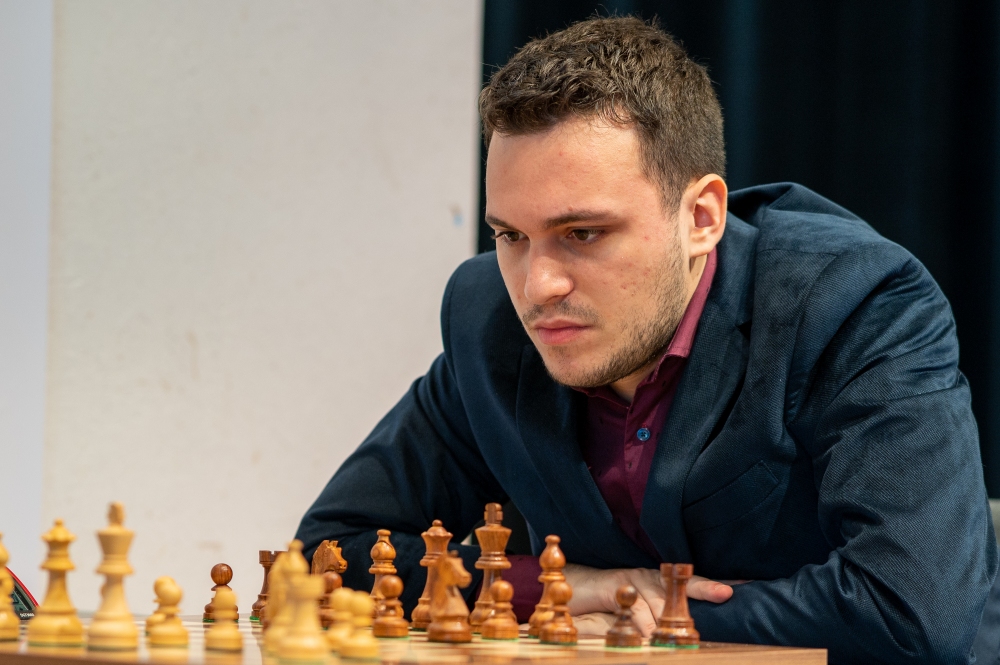
Alan Pichot
Boris Gelfand played against Alan Pichot and was initially better but then lost the thread.
22.Nd5 Qxf2+ 23.Kh1 A complicated position: Black is two pawns up but both sides have chances. The engines consider the position to be roughly equal.
23...f4?! It was probably better to play 23...Bb7 24.Qd2 f4 with chances for both sides.
24.gxf4 Bf5 The critical moment.
25.Qc3?! Gelfand misses a good chance: After 25.Qd2! Bd4 26.fxe5 White threatens to win the exchange with 27.Bh6+ and is close to a win.
25...Bd4
26.Qa3? 26.Qd2 Nc5 27.fxe5 is still good for White.
26...Nc5 27.e3 Now Black has the chance to strike back.
31...exf4 32.Bxf4 Rxf4 The pin proves to be very unpleasant for White.
33.Nxf4 Qxf4 34.exd4 Qxd4+ White resigned. After 35.Kf1 Qd1+ 36.Kf2 Nd3+ 37.Kg3 Qe1+ 38.Kg4 he will be mated soon. 0–1
Kirill Alekseenko
The game between Kirill Alekseenko and Nihal Sarin took much longer. The Russian Grandmaster and World Championship candidate needed 91 moves and seven hours of play to win against the 17-year-old Nihal Sarin in the endgame.
The third player to win was Gata Kamsky: he defeated Swiss Grandmaster Noel Studer.
You will learn how Black's dynamic piece activity and structural counterplay more than compensate for White's extra tempo in the colour-reversed setups.
In this course, you’ll learn how to take the initiative against the London and prevent White from comfortably playing their usual system by playing 1.d4 Nf6 2.Bf4 Nh5.
London System Powerbase 2026 is a database and contains in all 11 285 games from Mega 2026 and the Correspondence Database 2026, of which 282 are annotated.
The London System Powerbook 2026 is based on more than 410 000 games or game fragments from different opening moves and ECO codes; what they all have in common is that White plays d4 and Bf4 but does not play c4.
In this course, Grandmaster Elisabeth Pähtz presents the London System, a structured and ambitious approach based on the immediate Bf4, leading to rich and dynamic positions.
Opening videos: Open Spanish (Sipke Ernst) and Classical Sicilian (Nico Zwirs). Endgame Special by Igor Stohl: ‘Short or long side’ – where should the defending king be placed in rook endgames? ‘Lucky bag’ with 35 master analyses.
YOUR EASY ACCESS TO OPENING THEORY: Whether you want to build up a reliable and powerful opening repertoire or find new opening ideas for your existing repertoire, the Opening Encyclopaedia covers the entire opening theory on one product.
€169.90
We use cookies and comparable technologies to provide certain functions, to improve the user experience and to offer interest-oriented content. Depending on their intended use, analysis cookies and marketing cookies may be used in addition to technically required cookies. Here you can make detailed settings or revoke your consent (if necessary partially) with effect for the future. Further information can be found in our data protection declaration.
Pop-up for detailed settings
We use cookies and comparable technologies to provide certain functions, to improve the user experience and to offer interest-oriented content. Depending on their intended use, cookies may be used in addition to technically required cookies, analysis cookies and marketing cookies. You can decide which cookies to use by selecting the appropriate options below. Please note that your selection may affect the functionality of the service. Further information can be found in our privacy policy.
Technically required cookies
Technically required cookies: so that you can navigate and use the basic functions and store preferences.
Analysis Cookies
To help us determine how visitors interact with our website to improve the user experience.
Marketing-Cookies
To help us offer and evaluate relevant content and interesting and appropriate advertisement.