Biel stands out with creative tournament formats
The Biel International Chess Festival is known for its creative tournament formats. In the two ACCENTUS Chess960 invitational tournaments, divided into Masters and Generations Challenge, the players did not only play five rounds of Chess960 against the players within their own group. Two further rounds were added, with games against players from the other group. This makes the tournament format stand out. The results of this tournament, in turn, are used as a tiebreak for the Masters triathlon.
Final standings ACCENTUS Chess960 Masters
Legend: TB = tiebreak (here: direct encounter)
This crosstable also includes the results of the six participants from the Generations Challenge from the final two rounds. This is because the pairings in rounds six and seven were against players from the other group. However, the points they scored in these two rounds only count towards the standings of the tournament in their own group.
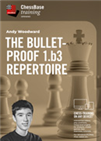 This compact course is designed specifically for practical play. Instead of overwhelming you with endless theory, it focuses on the critical lines, typical plans, and recurring tactical ideas.
Looking for an opening that gets your opponents thinking on move one? Grandmaster Andy Woodward has relied on 1.b3 for years in blitz and bullet, using it to defeat strong masters and grandmasters who underestimated its hidden venom. While many players dismiss the opening as harmless, they often find themselves caught in unfamiliar positions, tactical traps, and uncomfortable middlegames. This compact course is designed specifically for practical play. Instead of overwhelming you with endless theory, it focuses on the critical lines, typical plans, and recurring tactical ideas that matter most when the clock is ticking.
Free video sample: Introduction
Free video sample: King's Indian Setup
Carissa Yip was the only player from the Generations Challenge to beat a Masters player in the final two rounds. She achieved this victory in round six against Liem Le Quang. He finished with 3/7 in sixth place among the Masters participants. This left him one point behind Jose Martinez, Yagiz Kaan Erdogmus and Levon Aronian, and 1½ points behind Bluebaum and Suleymanli.
Martinez also prevailed over his direct rivals on the same score, Erdogmus and Aronian, thanks to the results of their direct encounters.
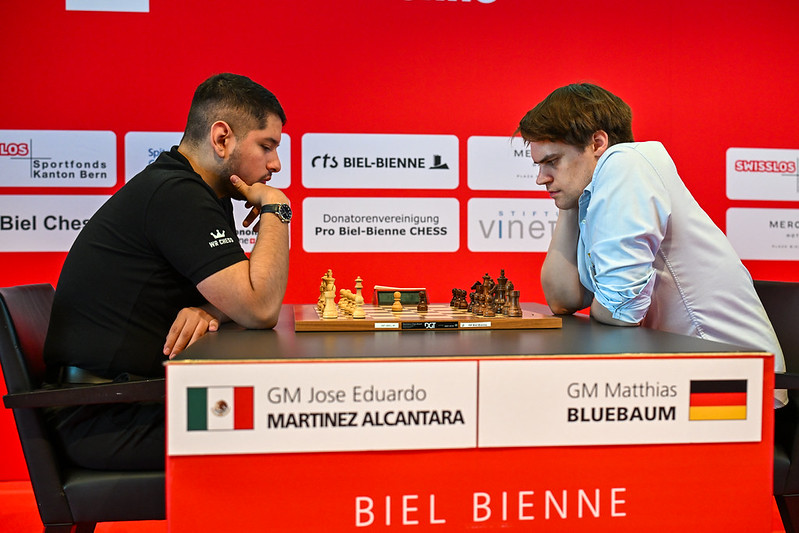
Jose Martinez (third place) lost his game with white against eventual winner Matthias Bluebaum | Photo: Biel Chess Festival
Levon Aronian, in turn, was the only Masters player to win both of the final two rounds. He defeated Xiao Tong and Vaclav Finek. Nobody went unbeaten in this Chess960 rapid tournament. Bluebaum, however, was the only participant from the Masters to lose just one game. He was beaten by Aronian in the first round. After that, he drew three times and collected three wins. His game in round four was particularly relevant for the final standings, as he defeated Suleymanli. Since the result of the direct encounter was used as the tiebreak, Bluebaum won the tournament.
Suleymanli v. Bluebaum (round four)
Bluebaum's advantage in the game against Suleymanli was achieved early on. While Suleymanli focused on developing his knights on the queenside, Bluebaum developed his bishops on the kingside first and, in the process, worsened his opponent's pawn structure on the queenside.
Suleymanli was not deterred from castling long later on, while Bluebaum castled short. In order to reach the safe square a2 after castling from c1, however, he had to spend a few extra tempi.
Before either of them castled, there was another dramatic moment. Bluebaum had just exchanged White's bishop on c4, leaving Suleymanli's queen on c4 and once again preventing Black from castling. Black therefore placed his knight in the way with 8...Ne6. In this position, the engine suggests long castling for White. But Suleymanli had other plans.
After 9.f4 Bluebaum first exchanged bishops on g1, captured the sacrificed pawn on f4 and soon returned the knight to e6 to make short castling possible again.
The game ended with Bluebaum a pawn up, with the more active and better coordinated rooks on the board, and with the clock working in his favour. He still had more than five minutes, while Suleymanli had to operate on the final seconds of his clock and with a short increment of five seconds.
Suleymanli is playing in the Masters as a last-minute replacement for Nodirbek Yakkuboev. That he immediately fought for tournament victory in the Chess960 event shows that he was an excellent choice for the vacant place in the tournament.
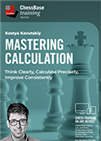 Chess is a concrete game. There is no way around training your calculation skills. Improve your visualization, pattern recognition and learn calculation techniques such as reciprocal thinking with this course.
Calculation is at the heart of practical chess. Every chess concept builds on proper calculation technique. Therefore, all chess players should continuosly train the fundamental techniques, concepts and patterns this course will present. The goal isn't only to teach you to calculate, but to give you the tools and insights to keep improving long after the final lesson.
Free sample video: Introduction
Free sample video: Quiet Moves
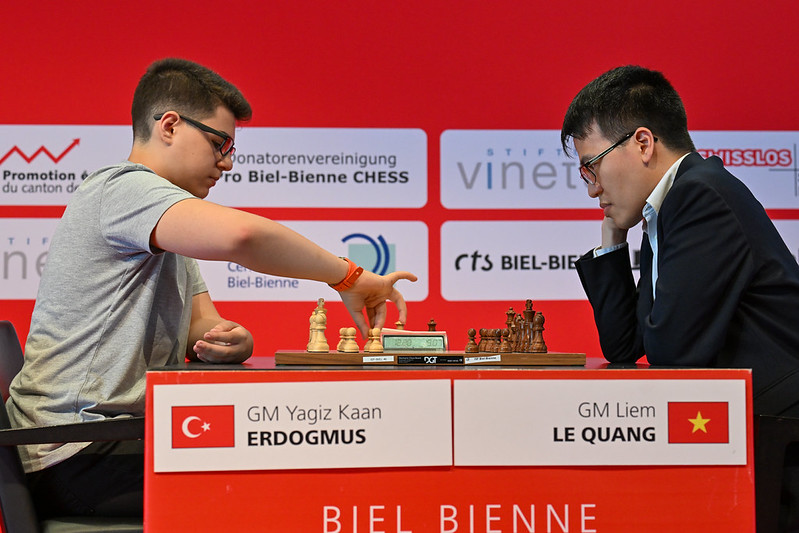
Le Quang Liem collected four losses (including against Yagiz Kaan Erdogmus) and three wins | Photo: Biel Chess Festival
Games Masters
Games Challenge (with Masters games Round 6 + Round 7)
Triathlons: Masters and Generations Challenge
 Doesn’t every chess game get decided by mistakes? Absolutely. But most players never truly comprehend that they are making the same kind of mistakes over and over again.
| Date |
11-24 July 2026 |
| Format |
Chess triathlons with 6 participants each |
| System |
Classical: 5 rounds (first legs) + 3 rounds (final: return games with the top four players). Rapid: 5 rounds (with colours reversed from the classical first legs). Blitz: 10 rounds |
| Time control |
Classical: 120' for the first 40 moves, then 30' for the rest of the game, with a 30'' increment per move from move 41. Rapid: 15'+5'' per move. Blitz: 3'+2'' per move |
| Scoring |
Classical: win 4 points; draw 1.5 points; loss 0 points. Rapid: win 2 points; draw 1 point; loss 0 points. Blitz: win 1 point; draw 0.5 points; loss 0 points. |
| Tiebreak |
The final standings are determined by adding together the points scored in the three sections (classical+rapid+blitz). In the event of a tie, the final standings of the ACCENTUS Chess960 decide the ranking for the prizes. |
Schedule
| 10 July |
20:00 |
Reception of participants - toast at the Congress Centre |
| 11 July |
11:30 |
Opening ceremony at the Congress Centre |
| 11 July |
14:00 |
ACCENTUS Fischer Random rapid tournament |
| 12 July |
14:00 |
Rapid games of the Masters & Generations Challenge |
| 13 July |
14:00 |
Visit to Omega with the Masters & Generations Challenge participants |
| 14-18 July |
14:00 |
Classical games of the Masters & Generations Challenge |
| 19 July |
14:00 |
Blitz games of the Masters & Generations Challenge |
| 20 July |
|
Rest day |
| 21-23 July |
14:00 |
Final rounds of the Masters & Generations Challenge (classical games) |
| 24 July |
10:30 |
Closing ceremony with prize-giving and apéritif at the Congress Centre |
Links




.png)