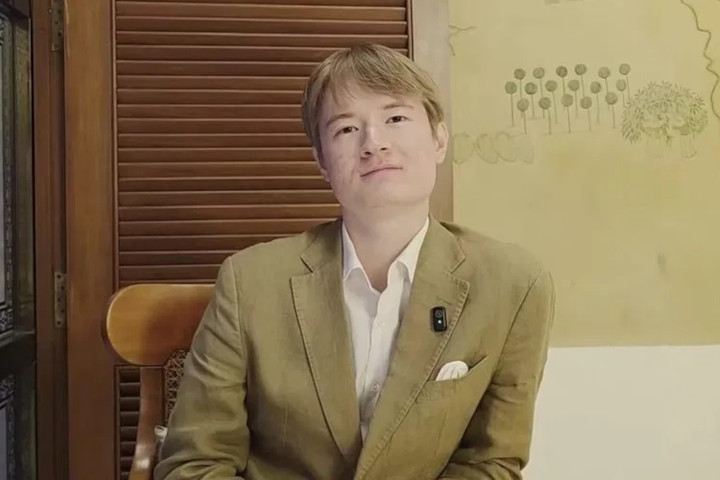
11/5/2026 – Chennai has given GM Alisher Suleymenov a title and a reason to return. After winning the 1st Chola Chess International GM Round Robin earlier this year, the Kazakh grandmaster is back for the 1st Chola Chess GM 2026. In this interview with Devansh Singh, he recalls beating a 12-year-old Gukesh Dommaraju and explains why he considers Javokhir Sindarov the favourite in the World Championship match. He also speaks about his ambitions in chess and the importance of staying psychologically strong. | Photo: ChessBase India
new: Fritz 20
Your personal chess trainer. Your toughest opponent. Your strongest ally. FRITZ 20 is more than just a chess engine – it is a training revolution for ambitious players and professionals. Whether you are taking your first steps into the world of serious chess training, or already playing at tournament level, FRITZ 20 will help you train more efficiently, intelligently and individually than ever before.
YOUR PERSONAL CHESS COACH - Whether you’re taking your first steps into the world of club chess, or already playing at a tournament level: with FRITZ, you can train more efficiently, intelligently and with a more personalised approach than ever before. FRITZ is more than just a chess engine – it’s a training revolution! Whether you’re taking your first steps into the world of club chess, or already playing at a tournament level: with FRITZ, you can train more efficiently, intelligently and with a more personalised approach than ever before.
If you're looking for a dynamic alternative to the Slav, Queen's Gambit Declined, or other mainstream systems, the Chigorin Defence offers exactly what modern tournament players need.
€34.90
Interview with Alisher Suleymenov
GM Alisher Suleymenov of Kazakhstan is back in Chennai, the city where he won the 1st Chola Chess International GM Round Robin earlier this year. He is the 21st seed at the Chola GM Open. Devansh Singh from the ChessBase India team spoke with him about why Chennai keeps drawing him back, the day he beat a 12-year-old Gukesh Dommaraju, the upcoming World Championship match and the psychological aspects of chess.
Devansh: Welcome to Chennai again, Alisher. Last time you played here, it was the 1st Chola Chess GM Round Robin, and you won that event. This is the first time a tournament of this strength is happening in India with average rating 2412 and 30–35 grandmasters. How does it feel to play this kind of event in India?
Alisher: It's wonderful. I want to thank Chola Chess again for inviting me. I really enjoy playing in Chennai, and in India overall. I believe this is my seventh time in India, and the third time in Chennai, because I also played the 44th Chess Olympiad here. I pretty much have only good memories of Chennai - I played very well at the Olympiad and gained even more rating points there than in the Round Robin event. And I always enjoy the conditions that the All India Chess Federation and Chola Chess provide. I have visited over 30 countries. During the 44th FIDE Chess Olympiad, the hotel we stayed in was the best. Also, everything here is just perfect.
Keep it simple. Stay objective. Watch the clock. Sometimes take the risk. GM Loek van Wely explains the ten principles that decide real games. They aren’t about theory. They’re about what you do at the board when it counts. Opening theory gets all the attention. But according to GM Loek van Wely, a player who has played in 14 Olympiads, is eight-time Dutch champion, and has decades of experience against Karpov, Kasparov, Anand, and Carlsen, most of what separates strong players from the rest has nothing to do with memorised lines.
Free sample video: Introduction
Free sample video: Don't Bluff the Donkey
Devansh: In that Round Robin tournament, you were the invited grandmaster while the Indian international masters were chasing norms, and some of them are grandmasters now. When you play such an event, do you feel extra motivation, knowing they have to get past you? Some players just play for draws in these events. You are not one of them.
Alisher: I was very happy when I got invited, because the average rating of the tournament was almost like mine - a very strong event. And I want to say that the idea of Chola Chess, inviting specifically young foreigners, is a very good idea. In most Round Robin events around the world, organisers invite older grandmasters who have sort of quit chess - they are not motivated, they don't work on chess - and it is much easier to earn a GM norm there. This time it was tough, because almost all the foreigners were young, motivated, hardworking professionals. The long-term growth is much more important than short-term achievements. After that tournament, I went straight to an open tournament in Russia and won it despite not being the favourite - so Chola was good training as well.
Devansh: Let's come to this tournament. Today you played one of the most talented girls in Indian chess, Shubhi. How was the game?
Alisher: A very equal game, I believe. In the opening, I was slightly better, with long-term pressure and no risk. From one point, she started defending very well. I won a pawn, but she got very active pieces in the endgame, and at once I missed a defensive resource of hers, after which it was just a draw. Before that, I could have tried something better - I would probably have posed more practical problems - but objectively it was still very much a draw.
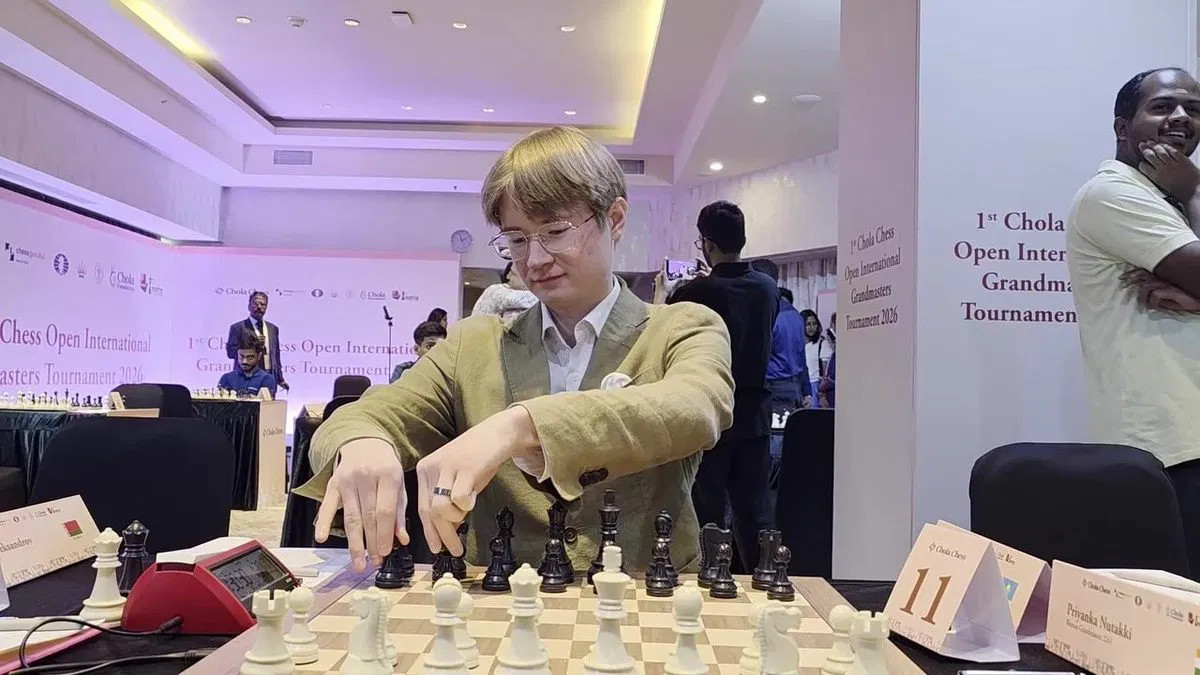
Alisher Suleymenov at the board during the Chola GM Open 2026
Devansh: The World Championship match is coming up. You have played both Gukesh and Sindarov in classical chess. Who do you think has the upper hand?
Alisher: I played once against Gukesh, when he was 2500, and I was 2430 - I was 19, he was 12. That was in Russia, at the Aeroflot Open 2019. Usually, there is one round a day, but because of some issues on the first day, they had to make a double round, and we played in the afternoon. He was quite small and might have been tired. I played extremely well, and even now I am proud of that game. Then we played at the World Rapid Championship in Samarkand 2023 - I was sort of winning there too, but the position remained complicated. I couldn't maintain my advantage, and Gukesh managed to outcalculate me very well.
Against Sindarov, I have played much more in classical chess, and honestly, looking at the positions we got, I should have had a plus score against him - but I kept losing completely winning or just dead-drawn positions. I was not able to make even a single draw against him. Once I was completely winning; another time I had more time and a nearly decisive advantage. So from my own experience of facing both of them, psychologically I believe Sindarov is a bit stronger, and that is the main reason I consider him the favourite. But I don't want to say I am rooting for anybody - I just want to see a very good match between two very strong players. Sindarov was never happy to just make a draw from a losing position against me; in drawn positions he was always trying to beat me, and to beat anyone, given the chance. He is a real fighter, I believe.
Gukesh Dommaraju | Photo: Nils Rohde
Devansh: You have played almost all the top players - Carlsen, Praggnanandhaa, Sindarov, Gukesh.
Alisher: Gukesh, Sindarov, Pragg, Abdusattorov I have played them - not all of them, but most of them.
Devansh: You are seeded 21st here by rating. What is your target? To win the tournament, or just to play well?
Alisher: For everybody, when you go to a tournament, you should always aim for the best. The ambitious aim would be to win the tournament, but I understand it is extremely strong, so I just want to play well and see how it goes.
How grandmasters win without fireworks: GM Jan Markos shows you 11 very practical tips from "How to play in a lost position" to "Be patient like Carlsen" that will improve your tournament chess. Most chess books teach you what to think about. This series teaches you what to actually do when the clock is running and the result is on the line. Compiled from GM Jan Markos's acclaimed "Practical Tips for the Tournament Player" column in ChessBase Magazine, Volume 1 covers the decisions every tournament player faces before the position ever gets complicated: how you use your time, how you handle pressure, and how you think when the stakes are real.
Free Video Sample: How to use your time effectively
Devansh: Doesn't aiming to win put extra pressure on you during the games or in preparation?
Alisher: You have such great questions. I have a 17-year career already. When you are less experienced and play close to ten tournaments a year, always aiming for the best, it creates extra expectations, and it backfired for me many times. With experience, you understand that these days everybody plays chess very well - you respect your opponents but still try for the best. I am happy that I managed to have no stress despite high aims. This year, apart from Chola Chess, I won two international tournaments, and I went there with high aims as usual. The psychological part in chess is extremely important.
Devansh: Take an ambitious player around 2200-2300 going for their first title or norm. Ambition creates pressure, but just playing without it can kill motivation. How do you manage that balance?
Alisher: I believe it depends a lot on concentration, and you should have a balance of both attitudes, because each can have drawbacks. It usually comes with experience. But if you have to pick one, and you are not experienced enough yet, I would still go with ambition - long-term, it is much better. I can compare two youngsters I have in mind - I won't say who. One is chess-wise just better, the other is psychologically better. Recently, I saw that the first one performed worse because he was not psychologically ready, while the other guy thinks he is super strong - and that really helps him, although it wastes too much energy sometimes. It is very individual. And it is not enough to have very good chess understanding - you have to play well, and you cannot keep working on the same things in the same manner. You have to work on everything for long-term improvement.
Devansh: Thanks for your time, Alisher! It's been nice talking to you.
In this Fritztrainer: “Attack like a Super GM” with Gukesh we touch upon all aspects of his play, with special emphasis on how you can become a better attacking player.
ChessBase IndiaChessBase India is currently the biggest chess news portal and chess software distributor in India. We have daily reports about tournaments in India, profiles of the best talents and information about players performing admirably at the international level. Our motto is “Powering Chess in India”. Apart from news, we provide all the services that are required to ease the life of a chess player.
11/3/2026 – In his last tournament before the World Championship match later this month, Javokhir Sindarov showed great form by winning Clutch Chess in Saint Louis. My favorite game was his spectacular victory with the black pieces against Nakamura. In a Saemisch Variation of the King's Indian, Nakamura used his pet line with 6.Bg5 which he has been using frequently playing against his own favorite opening he's had great successes with over the years. Interestingly up till move 17 the players were following an earlier blitz game played in Saint Louis back in 2016 between two KID specialists Nakamura and Kasparov! Despite the short time control (10 min + 5 sec) the young Uzbek superstar considered this game as ''one of his best games with the King's Indian'', so it's an absolute must-see!
10/31/2026 – Twelve years ago, a college student in Charlotte with an economics degree and no business plan asked his local chess community for $10,000 to open a chess club. They gave him $30,000. Today the Charlotte Chess Center teaches 2,500 children a week, runs more rated tournaments than there are days in the year, and hosts Judit Polgar, Peter Leko and Boris Gelfand as camp trainers. Sagar Shah travelled to Charlotte for the Daniel Naroditsky Memorial and sat down with founder Peter Giannatos to understand exactly how it was built. | All photos: Courtesy of Peter Giannatos and the Charlotte Chess Center
YOUR PERSONAL CHESS COACH - Whether you’re taking your first steps into the world of club chess, or already playing at a tournament level: with FRITZ, you can train more efficiently, intelligently and with a more personalised approach than ever before.
Keep it simple. Stay objective. Watch the clock. Sometimes take the risk. GM Loek van Wely explains the ten principles that decide real games. They aren’t about theory. They’re about what you do at the board when it counts.
2026 Chess Olympiad with analyses by Abdusattorov, Donchenko, Duda, So and many more – ‘Rooks love open files’: Tactics training with Oliver Reeh – ‘Don’t underestimate it’: Caruana’s blitz weapon 1.e4 e5 2.d3 – Total Video playing time: over 6 hours!
Most players don’t lack the urge to attack, they just strike at the wrong moment, and GM Sipke Ernst shows you which signals tell you to go for the king and which tell you to choose another plan.
How grandmasters win without fireworks: GM Jan Markos shows you 11 very practical tips from "How to play in a lost position" to "Be patient like Carlsen" that will improve your tournament chess.
The Nimzo-Indian has stood the test of time for over a century: Still a top choice for elite players today, from Magnus Carlsen to Praggnanandhaa, it remains one of Black's most reliable ways to fight for real chances against 1.d4 2.c4 3.Nc3.
1.c4 e5 2.Nc3 Bb4!? is an opening idea well worth considering. Black immediately threatens to double the pawns on c3 in the style of the Trompowski or Sicilian Grand Prix attack.
In this 60-minute video course you’ll learn how to use the Austrian Defence as a practical weapon for Black!
€9.90
We use cookies and comparable technologies to provide certain functions, to improve the user experience and to offer interest-oriented content. Depending on their intended use, analysis cookies and marketing cookies may be used in addition to technically required cookies. Here you can make detailed settings or revoke your consent (if necessary partially) with effect for the future. Further information can be found in our data protection declaration.
Pop-up for detailed settings
We use cookies and comparable technologies to provide certain functions, to improve the user experience and to offer interest-oriented content. Depending on their intended use, cookies may be used in addition to technically required cookies, analysis cookies and marketing cookies. You can decide which cookies to use by selecting the appropriate options below. Please note that your selection may affect the functionality of the service. Further information can be found in our privacy policy.
Technically required cookies
Technically required cookies: so that you can navigate and use the basic functions and store preferences.
Analysis Cookies
To help us determine how visitors interact with our website to improve the user experience.
Marketing-Cookies
To help us offer and evaluate relevant content and interesting and appropriate advertisement.

















.jpeg)