



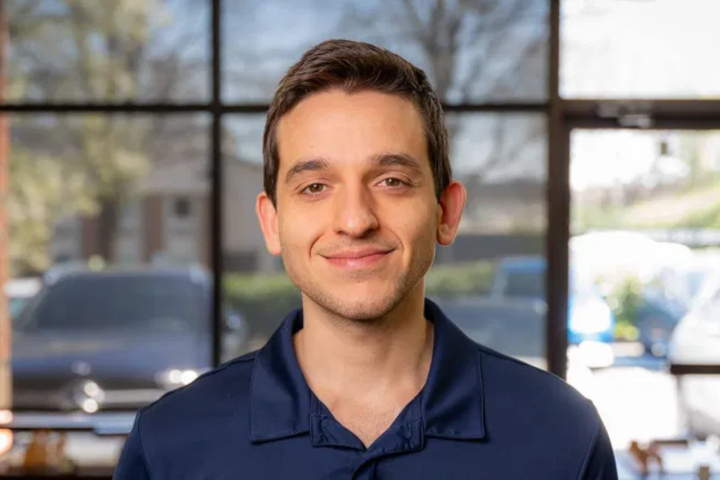

Peter Giannatos is a man on a mission. I observed him closely during the Naroditsky Memorial. He is the founder of the Charlotte Chess Center and also the person who made the Daniel Naroditsky Memorial possible. I found in Peter a rare combination of someone who meant business but also cared about the little details. He is extremely action-oriented, yet mindful of the right course of action. Seeing the Charlotte Chess Center grow into one of the biggest academies in the US, and indeed the world, made me curious: what were Peter and his team doing that had made them so successful? This interview is the result of that curiosity.
Sagar Shah (SS): This is one of two centres in Charlotte. How many students are there at the Charlotte Chess Center?
Peter Giannatos (PG): This is our North Center – it just opened a few years ago and serves the north corridor of Charlotte. We have a South Center which we call our main campus, which is a little larger. We teach about 500 students a week in our academy classes between the two facilities. We also have school programmes, where we visit schools – that's about 2,000 kids a week across roughly 60 area school programmes. And then of course we have tournaments and adult members. It's a vibrant, well-rounded chess community: young children learning chess, but also adults who play casually or in tournaments.
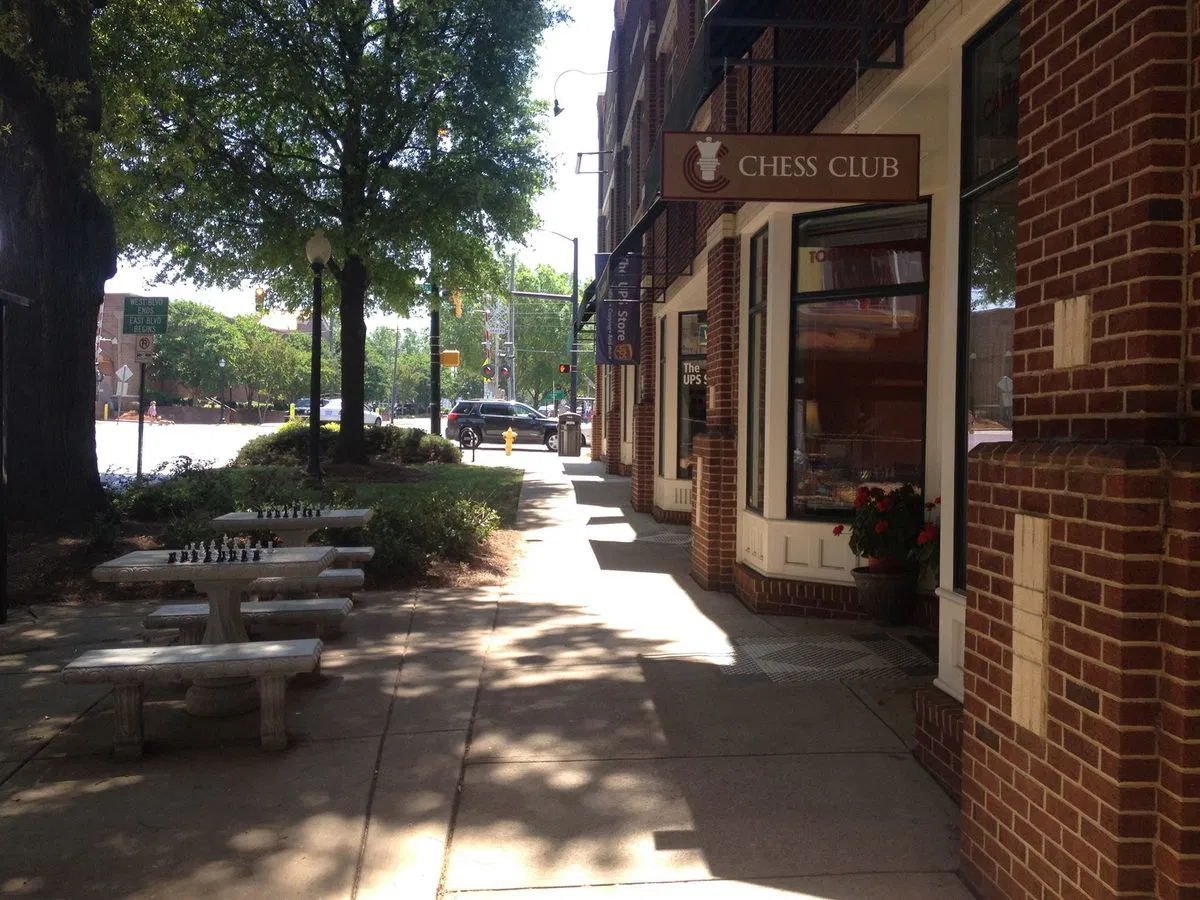
The approach road near the South Centre has chess sets outside the premises.
SS: 500 in the academies alone. That's a lot. How did the idea of the Charlotte Chess Center begin? Did you always want to teach chess?
PG: I can't say I necessarily always wanted to teach. But when I was at university I started giving private lessons, and eventually I worked in some school programmes to earn a little money. Of course I loved chess, so it didn't feel like a job.
I was very much involved with chess and playing, but I never thought of it as a business. It wasn't until later, as I approached graduation, that I realised I didn't want to give chess up – and that if I pursued a career outside of chess, I wouldn't be able to devote as much time to it.
SS: What were you studying?
PG: Economics at the University of North Carolina at Charlotte. I did finish the degree – but I actually opened the chess centre during my final semester at university. I only had a few credit hours left, so it was manageable.
But I had been organising chess from a very young age. The first event I organised and directed was in 2007. I was in high school, and the objective was to raise money for our high school chess team so we could go to nationals. That was my first step into organising chess.
Then a friend of mine, Gary Newsome, and I decided to start a chess club together that met at a library – Queen City Chess. That was in 2007–08. Once a week, occasionally a weekend tournament, but primarily just a club meeting. We were a community-based chess club like those that exist in many places in the US and I'm sure around the world.
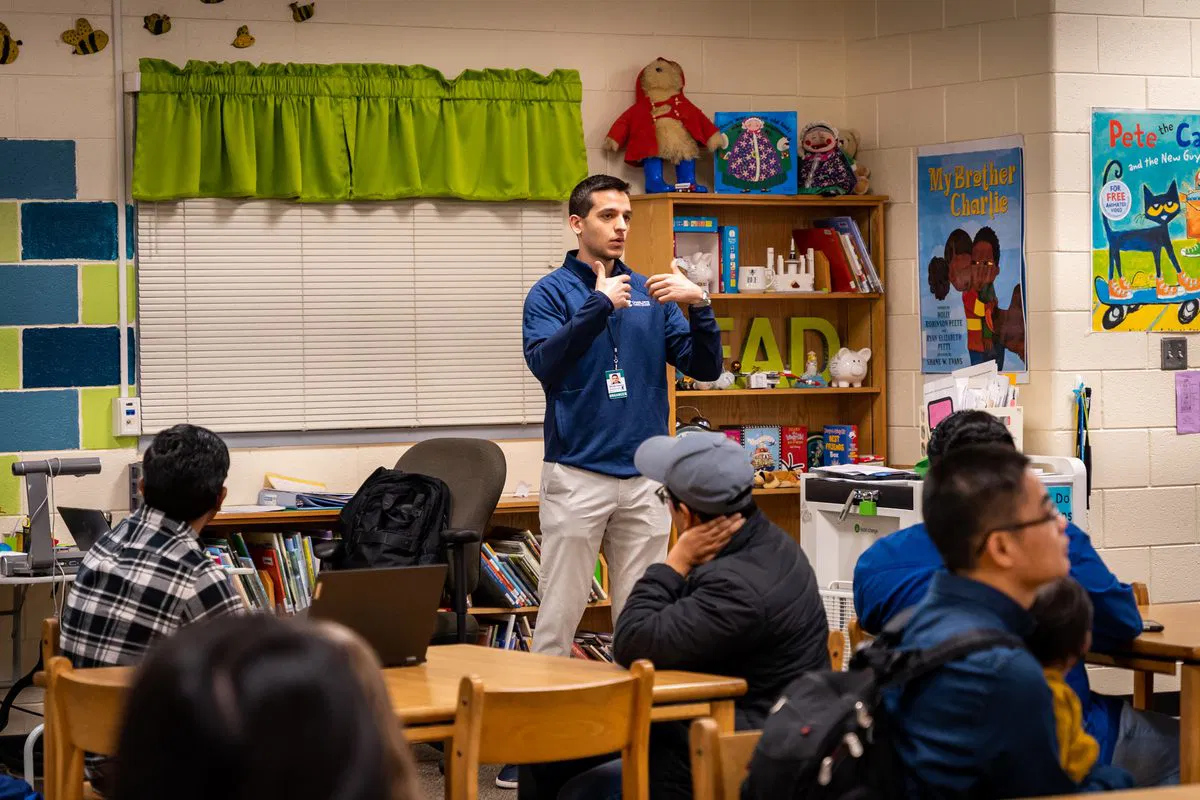
Teaching and organising came naturally to Peter.
SS: And there was no business intention behind that?
PG: None at all. I was involved with it because I wanted to play chess. I was in high school, then just starting college, and I was doing it so I had a place to play. It was all volunteer. It wasn't until late 2013, early 2014 that I understood – okay, my life is changing now. I was initially planning to go into banking. Charlotte is actually known as a financial hub in the US, and that was the most natural course for me to take.
But from 2007 to 2013 we had developed such a great reputation within our community with Queen City Chess. So I thought: could a self-sustaining chess centre work? There weren't many models to go by. But I had some business skills – my family ran businesses when I was a kid, restaurants – and I went to school for business. So I at least had an idea of how it could work.
My thinking at the time was simple: I could do everything. I could run the tournaments, I could teach the classes, I would do anything to make it work. So I put together a business proposal and I approached selected members of our community and asked for contributions to start the Charlotte Chess Center.
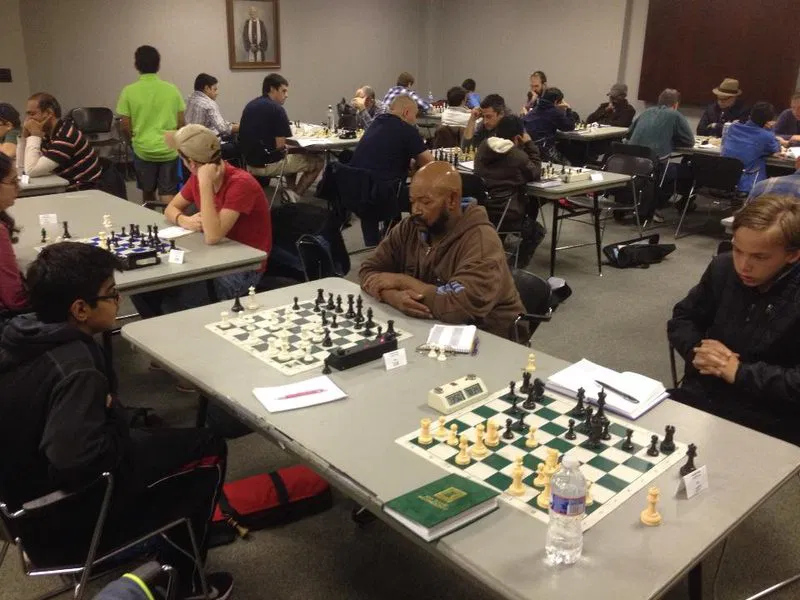
Bonnie Cone Center at UNC Charlotte (where Peter graduated from university). Peter used to run his monthly Saturday tournaments there. His events there dated back to 2008, when he was still at high school.
SS: Before we get to that – how strong were you as a player? You're an FM. What were your best achievements?
PG: I started chess late. I played my first tournament as a 13-year-old, in eighth grade, and I was no hidden gem or anything like that. My first US Chess rating was just over 500. So I was not some hidden talent.
But I fell in love with the game, and it consumed me a little bit. I'd say an early achievement was going from a 500-rated player to a 2000-rated player in about three and a half years, which was pretty fast for someone who had just started. But it was only because I loved it. I was immersed in it and studied all the time.
Back then I was playing on FICS – the Free Internet Chess Server, the alternative to ICC.
SS: I heard about FICS just two or three days ago! Everyone in the bughouse community played there.
PG: Yes. It was the Lichess of its time. My friend and I would play league games on FICS. I was totally consumed with chess; I would read every book. Then I became a National Master at 22, and I made the FM title when I was 27. I played a little after that – a couple of tournaments – and then focused my energy on the Charlotte Chess Center. I don't regret that shift, because I feel the impact has been so much greater as an organiser and facilitator of the game than as a player.
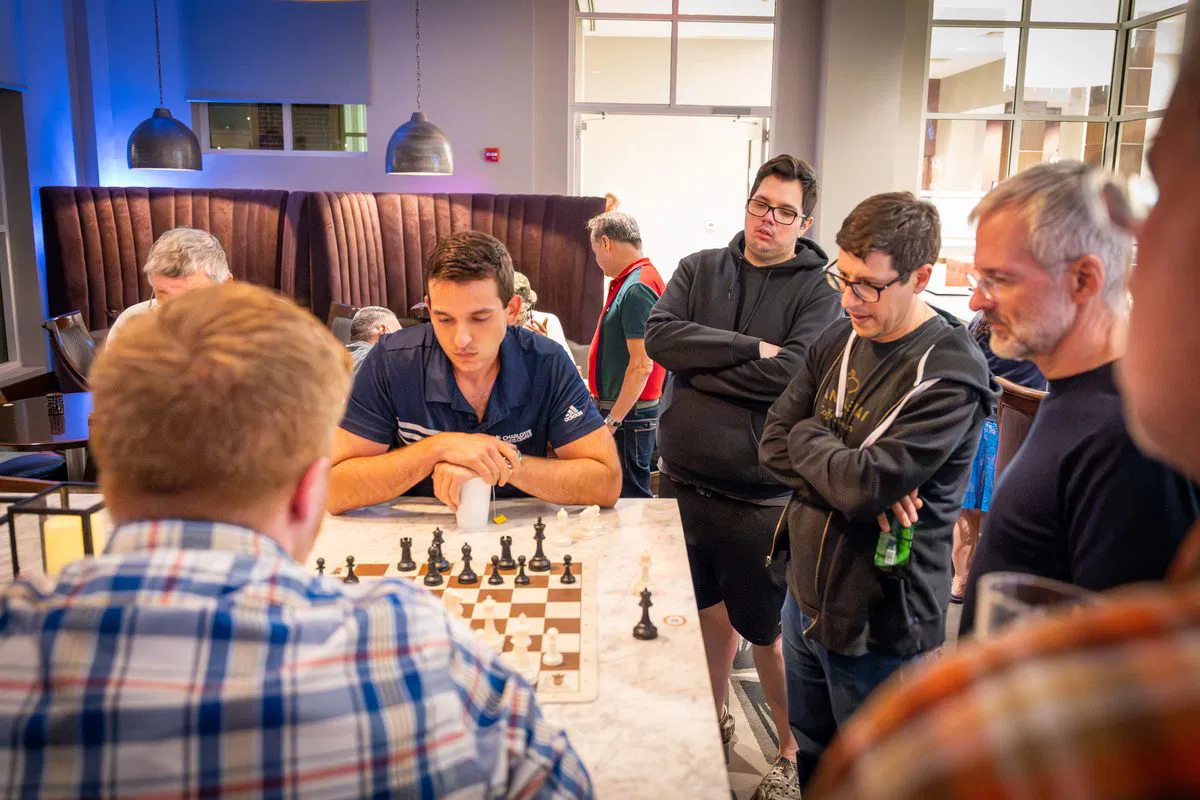
Although he didn't become an IM or a GM, Peter's impact towards the game of chess has been huge thanks to his work with the Charlotte Chess Center.
SS: What was it about chess that you liked so much?
PG: It's hard for me to say. I'm a natural competitor – I like a sense of achievement. I'm not sure exactly what was so attractive about chess back then, but once I got into it I was just hungry to compete. I think one attribute of chess I enjoy is that the burden of success and failure falls on the individual. I've always felt comfortable with that. Not that I'm not a team player – I just don't want my flaws to affect so many other people. So team sports were not always accommodating for me as a kid. Chess and tennis became my true life passions, and I still play both today. I'm on the tennis court about ten hours a week – you can probably see it from my tan.
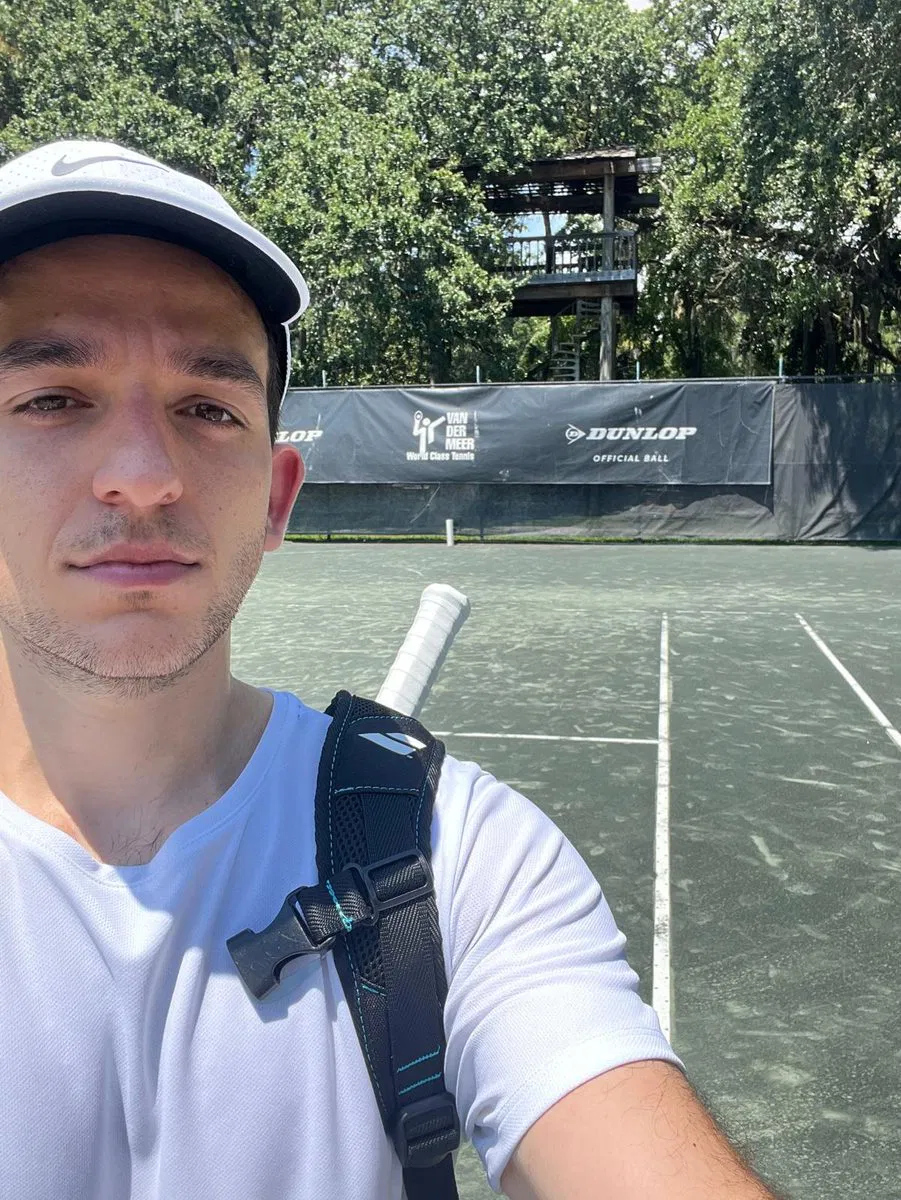
Another of Peter's passions: tennis
SS: Let's come back to starting the centre. You went to the community and said, I want to start a chess centre – will you contribute? That's a very novel approach.
PG: Queen City Chess had been running from 2007–08 up until that point, so there was at least some trust built in the community. I wasn't, let's say, a fly-by-night operator – somebody just coming through hoping for an opportunity and then leaving. I was very much a part of the community as a player, as somebody who grew up here in Charlotte, and as a facilitator of the game.
So when I asked for contributions, I approached members individually. Here's the plan, here's what we're trying to raise. Our goal was $10,000.
SS: That's not too much.
PG: Not a lot. The idea was a very simple, small club with tables and chairs, where I could manage everything myself. If we grew, fine; we could move into something bigger. But otherwise I was willing to do all the work myself to have a sustainable centre. We just needed some start-up money.
As I approached members individually, they were actually very welcoming to the idea of a dedicated place for chess. And little by little – long story short – through individual members of the community, no companies, nothing like that, we raised $30,000.
SS: Three times your target.
PG: That far exceeded my expectations. All of it went toward the facility, but it meant we could have a nicer facility than we'd planned – tables, chairs, some renovations.
That was the highlight for me, because the community supported it. It wasn't artificial. There was no venture capitalist. They were expecting nothing in return. All they did was trust that I would do it, and they were willing to take a risk on a philanthropic contribution to see what would happen. I hope they're proud now, 12 years later. But back then, it was rolling the dice for them.
SS: And you acknowledged their contribution permanently.
PG: At our South main centre, they're still listed to this day on a plaque on the wall. If we were there, you'd be able to see the original donors from more than 12 years ago.
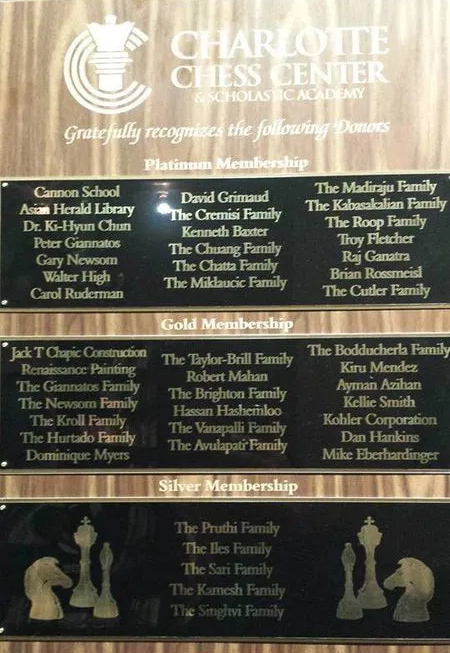
The people who contributed to making the Charlotte Chess Center possible
SS: What was Charlotte's chess scene like before that?
PG: There was chess in Charlotte, but it was fairly fragmented – and I'd say in most places it's like that. You have your adult faction, and you have youth groups and individuals teaching chess. But there wasn't a place where everybody was welcome.
If you were a child and you went to the adult chess club, maybe they'd say your etiquette isn't good. And the adults would not find a home in a youth chess organisation. So typically most places have this divide between adult or open groups and youth groups. My goal was to bring those groups together – which we were already doing to some degree with Queen City Chess. Our community wasn't huge, but it was vibrant, and it was balanced.
You have to get into my mind back then. It's not like it is now. The pure goal was just to give people a chess home where they could play and learn.
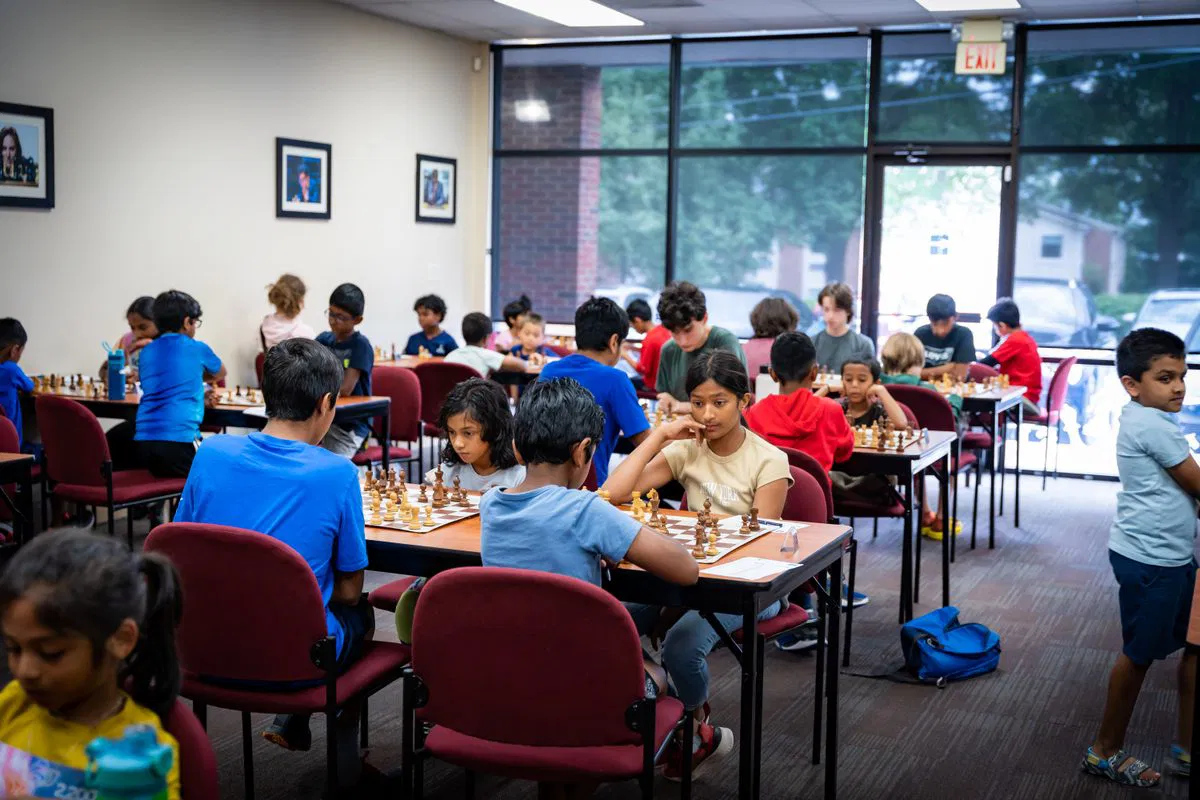
The premises of the Charlotte Chess Center
SS: But Queen City Chess was already doing a bit of that. What was the reason to build a physical centre from scratch?
PG: I'll tell you – I noted this in a previous interview with Ben Johnson of Perpetual Chess too. If I could turn back the hands of time, I would have done what you're describing. I would have built it more using common spaces, like the library we were in, and further built out the community before rushing into opening a centre.
Because having these walls, having to pay utilities, having to pay rent, actually takes resources away from the community. It provides opportunity – you have a dedicated space, you have flexibility over when you use it. But back then we were not in a place that warranted a facility, because we didn't have enough people playing and learning chess to justify that overhead. Now it's fully justified. But then it was not.
SS: So you'd call yourself lucky?
PG: Lucky, and maybe a little tenacious – because I was willing to work at no cost. I was following my dream and I wanted to show those who trusted me that I could pull it off.
That $30,000 primarily covered start-up costs. By the time it had run out, we were beginning to see a little revenue – but just enough to cover expenses, not for me to make a living. I was doing it purely out of passion, and I was okay with that.
So if you came into the chess centre back then, I was the one who greeted you at the front desk. I was the one doing the pairings. I was teaching the classes, cleaning the toilets and taking the rubbish out. It was a different time, but I was willing to do that because it was a dream.
My advice to anyone listening who might be interested in doing this: build the community more first. There are ways to build without sinking your resources into physical centres, without fixed costs and recurring expenses weighing on you. Once you reach a certain capacity, then you can start to consider it.
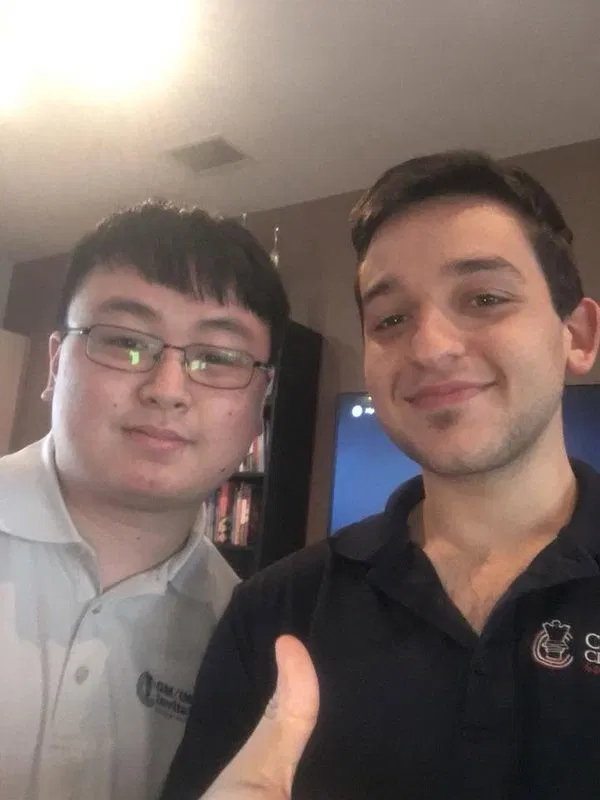
"I was doing it purely out of passion, and I was okay with that"
SS: Your family – didn't they have issues with this? You were an economics graduate, you could have made a very good living at a bank.
PG: There was definitely some anxiety and uncertainty on my parents' part, especially on my father's side. He really wanted me to take a more traditional route, and I imagine many viewers can understand that – something more secure, especially since I went to university and got a degree. It's like, hey, you set yourself up for this path and now you're diverting completely.
But I was following my heart. I've always been a bit of a renegade, somebody who goes his own way. My mother probably questioned the decision, but she remained supportive the whole way.
And even within the chess community, the mentors I had, the people I sought advice from – they were sceptical too. To be honest, with good reason. As I mentioned, at that time I probably was not making the right decision. It worked out in the end, but even with the knowledge I have now, I would not have done it at the time I did it.
So I'm very grateful it worked out, and I don't blame those who tried to nudge me in a different direction. Based on their knowledge of the chess world and what seemed possible in it, all things pointed toward it being the wrong thing to do. But I did it anyway.
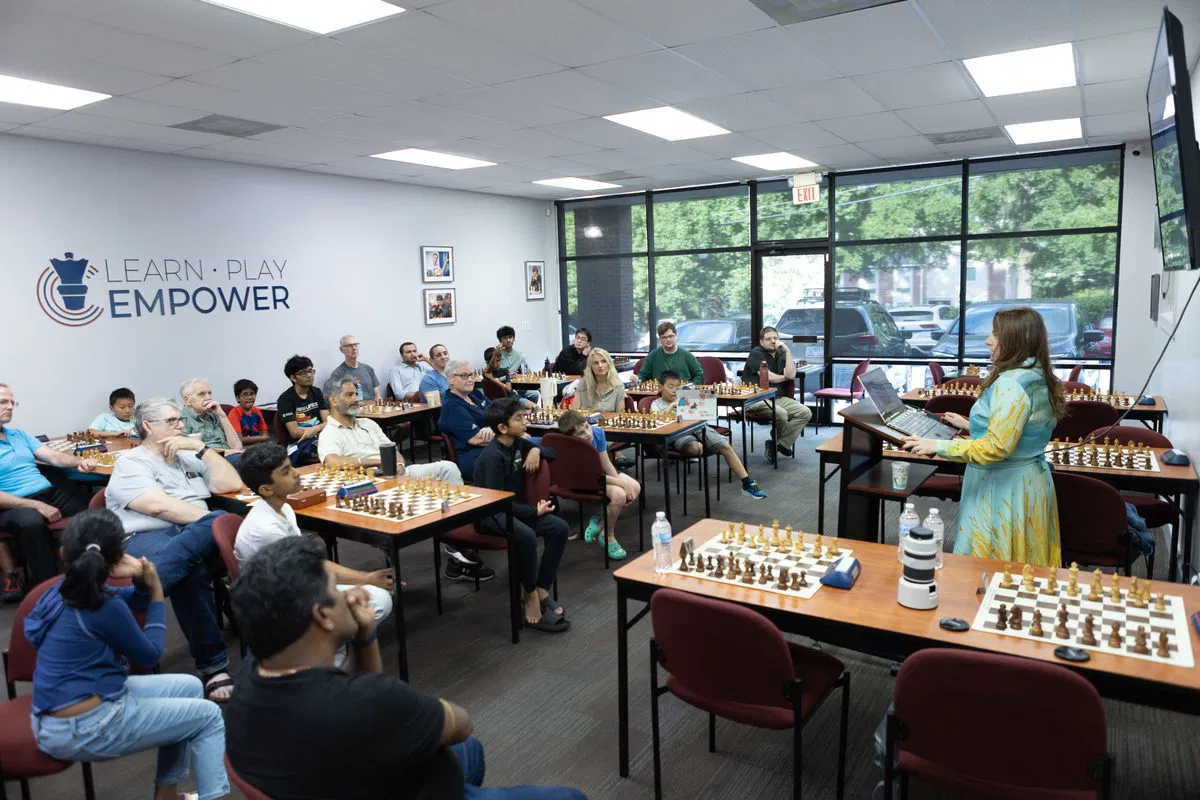
Judit Polgar giving a lecture at the Charlotte Chess Center
SS: What were the factors that made the centre start growing? Were there key people who entered your life, apart from your own tenacity?
PG: About a year and a half in, there still wasn't enough activity at the chess centre to support the chess centre – but I was doing a lot of teaching in the schools, and that put more resources into the bucket.
I had part-time coaches working alongside me in school programmes. One of them, Julian Parker, is still with me to this day teaching for the chess centre. Todd Mendenhall was somebody I went to university with, and he'd help me part-time as well. It was a very small group, but we were making just enough from the school programmes to pay the rent.
And then it was enough to hire another full-time person. At that point it was important for me to offload some of what I was doing, I'd reached a point where I could not really do it all.
SS: And that's when Grant Oen came in.
PG: To my surprise, yes. He had just graduated from Emory University – a very prestigious university in Atlanta. I think I was visiting New York when I saw his application. I had advertised a position offering the bare minimum in pay. It's what I could afford. But it was a job in chess.
And to my surprise, he applied. I knew Grant from working with him as counsellors at the Emory Castle Chess Camp – which is actually where I met Danya as well. I knew he was running tournaments in Atlanta while at university, and I was doing the same here in Charlotte.
I was thinking, what does he want to do working here for such low pay? But like me, and like many members of our team, we follow our passion. The moment I saw his message, I immediately called him. Shortly after that, Grant was part of the team – and as you know, he's still a member of our team today, 10 years later.
SS: He was chief arbiter and tournament director of the Naroditsky Memorial, and he did an incredible job.
PG: He is the best tournament director in the country, in my opinion – and I think we can back that up. He's been instrumental to the growth of the tournament side of the Charlotte Chess Center. Everything from norm round-robins to our large Swiss tournaments, and now the Naroditsky Memorial.
That was the key: once you get to the place where others come in and start to specialise in certain areas, you can offload things and really focus. That enabled us to branch out and grow a lot more. We were still in very early stages, but we started to assemble the right group of passionate chess people – who frankly are all still here today.
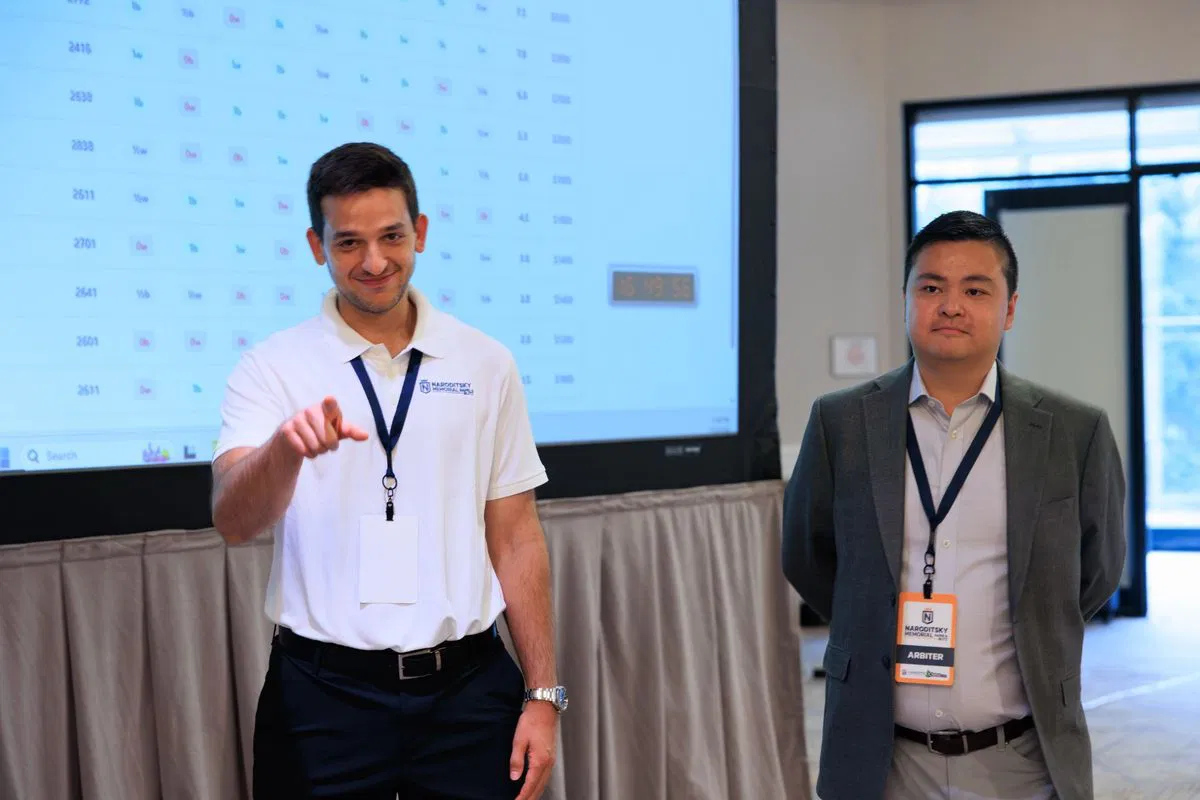
Peter with Grant Oen – the tournament director and man who grew the events domain of the Charlotte Chess Center | Photo: Kelly Centrelli
SS: There are two aspects to the Charlotte Chess Center – training and events. Let's start with training. How is it structured?
PG: Our school chess programmes we consider recreational chess. The goal there is to expose children to chess so that they become familiar with the game. From there we gauge interest – are there students who are really interested in learning?
Once they are, they come here to the academy, where training becomes more structured and there's a system that sets out where you start and how you progress.
We start with fundamentals-level classes – for beginners, or those who know how the pieces move but don't have a structured way of seeing the game or the board. Then comes intermediate, for unrated players up to about 600 over-the-board Elo. Advanced is 600 to 1000. Master class is 1000 to 1500. And then the elite chess team, which begins at 1500 and goes well above 2000 – what we call super elite.
So you start in one of those places, and there's a clear path up. It's a combination of learning physically here at the academies with a coach, having workbooks, doing tactical training puzzles, working online at home, and playing tournaments. It's all part of what it takes to move up from class to class.
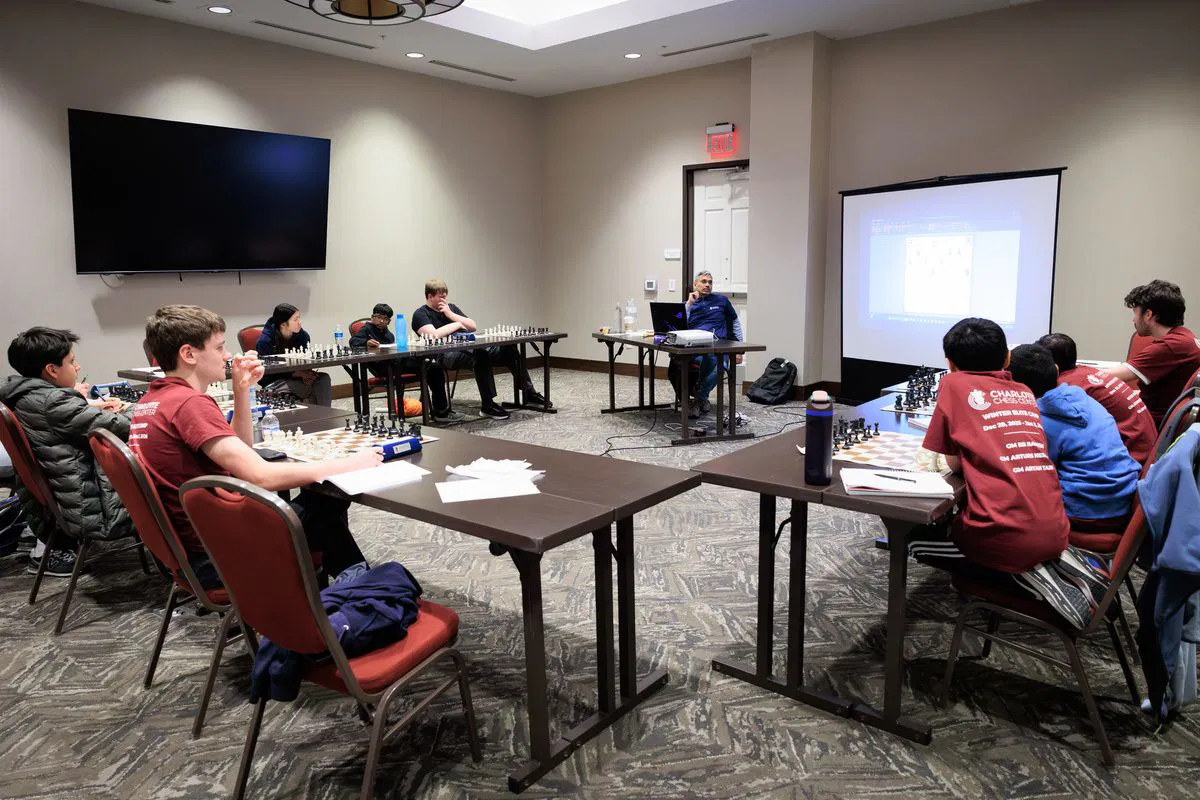
GM R. B. Ramesh, one of India's leading trainers, giving a session at the Charlotte Chess Center
SS: Did this system exist from the beginning?
PG: No, this came later. As you work with children, it's very important that they and their parents have a pathway to understand what it takes to move up from level to level. We didn't really implement such a system until around the time of the pandemic.
We started creating a more defined system: how you start, how you move up, and what key aspects are needed for chess improvement. Not just "read this worksheet, read this book." Should I be solving a hundred puzzles a week? Should I be reading a certain book? Watching certain videos? How many rated games should I play? What rating should I reach before I'm ready to move up?
A lot of things developed over time – from just giving chess lessons, to providing a blueprint for how you improve at chess.
SS: And that came from your data of working with different kids over five, six years?
PG: Exactly. And we also wanted to paint the picture for the parents. Many of our parents are not chess players themselves, so they need guidance too. What should I be helping my child do at home?
Chess is such a vast game that if you only did chess when you came in for lessons, you wouldn't improve. You must work on the game outside of that. Providing the blueprint to students and their parents was a pivotal point for us as an organisation. When we started doing that, more children remained interested in chess and improved faster. And that's our goal. We don't want them stuck in the same level classes.
SS: Is the system still evolving?
PG: All the time – the system itself, and the materials and curriculum. If you're actively playing chess, you're constantly looking for weak points, constantly looking for areas of refinement. We take the same approach with our curriculum. We're always searching for improvements based on the data we have.
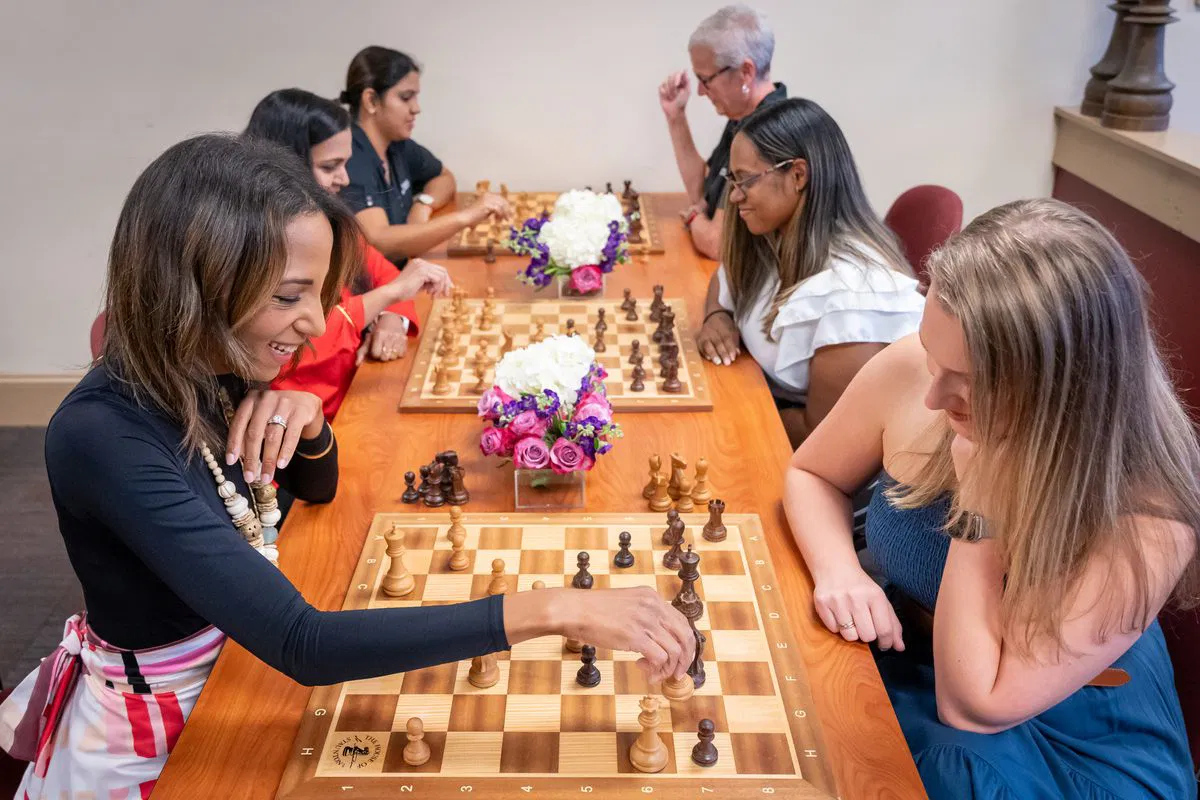
Another initiative: Moms of CCC
SS: This is your book, published by New in Chess. We stock it in the ChessBase India shop as well. Why did you write it?
PG: I always wanted to write it, but it takes time. I had some time during the pandemic because things were slower in person, so I decided to buckle down and actually do it. The reason is that at the fundamental levels we teach in our academy, the students didn't have the resources. Most of the chess material I see is designed for people who already play. So I had our students in mind. The book assumes you know how the pieces move – and hardly anything else. We start from there. There are plenty of chess materials out there and I didn't want to reinvent the wheel just to put my name on something. That wasn't the goal.
SS: So what's different about it?
PG: The first thing you'll see is that there's a place to write your answer. There are studies suggesting that writing down an answer helps reinforce your conviction. You say, okay, my answer is bishop e4, checkmate. Is it really? When you write it down, it's almost like setting it in stone – I confirm this is my answer. With young children developing at five, six years old, it's important to build those habits.
That didn't always exist in tactics workbooks. Often it's diagrams with very thin margins, so it's hard to write. And then students end up drawing arrows. That might be okay for one move, but for two or three moves it gets messy – and messy is not good for learning. I specifically requested this. I refused to write the book if they were going to sacrifice white space. I told them: you want me to write this book, it must have a place for students to put their answers. I will not write it otherwise. And yes, that means it needs to be bigger than a standard book that fits on the shelf, and there will be a lot of white space. We are not using all the real estate on the page – because this is a book for learning, not a book for reading. It's a book for active learning.
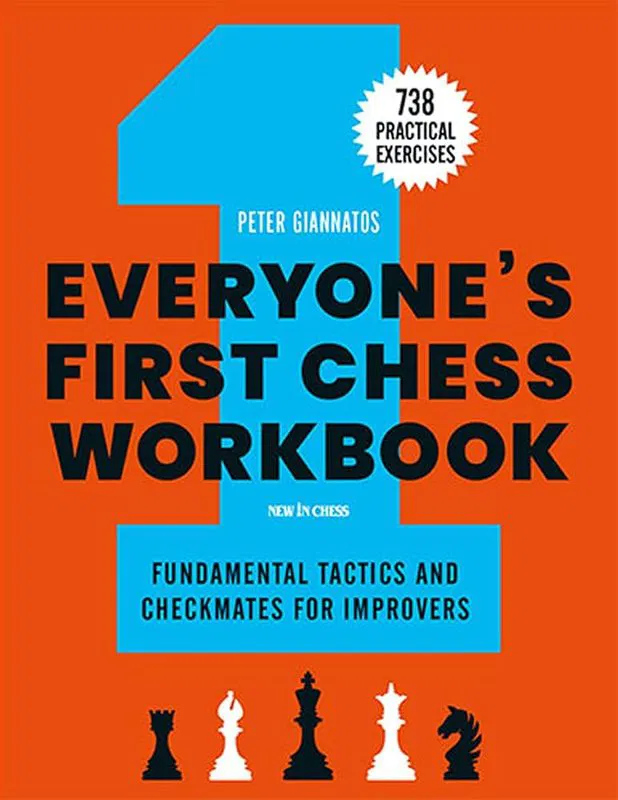
"Everyone's First Chess Workbook", by Peter Giannatos
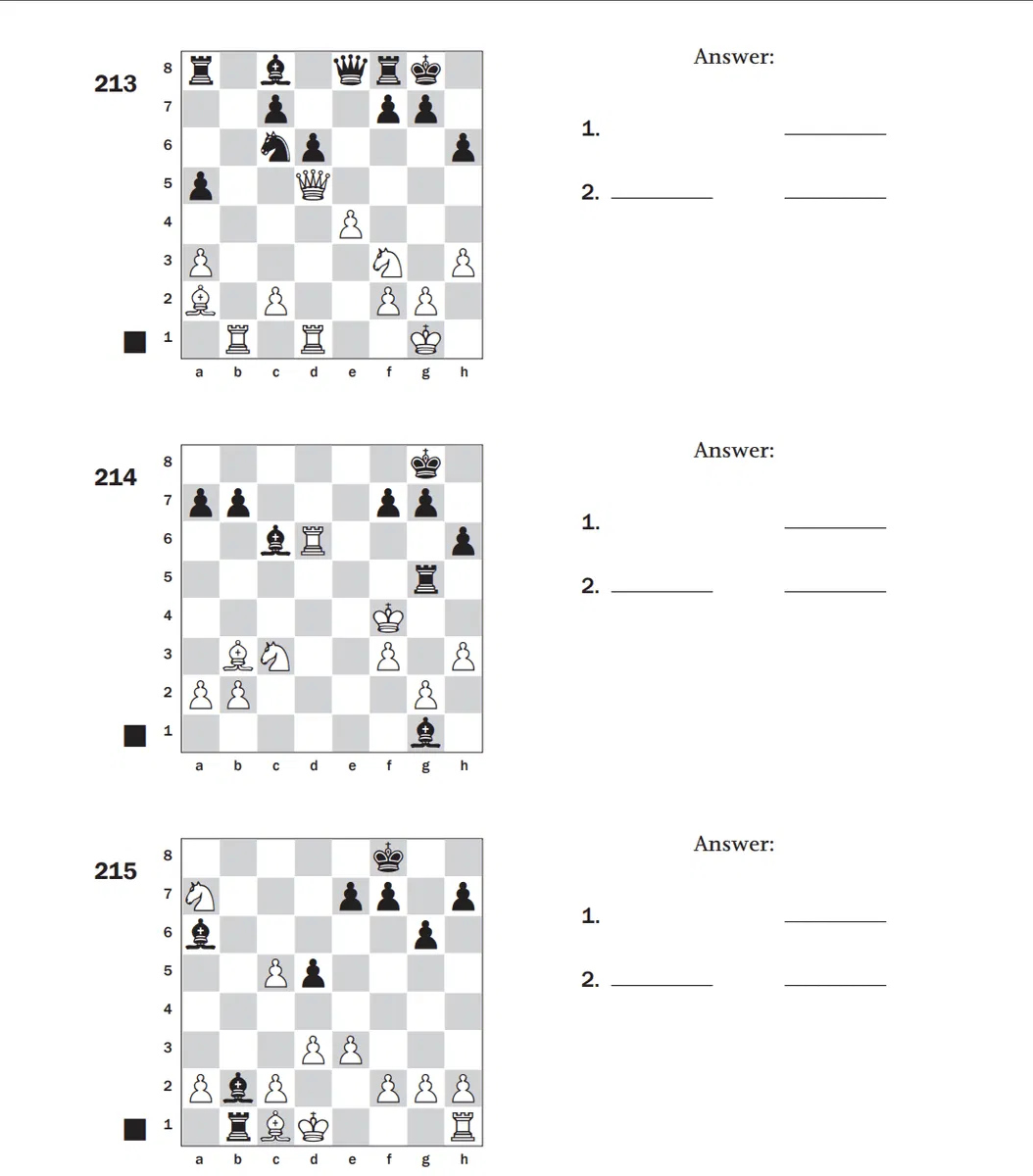
A sample page from the book, with plenty of space for children to work
SS: And the second thing?
PG: Every chapter starts with what's called guided practice. I give you a hint. If you're reading it, you'll effectively be led to the answer – not completely, but led to finding it, as if a coach were over your shoulder advising you. You get that for a number of puzzles, and then you finally reach the test portion, where there are no hints.
The idea is to assist you in learning the ideas – forks, pins, skewers – but eventually nobody is going to tell you exactly where it is. That structure is very important from a learning standpoint, and many books don't have such a thing. I think that's what makes this book popular.
There are about 700 puzzles in it. But I must have gone through tens of thousands of puzzles, online trainers, everywhere, to find the right level for this category. It wasn't just pulling random puzzles and assigning them to a category. I wanted clean puzzles – not lots of branching variations. Very much to the point, because this is for learners.
SS: And you have your own workbooks for the academy too.
PG: Yes – those are self-published. I created them in a word processor, had somebody do a cover, nothing overly produced. Still very interactive: identifying check, checkmate and stalemate, piece values, chess maths.
But those are a supplement to what's being taught in class. They're smaller and they don't have as much explanation, because the trainer is right there. And precisely for that reason, we do not sell them. They're only available to students in our classes. The New in Chess book is available on Amazon worldwide – that one is designed so you can study on your own, or a parent can go through it with a young child.
When we get to the higher levels, our grandmaster coaches take over and provide a lot more targeted worksheets and puzzles.
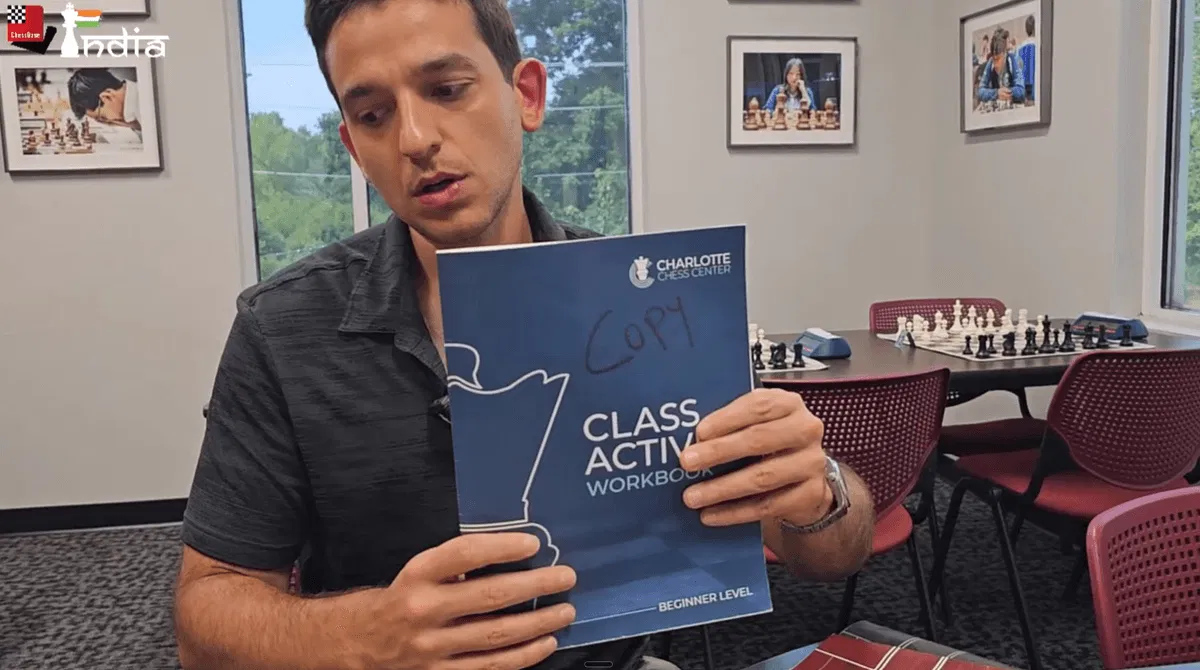
Workbooks used by teachers in class
SS: And then there's the sticker system.
PG: These are completed workbooks – that's why they look so used. You can see class participation stickers, and they're custom, with our logo. We had a designer create the characters. They don't have names, but the kids like them.
Students submit their workbooks upon graduation from their class – finishing the workbook isn't the only criterion, but the stickers can be cashed in for things around the centre. A hoodie, a hat, a chess board.
Creating the criteria took time. We got together with the coaches and asked: what do we value? What do we want to incentivise? Is it homework? Puzzles? Playing games? We identified the key points we believed were necessary for growth, and we weighted the stickers depending on what we most wanted students to do. So the children think, ooh, if I play more I get more points – I'm going to play the quads this week. The point values are not random. We place value where we think most improvement comes from.
SS: What's the most sought-after reward?
PG: Merchandise, by far. Hoodies and hats. That's what they want when they cash in.
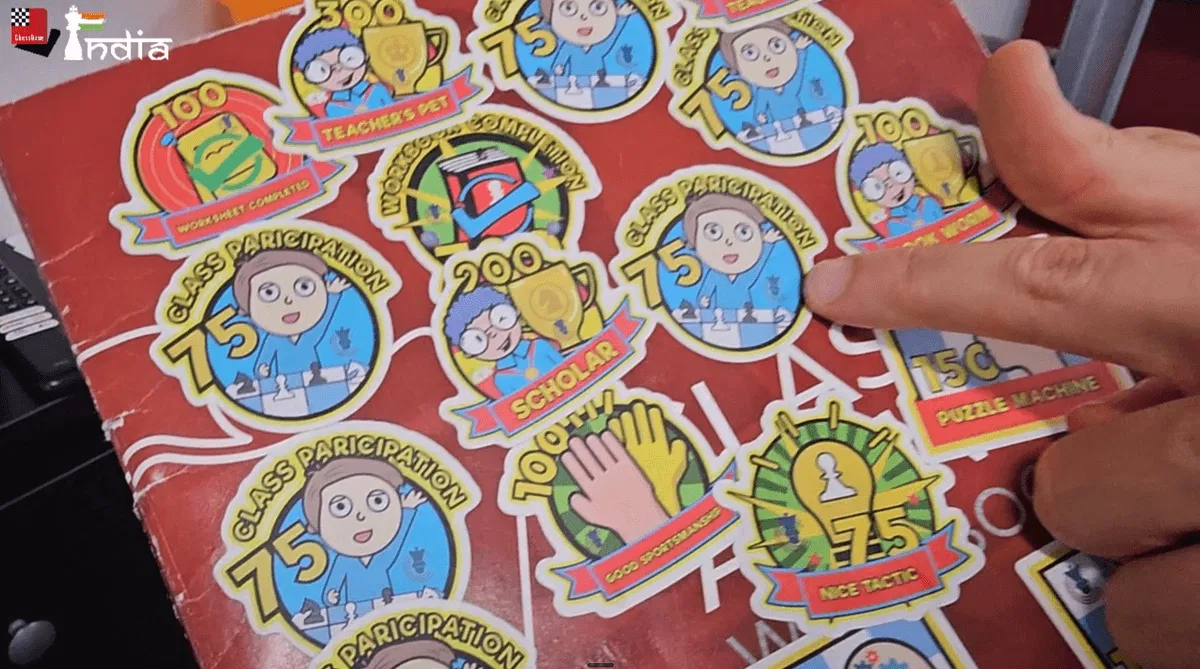
The Charlotte Chess Center's sticker system
SS: What has surprised me is the number of events happening – during a single week, not a year.
PG: Between our two facilities we run 10 rated tournaments a week. Rated competitions, not counting meetups. And then about once a month, sometimes twice, we have off-site tournaments – at schools if they're for kids, or at convention centres if they're open tournaments, like the Naroditsky Memorial and our other opens which need very large spaces.
Last year when we did our analysis, we had more tournaments than days in the year. More than 365 rated tournaments – more than one a day.
We are the most active US Chess Federation affiliate in the country, bar none. There is no chess centre that does more than we do. That includes St. Louis. That includes the Marshall. That includes Mechanics'.
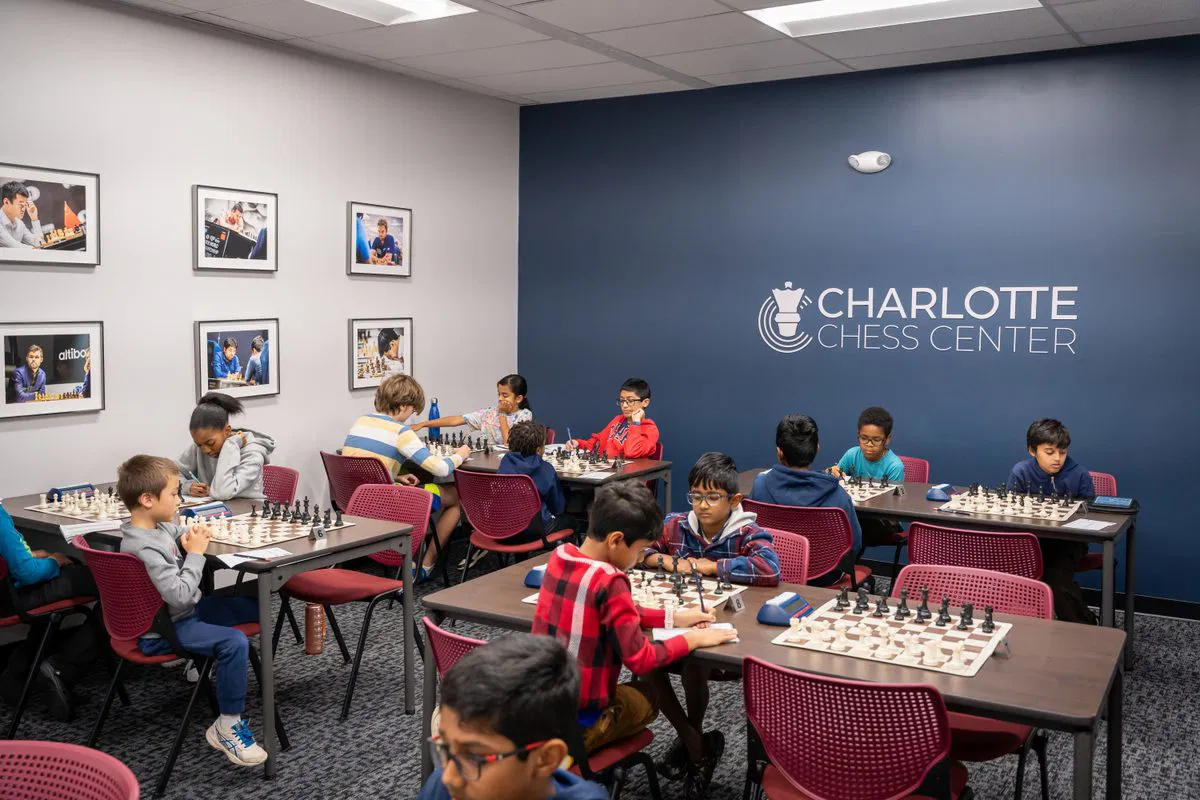
Whether small or large, the centre holds more than 365 rated events each year.
SS: And it's open to anyone, not just your students?
PG: Absolutely. If you're not a student or a member, you can still participate. Last year we had about 2,700 unique rated players participate in Charlotte Chess Center events. So it's not just the 500 students or the hundreds of adult members – people travel to play in our competitions. And that's on top of many unrated players who haven't achieved a rating yet. That's roughly three percent of the active tournament player base in the United States that played in Charlotte last year.
SS: And strong players take part too? Daniel Naroditsky used to play regularly, right?
PG: They still play. GM Kayden Troff, Sasha Bortnyk – still playing our blitz and rapid events. They enjoy that format, even if it's a club-level event where they know they'll be the strongest player and they risk shedding rating points. It happens. But they love it and they play.
We're very grateful that our members have the opportunity to play grandmasters on a semi-regular basis. They're always around for classes and everything, but I'm talking about playing. For our members it's such a great opportunity to have exposure to titled players.
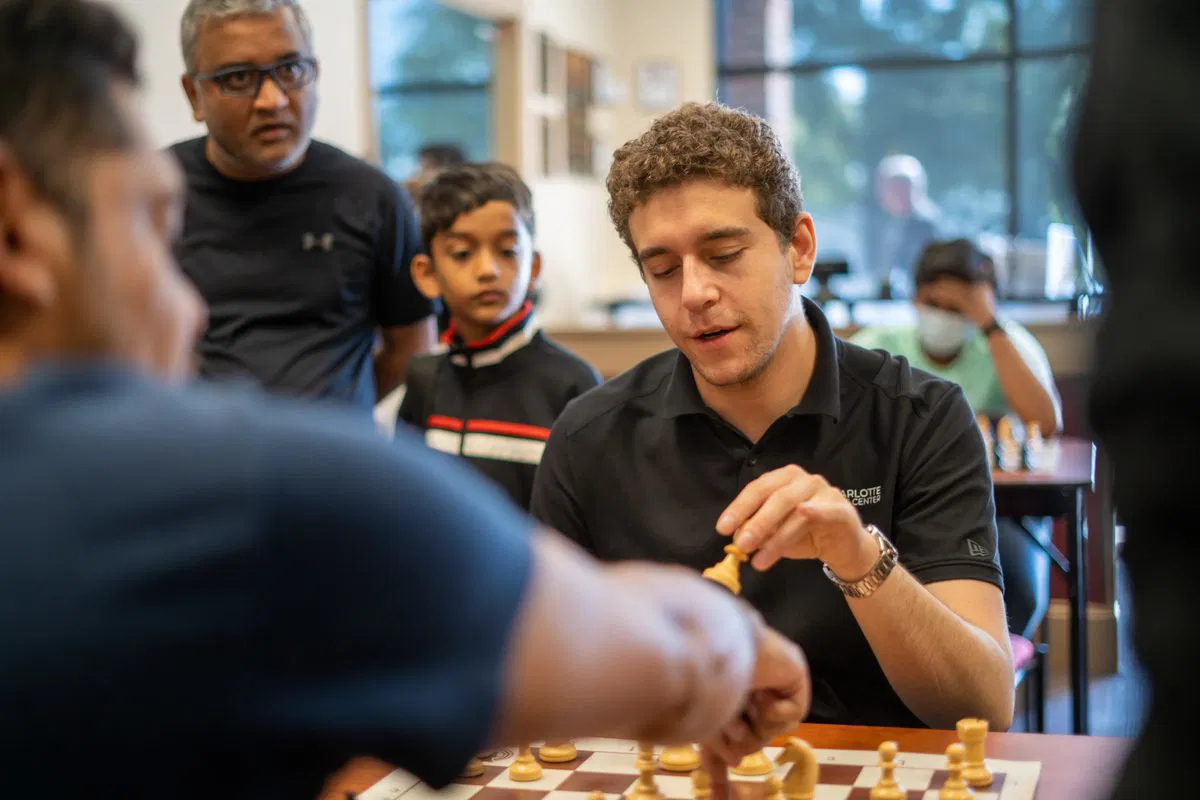
Danya used to play regularly at the Charlotte Chess Center events
SS: What allows you to do so many events? What's the secret?
PG: It comes organically. You have to build enough interest – adults who want to play more than they want to learn, and a large group of youth who want to learn but then need to play. The more you build interest and keep people involved, the more opportunities they seek. And expanding in our chess world really means beginning to play in rated competition.
There's nothing wrong with playing casually – we have casual nights. But when we talk about rated competition, we start with education. We're teaching you how to play chess. But now you have to go play, in a rated environment, so you understand where you fall. How much am I learning? How does this apply to practical play?
One of our coaches, Jay Garrison, puts it simply: if you're on a football team and you go to practice, then you have to attend the games. That's just the way it is.
SS: Is there evidence behind pushing rated play specifically?
PG: There were studies showing more developmental promise not just in learning chess, but specifically when students go from learning to participating in rated play – boosts in maths and reading skills once they begin competition.
That's why we push that angle. We don't care so much whether a child is rated 300 or 2300. It's more that they're applying themselves in a formal environment where they can concentrate fully on showing what they've truly learned. That sets the bar for them to know where they stand and how to improve. It's very much in the spirit of using chess as a developmental tool.
But this doesn't happen overnight. Remember we started with one chess centre and two or three rated tournaments a week at one place. It only became this through a grassroots effort to make chess more popular and keep people involved for longer – to motivate children, guide them and their parents. It's a long time of tweaking and evolving.
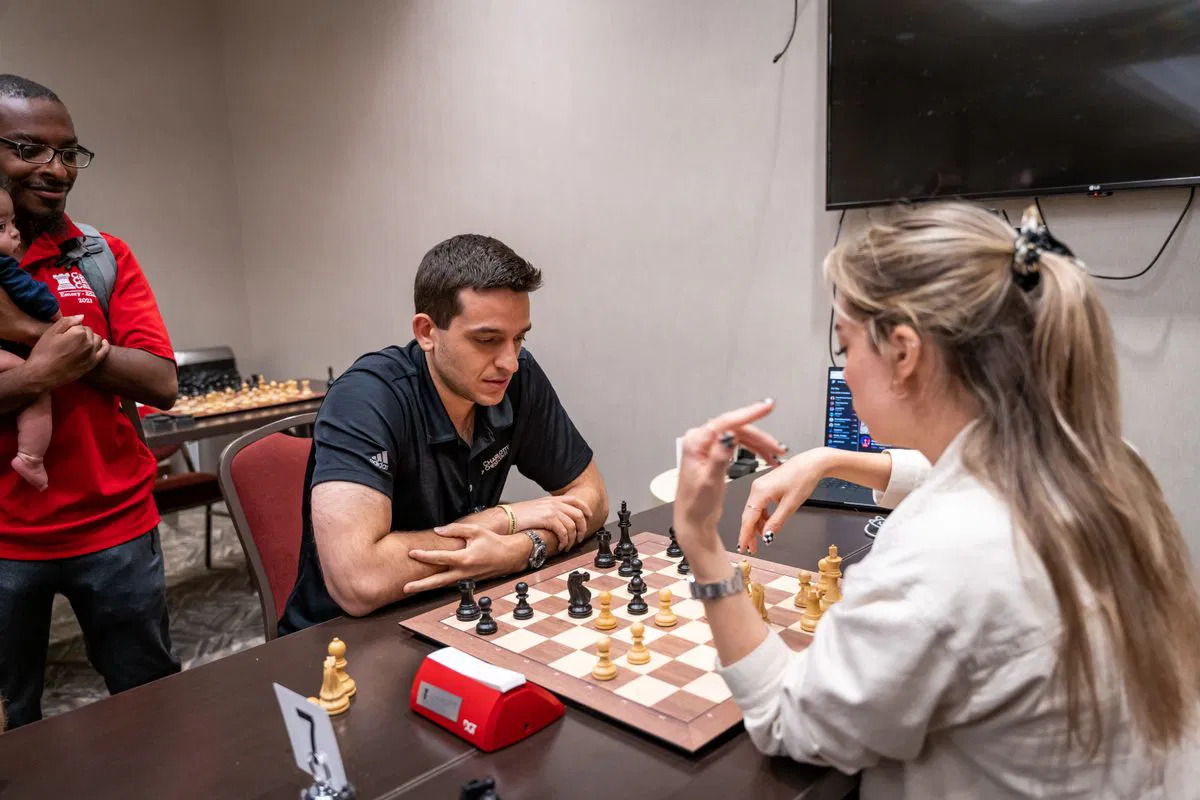
Rated events give students a chance to put their training into practice under tournament conditions
SS: So a student can join you as a complete beginner and go all the way – because you also run norm events.
PG: That's correct. We pride ourselves on this end-to-end chess path. We host four to six round-robin GM and IM norm tournaments a year, plus Swiss opens where you can also earn norms.
So far, our biggest success story is a student who began in a beginner programme and became a FIDE Master. We've had players become IMs, but they didn't start all the way down in our beginner programme.
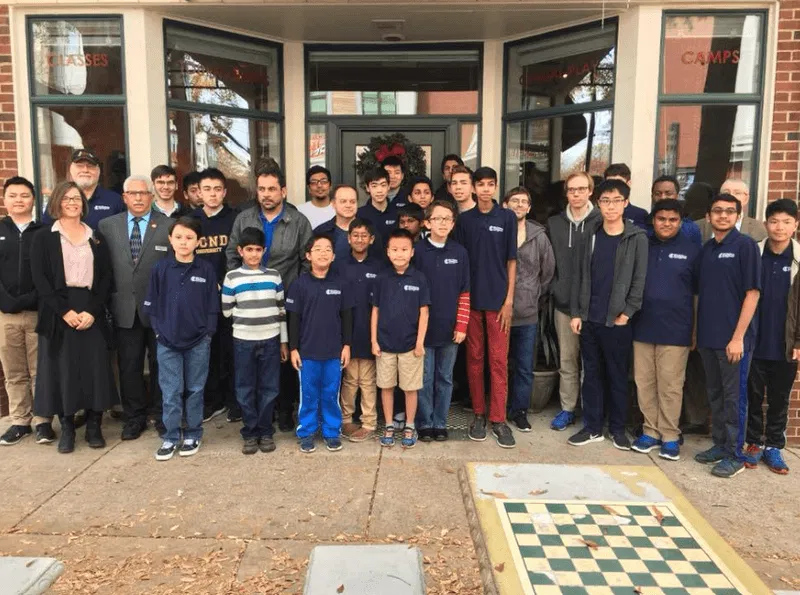
One of the norm events at the Charlotte Chess Center
SS: Can you name them?
PG: The first that comes to mind is Vishnu Vanapalli, who's now at university – 2400 USCF, a strong FM with a FIDE rating around 2350. He started at the chess centre when he was maybe four and a half or five years old, and he used to fall asleep at the board! His father Raj would bring him in and sit in the back of the room, because the games were in the evening and he'd often doze off. That was a long, long time ago.
He's one of the CCC's success stories, along with Tianshi Wang, who moved here from China at a young age, played a lot of our events, and eventually became an IM.
A lot of our students are now reaching 2000 or 2100 at even younger ages, and will soon break the master level. We have a much larger pool of those players than we did. But as you know, Sagar, it takes years to go from beginning to reaching 2200, 2300, 2400. I think we'll see a lot more next year and the year after, because we planted those seeds years ago.
SS: You don't push them, though.
PG: In our hearts, of course we want our students to achieve the most. But we don't push them so hard, because we want them to be passionate about the game. It's there for them if they want it.
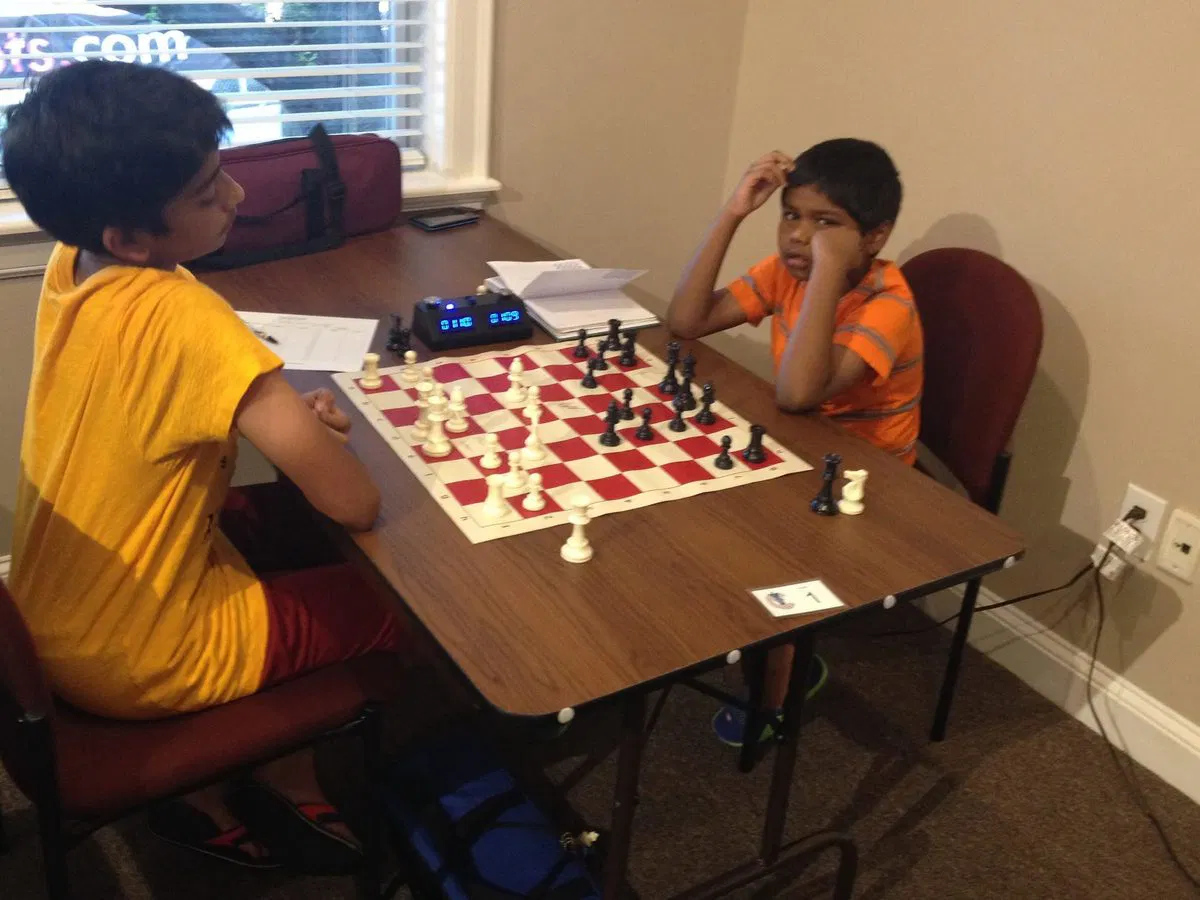
Little Vishnu Vanapalli (right) learnt the basics at the Charlotte Chess Center and reached a rating of over 2300
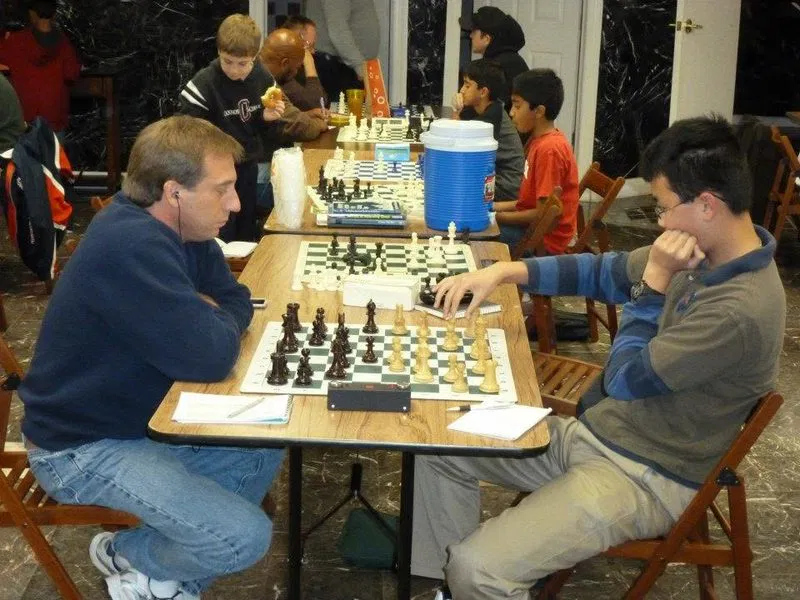
Young Tianqi Wang went on to become an IM
SS: One thing that has surprised me is how you manage to bring together people like Judit Polgar, Peter Leko, Ramesh, Boris Gelfand, Jacob Aagaard – all of them doing camps here. That's something very difficult even for people with very strong students.
PG: This was actually the brainchild of Grant Oen, who wanted to do a high-level camp. The first year we did it, it was Jacob Aagaard and Boris Avrukh. Avrukh of course wrote that amazing series on 1.d4 which revolutionised how people played the openings – at that time he was a world-renowned opening theoretician.
Grant had the idea of starting small. Aagaard and Avrukh, and let's see if we can do an elite training camp not just for local Charlotte juniors but nationally. Sometimes players come from Mexico and Canada too. And we realised there was a hunger to learn from the best.
As it evolved, we began to reach out further and further – as we began to be trusted not just within the local chess community but the national and international one. Veselin Topalov was here for a few years. Judit Polgar has been here for the last few years, Peter Leko too. Boris Gelfand was here. Mihail Marin was here. So many others. Our most recent camp had 50 students from all over the United States.
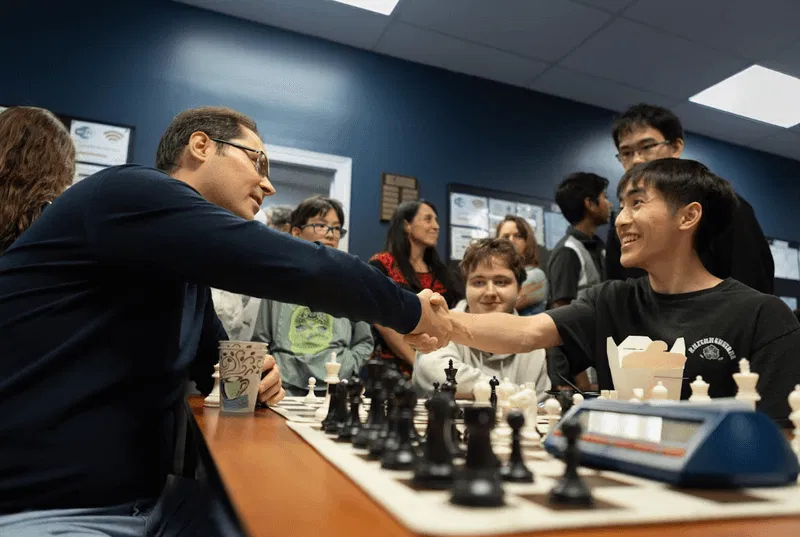
Playing against Peter Leko
SS: But why do they keep coming?
PG: I think when they come here for the first time, they understand that we do chess from the soul. We do chess from the heart. We are chess people. Every day we wake up, we devote our lives to the game of chess. So when they come here, they feel they're also doing something meaningful.
This camp could happen anywhere. It could happen anywhere. But as lifelong chess players who've devoted their lives to chess, they respect those who do the same. And of course we treat them well. For me they're like family now – Judit, Peter, Boris, Veselin, Jacob. These people are like family to me, and we treat them as such.
They feel comfortable here because they understand it's not a spectacle. It is meaningful. I think that's what's gained us their trust, and that's why they're willing to come back to Charlotte. We're incredibly grateful.
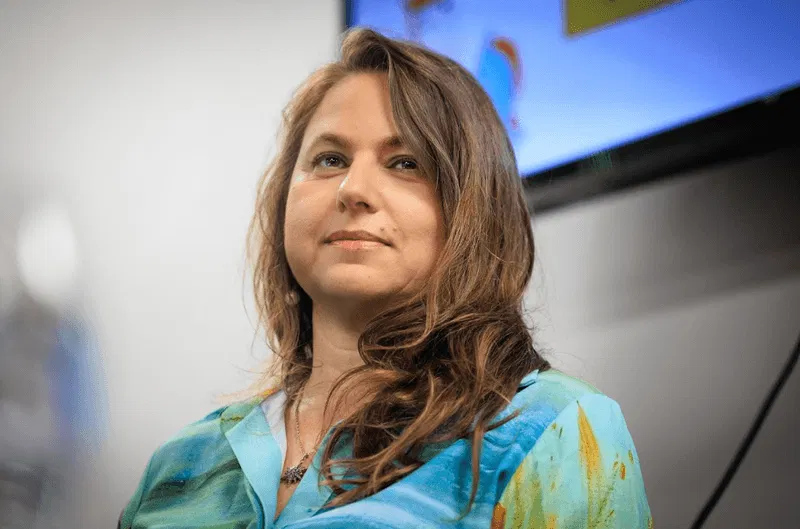
Judit Polgar
SS: For the last part – what drives you to wake up every day and do this? What you're doing is very intense. What is your motivation?
PG: I love chess and I always have. Later in life I stopped liking the competitive aspect as a player – but I love the game. Every day I check broadcasts to see the live games happening all over the world. I still play all the time. I follow chess very much. For me chess is purely a passion. I don't have to be forced to do it. I didn't do it because I saw a job or career opportunity. I did it because I love it.
But we should also go back in time. When I had the idea of starting a chess centre, nearly everybody I talked to was pushing me away from it. They didn't believe chess was a viable career path for anyone. And I wanted to change that. I wanted to make it clear that it can be.
Chess can be organised at the level of other professional games and sports, so that people trust the institutions they walk into. When they walk into a chess centre or a chess club, they shouldn't see chaos. They shouldn't see an unorganized place. Parents and members coming in for the first time should see something that represents professionalism.
So every day I wake up and think: how can we push the limits of the game of chess towards a higher professional standard, doing it organically? That motivates me very much. And I feel I'll never reach a point where I can't do anything to enhance chess further. If I did reach that point – similar to my own playing career – where I could no longer contribute with growth or enhancement in mind, I would probably retire. But I still feel there's so much for me to do.
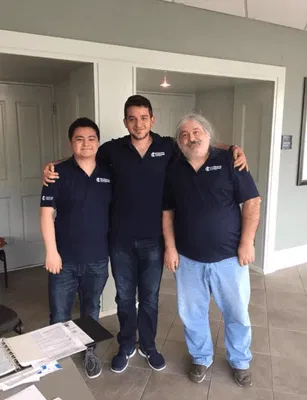
Charlotte Chess Center – built out of passion with other passionate individuals.
SS: There are so many facets – community building, training, organisation, media. It's very difficult to exhaust it.
PG: Yes, and finding that identity took time. When you start a business, sometimes you struggle to find your identity. Who are you trying to serve, and what is your overall purpose? Of course a business must make money to sustain careers – not just for an individual but for everybody who works alongside you. That goes without saying, there's no grey area. The question is what your long-term goals are, not just day-to-day sustainability.
Early on, especially when things weren't working out so well, I would often be distracted by opportunities. Partner with this person, partner with that person, do this, do that. And then as the chess centre became more successful, venture capitalists reached out about acquisitions, about franchising.
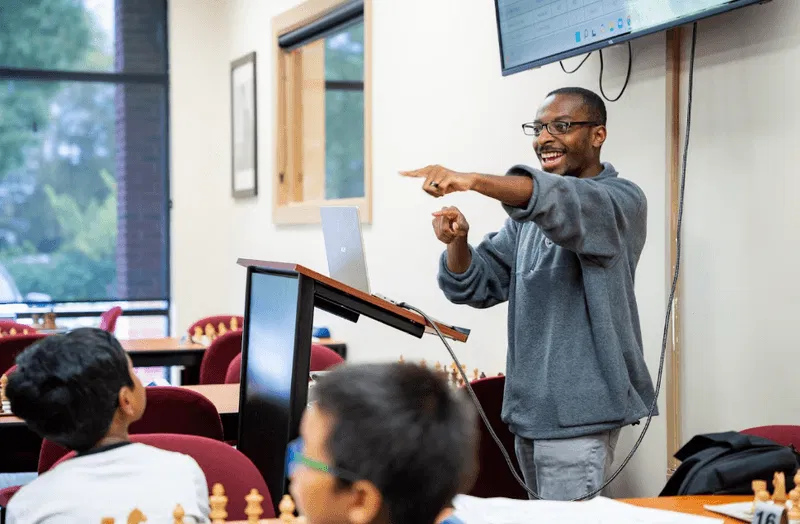
Now that's a trainer you would love to learn from - Dominique Myers
SS: And you said no.
PG: By then I had understood that what makes us unique is very hard to replicate. We're very much a family of chess enthusiasts, passionate players, organisers and teachers. Expansion outside our community would not truly reflect who we are. Without infinite resources - and frankly without other equally passionate and committed people – we wouldn't be able to expand successfully outside our city.
So I dropped it completely out of my head, because I wanted to maintain the standard we have here, across the board, from learning to organising. I knew the way to do that was by focusing on our community.
And there's still so much to do even narrowly focused on the Charlotte metro area. Even if we can't add more rated tournaments, there are ways to get more students involved in our paid programmes – and through our foundation, we can expand into lower-income neighbourhoods to provide opportunities.
One of the great rewards for me is walking into a supermarket and see a student from 10 or 12 years ago. Now I'm seeing students who have graduated from university that I used to teach. That's empowering. That's motivating.
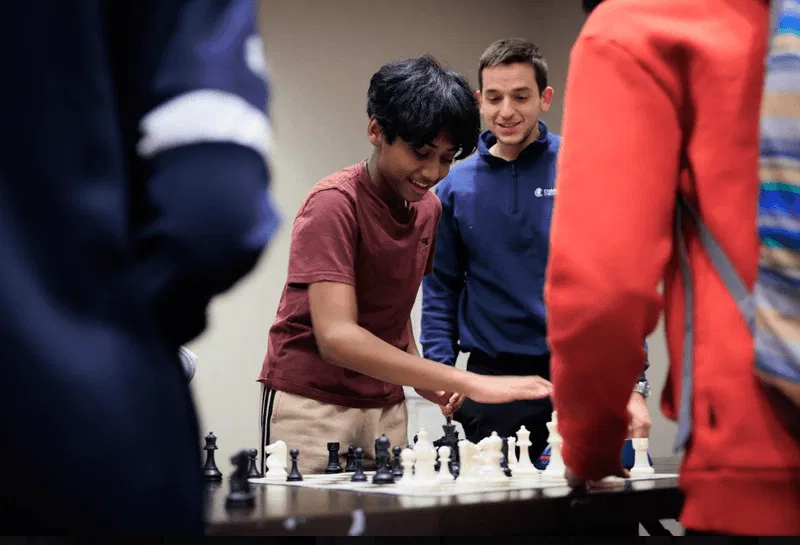
Peter finds much of his satisfaction in working with his students
SS: And the perception of chess as a career?
PG: Pushing the limits of what people perceive as the limitations of chess as a career - I want to break and shatter those completely. I want to tear them apart. Because as long as people believe that pursuing chess leads to ultimate career failure, they won't pursue it. Shattering that is a huge motivator for me. I think we've done that, and I think we'll continue to.
That comes from my own history of dealing with that adversity – people telling you, including people in chess, don't waste your time going down this road. If that's what you hear from the people around you and the people you trust, the vast majority will listen and won't pursue it.
But to this day, Sagar, it bothers me less that the outside world doesn't understand that chess can be a career. I understand why somebody who doesn't know anything about niche communities – chess, badminton, table tennis, whatever – might not understand. Those are games we play for fun. How could there be a career around that?
So I don't get offended if I go into the barber's and they make small talk and ask what I do. I say, well, I have a chess academy, I teach chess. And they say, "Oh really? And you do that for a living?" That's often the response I get. I say yes, and I'm generally polite, because I understand it's hard for them to grasp. Sometimes I lie and say I'm a maths teacher, just to avoid the conversation, because sometimes I get tired of it.
But it's within the chess community that I get a little frustrated. I've been running the chess centre for 12 years and people will still ask me, "Is this what you do for your career?"
I only take a little offence, because again it's their own lack of understanding. But I want us to get to a point as a chess world where it's respected at least within the industry. The outside world I don't hold accountable. But within our chess industry – until we get to a place where our own people give us dignity and credibility that we can do this for a living, I will not be satisfied.
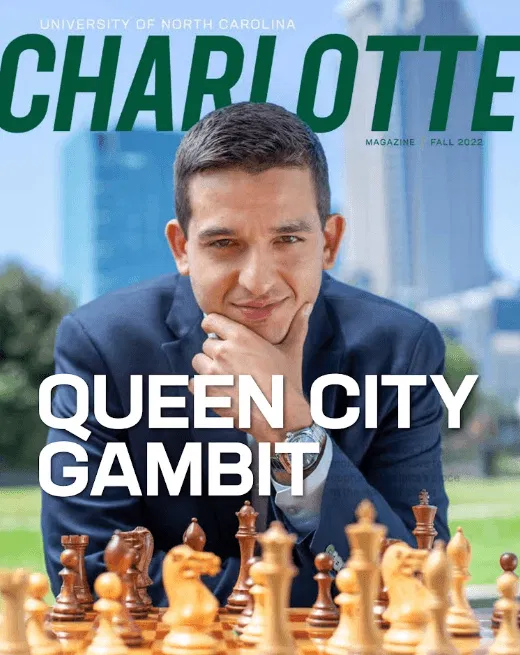
Peter on the cover of the University of North Carolina at Charlotte magazine
SS: In what you've built over 12, 13 years, I think you're setting a standard and an example that is going to inspire people across the US, and across the world.
PG: I hope so, and I think it already has. As I mentioned, there was no real blueprint for this. There were academies – don't get me wrong, there were always academies. But there was no blueprint for what is now the Charlotte Chess Center. So I hope people see what we're doing and try to emulate it.
The parts they don't see, which are hard to replicate, are passion and commitment. Most of the time when people ask me for advice, it's always about sustainability and finances. I've hardly ever had a conversation where somebody approached me for advice and I felt they were so passionate that my advice would actually motivate them to do it for the right reasons – and that they'd actually be successful. Most people come at it purely as a business opportunity: "hmm, my town doesn't have a Charlotte Chess Center. That's an opportunity for me."
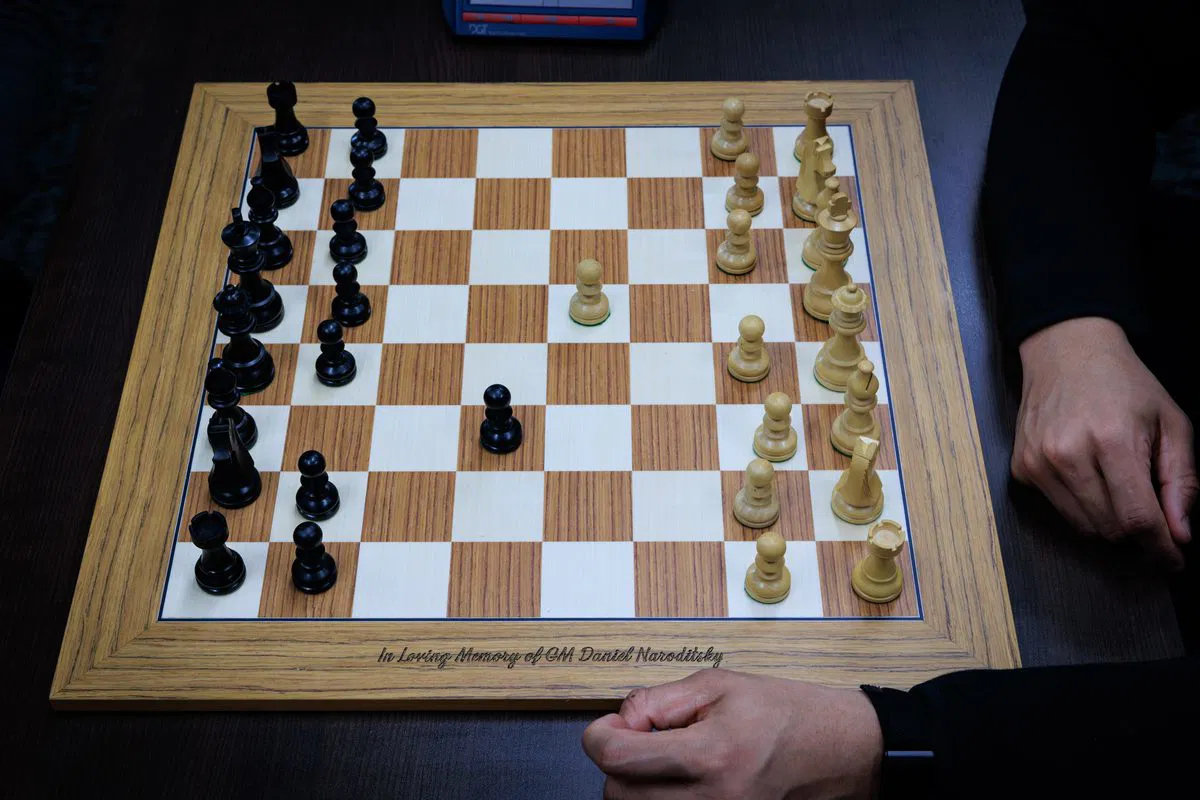
The Charlotte Chess Center's top board is engraved in memory of Daniel Naroditsky
I suppose it's fine to see it that way – but only if, in addition to seeing an opportunity, you're also truly passionate about it. Because I could sit here and give you every detail about how the Charlotte Chess Center works and every fine point I learned over the years. But without my own passion, which spreads to the rest of our 50-plus employees, and the core group of administrators around me who are equally dedicated – if we didn't have that and were just following a blueprint, no way we'd be sitting here having this conversation right now.
That's something I can't teach you, because it has to come from here (from the heart). You have to be a lover of chess. And frankly, to turn it around on you – I think your success is similarly grounded. I think that's the success of ChessBase India, and I think your viewers and audience feel the same way. That's hard to teach. Even if you gave someone a blueprint, it would still need to be the right person to carry it out and be willing to take the journey.
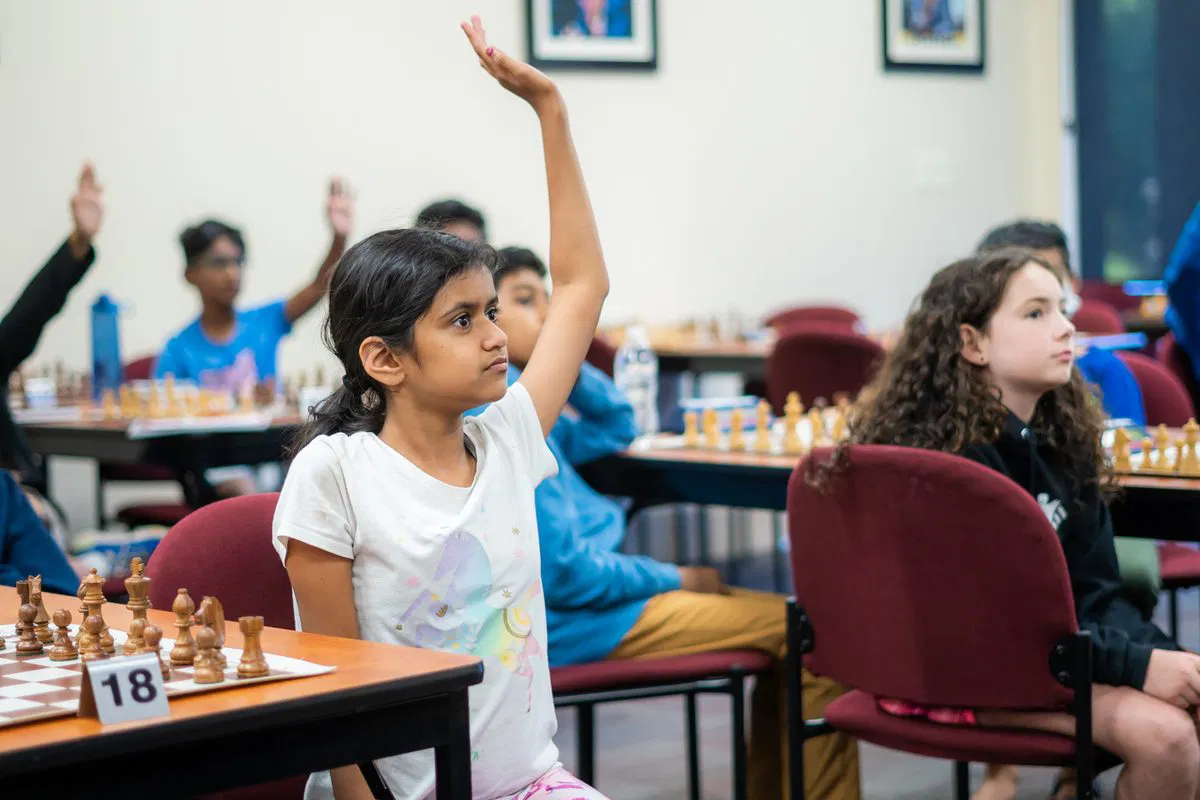
A young visitor at the Charlotte Chess Center
SS: So passion without an elaborate financial plan can work out – but not the other way around.
PG: Absolutely. You become tenacious. You hang in there. Of course you also have to be willing to change, willing to confront the things you do right and wrong. But that's where I see the elements of chess factor in – the application of chess principles to real-world situations. You see something's not working, you change it. You're not stuck in your ways. Passion drives you, it keeps you motivated.
It's like when you go to a tournament thinking you'll win, and you lose all your games and you're demotivated. You should actually use that as a way to improve. Then you come back and win the next tournament. Changing what isn't working, constantly wanting to improve, chasing more, being the best you can be.
I've personally shifted all of that same energy I had for chess to the Charlotte Chess Center – which in my view is just more valuable to chess than if I devoted all that energy to the chess board, where maybe I'd achieve the IM title after lots of hard work. Even at that level, my contribution to chess as a whole would not be as great as what I'm doing now.
SS: And maybe you'll create hundreds of IMs and GMs in the years to come.
PG: I would be so happy if that happened.
SS: Peter, thank you so much. We spoke about so many aspects of the Charlotte Chess Center, and I'm going back with a lot of inspiration and a lot of positive things to think about.
PG: Thank you, Sagar.
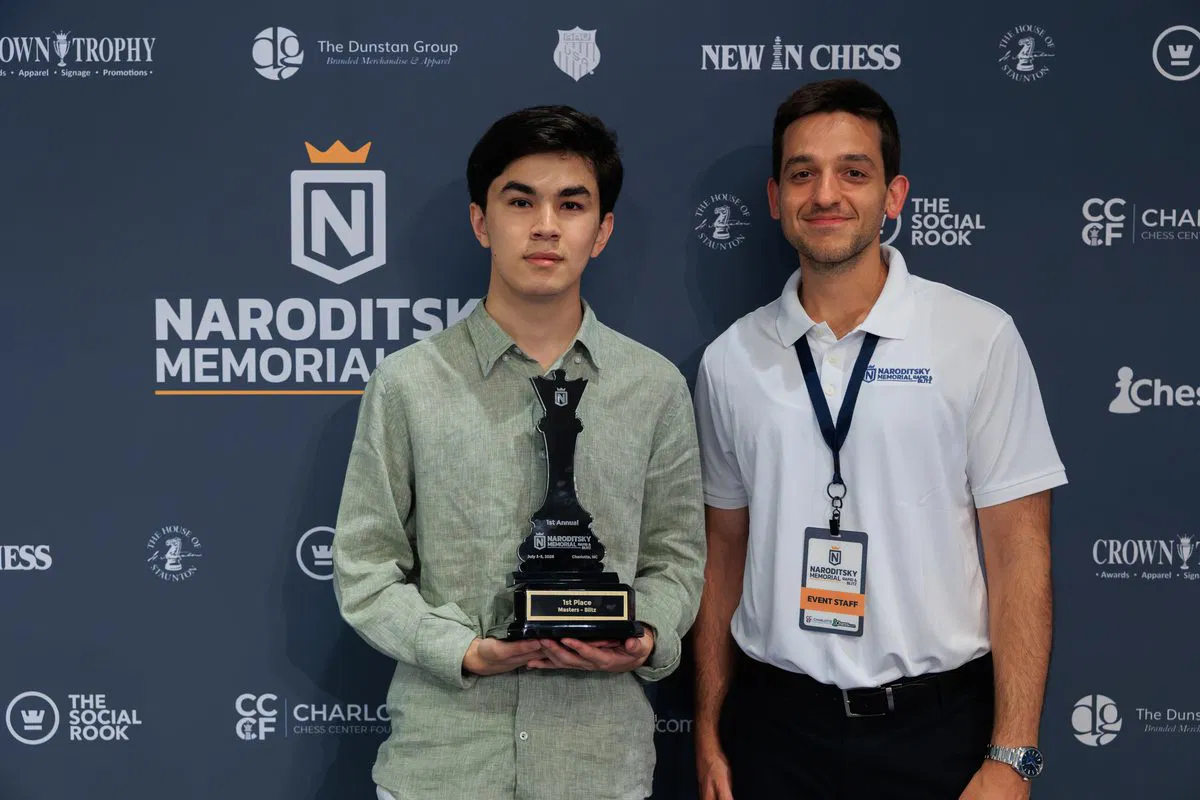
Peter Giannatos with Javokhir Sindarov, winner of the inaugural edition of the Daniel Naroditsky Memorial Rapid and Blitz


| Advertising |










.jpeg)

.jpeg)