
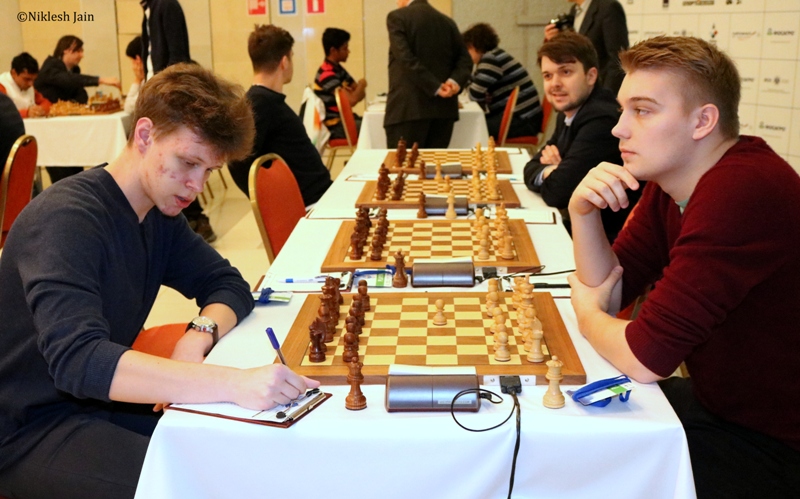

Walking to the venue today, I was thinking about some of the important games lined up for the round. The overnight leader, Vladislav Artemiev was pitted another Vladislav — Vladislav Kovalev. If Artemiev won, he would keep his lead; if Kovalev managed to bring home the point, he would propel himself to at least shared first place. On board three, there was the top seed, Vladimir Fedoseev, who had made it back to the top boards after a shaky start. He was to play Tabarabei Amin, the International Master with a GM rating. Also, my countryman and the second seed of the tournament, Vidit Gujrathi was yet to win his first game of the tournament. He was paired against the Uzbek child prodigy, Nodirbek Abdusattorov and I was curious to see if Vidit could finally pull out a victory.
Upon entering the tournament hall, however, all of this was sidelined. I was told by the chief arbiter that I will only be allowed to take pictures in the first 10 minutes so I hastily pulled out my camera.
A quick look at the happenings of round 6 | ChessBase India YouTube
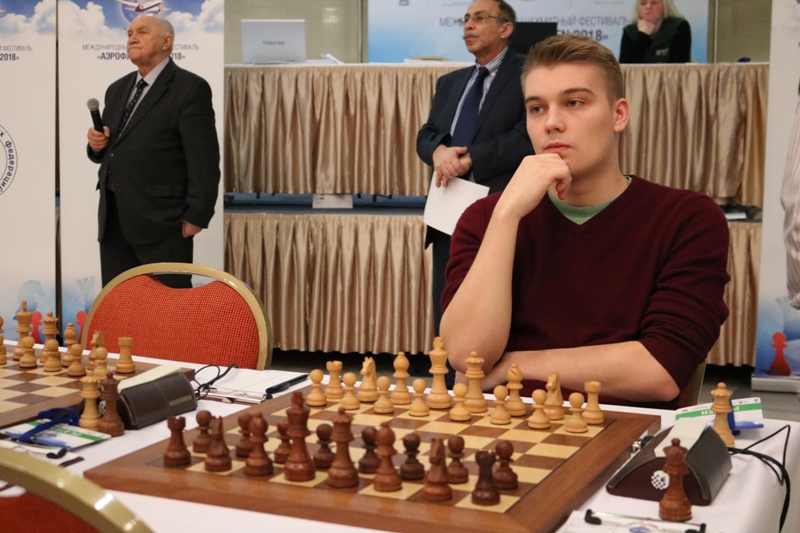
It was Kovalev who emerged on top in the 'Battle of the Vladislavs' | Photo: Niklesh Jain
Artemiev was faced with the 3.Bb5 variation against his Sicilian and as early as on move 7, the Russian teenager found a crafty way of rerouting his knight. In the ensuing position, Kovalev had a slight advantage because of his extra space and the limited mobility of Black's light-squared bishop. The position wasn't so bad for Artemiev but Kovalev kept pushing energetically and, after a few errors by his opponent, was able to bring home the full point.
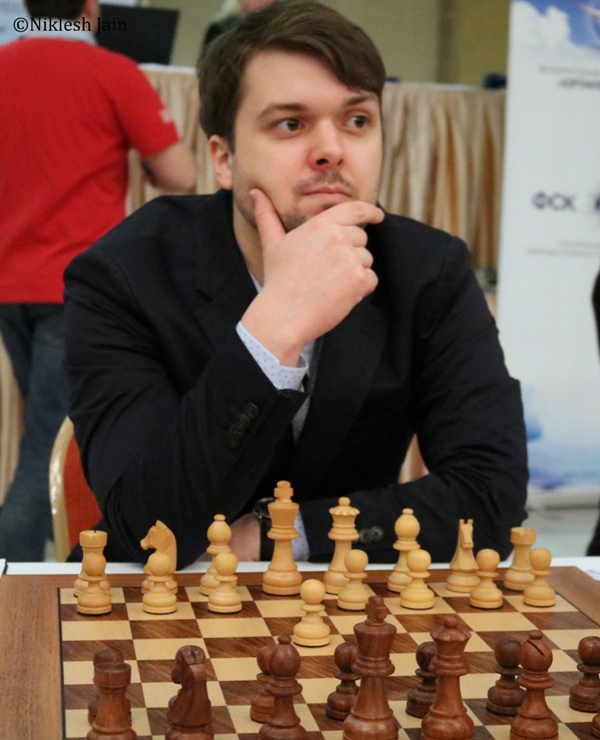
The top seed of the tournament, Vladimir Fedoseev had to walk on tightropes in his game against... | Photo: Niklesh Jain
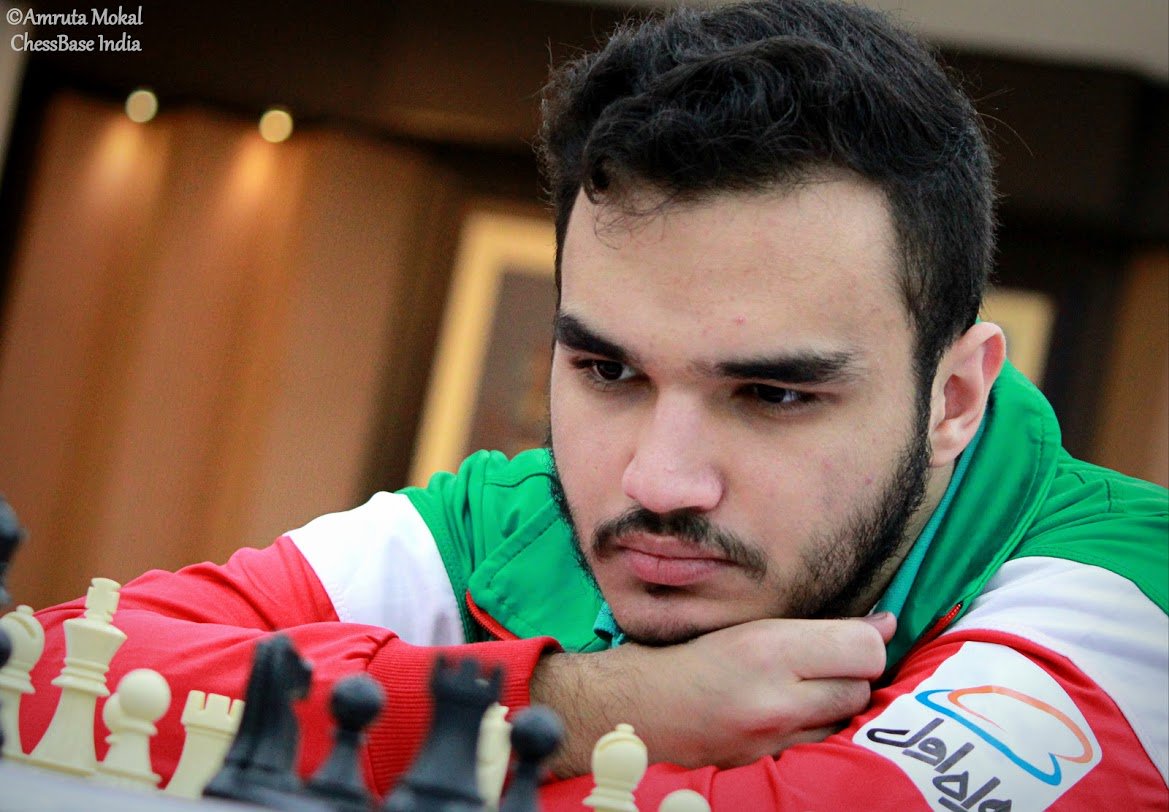
...IM Amin Tabatabaei | Photo: Amruta Mokal
Fedoseev's clash against Amin Tabatabaei was a crazy Caro-Kann were both players went after each other's king from the word 'go'. The Iranian IM had an imposing position out of the opening after his top-seeded opponent erred early in the game. The evaluation changed multiple times, however, as both players tried to find their way out of the dense woods of variations.
On his 17th turn, Tabatabaei almost threw away all of his advantage but soon afterwards, Fedoseev missed a zwischenzug and returned the favour. This simply spelt doom for Fedoseev as his lack of development on the queenside made it impossible for him to keep up the defence of his king.
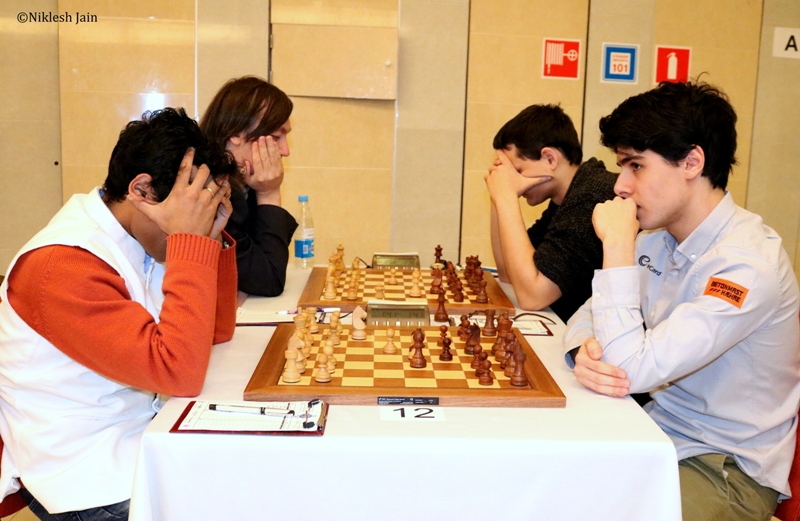
Sasikiran's game against Tari was also a Caro-Kann which was only slightly less crazy | Photo: Niklesh Jain
Unlike the Fedoseev-Tabatabaei, the Caro-Kann seen in the game between Sasikiran and Tari did not open as aggressively as the former. But as soon as the middlegame arose, vicious attacks were witnessed on both sides of the board. While Tari ripped open the queen-side to eke out a pawn, Sasikiran went on the offensive on the king's wing.
The long, tactical sequence that followed, left the Norwegian with three pawns for a piece. But Sasikiran's extra piece along with his initiative on the king-side turned out to be a bit too much for Tari to handle. In the end, Sasi, with a crafty sequence of knight moves caught the black king in a mating net and forced resignation.
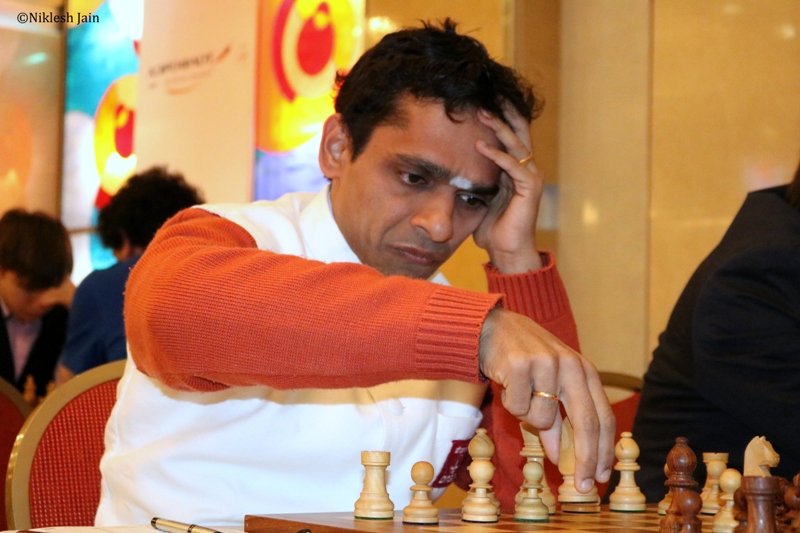
When Sasi gives that killer gaze, you know you're in trouble! | Photo: Niklesh Jain
.JPG)
Sethuraman received a nice birthday present from his opponent in round 6 | Photo: Niklesh Jain
The all-Indian encounter between SP Sethuraman and Aryan Chopra concluded with a surprising win for the former. The two battled in the Saemisch variation of the King's Indian wherein Chopra forced his opponent to go on a king march. Sethuraman had the better position for the most part of the game but on his 32nd move, a missed tactical shot by Sethuraman re-established equality.
This wasn't, however, the end of the story. Just four moves later, on move 36, Chopra blundered mate in one and gifted his opponent the full point. Given that this happened only four moves before the first time control, this might well have been the case of a time-trouble mishap.
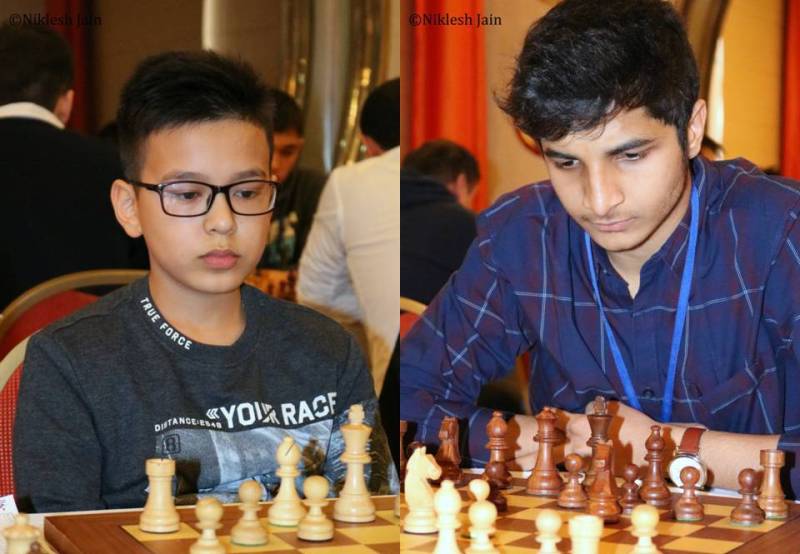
Vidit Gujrathi (right) is still looking for his first win of the tournament | Photo: Niklesh Jain
The second highest rated player in the tournament, Vidit Gujrathi is still looking for his first win in the tournament. In round 6, he was paired to play against the child prodigy from Uzbekistan, IM Nodirbek Abdusattorov. With the white pieces, the 13-year-old International Master went for the razor-sharp Keres Attack to counter Vidit's Sicilian Najdorf.
Vidit was able to equalise very comfortably out of the opening but that was only as far as he could get. Although objectively equal, the position was still razor sharp when the young International Master sacrificed a full rook and forced a perpetual.
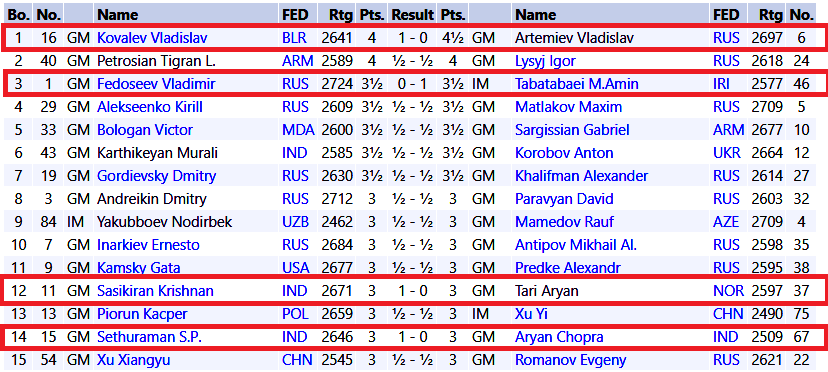
Out of the top 15 games, only four finished with a decisive result!
| Rk. | Name | Rtg | Pts. | TB1 | |
| 1 | GM | Kovalev Vladislav | 2641 | 5,0 | 2 |
| 2 | GM | Artemiev Vladislav | 2697 | 4,5 | 3 |
| 3 | GM | Lysyj Igor | 2618 | 4,5 | 3 |
| 4 | IM | Tabatabaei M.Amin | 2577 | 4,5 | 3 |
| 5 | GM | Petrosian Tigran L. | 2589 | 4,5 | 2 |
| 6 | GM | Khalifman Alexander | 2614 | 4,0 | 3 |
| 7 | GM | Karthikeyan Murali | 2585 | 4,0 | 3 |
| 8 | GM | Maghsoodloo Parham | 2594 | 4,0 | 3 |
| 9 | GM | Bologan Victor | 2600 | 4,0 | 3 |
| 10 | GM | Matlakov Maxim | 2709 | 4,0 | 3 |
| 11 | GM | Korobov Anton | 2664 | 4,0 | 3 |
| 12 | GM | Sethuraman S.P. | 2646 | 4,0 | 3 |
| 13 | GM | Sargissian Gabriel | 2677 | 4,0 | 3 |
| 14 | GM | Sasikiran Krishnan | 2671 | 4,0 | 3 |
| 15 | GM | Gordievsky Dmitry | 2630 | 4,0 | 3 |
| 16 | GM | Alekseenko Kirill | 2609 | 4,0 | 3 |
| 17 | GM | Xu Xiangyu | 2545 | 3,5 | 3 |
| 18 | GM | Antipov Mikhail Al. | 2598 | 3,5 | 3 |
| 19 | IM | Yakubboev Nodirbek | 2462 | 3,5 | 3 |
| 20 | GM | Yuffa Daniil | 2521 | 3,5 | 3 |
| IM | Xu Yi | 2490 | 3,5 | 3 | |
| 22 | GM | Fedoseev Vladimir | 2724 | 3,5 | 3 |
| 23 | IM | Iniyan P | 2460 | 3,5 | 3 |
| 24 | GM | Andreikin Dmitry | 2712 | 3,5 | 3 |
| 25 | GM | Kamsky Gata | 2677 | 3,5 | 3 |