9/23/2021 – While the Solve Tactics mode is undoubtedly the meat of the of the Tactics web app, there are two other modes that provide a very different sort of training, excellent to stay sharp. Both are based on trying to solve as quickly as possible, but each with a slightly different angle. They are also the perfect trainer for bullet chess. You will also find part one demonstrated in a video!
new: ChessBase Magazine 225
Chess Festival Prague 2025 with analyses by Aravindh, Giri, Gurel, Navara and others. ‘Special’: 27 highly entertaining miniatures. Opening videos by Werle, King and Ris. 10 opening articles with new repertoire ideas and much more. ChessBase Magazine offers first-class training material for club players and professionals! World-class players analyse their brilliant games and explain the ideas behind the moves. Opening specialists present the latest trends in opening theory and exciting ideas for your repertoire. Master trainers in tactics, strategy and endgames show you the tricks and techniques you need to be a successful tournament player! Available as a direct download (incl. booklet as pdf file) or booklet with download key by post. Included in delivery: ChessBase Magazine #225 as “ChessBase Book” for iPad, tablet, Mac etc.!
Order the annual ChessBase Premium Membership and save twice! You only pay for ten months Premium and you get a 13th month for free. Payment only by credit card. The subscription is automatically renewed on the expiration date.
The Benko Gambit is back at the very highest level - and it's easy to see why. Black sacrifices a pawn to seize the initiative on the queenside, obtaining long-lasting pressure, active pieces and open files that make life difficult for White.
€39.90
In the first article on the Tactics web app we looked in detail at the main tactics training mode: Solve Tactics. It is by far the most traditional of the modes, with near endless positions ranging from elementary to master level exercises with no time limits or constraints. However, the next two modes are quite literally the diametric opposite.
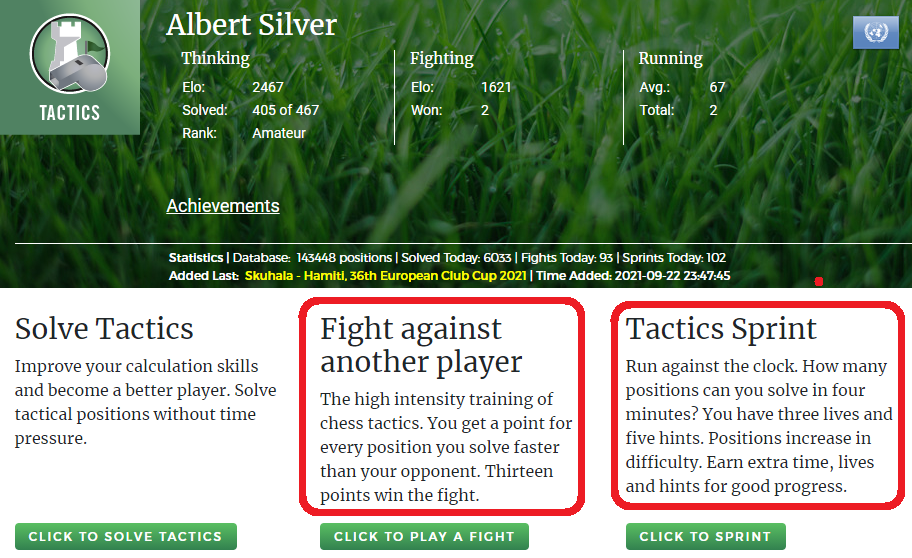
Fight Against Another Player
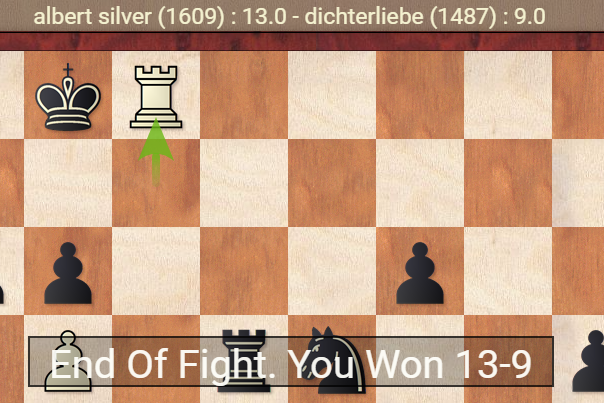
The purpose of this mode is to face another player and try to outsolve them over 24 positions. The first to score 12.5 points (yes, it is possible) wins the bout. Each player is given the exact same position to solve, and the first player to solve it scores a point. So how can you score a 'half-point'? If neither player posts a solution before 60 seconds, the position is considered a fail by both, and the players are given a half-point each.
As you can see here, the toolbar subtly offers buttons to start a bout or observe one. To start a bout, just click on Seek Fight and a match will immediately start with the free opponent closest to your ranking.
There are almost always a couple of players to choose against, some easy, some hard. It can be quite a nail-biter as you try to solve a puzzle, and suddenly see the message that the other player beat you to the punch, meaning you must try again in the next position, since this one is over.
The tactics are all usually very direct, and require an alert mind honed for quick but deadly tactics. Training such positions is not always obvious since the core tactics trainer is meant for a more normal range. So what to do? That is where Tactics Sprint comes into play.
Tactics Sprint
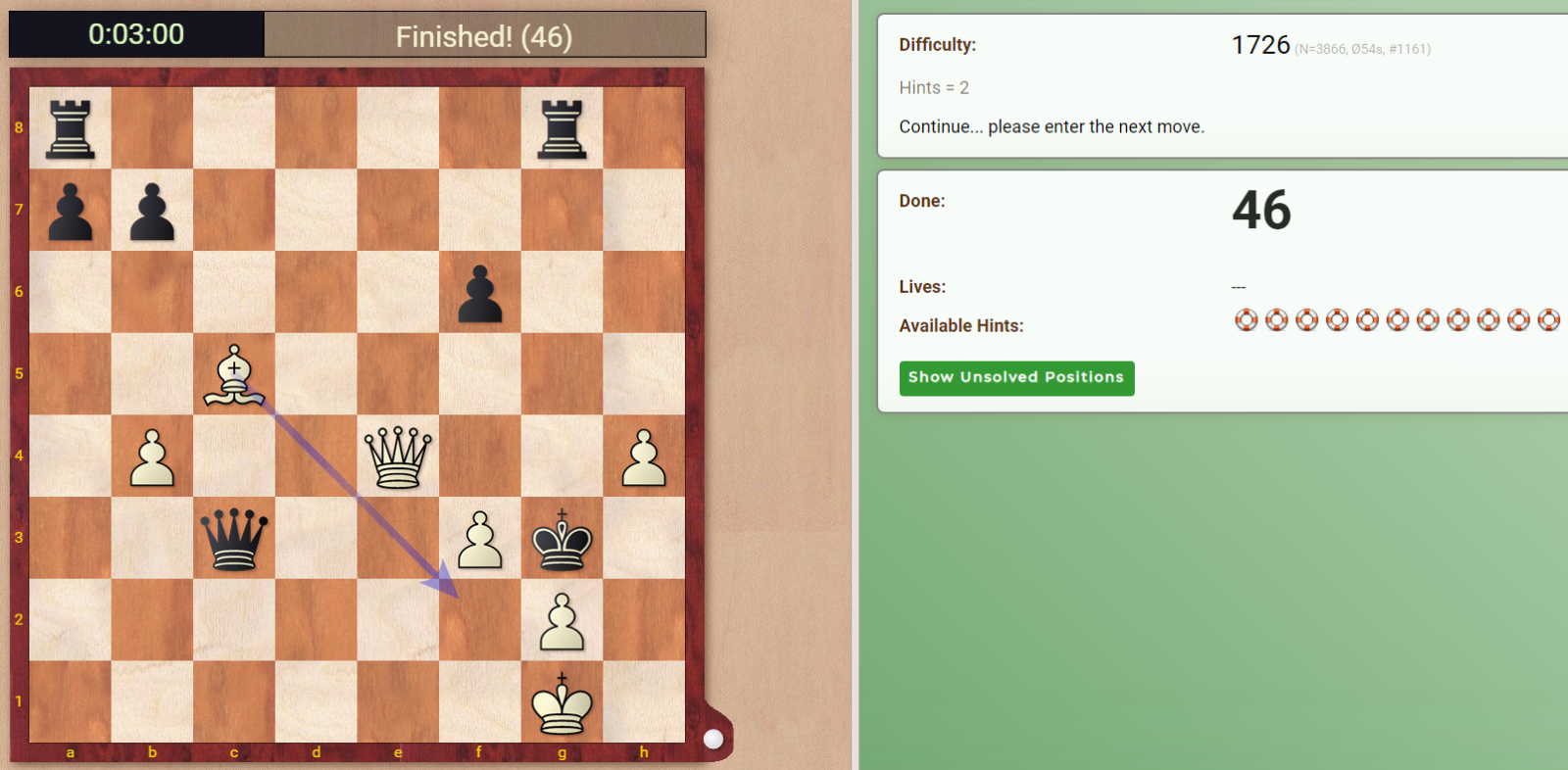
This is a single player exercise, but definitely one that can really grab a hold of you. The idea is fairly simple: You have four minutes and must solve as many positions as possible in that time. The more you solve the harder they get. Sounds simple enough, right? But there is more. This is not a four-minute knockout, no, this has time added for each solution. In fact in theory you could be at the board for much much more than four minutes, but the time you get is not really enough to keep you above water for too long, unless your name is Hikaru Nakamura. Then you may be at it for quite a bit longer.
This format can be a real adrenaline rush, not just because of the dwindling time, but because of the desire to be quick to get those precious increment seconds added to your clock. Overall these can be really fun as you try to blitz through as many as possible, and of course each time try to break your own high score.
However, it is not only about extending your time. There is a real price to pay if your solution is wrong. At the onset you get five 'lives', so if you fail five times then like any self-respecting video game, your lives are up and it is game over. As a result, unless you are literally down to the dregs of time, with nothing to lose, spend a few extra seconds to be sure of your reply before playing it.
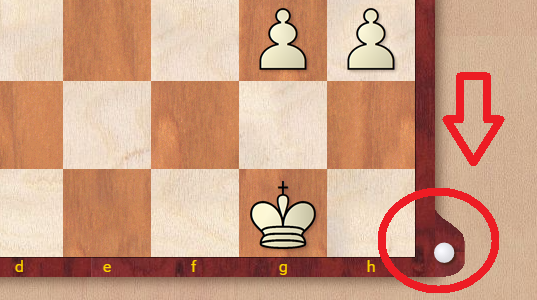
Finally, there is a trick you may wish to be careful for. When you are racing against the clock (or an opponent), some positions can easily get you looking for a move for the wrong color. So be sure to check the bottom right corner of the board if you are not immediately sure.
If you missed part one of this overview, feel free to see the video below to see the app in action, including how it plays on a smartphone.
Albert SilverBorn in the US, he grew up in Paris, France, and after college moved to Rio de Janeiro, Brazil. He had a peak rating of 2240 FIDE, and was a key designer of Chess Assistant 6. In 2010 he joined the ChessBase family as an editor and writer at ChessBase News. He is also a passionate photographer with work appearing in numerous publications, and the content creator of the YouTube channel, Chess & Tech as well as the author of Typing Tomes, a powerful typing program.
YOUR PERSONAL CHESS COACH - Whether you’re taking your first steps into the world of club chess, or already playing at a tournament level: with FRITZ, you can train more efficiently, intelligently and with a more personalised approach than ever before.
The Nimzo-Indian has stood the test of time for over a century: Still a top choice for elite players today, from Magnus Carlsen to Praggnanandhaa, it remains one of Black's most reliable ways to fight for real chances against 1.d4 2.c4 3.Nc3.
1.c4 e5 2.Nc3 Bb4!? is an opening idea well worth considering. Black immediately threatens to double the pawns on c3 in the style of the Trompowski or Sicilian Grand Prix attack.
Italian Game Powerbase 2026 is a database and contains 8571 top class games from Mega 2026 and the Correspondence Database 2026, of which 479 are annotated.
Videos: Nico Zwirs discusses the Sicilian with 2…e6 3.d4 cxd4 4.Qxd4 Nc6 5.Qe3 Nf6 6.Nc3. Mihail Marin examines Sindarov’s 6.Ne5 in the Queen’s Pawn Defence. Plus the ‘Lucky bag’ featuring 41 analyses by Berg, Ftacnik, Gupta and many others.
If you're looking for a dynamic alternative to the Slav, Queen's Gambit Declined, or other mainstream systems, the Chigorin Defence offers exactly what modern tournament players need.
€34.90
We use cookies and comparable technologies to provide certain functions, to improve the user experience and to offer interest-oriented content. Depending on their intended use, analysis cookies and marketing cookies may be used in addition to technically required cookies. Here you can make detailed settings or revoke your consent (if necessary partially) with effect for the future. Further information can be found in our data protection declaration.
Pop-up for detailed settings
We use cookies and comparable technologies to provide certain functions, to improve the user experience and to offer interest-oriented content. Depending on their intended use, cookies may be used in addition to technically required cookies, analysis cookies and marketing cookies. You can decide which cookies to use by selecting the appropriate options below. Please note that your selection may affect the functionality of the service. Further information can be found in our privacy policy.
Technically required cookies
Technically required cookies: so that you can navigate and use the basic functions and store preferences.
Analysis Cookies
To help us determine how visitors interact with our website to improve the user experience.
Marketing-Cookies
To help us offer and evaluate relevant content and interesting and appropriate advertisement.