



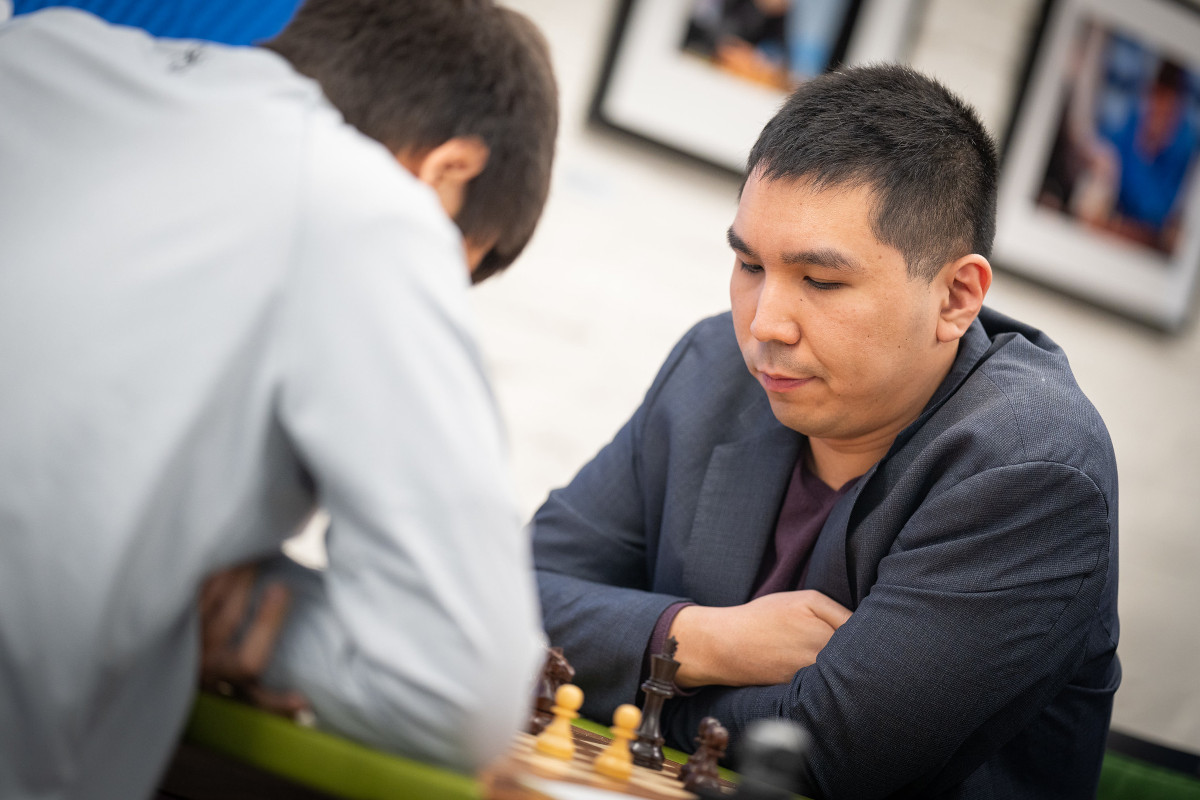

Wesley So emerged as the sole leader of the US Chess Championship after defeating Ray Robson with the black pieces in round seven. The three-time national champion now has 5/7 points, half a point ahead of Fabiano Caruana and Andy Woodward, who both drew their games. Awonder Liang, who had entered the round sharing first place, suffered his second defeat against Grigoriy Oparin and dropped to 4/7.
With four rounds remaining, So leads Caruana and Woodward by half a point. The eighth round will feature a direct encounter between So and Woodward, with the latter looking to catch the tournament leader before Sunday's rest day.
So's victory over Robson was far from straightforward. After obtaining a satisfactory position, he allowed his opponent to take control of the endgame. However, Robson failed to maintain his advantage as the players approached the first time control. Following inaccuracies by both sides, the position simplified into a bishop endgame in which So had two connected passed pawns. Robson was unable to find the precise defensive continuation, allowing So to secure his fourth victory of the tournament.
Robson v. So
Annotations by Martina Gerdts
In this position, White had to do something about the knight on d7, which he would actually have preferred to leave there. Since this was not possible without losing material, Robson chose 32.Nxf8. In doing so, he exchanged the knight that he had just driven back to the last rank. 32.Nc5 does not work because Black takes on d7 and then wins a pawn on d4. 32.Nxb6 relieves the pressure on the d-pawn, allowing the other white knight to become active, while leaving Black with the knight on f8. For example, 32.Nxb6 cxb6 33.Bf4 Nc4 34.Nd2 would have been a playable line for White.
After 32.Nxf8 Rxf8 33.Nc5 Nc4 34.Bc3, the timing was less favourable for the white bishop, leaving it more passive than in the alternative line.
35...Kg8 would have attacked the f-pawn without worsening the position of Black's knight. With 35...Nd6, Wesley So made things easier for his opponent. 36.Nd7 would have prevented Black from also attacking the f-pawn with the rook. So was fortunate that 36.Re5 followed, allowing him to reply with 36...Kg8.
The players transitioned into an endgame with same-coloured bishops, in which Wesley So had two connected extra pawns, while Robson's king was closer to the opposing pawns.
78.Kf5 would also have been better than 78.Kg6, because the king would then not be standing behind the pawns that it is actually trying to stop.
This course offers a structured and practical introduction to the core elements of positional chess.
Free video sample: Introduction
Free video sample: Strategic Classic: Bondarevsky - Smyslov
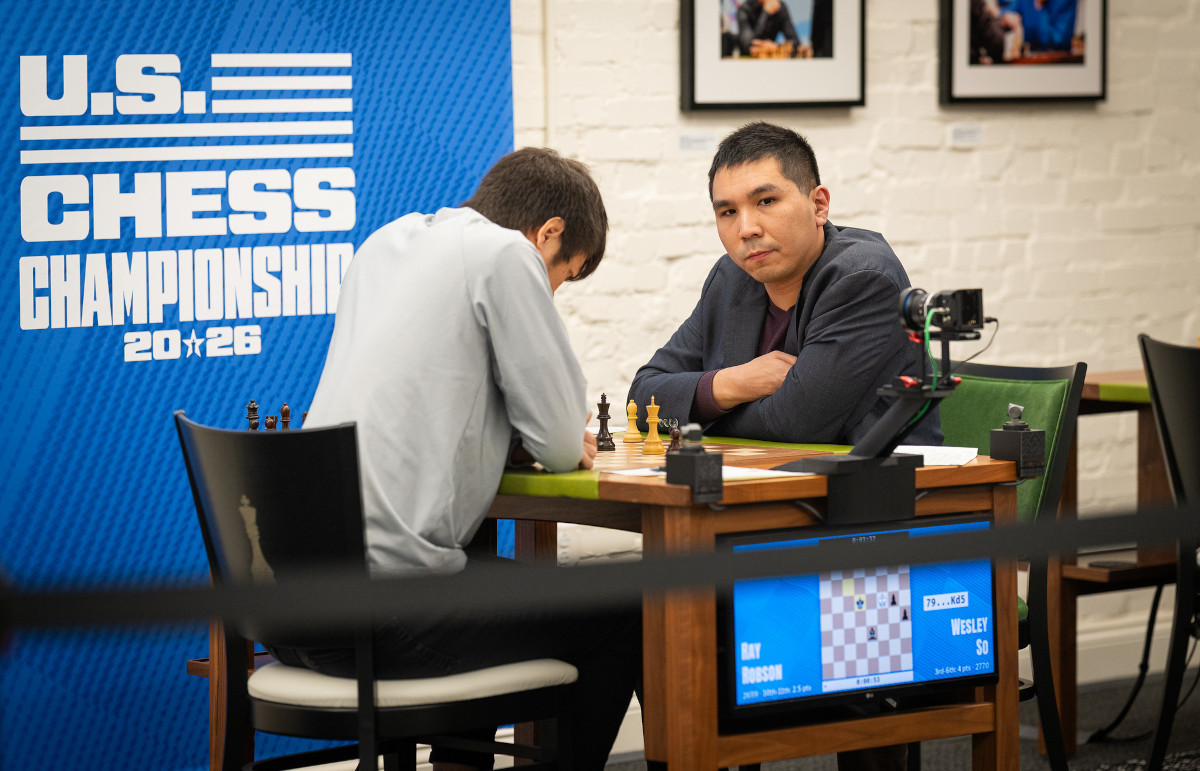
Black is already winning after move 79 | Photo: Lennart Ootes
The most surprising result of the round was Oparin's victory over Liang. Playing white, Oparin obtained a promising position after his opponent made several questionable strategic decisions in the middlegame. Liang's pawn structure restricted the activity of his dark-squared bishop, leaving him with limited defensive resources. Further inaccuracies allowed Oparin to increase the pressure, and the game ended when Liang overlooked a direct mating threat.
Oparin v. Liang
Annotations by Martina Gerdts
In an already inferior position, Awonder Liang overlooked Grigoriy Oparin's mating threat and played 26...Bd8. There followed 27.Bh7+, and Black resigned.
Awonder Liang did not want to be shown the checkmate: 27...Kh8 28.Rxf8+ Ng6 29.Rxg8#.
Caruana and Woodward, meanwhile, were unable to keep pace with So. Caruana drew against Hans Niemann after a relatively balanced struggle, while Woodward split the point with Sam Sevian. The latter successfully defended against Woodward's attempts to generate attacking chances on the kingside.
The other decisive encounter saw Levon Aronian collect his first victory of the tournament by defeating Sam Shankland. Aronian made effective use of his bishop pair and successfully neutralised his opponent's counterplay.
Alice Lee and Rachael Li scored victories in round seven of the US Women's Championship to keep the joint lead now on 5½/7 points. Lee defeated Rose Atwell, while Li got the better of Megan Paragua. A previous co-leader, Thalia Cervantes, suffered her first defeat against Anna Sargsyan and dropped out of first place. Eight-time national champion Irina Krush also won and now stands alone in third place on 5/7.
Lee recovered immediately from her sixth-round defeat against Li, which had ended a four-game winning streak. Playing black against Atwell, the 17-year-old initially faced some difficulties but gradually took control of the position. Atwell had opportunities to maintain the balance, but Lee eventually obtained the more promising prospects and converted her advantage.
Li, meanwhile, produced a convincing performance against Paragua. The 16-year-old employed an unusual opening setup before adopting an active approach in the middlegame. Her pieces became increasingly well coordinated, allowing her to generate threats that her opponent could not meet satisfactorily.
Li has now won five of her seven games, with her only defeat coming against Cervantes in round two.
Cervantes lost to Sargsyan after overextending her position. The former co-leader attempted to generate winning chances by opening lines on the kingside, but her plan backfired. Sargsyan exploited the resulting weaknesses, while Cervantes struggled to defend accurately under time pressure.
Krush also collected a full point, taking down defending champion Carissa Yip in a complicated encounter. The players reached a sharp position from a King's Indian Defence, with both sides obtaining opportunities. Under considerable time pressure, Yip eventually committed the decisive mistake, allowing Krush to secure her fourth victory of the championship.


| Advertising |











.jpeg)