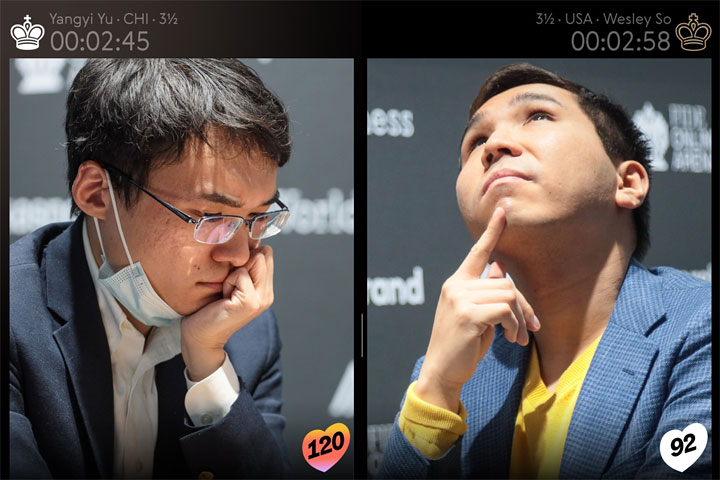
3/30/2022 – World Chess has introduced an innovation that will likely add a new dimension to the way fans watch chess (and other mind sports, for that matter!). They have developed – and will roll out today – a tool that tracks the players' heart rate over video signal (without playing having to wear a pulse-tracking device). Please find the press release below and tune in today to see the technology in action during the semi-finals of the Grand Prix in Berlin. Press release.
new: Fritz 20
Your personal chess trainer. Your toughest opponent. Your strongest ally. FRITZ 20 is more than just a chess engine – it is a training revolution for ambitious players and professionals. Whether you are taking your first steps into the world of serious chess training, or already playing at tournament level, FRITZ 20 will help you train more efficiently, intelligently and individually than ever before.
Throughout the video course, Sasikran shows various examples from his career to explain sacrifices for initiative, an attack, a better pawn structure and much more.
€49.90
Chess broadcast to include players’ heart rate determined by AI
March 30, 2022 — BERLIN, Germany — The official broadcast of the final rounds of the FIDE Grand Prix Series, an important part of the World Chess Championship cycle, will feature players’ heart rate indicator, according to World Chess, the Series organizer.
This is the first time when the players’ heart rate is measured and displayed in the broadcast of the World Chess Championship cycle event. It will allow spectators to better understand players’ emotions and true feelings (as far as they are reflected in the heart rate) — a rare insight into the psychology of the elite chess players who are trained and especially good at keeping a poker face.
You can watch the broadcast with the heart rate monitor here
By adding a heart rate indicator, World Chess brings a new dimension into chess broadcasting and opens a new page of the way fans follow chess. Until now, the only way to learn about players’ emotions in a specifically tense moment was to ask them about it in a post-game press conference, and players rarely talk about emotions. With a heart rate tracker in the broadcast, spectators can sense players emotions while the game is going on.
To accurately measure the heart rate without disturbing the players, World Chess is deploying a bespoke AI technology similar to that used by hospitals to track patients’ vitals over video. It’s the first time such technology is used in sports broadcasting. AI has been trained to read almost invisible changes in reflections of the skin color that change based on a person’s heart rate.
“Chess games are thrilling, full of emotions and often rage or disappointment, but you don’t get to see it during the broadcast because the players are conditioned to hide it. We are happy to add a layer of human sensitivity so spectators can have some insight into the state of mind of their favorite players,’ — says Ilya Merenzon, World Chess CEO.
The official broadcast of the FIDE Grand Prix is available for free on worldchess.com and on World Chess Youtube and Twitch channels. In addition to the heart rate indicator, it includes live video from the playing area, expert commentary, as well as players’ and spectators’ interviews and more. World Chess will continue developing and using the video heart rate reading technology in future events and broadcasting.
A word of explanation – by Frederic Friedel
I have witnesses experiments conducted by an AI group (which currently wishes to remain unnamed). A webcam was used to measure the heart rate and then derive “excitement” level during chess games from the values measured. Apparently, each heartbeat subtly changes the colour of the skin, and this can be detected by the AI. In a test, a notebook webcam was able to track my heart rate, which closely matched the value displayed by a traditional pulse monitor. The AI heart rate monitoring actually worked!
London System Powerbase 2026 is a database and contains in all 11 285 games from Mega 2026 and the Correspondence Database 2026, of which 282 are annotated.
The London System Powerbook 2026 is based on more than 410 000 games or game fragments from different opening moves and ECO codes; what they all have in common is that White plays d4 and Bf4 but does not play c4.
In this course, Grandmaster Elisabeth Pähtz presents the London System, a structured and ambitious approach based on the immediate Bf4, leading to rich and dynamic positions.
Opening videos: Open Spanish (Sipke Ernst) and Classical Sicilian (Nico Zwirs). Endgame Special by Igor Stohl: ‘Short or long side’ – where should the defending king be placed in rook endgames? ‘Lucky bag’ with 35 master analyses.
YOUR EASY ACCESS TO OPENING THEORY: Whether you want to build up a reliable and powerful opening repertoire or find new opening ideas for your existing repertoire, the Opening Encyclopaedia covers the entire opening theory on one product.
The Queen’s Gambit Declined Exchange Variation with 5.Bf4 has a great balance between positional play and sharp pawn pushes; and will be a surprise for your opponents while being easy to learn for you, as the key patterns are familiar.
€9.90
We use cookies and comparable technologies to provide certain functions, to improve the user experience and to offer interest-oriented content. Depending on their intended use, analysis cookies and marketing cookies may be used in addition to technically required cookies. Here you can make detailed settings or revoke your consent (if necessary partially) with effect for the future. Further information can be found in our data protection declaration.
Pop-up for detailed settings
We use cookies and comparable technologies to provide certain functions, to improve the user experience and to offer interest-oriented content. Depending on their intended use, cookies may be used in addition to technically required cookies, analysis cookies and marketing cookies. You can decide which cookies to use by selecting the appropriate options below. Please note that your selection may affect the functionality of the service. Further information can be found in our privacy policy.
Technically required cookies
Technically required cookies: so that you can navigate and use the basic functions and store preferences.
Analysis Cookies
To help us determine how visitors interact with our website to improve the user experience.
Marketing-Cookies
To help us offer and evaluate relevant content and interesting and appropriate advertisement.