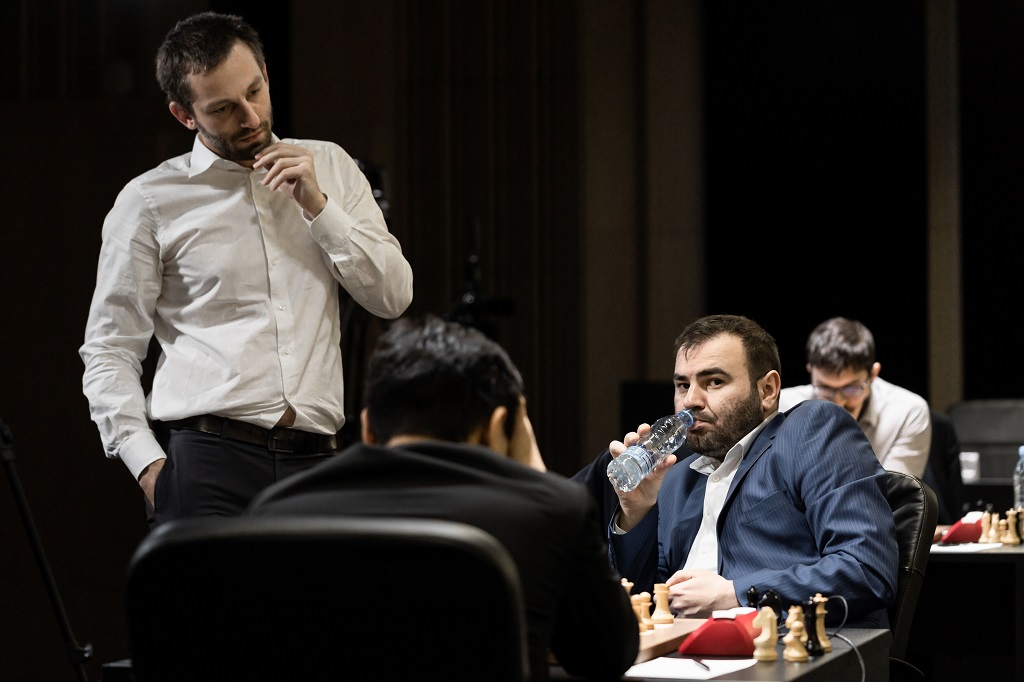
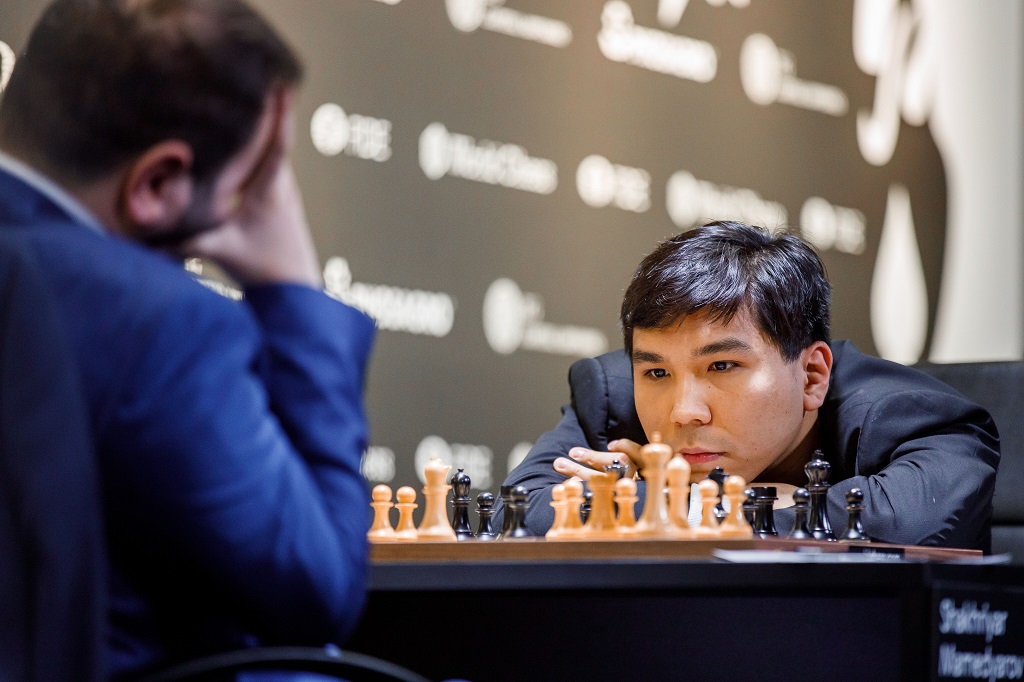
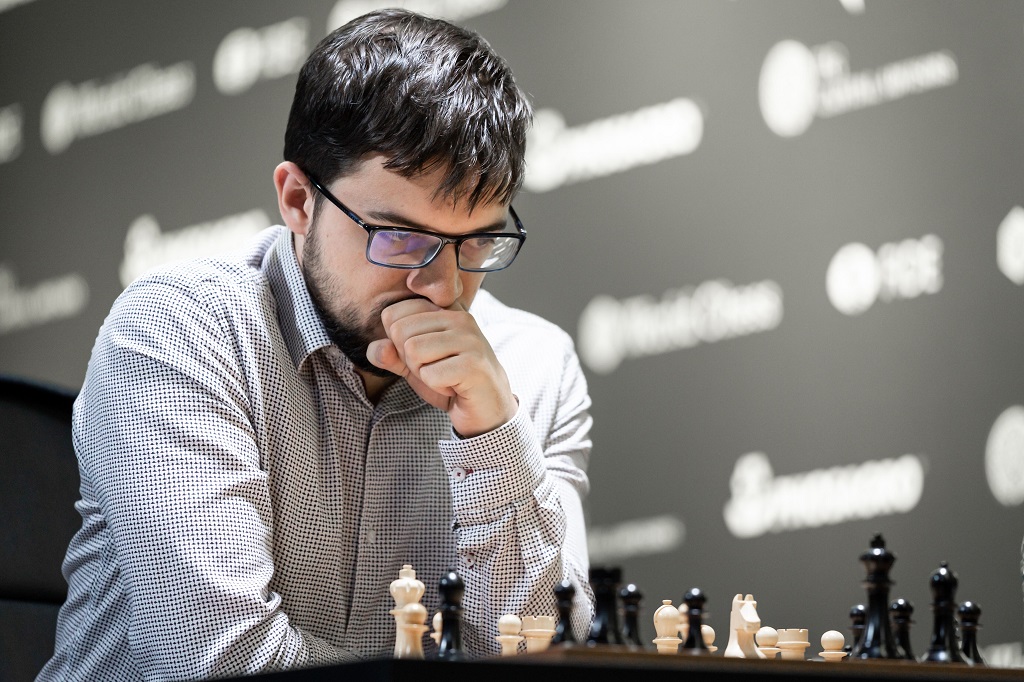
7/18/2019 – In the first game of the semi-finals at the FIDE Grand Prix in Riga we saw a couple of elite chess battles, as Shakhriyar Mamedyarov surprised Wesley So to get a quick win and Alexander Grischuk got himself in trouble out of a Berlin Defence against Maxime Vachier-Lagrave. Grischuk and So will have the white pieces in Friday's rematch encounters. | Photo: World Chess
new: ChessBase Magazine 225
Chess Festival Prague 2025 with analyses by Aravindh, Giri, Gurel, Navara and others. ‘Special’: 27 highly entertaining miniatures. Opening videos by Werle, King and Ris. 10 opening articles with new repertoire ideas and much more. ChessBase Magazine offers first-class training material for club players and professionals! World-class players analyse their brilliant games and explain the ideas behind the moves. Opening specialists present the latest trends in opening theory and exciting ideas for your repertoire. Master trainers in tactics, strategy and endgames show you the tricks and techniques you need to be a successful tournament player! Available as a direct download (incl. booklet as pdf file) or booklet with download key by post. Included in delivery: ChessBase Magazine #225 as “ChessBase Book” for iPad, tablet, Mac etc.!
YOUR PERSONAL CHESS COACH - Whether you’re taking your first steps into the world of club chess, or already playing at a tournament level: with FRITZ, you can train more efficiently, intelligently and with a more personalised approach than ever before. FRITZ is more than just a chess engine – it’s a training revolution! Whether you’re taking your first steps into the world of club chess, or already playing at a tournament level: with FRITZ, you can train more efficiently, intelligently and with a more personalised approach than ever before.
You will learn how Black's dynamic piece activity and structural counterplay more than compensate for White's extra tempo in the colour-reversed setups.
€39.90
A Catalan and a Berlin
At the end of the twentieth century, when Garry Kasparov was dominating the chess elite, the best players in the world were looking for theoretical ways to 'solve the game'. To find surprising novelties was a huge commodity, with certain openings more prone to be explored by those following this 'scientific approach' — the Berlin and the Catalan were among these systems (in fact, one of the biggest advocates to this approach, Vladimir Kramnik, studied both of them deeply).
On day one of the semi-finals, Shakhriyar Mamedyarov uncorked a nice novelty in the Catalan to get a comfortable win over Wesley So, while Alexander Grischuk got himself in trouble from the black side of a Berlin Defence against Maxime Vachier-Lagrave, but managed to save a draw in the end.
Match results
Click or tap any result to open the game via Live.ChessBase.com
Alexander Grischuk looking on his potential contenders | Photo: Niki Riga / World Chess
Mamedyarov 1:0 So
The Azerbaijani went for a sharp line of the Catalan, in which White is a pawn down but gets the pair of bishops and cripples Black's pawn structure. As so often happens in this opening, the theoretical lines are lengthy and specific. This time, Mamedyarov was the first one to deviate:
This DVD allows you to learn from the example of one of the best players in the history of chess and from the explanations of the authors (Pelletier, Marin, Müller and Reeh) how to successfully organise your games strategically, consequently how to keep y
The novelty was the quiet 14.a3, which nonetheless prompted So to invest around fifteen minutes on 14...♜fb8. Later on, Mamedyarov mentioned that the American had told him in the post-mortem discussion that he considered his fourteenth move to have been a mistake, but the Azeri — who remembered this line completely — clarified that So's move was actually the best one in the position.
The mistake came after 15.e4:
So now spent twenty minutes on 15...c3, the crucial mistake. Mamedyarov seemed worried, as he thought he had every line analysed in full, except this one. But, in fact, he had not memorized it because it gave White too much of an advantage.
After explaining that this will probably be a 'one-off novelty', Mamedyarov noted that after e4 Black has the strong 15...♞xe4 — the point of this move is that after the long sequence 16.♗xe4 ♛xd4 17.♗e3 ♛xe4 18.♗xb6 ♜xb6 19.♖fe1 Black has the unexpected 19...♛g6.
We certainly cannot blame So for not having seen this line from afar, as the more natural-looking 19...♛c2 or 19...♛f3, for example, are bad for Black.
After the text, it did not take long before the queens left the board. From that point on, Mamedyarov showed fine technique to prove his pair of bishops was stronger than Black's rook. Resignation came on move 34.
On this DVD Grandmaster Daniel King offers you a repertoire for Black against the Catalan, based around maintaining the rock of a pawn on d5. Keeping central control ultimately gives Black good chances to launch an attack against the enemy king.
It is tough to be an elite chess player — Wesley So knows it all too well | Photo: World Chess
Game analysis with Shakhriyar Mamedyarov
Vachier-Lagrave ½:½ Grischuk
Two well-established members of the elite explored the notorious Berlin Defence and followed a Vachier-Lagrave v Aronian game from the 2018 London Chess Classic until move 12. Grischuk himself spent some time — as usual — before going for the novelty of the game:
The players started figuring things out over the board after 12...a5, and things seemed to be going well for Black until Vachier-Lagrave's 21st move:
The problem with 21.♖d3 is that Grischuk had not foreseen it, while he already thought it was only a matter of time before a draw would be agreed. The Russian, in fact, spent over half an hour before finding the correct plan to defend against White's initiative — to advance on the queenside with 21...b5, 22...b4, 23...a4.
Grischuk kept pushing his queenside pawns later on:
The game continued 26...b3 27.cxb3 axb3 28.a4 c5 29.a5 c4 30.a6 c3 and the point was split three moves later. Both players were not sure whether White had some study-like win at some point, but certainly Vachier-Lagrave was the one with the chances.
This DVD gives you the key to start out with the French Defence. GM Yannick Pelletier is a specialist of this opening, and believes that the most efficient way to understand its ideas, plans, and typical structures is to study classical lines.
Commentary by GMs Evgeny Miroshnichenko and Arturs Neikans
Antonio PereiraAntonio is a freelance writer and a philologist. He is mainly interested in the links between chess and culture, primarily literature. In chess games, he skews towards endgames and positional play.
YOUR PERSONAL CHESS COACH - Whether you’re taking your first steps into the world of club chess, or already playing at a tournament level: with FRITZ, you can train more efficiently, intelligently and with a more personalised approach than ever before.
1.c4 e5 2.Nc3 Bb4!? is an opening idea well worth considering. Black immediately threatens to double the pawns on c3 in the style of the Trompowski or Sicilian Grand Prix attack.
Italian Game Powerbase 2026 is a database and contains 8571 top class games from Mega 2026 and the Correspondence Database 2026, of which 479 are annotated.
Videos: Nico Zwirs discusses the Sicilian with 2…e6 3.d4 cxd4 4.Qxd4 Nc6 5.Qe3 Nf6 6.Nc3. Mihail Marin examines Sindarov’s 6.Ne5 in the Queen’s Pawn Defence. Plus the ‘Lucky bag’ featuring 41 analyses by Berg, Ftacnik, Gupta and many others.
If you're looking for a dynamic alternative to the Slav, Queen's Gambit Declined, or other mainstream systems, the Chigorin Defence offers exactly what modern tournament players need.
Michael Kotyk presents a complete repertoire after 1.e4 e5, built around creative ideas, surprising move orders, and practical weapons designed to catch your opponents off guard.
€69.80
€59.90
We use cookies and comparable technologies to provide certain functions, to improve the user experience and to offer interest-oriented content. Depending on their intended use, analysis cookies and marketing cookies may be used in addition to technically required cookies. Here you can make detailed settings or revoke your consent (if necessary partially) with effect for the future. Further information can be found in our data protection declaration.
Pop-up for detailed settings
We use cookies and comparable technologies to provide certain functions, to improve the user experience and to offer interest-oriented content. Depending on their intended use, cookies may be used in addition to technically required cookies, analysis cookies and marketing cookies. You can decide which cookies to use by selecting the appropriate options below. Please note that your selection may affect the functionality of the service. Further information can be found in our privacy policy.
Technically required cookies
Technically required cookies: so that you can navigate and use the basic functions and store preferences.
Analysis Cookies
To help us determine how visitors interact with our website to improve the user experience.
Marketing-Cookies
To help us offer and evaluate relevant content and interesting and appropriate advertisement.