10/27/2021 – Top German player, IM Elisabeth Pähtz, was recently invited to speak at the Digital Demo Day in Germany, in English, where she was asked to discuss the application of quantum computing on chess. She was later interviewed about her life as a chess player with questions on how it compares to Queen's Gambit, but the key question she was asked was: can quantum computing solve chess?
new: Fritz 20
Your personal chess trainer. Your toughest opponent. Your strongest ally. FRITZ 20 is more than just a chess engine – it is a training revolution for ambitious players and professionals. Whether you are taking your first steps into the world of serious chess training, or already playing at tournament level, FRITZ 20 will help you train more efficiently, intelligently and individually than ever before.
YOUR PERSONAL CHESS COACH - Whether you’re taking your first steps into the world of club chess, or already playing at a tournament level: with FRITZ, you can train more efficiently, intelligently and with a more personalised approach than ever before. FRITZ is more than just a chess engine – it’s a training revolution! Whether you’re taking your first steps into the world of club chess, or already playing at a tournament level: with FRITZ, you can train more efficiently, intelligently and with a more personalised approach than ever before.
EXPAND YOUR CHESS HORIZONS
It doesn't get any better than this: the premium equipment perfect for tournament players and professionals: with ChessBase program '26, Mega Database, CORR-Database and much more.
€499.90
DIGITAL DEMO DAY is Germany’s leading startup expo & conference for industrial tech. National and international industrial tech & smart services start-ups put their products and latest technologies on show. This is all rounded off with a multifaceted conference program, interactive workshops, guided tours and plenty of matchmaking opportunities.
Speaker: Elisabeth Pähtz, chess player and teacher
Moderator: Céline Flores Willers, founder and CEO of The People Branding Company, LinkedIn Top Voice 2018 + 2019, The People Branding Company GmbH
(Note: the English was slightly revised for fluency.)
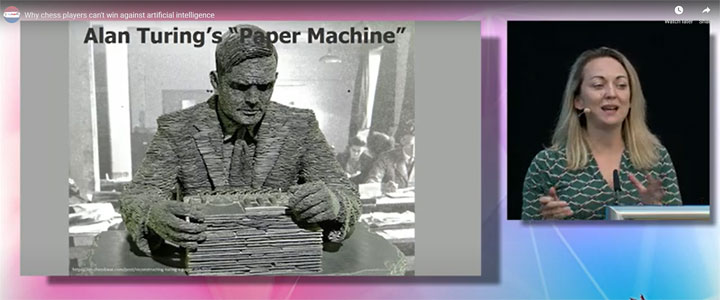
Elisabeth Pähtz: Alan turing is the key person regarding the historical development of today's chess engine. In 1948 he developed the so-called paper machine. This was to be able to run a chess engine before the computers to execute it were actually developed. As such, in 1948 he wrote it in which he served as a human CPU.
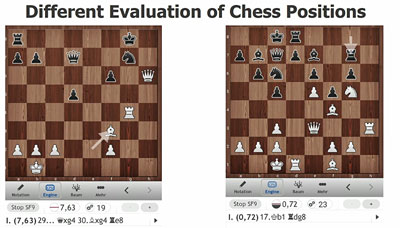
Elizabeth then proceeds to illustrate how the piece count may serve as a starting point for evaluation, it is soon overridden by other factors as the goal of the game is not to win material, but to mate the king.
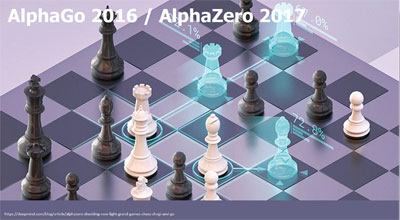
Elisabeth Pähtz: In 2016 AlphaGo was developed and this was the first neural network which was able to beat the Go world champion.
Unlike chess, she explains, where brute force programs had already achieved superiority.
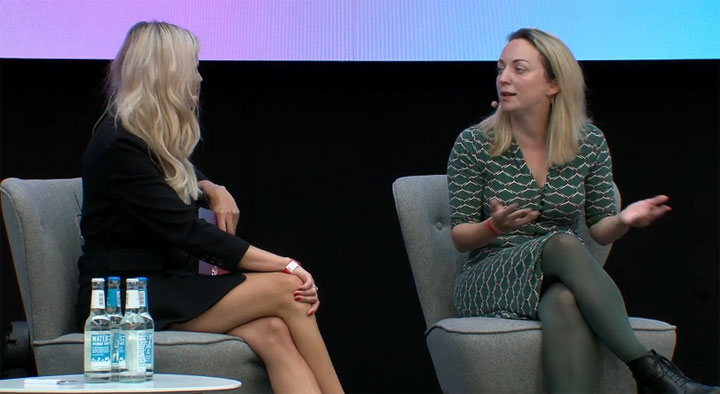
After her core presentation, she was interviewed by the moderator, Céline Flores Willers:
Elisabeth Pähtz: And regarding the last question: can quantum computing solve chess? A couple of days ago I asked one of the most important chess programmers in ChessBase and he said....
About the author
Elisabeth Pähtz (or Paehtz – rhymes with "Rates") is a German WGM and men's IM, currently rated 2473, making her the strongest female player in the country. Elisabeth (or Elli, or Lizzy) was trained in chess from early childhood by her father, GM Thomas Pähtz.
At the age of nine years she won her first German Championship in the under-11 age group. In 1999 she became Germany's women's chess champion. In 2002 Pähtz became the Youth World Champion in the under-18 age group, and in 2004 the U20 Junior World Champion. As one of the greatest German new-generation talents Pähtz was the subject of a large media interest when growing up. Among other things it was reported that she was likely to fail high school mathematics. Her own explanation for this is that she is an intuitive player, not a universal genius. Elisabeth holds the FIDE titles of International Master and Woman Grandmaster. She is an active streamer on YouTube.
Albert SilverBorn in the US, he grew up in Paris, France, and after college moved to Rio de Janeiro, Brazil. He had a peak rating of 2240 FIDE, and was a key designer of Chess Assistant 6. In 2010 he joined the ChessBase family as an editor and writer at ChessBase News. He is also a passionate photographer with work appearing in numerous publications, and the content creator of the YouTube channel, Chess & Tech as well as the author of Typing Tomes, a powerful typing program.
YOUR PERSONAL CHESS COACH - Whether you’re taking your first steps into the world of club chess, or already playing at a tournament level: with FRITZ, you can train more efficiently, intelligently and with a more personalised approach than ever before.
The Nimzo-Indian has stood the test of time for over a century: Still a top choice for elite players today, from Magnus Carlsen to Praggnanandhaa, it remains one of Black's most reliable ways to fight for real chances against 1.d4 2.c4 3.Nc3.
1.c4 e5 2.Nc3 Bb4!? is an opening idea well worth considering. Black immediately threatens to double the pawns on c3 in the style of the Trompowski or Sicilian Grand Prix attack.
Italian Game Powerbase 2026 is a database and contains 8571 top class games from Mega 2026 and the Correspondence Database 2026, of which 479 are annotated.
Videos: Nico Zwirs discusses the Sicilian with 2…e6 3.d4 cxd4 4.Qxd4 Nc6 5.Qe3 Nf6 6.Nc3. Mihail Marin examines Sindarov’s 6.Ne5 in the Queen’s Pawn Defence. Plus the ‘Lucky bag’ featuring 41 analyses by Berg, Ftacnik, Gupta and many others.
If you're looking for a dynamic alternative to the Slav, Queen's Gambit Declined, or other mainstream systems, the Chigorin Defence offers exactly what modern tournament players need.
€34.90
We use cookies and comparable technologies to provide certain functions, to improve the user experience and to offer interest-oriented content. Depending on their intended use, analysis cookies and marketing cookies may be used in addition to technically required cookies. Here you can make detailed settings or revoke your consent (if necessary partially) with effect for the future. Further information can be found in our data protection declaration.
Pop-up for detailed settings
We use cookies and comparable technologies to provide certain functions, to improve the user experience and to offer interest-oriented content. Depending on their intended use, cookies may be used in addition to technically required cookies, analysis cookies and marketing cookies. You can decide which cookies to use by selecting the appropriate options below. Please note that your selection may affect the functionality of the service. Further information can be found in our privacy policy.
Technically required cookies
Technically required cookies: so that you can navigate and use the basic functions and store preferences.
Analysis Cookies
To help us determine how visitors interact with our website to improve the user experience.
Marketing-Cookies
To help us offer and evaluate relevant content and interesting and appropriate advertisement.













 Elisabeth Pähtz (or Paehtz – rhymes with "Rates") is a German WGM and men's IM, currently rated 2473, making her the strongest female player in the country. Elisabeth (or Elli, or Lizzy) was trained in chess from early childhood by her father, GM Thomas Pähtz.