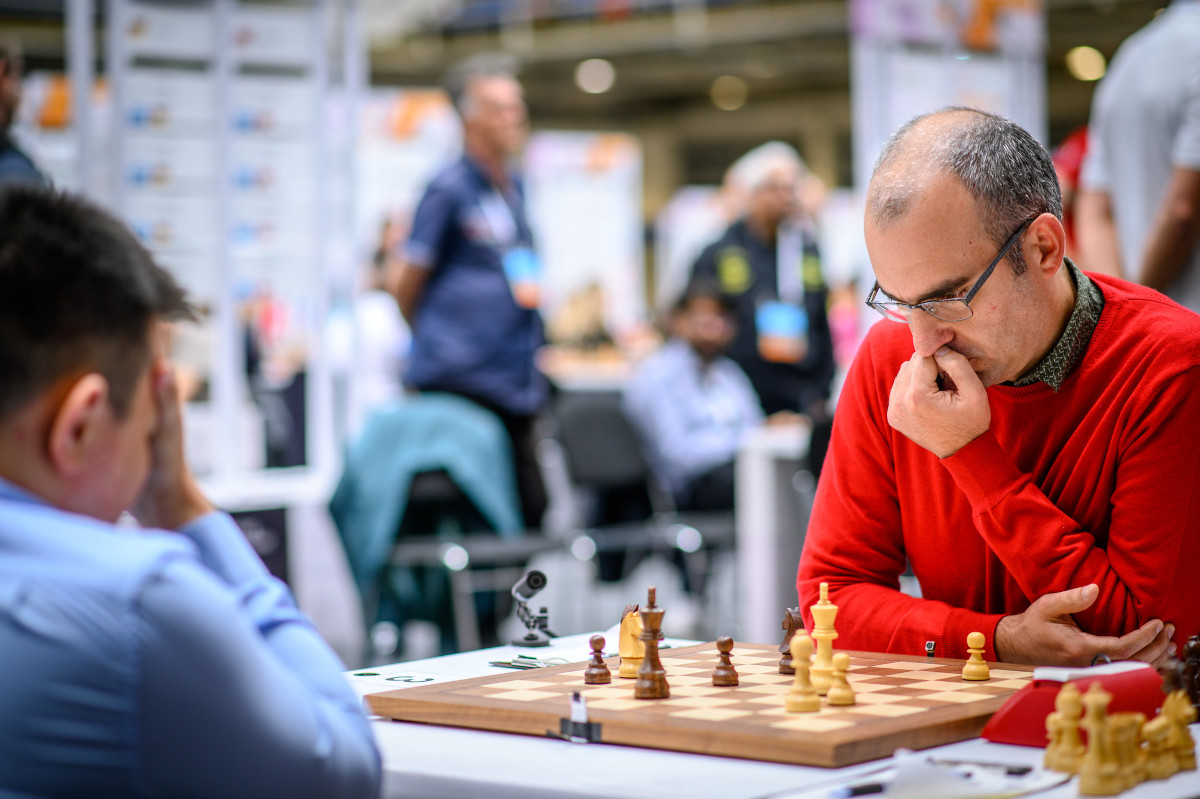
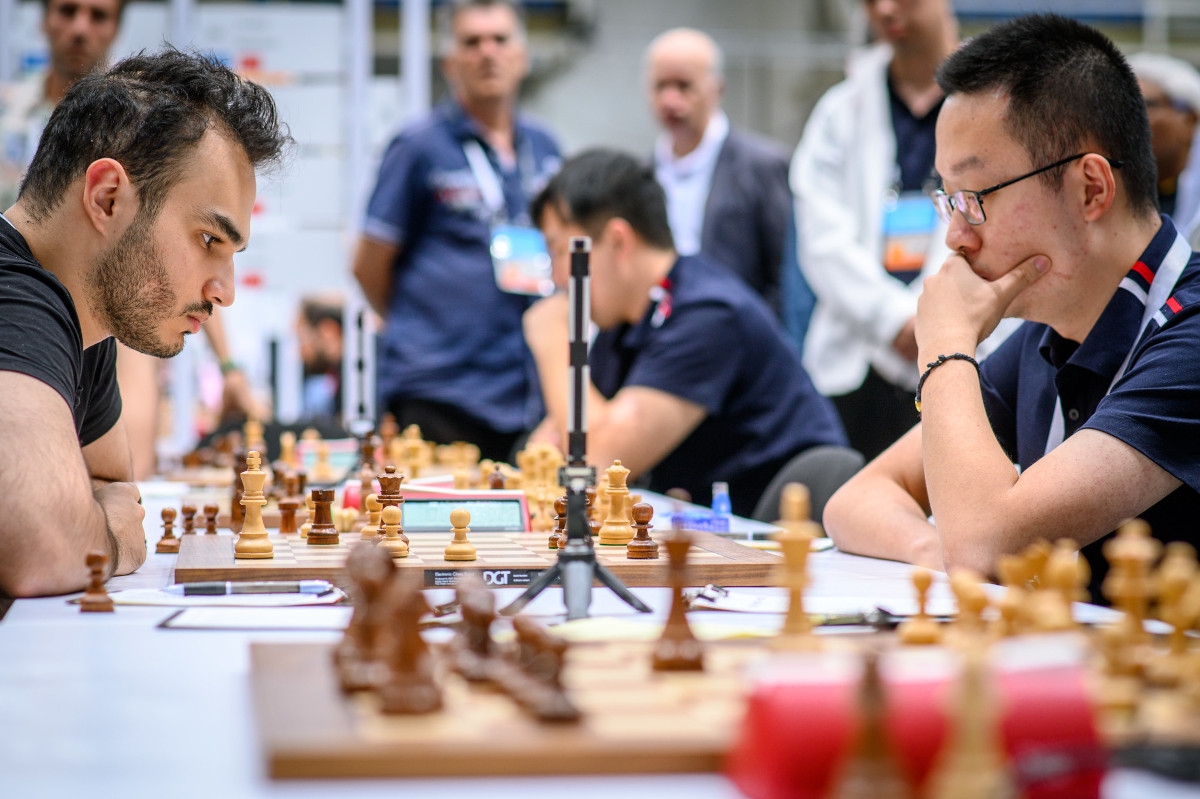
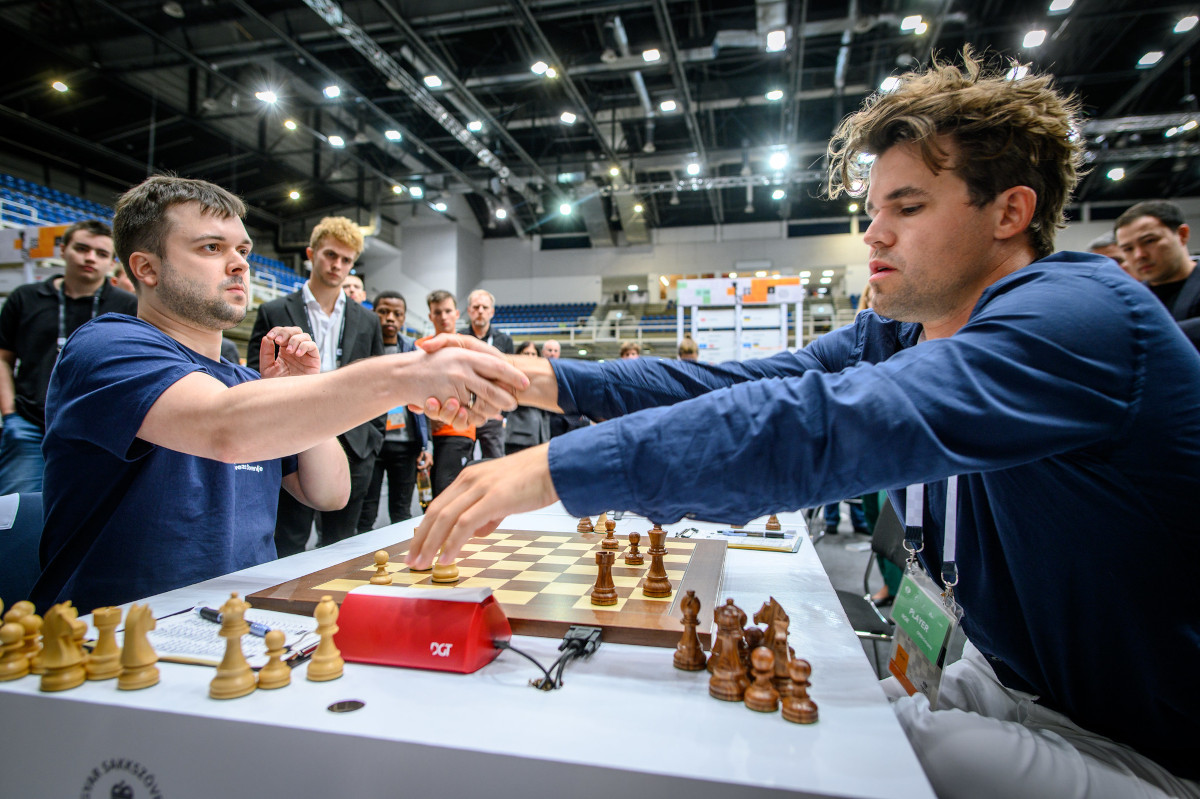
9/21/2024 – India were held to their first draw in the Chess Olympiad after Uzbekistan managed to secure draws on all four boards in an intense encounter. Despite the stalemate, India maintain a 2-point lead over their closest rivals. The United States and China both won their matches, joining Uzbekistan in second place with 15 match points. Team USA will face the Indian squad in Saturday's crucial penultimate round, while China will take on Iran as the battle for the top positions intensifies. | Photo: FIDE / Michal Walusza
new: Fritz 20
Your personal chess trainer. Your toughest opponent. Your strongest ally. FRITZ 20 is more than just a chess engine – it is a training revolution for ambitious players and professionals. Whether you are taking your first steps into the world of serious chess training, or already playing at tournament level, FRITZ 20 will help you train more efficiently, intelligently and individually than ever before.
YOUR PERSONAL CHESS COACH - Whether you’re taking your first steps into the world of club chess, or already playing at a tournament level: with FRITZ, you can train more efficiently, intelligently and with a more personalised approach than ever before. FRITZ is more than just a chess engine – it’s a training revolution! Whether you’re taking your first steps into the world of club chess, or already playing at a tournament level: with FRITZ, you can train more efficiently, intelligently and with a more personalised approach than ever before.
“Attack with Qh5!!” – Tactical training with Oliver Reeh, “6…g5 – nothing ventured, nothing …” – Le Quang Liem comments on one of his victories in Biel, “Grischuk’s stroke of genius” – Petra Papp reveals a surprise in the Sicilian Kan Variation, and much
€21.90
India still 2 points ahead
Find below videos from the venue by Arne Kaehler and expert analysis by GM Daniel King and IM Robert Ris.
India's winning streak was halted by Uzbekistan in round 9 of the Chess Olympiad. All four games ended in draws, making Uzbekistan the first team to hold India to a draw in Budapest. The match was far from dull, however, as both Arjun Erigaisi (India) and Javokhir Sindarov (Uzbekistan) found realistic winning chances during their respective games, adding excitement to the close contest.
Despite the draw, India maintain a 2-point lead over three teams: Uzbekistan, the United States and China. Both the US and China secured victories on Friday with identical 2.5-1.5 scores. As in the previous round, each match featured three draws and one decisive result, with Leinier Dominguez and Wei Yi delivering the crucial wins for the US and China, respectively.
In this video course, experts including Dorian Rogozenco, Mihail Marin, Karsten Müller and Oliver Reeh, examine the games of Boris Spassky. Let them show you which openings Spassky chose to play, where his strength in middlegames were and much more.
Leinier Dominguez (United States) beat Sanan Sjugirov (Hungary) in a double-edged struggle | Photo: FIDE / Michal Walusza
Wei Yi (China) defeated Amin Tabatabaei (Iran) with black | Photo: FIDE / Michal Walusza
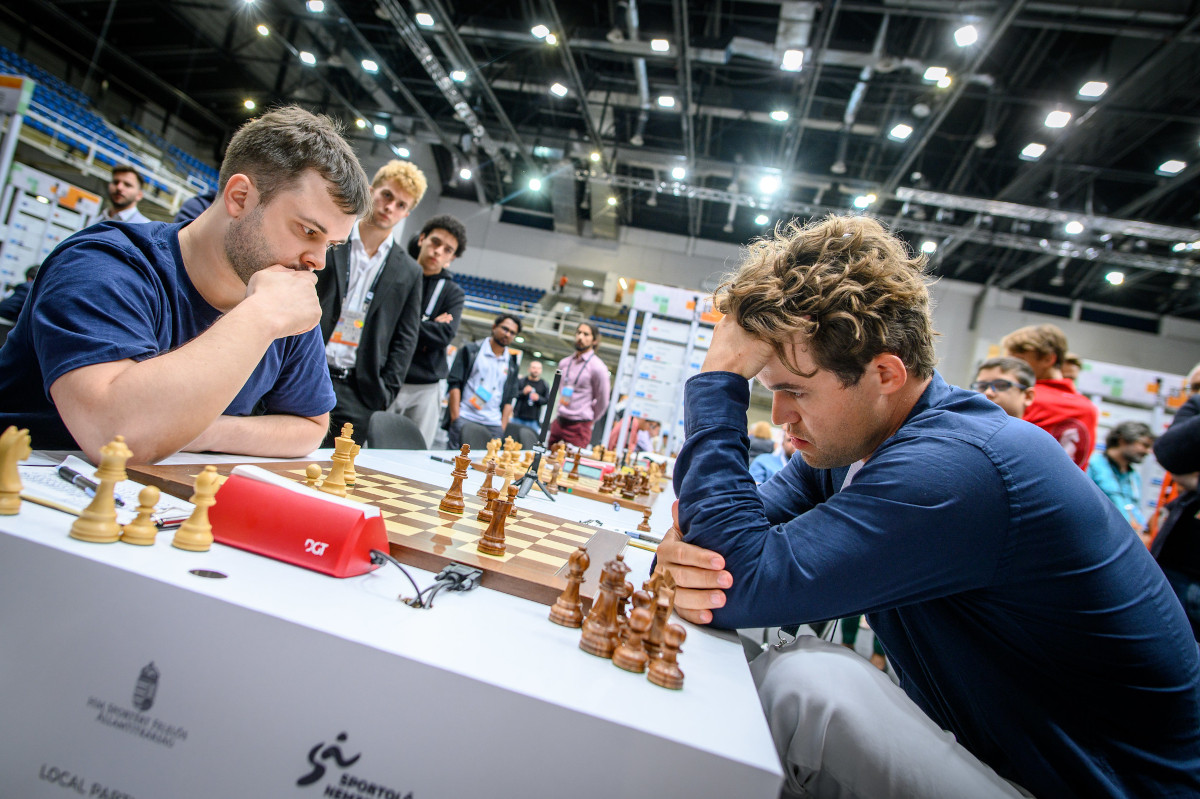
A further five teams stand a point further back, with Slovenia being the lowest-rated among them. The Slovenians have performed impressively, boasting the second-highest score on individual boards behind India, with 26½/36 points. Their win on Friday came against Norway, as Vladimir Fedoseev defeated Magnus Carlsen, handing the former world champion his first loss in the event. This marked Fedoseev's fourth consecutive win in Budapest.
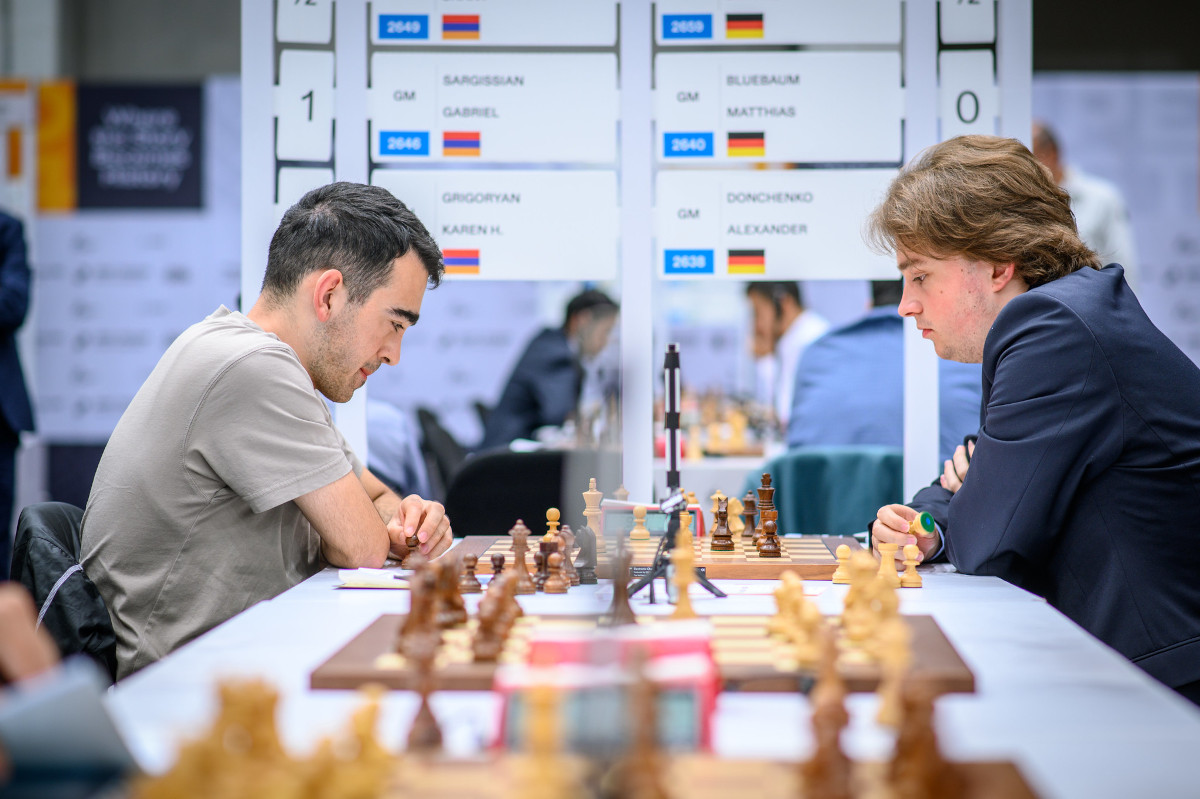
Hungary, Ukraine, Serbia, and Armenia also remain in the hunt for top places with 14 match points each. Armenia, led by Haik Martirosyan, pulled off a surprise win over seventh-seeded Germany in round 9, as Gabriel Sargissian defeated Matthias Blubaum on board 3, while the remaining three games ended in draws.
These results set up a crucial clash between the top two seeds for Saturday, with the US needing to beat India to stay in the race for gold. If the match ends in a draw, the US would only have a mathematical chance of catching India in the final round, but the Indians have a significantly superior tiebreak score. Meanwhile, Uzbekistan and China will face off in the other pivotal encounter of the day.
Haik Martirosyan (Armenia) facing Vincent Keymer (Germany) | Photo: FIDE / Michal Walusza
This video course includes GM Anish Giri's deep insights and IM Sagar Shah's pertinent questions to the super GM. In Vol.1 all the openings after 1.e4 are covered.
Magnus Carlsen knows there is no way to escape...
...and soon resigns the game | Photos: FIDE / Michal Walusza
In this video course, kings will play a role of strong and active pieces. We will explore how Kings can be helpful in defence and prophylaxis, or even in attack!
ChessBase TV presents
Michael Adams - "I own ChessBase 13, 15, and 17!"
Benjamin Gledura - "I take long walks in the evening with the team!"
In this Fritztrainer: “Attack like a Super GM” with Gukesh we touch upon all aspects of his play, with special emphasis on how you can become a better attacking player.
Carlos Alberto ColodroCarlos Colodro is a Hispanic Philologist from Bolivia. He works as a freelance translator and writer since 2012. A lot of his work is done in chess-related texts, as the game is one of his biggest interests, along with literature and music.
YOUR PERSONAL CHESS COACH - Whether you’re taking your first steps into the world of club chess, or already playing at a tournament level: with FRITZ, you can train more efficiently, intelligently and with a more personalised approach than ever before.
The Nimzo-Indian has stood the test of time for over a century: Still a top choice for elite players today, from Magnus Carlsen to Praggnanandhaa, it remains one of Black's most reliable ways to fight for real chances against 1.d4 2.c4 3.Nc3.
1.c4 e5 2.Nc3 Bb4!? is an opening idea well worth considering. Black immediately threatens to double the pawns on c3 in the style of the Trompowski or Sicilian Grand Prix attack.
Italian Game Powerbase 2026 is a database and contains 8571 top class games from Mega 2026 and the Correspondence Database 2026, of which 479 are annotated.
Videos: Nico Zwirs discusses the Sicilian with 2…e6 3.d4 cxd4 4.Qxd4 Nc6 5.Qe3 Nf6 6.Nc3. Mihail Marin examines Sindarov’s 6.Ne5 in the Queen’s Pawn Defence. Plus the ‘Lucky bag’ featuring 41 analyses by Berg, Ftacnik, Gupta and many others.
If you're looking for a dynamic alternative to the Slav, Queen's Gambit Declined, or other mainstream systems, the Chigorin Defence offers exactly what modern tournament players need.
€34.90
We use cookies and comparable technologies to provide certain functions, to improve the user experience and to offer interest-oriented content. Depending on their intended use, analysis cookies and marketing cookies may be used in addition to technically required cookies. Here you can make detailed settings or revoke your consent (if necessary partially) with effect for the future. Further information can be found in our data protection declaration.
Pop-up for detailed settings
We use cookies and comparable technologies to provide certain functions, to improve the user experience and to offer interest-oriented content. Depending on their intended use, cookies may be used in addition to technically required cookies, analysis cookies and marketing cookies. You can decide which cookies to use by selecting the appropriate options below. Please note that your selection may affect the functionality of the service. Further information can be found in our privacy policy.
Technically required cookies
Technically required cookies: so that you can navigate and use the basic functions and store preferences.
Analysis Cookies
To help us determine how visitors interact with our website to improve the user experience.
Marketing-Cookies
To help us offer and evaluate relevant content and interesting and appropriate advertisement.




.jpeg)