Divya reaches World Cup final, gets maiden grandmaster norm
 In this video course, experts (Pelletier, Marin, Müller and Reeh) examine the games of Judit Polgar. Let them show you which openings Polgar chose to play, where her strength in middlegames were, or how she outplayed her opponents in the endgame.
Find here the full tournament tree
The return games of the Women's World Cup semifinals in Batumi delivered high drama on Wednesday, with one match decided and the other heading to tiebreaks. In a marathon encounter lasting 101 moves, India's Divya Deshmukh defeated China's Tan Zhongyi to become the first finalist of the 2025 edition - and the first Indian woman to reach a Women's World Cup final. In the parallel match, Humpy Koneru and Lei Tingjie drew again, this time after a tense rook endgame, and will return to the board on Thursday for a tiebreak decider.
After both semifinal first games had ended in draws, the two Indian players, Humpy and Divya, had the white pieces in game two. From the outset, both appeared well-prepared and determined to press for a result. The day began promisingly for both.
Humpy Koneru chose the Exchange Variation of the Slav Defence against Lei Tingjie. The plan paid off early, as Humpy won a pawn and entered a rook endgame with realistic winning chances. The position was objectively holdable for Black with precise defence, but Lei misplayed the position under time pressure, allowing Humpy to reach a technically winning setup. However, Humpy then let the advantage slip with an inaccurate pawn move, and the opportunity passed.
The game was drawn after a long struggle, sending the match to Thursday’s tiebreaks. Lei later acknowledged the endgame had been difficult to defend, especially under time pressure.
Humpy ½-½ Lei
Analysis by André Schulz
 The King‘s Indian Attack is a universal opening: easy to learn, flexible, and rich in both tactical and positional opportunities.
Humpy Koneru and Lei Tingjie | Photo: Anna Shtourman
The other game of the day was far more chaotic. Divya Deshmukh, playing white, opted for the Alapin Variation (2.c3) against Tan Zhongyi's Sicilian Defence and obtained the more comfortable position in the early middlegame. However, she allowed Tan to sacrifice a pawn and activate her previously passive pieces. The former women's world champion took the initiative but failed to find the most testing continuations to convert her advantage.
What followed was a rollercoaster rook endgame in which both players missed multiple chances. At several points, Divya had winning positions, only to lose her grip, while Tan also passed up several opportunities to hold the draw. Eventually, Divya found a clear winning plan, but after another inaccuracy, Tan again had chances to escape.
By this stage, the endgame had taken on study-like complexity and demanded extreme precision. Tan faltered near the end, and Divya finally converted the full point on move 101.
Divya 1-0 Tan
Analysis by André Schulz
 In this insightful video course, Grandmaster David Navara shares practical advice on when to calculate deeply in a position — and just as importantly, when not to.
In this insightful video course, Grandmaster David Navara shares practical advice on when to calculate deeply in a position — and just as importantly, when not to.
Free sample video: Introduction
Free sample video: Invisible moves
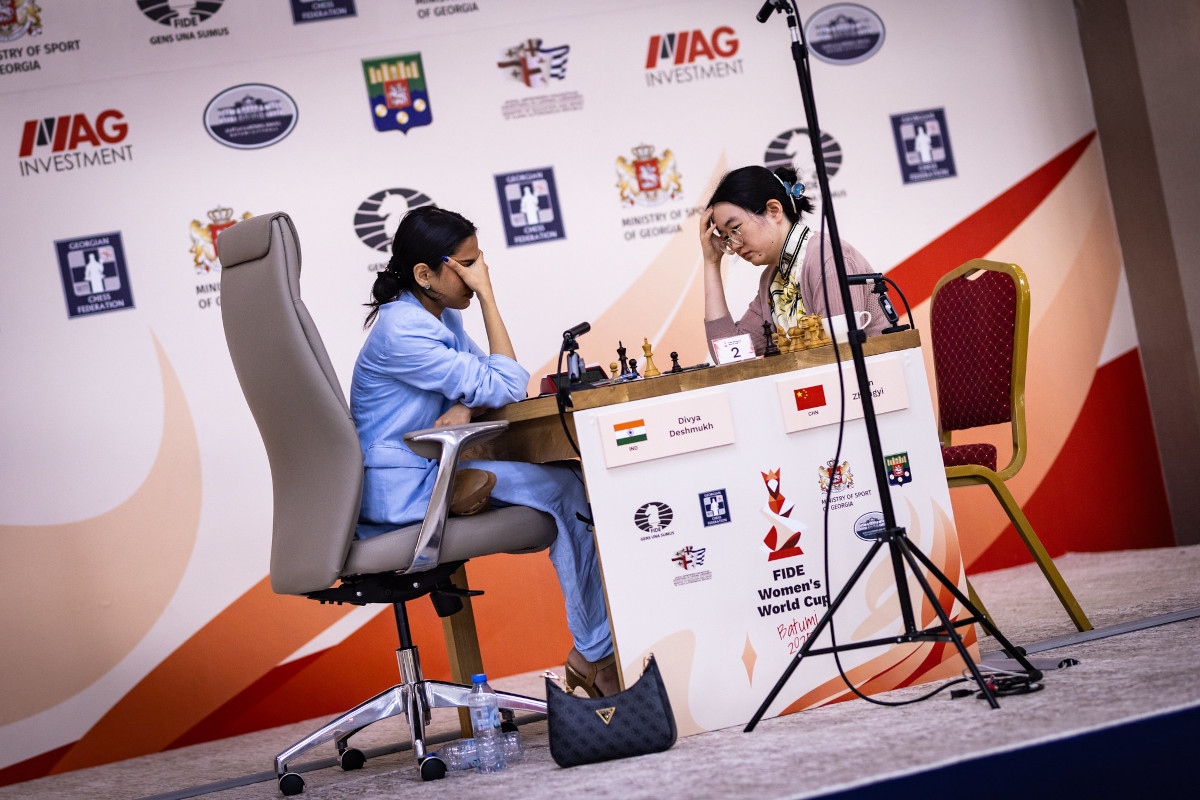
Amid a very tense struggle - Divya Deshmukh and Tan Zhongyi | Photo: Anna Shtourman
With the win, Divya reaches the final and secures a spot in the 2026 Women's Candidates Tournament while earning her first grandmaster norm. Tan will now play in the match for third place, which also offers a chance to qualify for the Candidates.
Humpy and Lei return on Thursday for their tiebreak match. The winner will meet Divya in the final, while the loser will face Tan Zhongyi for third place and the third spot in the next edition of the Candidates.

The first finalist at the Women's World Cup in Batumi | Photo: Anna Shtourman
All games
Links




.jpeg)