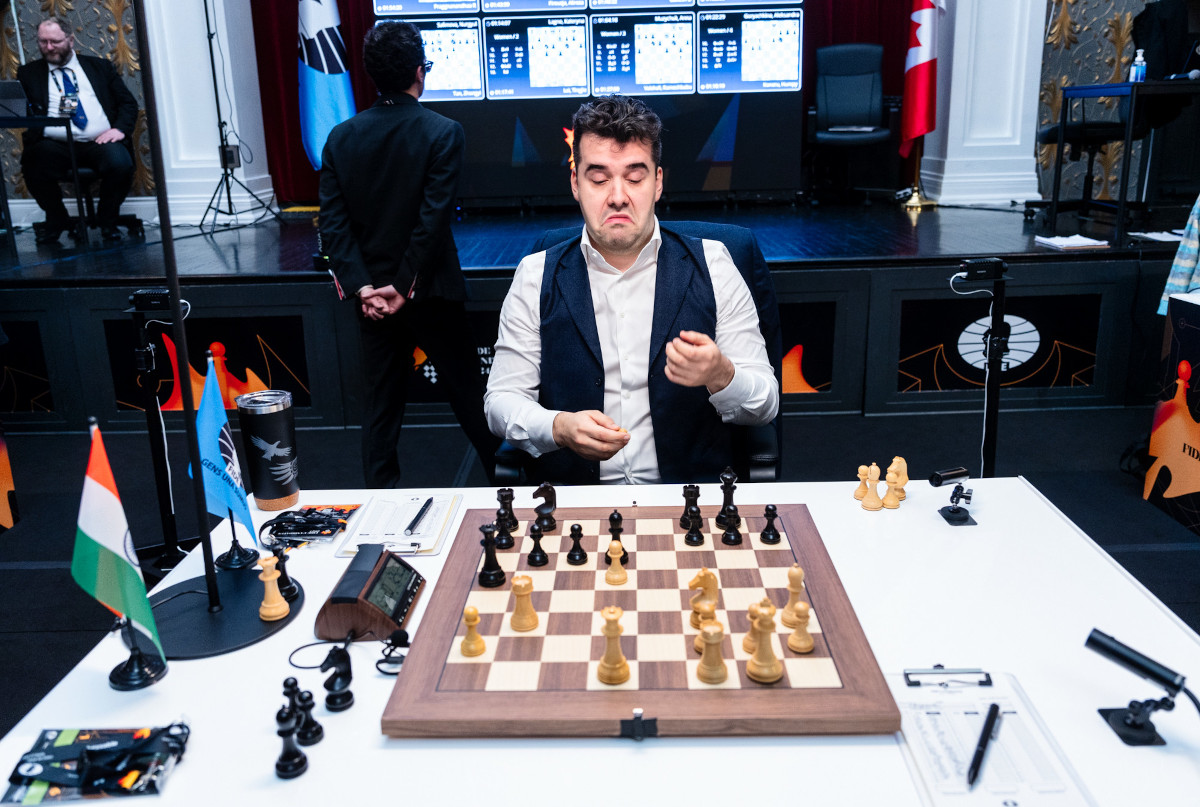
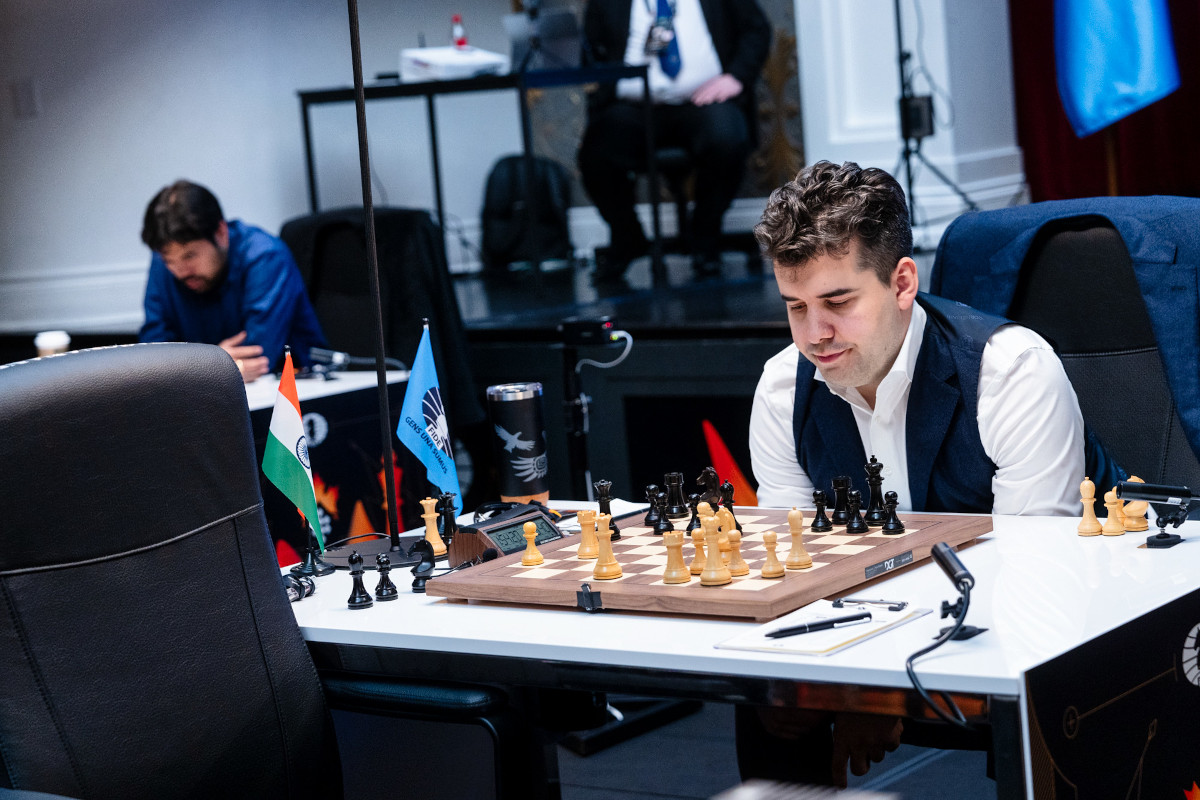
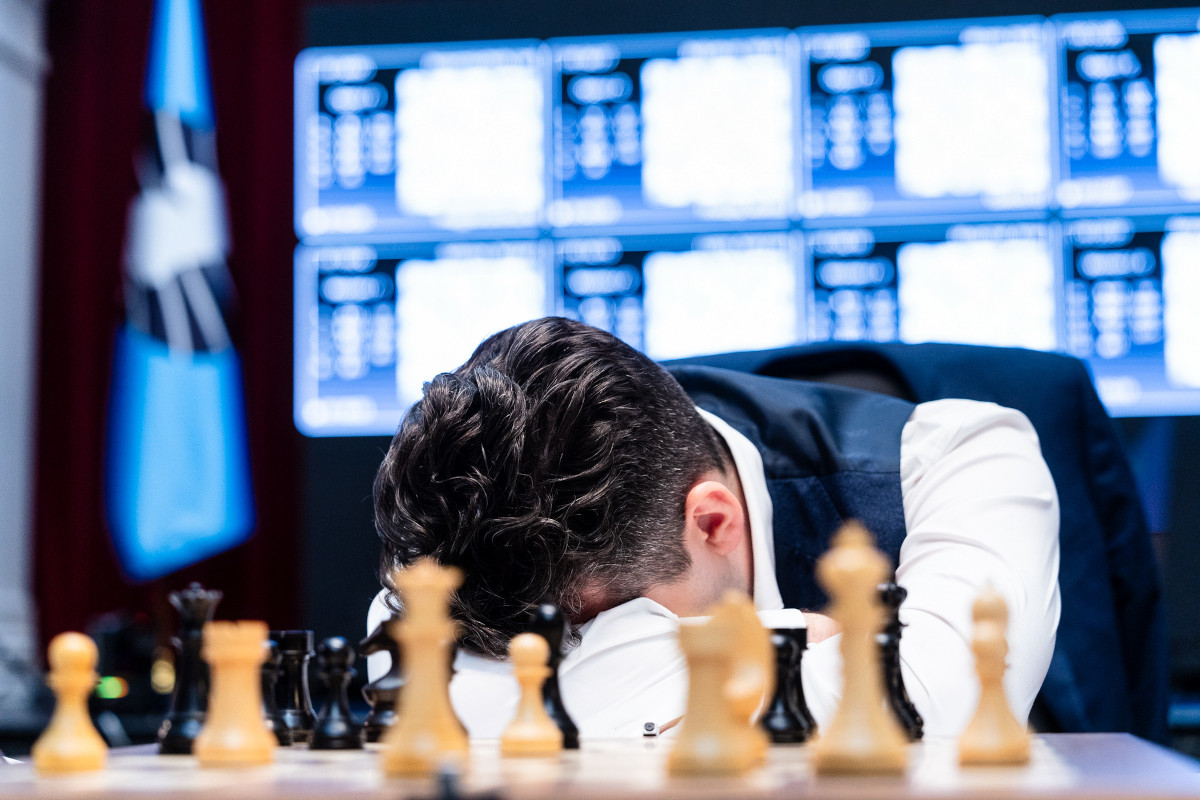
9/9/2025 – Computers continue to shape the way chess is played, studied and understood, but they also present challenges for humans trying to assert their creativity at the board. This month's column highlights two recent encounters where human ingenuity met silicon precision: Wesley So's victory over world champion Gukesh Dommaraju at the Sinquefield Cup (pictured), and Ian Nepomniachtchi's resilient defence against Praggnanandhaa Rameshbabu at the 2024 Candidates in Toronto. Both games illustrate the tension between preparation, psychology and practical decision-making. | Photo: Lennart Ootes / Grand Chess Tour
new: Fritz 20
Your personal chess trainer. Your toughest opponent. Your strongest ally. FRITZ 20 is more than just a chess engine – it is a training revolution for ambitious players and professionals. Whether you are taking your first steps into the world of serious chess training, or already playing at tournament level, FRITZ 20 will help you train more efficiently, intelligently and individually than ever before.
YOUR PERSONAL CHESS COACH - Whether you’re taking your first steps into the world of club chess, or already playing at a tournament level: with FRITZ, you can train more efficiently, intelligently and with a more personalised approach than ever before. FRITZ is more than just a chess engine – it’s a training revolution! Whether you’re taking your first steps into the world of club chess, or already playing at a tournament level: with FRITZ, you can train more efficiently, intelligently and with a more personalised approach than ever before.
In this two-volume course GM Ganguly turns calculation into a trainable skill with a structured path for any level.
€39.90
Hand versus chip
[Note that Jon Speelman also looks at the content of the article in video format, here embedded at the end of the article.]
I'm returning today to a topic which I've covered here a number of times over the years: the effect on us carbon-based critters of chess computers.
This is a relationship which has existed only for a fraction of the long history of our game but, as in other aspects of life, had a massive effect. I'm no good with dates but when I checked, it was some time in the 1980s that machines became really strong, and not of course until 1997 that IBM's bespoke hardware Deep Blue defeated Garry Kasparov, proving once and for all that in hand v. chip combat the silicon had it.
On this DVD a team of experts gets to the bottom of Kasparov's play. In over 8 hours of video running time the authors Rogozenko, Marin, Reeh and Müller cast light on four important aspects of Kasparov's play: opening, strategy, tactics and endgame.
There are still people who play against computers, but I'm certainly not one of them. Either they are much too strong because of their magnificent calculation and error-checking capabilities or they have to be hobbled, which tends not to work very well since unless they are taught to blunder in a human way then they play moves which even the rankest amateur would never entertain.
We use them of course in several ways: during preparation, to check our games afterwards and while watching online. The engines have totally transformed opening preparation, but I would add the caveat that you must direct them rather than be swept along. It's all very well if a machine tells you that a position is good - it's no doubt perfectly correct. But if you have created a maelstrom and your opponent unsportingly tries a move that you haven't analysed beforehand, then even if it "should" be bad or indeed lose, that may turn out to be little help to you at the board.
Until the advent of chess engines, it was normal to have a post-mortem after a game with your opponent and while this has to some extent been superseded by the machines, it's still an excellent idea. You were playing a person, and they will have had ideas at the board. Afterwards you can genuflect to the machine's wisdom.
It's fun to engage software when you're watching games online, but it's important to understand that these are people playing and if they failed to spot some obscure idea, then that doesn't mean that they're weak - merely mortal. I tend to turn the engine on for a second or so to get an evaluation and then, if I'm feeling strong, I turn it off so that I can try to understand why. And I also try to direct what it looks at, since I presume that I will have a much better idea of what the players are actually thinking about than it. Directing it can lead to some interesting consequences, and I've come to this topic today because of a variation which I noticed in the recent Sinquefield Cup - in Wesley So's victory against the world champion Gukesh Dommaraju.
The game position was in this diagram, and I wondered about cutting off the bishop from the kingside with 19...d5 30 Bxa8 Qh3, which seemed extremely natural. However, in the blink of an eye (I can't immediately think of what the equivalent machine metaphor should be), the engine comes up with a brilliant move which gives White a significant advantage. Perhaps you can try to find it (though it would be unreasonable to expect the reader to analyse it in any detail.)
Unleash your chess potential with this dynamic course focused on mastering the initiative.
When Bobby Fischer and later Garry Kasparov dominated the chess world in their time, both were streets ahead of their rivals in their opening preparation. Today computers have raised the bar still further and perhaps levelled the playing field, since all top players have excellent software, albeit running on hardware of variable splendiferousness.
One of the main problems for the chess player sitting alone at the board is to remember his or her analysis, and one approach quite often used by Magnus Carlsen himself is to aim simply for a playable position which you can fight from. The Holy Grail though is to reach a variation which you have analysed with a computer and your opponent has not: a battle between "Centaur" and man.
In the way of things, the man will tend to deviate from the analysis, rendering the Centaur a mere rider but still armed with the evaluation and ideas from other lines. But the effect of having to work it all out yourself is likely to be tremendous both in terms of the technical task, the psychological hit and the time you need to consume.
In order to achieve these players tend to look not for the "best" move in a variation - which engines will tend to agree on more or less - but ones further down the list which could plausibly have been overlooked or discarded and are still eminently playable even if the engines find a way to equalise or even gain some advantage against them - this "Caissic hunt of the Cenraur" is a serious task.
Moreover, the results tend to surface in the strongest tournaments, such as the last Candidates in Toronto 2024, when there were several instances including this one in which Ian Nepomniachtchi showed tremendous resilience to demote Praggnanandhaa Rameshbabu from a Centaur to a rider and eventually to a mere pedestrian.
A shout-out for Xsplit, the software I use to make the videos and also occasionally stream. It stopped loading on Sunday, and after I sent in a query they sorted it out by the next morning. Brilliant customer service!
The course is designed to provide a deep yet practical repertoire for Black, balancing solid foundations with aggressive counterplay. The Classical Sicilian has stood the test of time as one of the most principled and fighting defences against 1.e4. With its rich history spanning world championship matches and modern elite tournaments, this opening remains a favourite among players who seek a dynamic, counterattacking approach without venturing into extreme theoretical battles like the Najdorf or Sveshnikov.
Free video sample: Introduction
Free video sample: 6.h3
The ever-expressive Ian Nepomniachtchi dealing with a tough position during his fifth-round game against Praggnanandhaa Rameshbabu at the 2024 Candidates Tournament | Photos: Maria Emelianova / chess.com
In this video course, experts including Dorian Rogozenco, Mihail Marin, Karsten Müller and Oliver Reeh, examine the games of Boris Spassky. Let them show you which openings Spassky chose to play, where his strength in middlegames were and much more.
Jonathan SpeelmanJonathan Speelman, born in 1956, studied mathematics but became a professional chess player in 1977. He was a member of the English Olympic team from 1980–2006 and three times British Champion. He played twice in Candidates Tournaments, reaching the semi-final in 1989. He twice seconded a World Championship challenger: Nigel Short and then Viswanathan Anand against Garry Kasparov in London 1993 and New York 1995.
YOUR PERSONAL CHESS COACH - Whether you’re taking your first steps into the world of club chess, or already playing at a tournament level: with FRITZ, you can train more efficiently, intelligently and with a more personalised approach than ever before.
How grandmasters win without fireworks: GM Jan Markos shows you 11 very practical tips from "How to play in a lost position" to "Be patient like Carlsen" that will improve your tournament chess.
The Nimzo-Indian has stood the test of time for over a century: Still a top choice for elite players today, from Magnus Carlsen to Praggnanandhaa, it remains one of Black's most reliable ways to fight for real chances against 1.d4 2.c4 3.Nc3.
1.c4 e5 2.Nc3 Bb4!? is an opening idea well worth considering. Black immediately threatens to double the pawns on c3 in the style of the Trompowski or Sicilian Grand Prix attack.
Italian Game Powerbase 2026 is a database and contains 8571 top class games from Mega 2026 and the Correspondence Database 2026, of which 479 are annotated.
Videos: Nico Zwirs discusses the Sicilian with 2…e6 3.d4 cxd4 4.Qxd4 Nc6 5.Qe3 Nf6 6.Nc3. Mihail Marin examines Sindarov’s 6.Ne5 in the Queen’s Pawn Defence. Plus the ‘Lucky bag’ featuring 41 analyses by Berg, Ftacnik, Gupta and many others.
€14.90
We use cookies and comparable technologies to provide certain functions, to improve the user experience and to offer interest-oriented content. Depending on their intended use, analysis cookies and marketing cookies may be used in addition to technically required cookies. Here you can make detailed settings or revoke your consent (if necessary partially) with effect for the future. Further information can be found in our data protection declaration.
Pop-up for detailed settings
We use cookies and comparable technologies to provide certain functions, to improve the user experience and to offer interest-oriented content. Depending on their intended use, cookies may be used in addition to technically required cookies, analysis cookies and marketing cookies. You can decide which cookies to use by selecting the appropriate options below. Please note that your selection may affect the functionality of the service. Further information can be found in our privacy policy.
Technically required cookies
Technically required cookies: so that you can navigate and use the basic functions and store preferences.
Analysis Cookies
To help us determine how visitors interact with our website to improve the user experience.
Marketing-Cookies
To help us offer and evaluate relevant content and interesting and appropriate advertisement.




.jpeg)