2/20/2022 – Star columnist Jon Speelman continues to link chess positions with Monty Python sketches. Readers pitched in with further suggestions, and in particular one noted the unexpected absence of the expectedly ‘Unexpected Spanish Inquisition’!
new: Fritz 20
Your personal chess trainer. Your toughest opponent. Your strongest ally. FRITZ 20 is more than just a chess engine – it is a training revolution for ambitious players and professionals. Whether you are taking your first steps into the world of serious chess training, or already playing at tournament level, FRITZ 20 will help you train more efficiently, intelligently and individually than ever before.
YOUR PERSONAL CHESS COACH - Whether you’re taking your first steps into the world of club chess, or already playing at a tournament level: with FRITZ, you can train more efficiently, intelligently and with a more personalised approach than ever before. FRITZ is more than just a chess engine – it’s a training revolution! Whether you’re taking your first steps into the world of club chess, or already playing at a tournament level: with FRITZ, you can train more efficiently, intelligently and with a more personalised approach than ever before.
Michael Kotyk presents a complete repertoire after 1.e4 e5, built around creative ideas, surprising move orders, and practical weapons designed to catch your opponents off guard.
€34.90
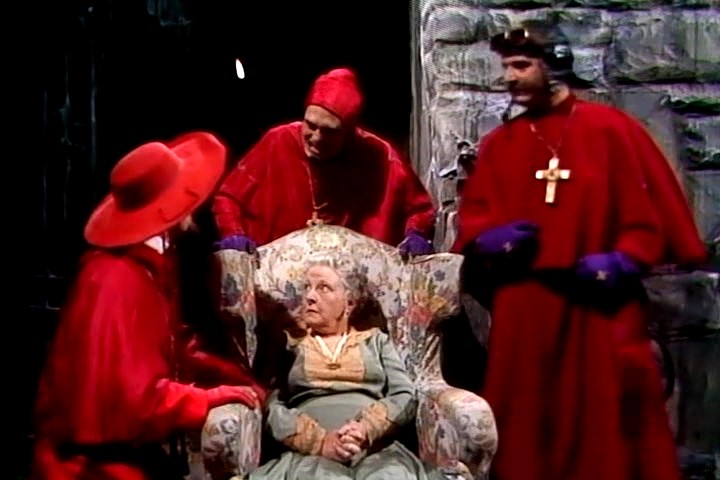
The Inquisition is here
[Note that Jon Speelman also looks at the content of the article in video format, here embedded at the end of the article.]
A fortnight ago, I attempted, somewhat spuriously, to link chess positions to Monty Python sketches. As requested, readers pitched in with further suggestions, and in particular one noted the unexpected absence of the expectedly Unexpected Spanish Inquisition.
So this time I’m continuing with a few more, more or less tenuous, links. The Inquisitors will drop by when, I hope, I’ve diverted you sufficiently for them to be something of a surprise. But first from Monty Python and the Holy Grail.
This nice finish was suggested in the comments to the previous column as an example of this.
But there was no hint of a shrubbery, and I was wondering what else to add when I came across this in the latest edition of Chess magazine as a Christmas solution. The clumps of Black pieces are at least plausibly shrubby, and I’m grateful to Chess’ editor Richard Palliser for kindly endorsing my plagiarism here.
There’s also some shrubbery allied with several horses in this study by a Dutch composer, which was championed a few years ago by Jim Plaskett. I knew of it but couldn’t recall more than the outline, and indeed finally tracked down on Luke McShane’s advice by googling “Plaskett’s puzzle”. I have a vague memory that it may have appeared in Chess too, possibly even as part of a Christmas competition.
In the Van Breukelen study it is the Bishop who is boss, and we continue with a famous study in which, with the help of a single fierce pawn, a bishop outplays a queen and knight.
This sketch ends with the shopkeeper Graham Chapman being thumped by John Cleese's Hungarian. But perhaps it was “only a scratch”, as the Black knight claims.
I think that’s enough Python for the moment, though please do send any other ideas for a later date. It did occur to me that the comfy chair might be the opening 1.d4 Nf6 2.Nf3 e6 3.g3 b5, which I sometimes encourage as White when I want a very quiet game – but I’ve also lost this position a couple of times, perhaps through getting too comfy...
In a fortnight we’ll move on to something a bit more serious. I haven’t decided what yet, so any suggestions in the comments would be most welcome.
Considered a master of prophylaxis, Petrosian sensed dangers long before they actually became acute on the board. In his prime, Petrosian was almost invincible. Let our authors introduce you into the world of Tigran Petrosian.
Jonathan SpeelmanJonathan Speelman, born in 1956, studied mathematics but became a professional chess player in 1977. He was a member of the English Olympic team from 1980–2006 and three times British Champion. He played twice in Candidates Tournaments, reaching the semi-final in 1989. He twice seconded a World Championship challenger: Nigel Short and then Viswanathan Anand against Garry Kasparov in London 1993 and New York 1995.
YOUR PERSONAL CHESS COACH - Whether you’re taking your first steps into the world of club chess, or already playing at a tournament level: with FRITZ, you can train more efficiently, intelligently and with a more personalised approach than ever before.
The Nimzo-Indian has stood the test of time for over a century: Still a top choice for elite players today, from Magnus Carlsen to Praggnanandhaa, it remains one of Black's most reliable ways to fight for real chances against 1.d4 2.c4 3.Nc3.
1.c4 e5 2.Nc3 Bb4!? is an opening idea well worth considering. Black immediately threatens to double the pawns on c3 in the style of the Trompowski or Sicilian Grand Prix attack.
Italian Game Powerbase 2026 is a database and contains 8571 top class games from Mega 2026 and the Correspondence Database 2026, of which 479 are annotated.
Videos: Nico Zwirs discusses the Sicilian with 2…e6 3.d4 cxd4 4.Qxd4 Nc6 5.Qe3 Nf6 6.Nc3. Mihail Marin examines Sindarov’s 6.Ne5 in the Queen’s Pawn Defence. Plus the ‘Lucky bag’ featuring 41 analyses by Berg, Ftacnik, Gupta and many others.
If you're looking for a dynamic alternative to the Slav, Queen's Gambit Declined, or other mainstream systems, the Chigorin Defence offers exactly what modern tournament players need.
€34.90
We use cookies and comparable technologies to provide certain functions, to improve the user experience and to offer interest-oriented content. Depending on their intended use, analysis cookies and marketing cookies may be used in addition to technically required cookies. Here you can make detailed settings or revoke your consent (if necessary partially) with effect for the future. Further information can be found in our data protection declaration.
Pop-up for detailed settings
We use cookies and comparable technologies to provide certain functions, to improve the user experience and to offer interest-oriented content. Depending on their intended use, cookies may be used in addition to technically required cookies, analysis cookies and marketing cookies. You can decide which cookies to use by selecting the appropriate options below. Please note that your selection may affect the functionality of the service. Further information can be found in our privacy policy.
Technically required cookies
Technically required cookies: so that you can navigate and use the basic functions and store preferences.
Analysis Cookies
To help us determine how visitors interact with our website to improve the user experience.
Marketing-Cookies
To help us offer and evaluate relevant content and interesting and appropriate advertisement.











 [Note that Jon Speelman also looks at the content of the article