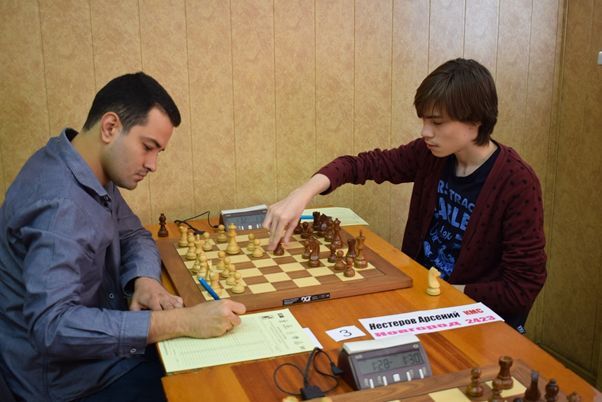
3/7/2021 – In this week’s column, Jon Speelman looks deeply into “a real fire fight” in which 18-year-old Arseniy Nesterov came out on top after a terrific battle. In the game, the aggression was mutual and included extended hand-to-hand fighting!
new: Fritz 20
Your personal chess trainer. Your toughest opponent. Your strongest ally. FRITZ 20 is more than just a chess engine – it is a training revolution for ambitious players and professionals. Whether you are taking your first steps into the world of serious chess training, or already playing at tournament level, FRITZ 20 will help you train more efficiently, intelligently and individually than ever before.
By opting for a fianchetto setup, you embrace unbalanced and strategically rich positions, steering away from predictable theory battles.
€39.90
A real fire fight
[Note that Jon Speelman also looks at the content of the article in video format, here embedded at the end of the article.]
When things kick off in a game of chess, the explosion generally lasts for just a few moves — or at least, without any real evidence, that’s my impression. But there are occasional games in which the violence runs and runs.
When this does occur, the most common scenario is probably a long attacking battle in which one player aims blows at the other’s head and the other finds heroic ways to defend.
But sometimes the aggression is mutual with extended hand-to-hand fighting, and today’s game is very much in this mould. It comes from the final round a week ago of the Moscow Open, which was won on tiebreak by Ivan Rozum ahead of six others.
In this DVD Sam Collins presents a repertoire for Black based on the Queen’s Gambit Accepted, 1.d4 d5 2.c4 dxc4. Rather than get involved in the heavy theory of the Classical Main Line, the lynchpin of the repertoire is the active development of the queen’s bishop. The resulting positions have close similarities to the Nimzo Indian and Slav Defences, and Collins explains the way for Black to approach the middlegame with confidence based on a blockade and light square strategy. The resulting repertoire is solid, reliable, and suitable as either a main weapon or an occasional surprise choice. Video running time: 3 hours 30 min
One of the six was 18-year-old Arseniy Nesterov, who came out on top after a real fire fight!
16.d5! This and the next move scream out to be played to destabilise Black before his queenaside attack lands — 16...exd5 17.e6!
Arseniy Nesterov (right) at the 2019 Voronezh Masters — here facing IM Christian Rios
To finish up, a small tactical position I thought of earlier in the week. It’s fairly banal, but carries a small twist.
To avoid theory battles in well-known lines against Ruy Lopez (Berlin, Open Variation or the Marshall Attack), Sergey Tiviakov invites you into the world of an extraordinary early queen move for White: Qe2 – elegant, effective and easy to learn!
Jonathan SpeelmanJonathan Speelman, born in 1956, studied mathematics but became a professional chess player in 1977. He was a member of the English Olympic team from 1980–2006 and three times British Champion. He played twice in Candidates Tournaments, reaching the semi-final in 1989. He twice seconded a World Championship challenger: Nigel Short and then Viswanathan Anand against Garry Kasparov in London 1993 and New York 1995.
In this video course experts examine the games of Bent Larsen. Let them show you which openings Larsen chose, where his strength in middlegames were, how he outplayed his opponents in the endgame & you’ll get a glimpse of his tactical abilities!
From the 2026 Candidates Tournament, featuring a video review by Dorian Rogozenco, to Jan Werle’s opening video on the French Tarrasch Defence, and Oliver Reeh’s tactical column ‘Top Grandmasters at Work’. Analyses by Giri, So, Wei Yi and many others.
You will learn how Black's dynamic piece activity and structural counterplay more than compensate for White's extra tempo in the colour-reversed setups.
In this course, you’ll learn how to take the initiative against the London and prevent White from comfortably playing their usual system by playing 1.d4 Nf6 2.Bf4 Nh5.
London System Powerbase 2026 is a database and contains in all 11 285 games from Mega 2026 and the Correspondence Database 2026, of which 282 are annotated.
The London System Powerbook 2026 is based on more than 410 000 games or game fragments from different opening moves and ECO codes; what they all have in common is that White plays d4 and Bf4 but does not play c4.
In this course, Grandmaster Elisabeth Pähtz presents the London System, a structured and ambitious approach based on the immediate Bf4, leading to rich and dynamic positions.
€59.90
We use cookies and comparable technologies to provide certain functions, to improve the user experience and to offer interest-oriented content. Depending on their intended use, analysis cookies and marketing cookies may be used in addition to technically required cookies. Here you can make detailed settings or revoke your consent (if necessary partially) with effect for the future. Further information can be found in our data protection declaration.
Pop-up for detailed settings
We use cookies and comparable technologies to provide certain functions, to improve the user experience and to offer interest-oriented content. Depending on their intended use, cookies may be used in addition to technically required cookies, analysis cookies and marketing cookies. You can decide which cookies to use by selecting the appropriate options below. Please note that your selection may affect the functionality of the service. Further information can be found in our privacy policy.
Technically required cookies
Technically required cookies: so that you can navigate and use the basic functions and store preferences.
Analysis Cookies
To help us determine how visitors interact with our website to improve the user experience.
Marketing-Cookies
To help us offer and evaluate relevant content and interesting and appropriate advertisement.