
The second volume of the Understanding Middlegame Strategies series by Ivan Sokolov deals with one of the most difficult aspects of chess - 'favourable' and 'non-favourable' trades.
One of the games analysed sees 13th world champion Garry Kasparov failing to find the correct strategic plan after getting the kind of position he loved so much, one with flexible pawns in which he can create pressure against the opponent's king.
Just going over the game with an engine does not give us the depth of understanding shared by Sokolov in the FritzTrainer. What computers simply deem to be a change of +0.23 into -0.30 is described by Sokolov as a crucial strategic mistake. The decision on move 27 is the kind of decision that grandmasters analyse deeply - consistently making the right choice in such critical junctures is what helps a player to climb the rating ladder.
In the game, Kasparov errs by pushing his central pawn. Jan Timman finds the correct reply, but once he is out of trouble, he fails to figure out a way to press his newfound advantage. In the end, following a few more inaccuracies, Kasparov scores the full point. The former world champion won that edition of the tournament in Wijk aan Zee with a commanding 9/13 score.
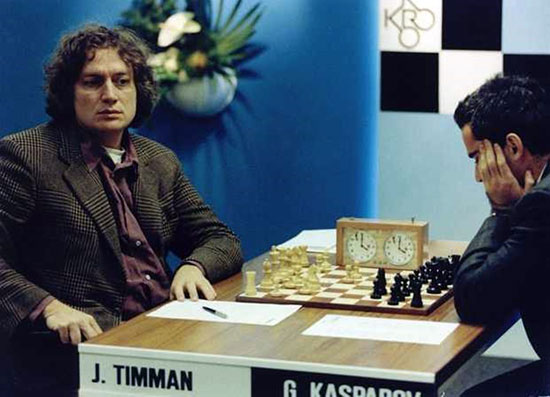
Jan Timman and Garry Kasparov ten years before the game analysed by Ivan Sokolov, during the 1991 Tilburg tournament | Photo: ANP / Arthur Bastiaans
1.c4 e5 2.Nc3 Nf6 3.Nf3 Nc6 4.g3 d5 5.cxd5 Nxd5 6.Bg2 Nb6 7.O-O Be7 8.Rb1 O-O 9.b4 Nxb4 10.Nxe5 c6 11.a3 N4d5 12.Nxd5 cxd5 13.a4 Bf6 14.d4 Bf5 15.Rb5 a6 16.Rb2 Rc8 17.Bf4 Bxe5 18.Bxe5 Re8 19.e3 Re7 20.g4 Be4 21.f3 Nc4 22.Re2 Bg6 23.h4 f6 24.Bf4 Qd7 25.Rfe1 Rc6 26.h5 Bf7
It is clear that White, who has the bishop pair, wants to push his initiative on the kingside, while Black will try to deal with the threats and to eventually find counterplay on the opposite flank by playing ...b7-b5, getting an outside passed pawn. Kasparov, who was leading the standings, had a major chance to grab yet another victory - in the kind of dynamic position that was so to his liking.
However, even Kasparov can falter in such complex middlegames. Here, he had to either start by weakening Black's kingside pawns with 27.h6 or rearrange his pieces via 27.Bf1, preparing a potential Re2-g2, bringing more pieces to the attack.
Instead, he went for e3-e4, a strategic mistake. The trades in the centre, in fact, allowed Black to get the upper hand.
27.e4 dxe4 28.Rxe4 Rxe4
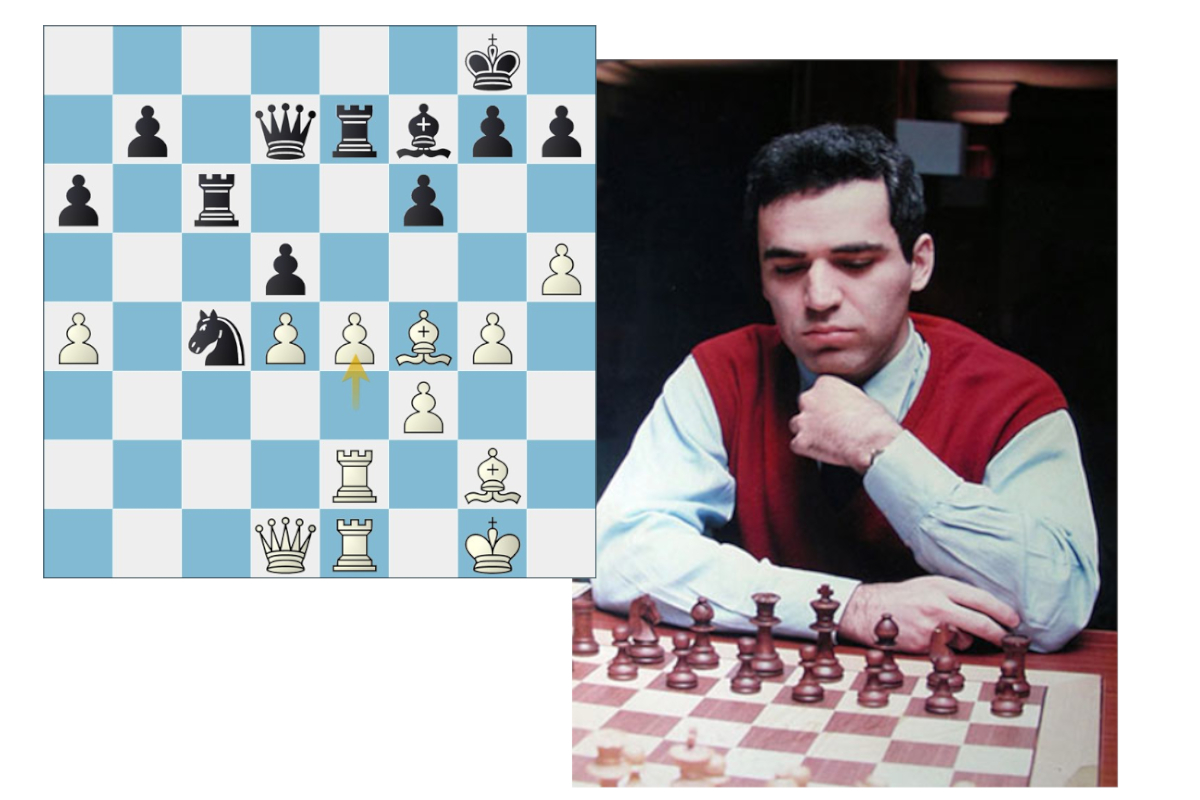
Kasparov faltered again in this position, perhaps already noticing that something had gone wrong. The correct way to capture is with the pawn - e.g. 29.fxe4 Nb2 30.Qd2 Qxg4 31.Qxb2 Qxf4 32.Qxb7 Re6 (diagram).
Surely Kasparov calculated this line and was not satisfied with the outcome, though following a few more simplifications, White should be able to hold the draw. However, the fact that he probably felt he had good winning chances earlier in the game pushed him to capture with the rook, entering what is objectively an inferior position.
29.Rxe4 Bd5 30.Re2
Timman, most likely in time trouble, erred here. Playing the quiet 30...h6 would have left White struggling to create attacking chances on the kingside, while Black can attack the isolated pawn on d4 and push his queenside majority at the right moment.
Instead, the Dutchman went for ...Rc6-c8, allowing Kasparov to seize his chance and push his pawn with h5-h6, complicating matters.
30...Rc8 31.h6 g5 32.Bg3 Re8 33.Qe1 Rxe2 34.Qxe2 Kf8 35.Qd3
Engines here evaluate the position as close to equal, but White's bishop pair might prove to be a favourable factor in the long run. Timman, however, once again played inaccurately by jumping backwards with his knight: ...Nc4-b6. Instead ...b7-b5 was called for at once.
White had a slight edge, but Black could still fight, anyway.
35...Nb6 36.a5 Nc4 37.Bf1 Qe7 38.Qc3
After surviving an inferior position, getting the upper hand and missing a few chances to put more pressure on his opponent, Timman falters decisively by forcing a trade of queens. Playing ...Qe7-e6 would have made things more difficult for Kasparov, though the man from Baku still could have pushed for the win with his bishop pair.
38...Qe3+ 39.Qxe3 Nxe3 40.Bd3 Nc4 41.Be1 Kg8 42.Kf2 b5 43.Bb4
Capturing the pawn en passant after ...b7-b5 would have been inaccurate. Kasparov has no trouble converting his advantage from this point on.