The Ultimate Antidote against the London System –
In 60 Minutes by GM Mihail Marin
YOUR EASY ACCESS TO OPENING THEORY: Whether you want to build up a reliable and powerful opening repertoire or find new opening ideas for your existing repertoire, the Opening Encyclopaedia covers the entire opening theory on one product.
YOUR EASY ACCESS TO OPENING THEORY
Be well prepared with the new Opening Encyclopaedia 2026! Whether you want to build up a reliable and powerful opening repertoire or find new opening ideas for your existing repertoire, the Opening Encyclopaedia covers the entire opening theory on one product and is the ideal start for your opening training. Many new articles enrich the current theory with new or revisited ideas. The Encyclopaedia can help you learn openings quickly and give you a head start on your next opponent. Each article contains explanations and annotated games illustrating typical plans to deepen your understanding.

1. Typical move orders of the London System
In practice, the London System typically arises via two move orders:
1.d4 Nf6 (alternatively 1...d5) 2.Nf3 and 3.Bf4
1.d4 Nf6 2.Bf4 and 3.Nf3 (alternatively 3.e3 or 3.c3)
Advocates of the 2.Bf4 move order often argue that it offers greater flexibility:
White deliberately refrains from committing the king’s knight too early in order to react more flexibly to Black’s setup, while at the same time keeping the d1–h5 diagonal open.
A practical antidote to a schematic setup
2. Marin's concept: The early counter …Nh5
This is precisely where Marin’s idea comes in: with the provocative knight move to h5, Black immediately challenges White’s concept and initiates an early hunt for the bishop.
1.d4 Nf6 2.Bf4 Nh5!?
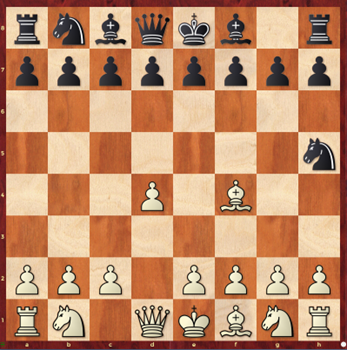
This move should by no means be dismissed as a mere “coffeehouse idea”, but is based on a clearly defined strategic concept. Black aims to secure the bishop pair and is willing to invest a tempo in the opening to achieve it.
In practical play, the idea is quite venomous and perfectly suited to the 60 Minutes format, in which a concept or opening variation is presented within the space of one hour.
In this course, Grandmaster Elisabeth Pähtz presents the London System, a structured and ambitious approach based on the immediate Bf4, leading to rich and dynamic positions.
The London System is one of the most popular openings at every level of chess but not all Londons are the same. In this course, Grandmaster Elisabeth Pähtz presents the London System, a structured and ambitious approach based on the immediate Bf4, leading to rich and dynamic positions.
Free sample video: Introduction
Free sample video: 5...cxd4 6.exd4 Qb6 sidelines
3. Strategic Consequences for White
Although the London System still carries the reputation of being a schematic opening, this assessment is outdated. Modern London players possess a far more nuanced understanding of the resulting structures. Nevertheless, the early thrust 2...Nh5 forces White out of familiar territory: the bishop on f4 is immediately challenged, compelling White to make a fundamental decision at an early stage.
Since the bishop pair is often regarded as a long-term strategic asset, White’s main choices are essentially limited to 3.Bd2 and 3.Bg5. These two continuations form the thematic core of the course. Marin examines them — supplemented by an introductory chapter on general concepts and sidelines — across four chapters in total, with 3.Bd2 receiving the main emphasis.

4. The Practical Value of the Idea
What does Black gain in concrete terms? Above all, White is prevented from reaching the familiar London setup. Instead, the game tends to transpose into structures more typical of classical Queen’s Pawn openings. This can seriously disrupt White’s preparation and often forces the first player into less familiar types of positions, where general positional understanding becomes more important than concrete theoretical knowledge.
Demonstrating that the extra tempo can actually be exploited is by no means straightforward — especially for players with limited experience in these structures.
The free app from ChessBase! ChessBase Mobile has everything you need as a chess player on the go:
access your chess data in cloud databases - and 13 million games.
ChessBase Mobile has everything you need as a chess player on the go:
- Access the ChessBase online database - with more than 13 million games: search for players, positions, openings etc.
- Save your own games and analyses in cloud databases
- Synchronise your personal databases across all your devices
- Analyse your games with the built-in engine
- Live opening book: use the most comprehensive and up-to-date statistics for every opening position
- Access your opening repertoire in the cloud: create and edit your personal opening repertoire
- 300 opening overviews, with repertoire suggestions: get started with new systems!
- Practise opening variations with three modes.
- Advanced notation: add comments, symbols, variations, arrows and markings to your games
- Advanced sharing options: share games and positions via link, image, GIF, FEN or QR code
- PGN compatibility: upload and download games or databases as PGN files
5. Conclusion
The idea 2.Bf4 Nh5 is primarily to be understood as a practical weapon. Objectively, it does not necessarily promise full equality against precise play by White, but it derives considerable value from confronting the opponent with concrete problems at an early stage and provoking inaccuracies. In addition, Black quickly seizes the initiative, since the threat of securing the bishop pair demands an immediate reaction.
As a permanent cornerstone of a repertoire, the variation may be less convincing. As a targeted surprise weapon, however, it possesses significant practical potential. Especially against less experienced London players and in games with reduced time controls, this approach is likely to prove highly effective.
What more could one ask from a surprise weapon that appears on the board as early as move two?
Overall evaluation: ★★★★★ 4/5
About the author
The London System Powerbook 2026 is based on more than 410 000 games or game fragments from different opening moves and ECO codes; what they all have in common is that White plays d4 and Bf4 but does not play c4.
This way of starting the game has long since shed its image as an opening for amateurs, world class players like So, Kramnik, Grischuk, Vachier-Lagrave, Aronian and Karjakin play the opening with both colours, and included in the basis for the London Book there are also 254 games by Magnus Carlsen. In order to guarantee a high degree of reliability in the statistics a threshold for the acceptance of games and parts of games was set at 2300. Thus the Powerbook is based on 350 000 engine games and also 62 000 games from Mega 2026 + Correspondence Database 2026.
 Born in 1965, Mihail Marin is a multiple Romanian champion and first crossed the 2600 Elo mark in 2001. Marin possesses a gift that is rare among grandmasters: the ability to explain the ideas and underlying concepts behind moves, variations and positions in a clear and accessible way. This talent is particularly evident in his contributions to ChessBase Magazine. Marin has written several highly acclaimed books, including Secrets of Chess Defence and Learn from the Legends. He lives in Leiro, Spain, together with his wife Maria Yugina.
Mihail Marin in the ChessBase Shop
More about the London System
--> More reviews <--
London System Powerbase 2026 is a database and contains in all 11 285 games from Mega 2026 and the Correspondence Database 2026, of which 282 are annotated.
The database contains a total of 11285 games where the average rating of the players is at least 2570 (apart from annotated games and games played by specialists). Among the annotators there are some world-famous names such as Adhiban, Anand, Duda, Edouard, Firouzja, Giri, Grandelius, Kasimdzhanov, Meier, Nielsen, Nihal and more.




.jpeg)