

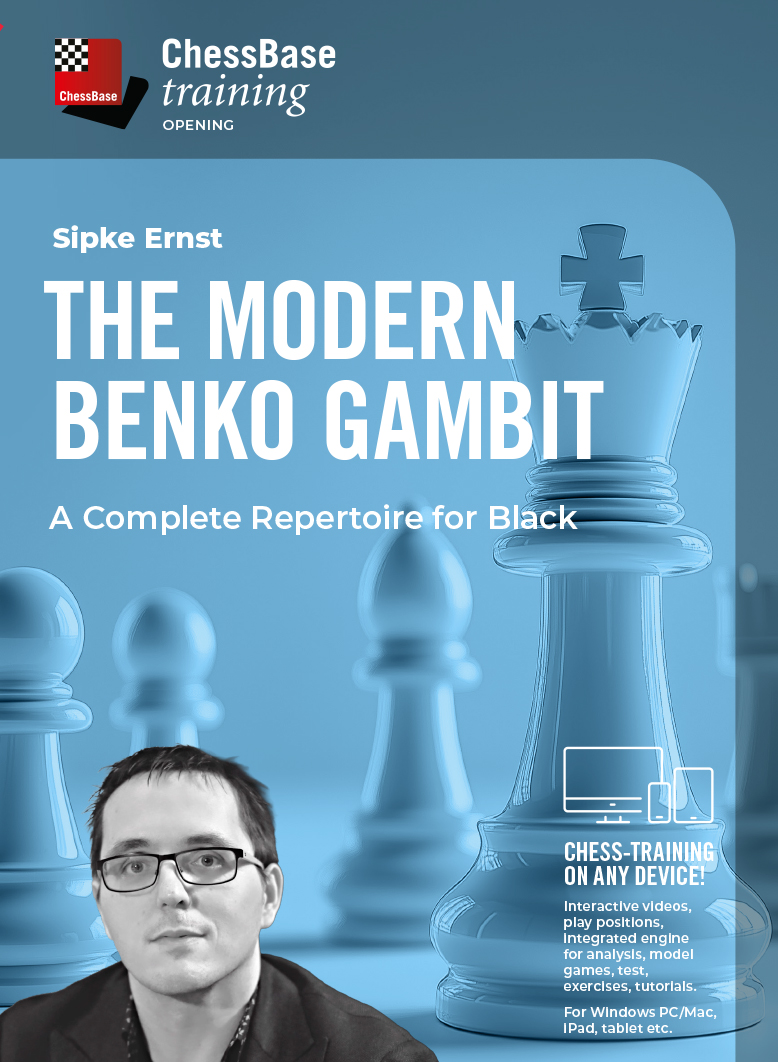
Review: The Modern Benko Gambit - A Full Repertoire Against 1.d4 by GM Sipke Ernst

by Christian Hoethe
10/17/2026 – In his latest ChessBase course, Grandmaster Sipke Ernst thoroughly dispels the Benko Gambit's poor reputation. His modern approach, featuring an early 5...e6!, revolutionises the gambit, breathes new life into it and elegantly sidesteps White's traditional attempts at refutation. A new chapter in the history of the Benko Gambit has been written – and Christian Höthe takes a close look!

YOUR PERSONAL CHESS COACH - Whether you’re taking your first steps into the world of club chess, or already playing at a tournament level: with FRITZ, you can train more efficiently, intelligently and with a more personalised approach than ever before.
FRITZ is more than just a chess engine – it’s a training revolution! Whether you’re taking your first steps into the world of club chess, or already playing at a tournament level: with FRITZ, you can train more efficiently, intelligently and with a more personalised approach than ever before.

In modern chess, activity has become one of the most valuable resources of all. In recent years, the popular Benko Gambit has come under considerable theoretical pressure: in particular, the critical White line with 12.a4 posed extremely difficult problems for Black and seemed to rob the opening of its dynamic potential.

A look at the repertoire:

With a total running time of approximately three hours, the Dutch grandmaster demonstrates that the Benko Gambit is perfectly suited to the modern computer era. Rather than drifting into the typical manoeuvring positions associated with 1.d4, Black forces the opponent into sharp, double-edged play right from the start. The repertoire is divided into the following sections:
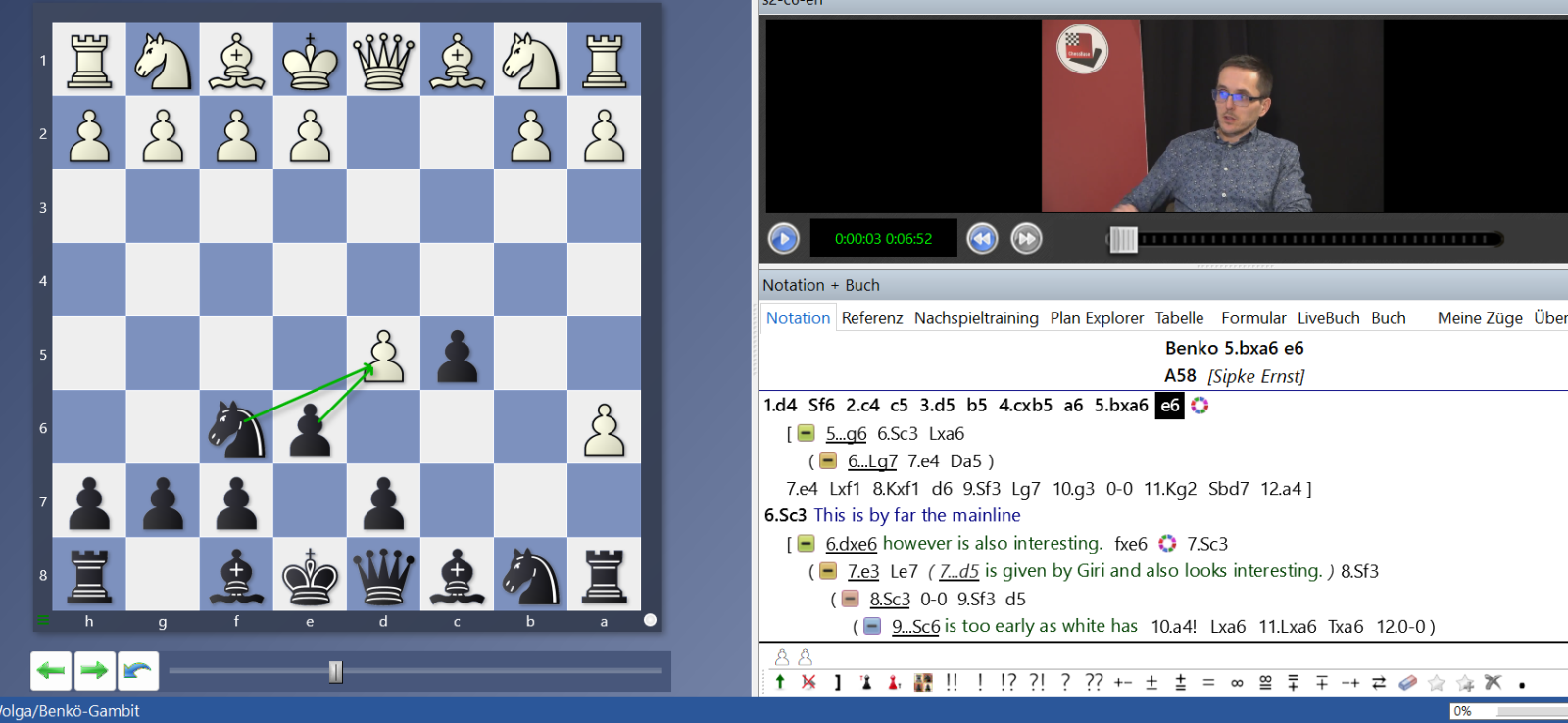
  • The new main line: After 1.d4 Nf6 2.c4 c5 3.d5 b5 4.cxb5 a6 5.bxa6, Sipke Ernst unveils the novelty 5...e6!:
  • Ernst provides a detailed analysis of the critical 6.dxe6 as well as the highly complex and exciting positions arising after 6.Nc3 exd5 7.Nxd5 Be7. White's traditional attempt to cling to the extra pawn is met with uncompromising central activity.
  • White's alternatives on move 5: Ernst provides precise antidotes to the solid 5.e3, including sharp analysis after 5...Bb7 6.Nc3 axb5 7.Bxb5 Qa5, as well as against all sidelines, including 5.Nc3, 5.b6 and the ambitious 5.f3.
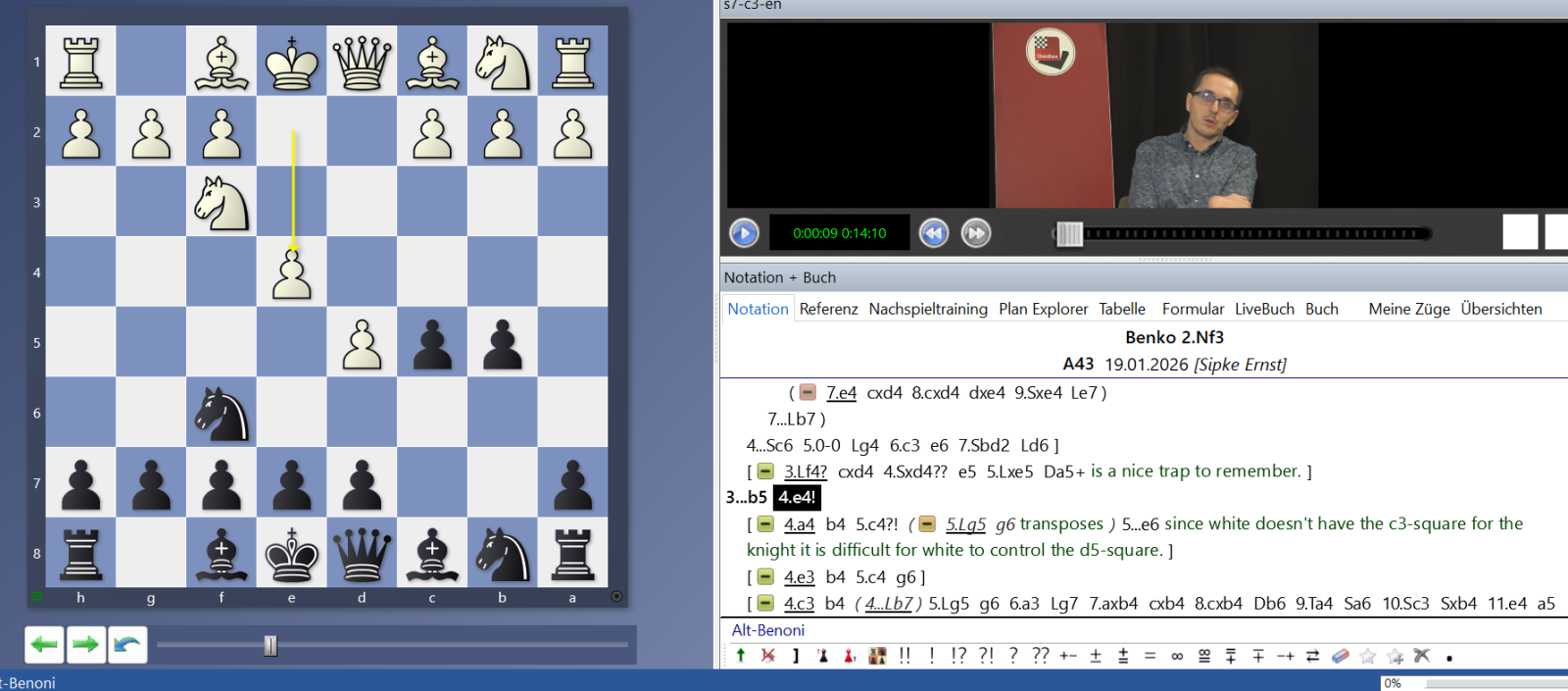
  • Early deviations on moves 3 and 4: The course covers all of White's attempts to decline the pawn sacrifice, including 4.a4, 4.Nd2, 4.Qc2 and 4.Nf3, as well as 3.dxc5 or 3.Nf3.

The Benko Gambit is back at the very highest level - and it's easy to see why. Black sacrifices a pawn to seize the initiative on the queenside, obtaining long-lasting pressure, active pieces and open files that make life difficult for White.
In modern chess, activity has become one of the most prized ressources of all. Engines have taught us again and again that active piece play, the initiative and dynamic pressure can more than compensate for small material or structural concessions. The Benko Gambit fits this philosophy perfectly. By giving up a pawn early, Black immediately gets exactly what the modern player is looking for: open lines, harmonious development and relentless, long-term pressure on White's queenside. It's a genuine fighting opening, ideal for players who don't want to drift into the quiet, slow-maneuvering waters that 1.d4 so often leads to, but instead prefer to seize the initiative and steer the game into sharp, dynamic and double-edged territory.
Free sample video: Introduction
Free sample chapter: Alternatives Move 3

A major strength of this course is its pragmatic and comprehensive approach. Ernst offers complete systems against 2.Nf3 and provides full coverage of popular Queen's Pawn openings such as the London System, the Trompowsky Attack and the Richter-Veresov Attack.
The Volga Benko Gambit Powerbook 2020 is based on over 21 000 games from the engine room of playchess.com and also 12 000 games from Mega 2020 and the Correspondence Database 2020
For the 21 000 games from the engine room of playchess.com and 12 000 games from Mega 2020 and the Correspondence Database 2020 the threshold set was an Elo average of 2300. The result of this was a small specialist book which nevertheless allows reliable statistics concerning a gambit opening, which is played from time to time even by top grandmasters.

Volga Benko Gambit Powerbase 2020 is a database and contains a total of 4056 games from the Mega 2020 and the Correspondence Database 2020, 307 of which are annotated.
In the 307 selected annotated games you will find, e.g., annotations from Bologan, Inarkiev and Radjabov, but the lion’s share – 169 games – come from Igor Stohl, who looked after the opening for many years for ChessBase Magazine. As a total there are 4056 games, with an average rating of the players of at least 2450 (apart from games played by experts and those which have comments).

Black thus gets an all-in-one repertoire against 1.d4.

As we have come to expect from ChessBase, the video material is complemented by an extensive range of learning tools. The course runs across platforms in the FritzTrainer app for Windows and Mac, is available as a download or CB Book, and can also be streamed conveniently via the ChessBase video portal.

Throughout the videos, Ernst regularly presents the user with key positions. After the user enters a move, the author either praises the correct plan or explains clearly through video feedback why an incorrect attempt fails. Using the Fritz Online web app, newly learned positions can immediately be put to the test in training games against Fritz. The Opening web app also allows users to play through complex variations using Autoplay and memorise them systematically until the move sequences become second nature.

The interface allows users to enter their own variations at any time or activate any locally installed engine for in-depth analysis, supported by useful features such as LiveBook and Assisted Analysis.

The package includes comprehensive databases of illustrative games and repertoire variations. All of GM Sipke Ernst's analyses can be saved directly to the user's personal digital opening repertoire. With the help of the Opening Reference, users can play through the variations on the analysis board, examine them and compare them with current grandmaster practice. Replay Training also helps improve their understanding of the resulting middlegame structures.

Conclusion

The Modern Benko Gambit is a milestone for all Benko Gambit players. Sipke Ernst succeeds in thoroughly modernising the gambit with his exciting new approach based on 5...e6. Anyone who no longer wants to defend passively against 1.d4, but instead wants to put White under sustained, dynamic pressure right from the start, should not miss this course.

***

In this DVD, Erwin l'Ami guides you through the fascinating Benko Gambit. As early as move three Black starts a fight for the initiative, a strategy that has proved to be successful in countless amateur and master level games.

About the author:

Sipke Ernst, born in 1979, is a Dutch chess grandmaster and FIDE Trainer. He earned the grandmaster title in 2007 and reached his peak Elo rating of 2606 in January 2012. 

Ernst won three bronze medals at the Dutch Chess Championship and finished runner-up in 2017 after a playoff. He also represented the Netherlands at the 2002 Chess Olympiad and the 2009 European Team Championship. Today, he works primarily as a professional chess coach and produces training courses for ChessBase.

Sipke Ernst in the ChessBase Shop

--> MORE REVIEWS <--


The product was provided to the author by ChessBase for review.


Christian Hoethe was born in 1975, is father of two daughters and one son, lives in Brunswick, Germany, and learned chess relatively late, at the age of 13, from his father. At his peak he reached an Elo of 2247. He plays for the German club SC Wolfsburg where he also teaches once a month.
Discussion and Feedback Submit your feedback to the editors