Ivan Sokolov on Reversed-Colour Benoni, Blumenfeld and Benko – Complex Positions for White and Black
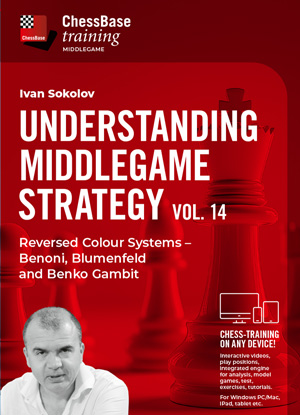
Playing your own Black opening with the white pieces is an attractive idea. After all, you have an extra tempo and the comfort of being familiar with the resulting structures. Three such reversed-colour systems are the subject of Grandmaster Ivan Sokolov's latest middlegame course: the Benoni, the Blumenfeld Gambit and the Benko Gambit, all with colours reversed.
The heart of the course consists of eleven deeply annotated model games with a total video running time of 5 hours and 50 minutes. Six games cover the reversed-colour Benoni, four the reversed-colour Benko, but only one is devoted to the reversed-colour Blumenfeld Gambit.
You will learn how Black's dynamic piece activity and structural counterplay more than compensate for White's extra tempo in the colour-reversed setups.
The Benoni family of openings has toppled world champions, decided match games under the highest pressure, and rewarded those brave enough to play them with some of the most electrifying chess imaginable. In this Fritztrainer, Grandmaster Ivan Sokolov - continuing his successful series "Understanding Middlegame Structures" - takes you deep inside the complexities of the Colour-Reversed Benoni, the Colour-Reversed Benko Gambit, and the Colour-Reversed Blumenfeld Gambit.
Free sample video: Introduction
Free sample video: Colour Reversed Banoni - Game 1
Benoni, the Benko Gambit and similar openings are perfectly playable with Black, but objectively speaking they leave the second player walking a fine line. The following example shows how much more comfortable these structures can be with colours reversed:
1.c4 e6 2.g3 d5 3.Bg2 Nf6 4.Nf3 d4
Black opts for a reversed Benoni. This is a perfectly acceptable choice, but by no means a forced one. Solid alternatives such as 4...dxc4 and 4...Be7 are available, although they are not covered in Sokolov's course.
5.0-0 Nc6 6.e3 e5 7.exd4 exd4?!
Here Black should enter the complications after 7...e4!, but unless you know that line, the move played in the game is the more natural choice.
8.d3 +=
Here Black is simply missing the extra tempo he would have with colours reversed. As a result, his pieces come into play just a little too slowly.
8...Be7 9.Na3!
This move comes naturally to anyone familiar with the Benoni. The knight is heading for c2.
9...0-0 10.Nc2 Bf5 11.a3 a5 12.b3 Qd7 13.Re1 Rfe8 14.Qd2
The pawn on d4 is weak, and the advance b3–b4 remains a recurring theme. Black soon ran into serious difficulties and eventually lost the game to Andrey Esipenko (A. Esipenko–K. Lagno, Russia 2023).
Of course, things do not always go so smoothly. Sokolov also points out the inherent risk of these reversed-colour systems. By voluntarily conceding space with White, you are making a significant strategic commitment, and the game can just as easily develop in your opponent's favour.
REPLACE_BY_ADV_2
K. Shevchenko–P. Eljanov, Hungary 2023
1.c4 e6 2.g3 d5 3.Bg2 Nf6 4.Nf3 Be7 5.0-0 0-0 6.b3 c5 7.Bb2 d4 8.b4 a6 9.bxc5 Nc6 10.d3 e5 11.Nbd2 Nd7 12.Rb1 Nxc5
Black has an excellent knight on c5 and enjoys more space. White still has enough resources to generate counterplay, but in the game this never really happened. The Ukrainian grandmaster gradually took control and went on to win with the black pieces.
One of the strengths of Sokolov's course is that he does not favour either side. Instead, he demonstrates the typical ideas for both White and Black. It is no coincidence that each side wins five of the eleven model games, with the remaining game ending in a draw.
What the course is explicitly not is a theoretical survey or a repertoire course. If that is what you are looking for, you will need to do some additional work on your own. Players seeking a microscopic objective edge with White are probably better advised to look for it in the main lines. In the reversed Benoni and Benko, the emphasis is on strategically complex middlegame positions rather than theoretical debates. Opening theory ends relatively early, engines often assess the position as equal, but with plenty of pieces still on the board, almost anything can happen.
Ding Liren–A. Giri, Tata Steel Masters 2023
1.c4 e6 2.g3 d5 3.Bg2 Nf6 4.Nf3 Be7 5.0-0 0-0 6.b3 d4 7.e3 c5 8.Ne5 Qc7 9.f4 Nbd7 10.Nd3 e5 11.Na3 a6 12.Bb2 Bd6 13.g4
Even in this extraordinary position from a game between two world-class players, virtually anything can happen. Ding Liren went on to outplay his opponent impressively, only to lose the thread later in the game.
Conclusion
Players who already use, or are considering taking up, the Benoni or Benko with colours reversed will find plenty of valuable strategic ideas in Ivan Sokolov's middlegame course. The same applies to Black players who are prepared to meet these systems with an early ...d5-d4, as the experienced Dutch trainer explains the typical plans for both sides. The reversed Blumenfeld Gambit, by contrast, receives only brief coverage through a single model game, in which White's concept does not prove particularly successful.
In this video course, Grandmaster Ivan Sokolov explores the fascinating world of King’s Indian and Pirc structures with colours reversed, often arising from the French or Sicilian.
The King’s Indian Defence is one of the most dynamic openings in chess - and Pirc structures share much of the same DNA. With colours reversed (the King’s Indian Attack), these setups can be just as powerful. What may look modest at first often transforms into highly complex middlegames, where timing, precision, and a deep feel for dynamics make all the difference.
Free video sample: Introduction
Free video sample: Misplaced Pieces
Zum Autor:
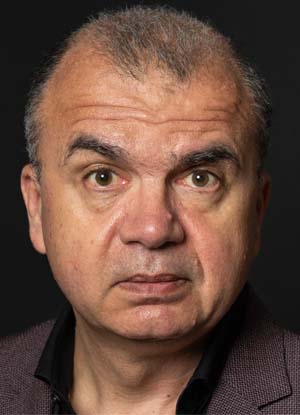
Ivan Sokolov is a Dutch grandmaster and the author of several popular chess books. He won the Yugoslav Championship in 1988 and the Dutch Championship in 1995 and 1998. For more than two decades, he has been one of the world's leading players and has defeated many of the strongest grandmasters of his era.
More products by Ivan Sokolov...