





Andrew Martin is one of my favourite ChessBase authors. I like his excellent, approachable teaching style, as well as the fact that he regularly gives less common openings and variations a chance. I am thinking, for example, of his course on the "Black Knights' Tango" (1.d4 Nf6 2.c4 Nc6), a move order that I studied with a chess friend in my early youth in the 1980s under the name "Two Knights Indian".
His 60-minute courses on various rare lines in well-known openings are also very interesting. They can be found here:

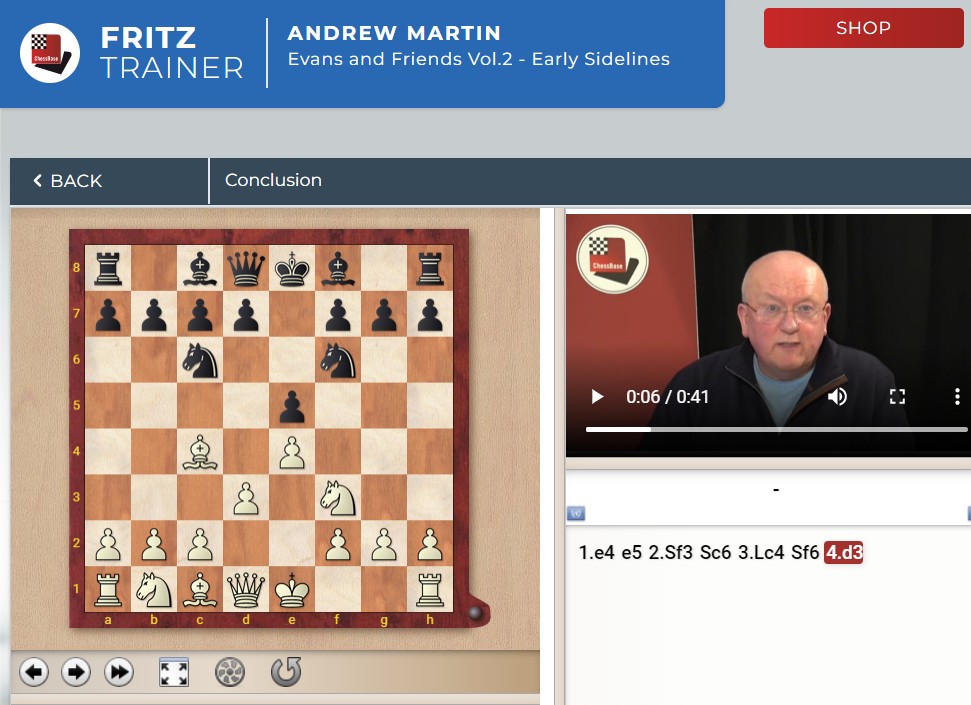
I was therefore very curious about his new course "Evans & Friends", as I already have a few slightly dubious gambits in my repertoire, such as the Morra Gambit in the Sicilian and the Schara-Hennig Gambit. I was somewhat surprised by Andrew Martin's repertoire recommendation against the Two Knights Defence (1.e4 e5 2.Nf3 Nc6 3.Bc4 Nf6): unlike in his book published in parallel, "The Evans Gambit: A Full Repertoire for White after 1.e4 e5", in which he recommends the aggressive line 4.d4 exd4 5.e5, here he opts for the more positional continuation 4.d3. His explanation is that he wanted to offer an alternative to the book in the video course. Those who, like me, believe that 4.d4 fits an Evans Gambit repertoire better than 4.d3 can additionally take a look at this 60-minute course:
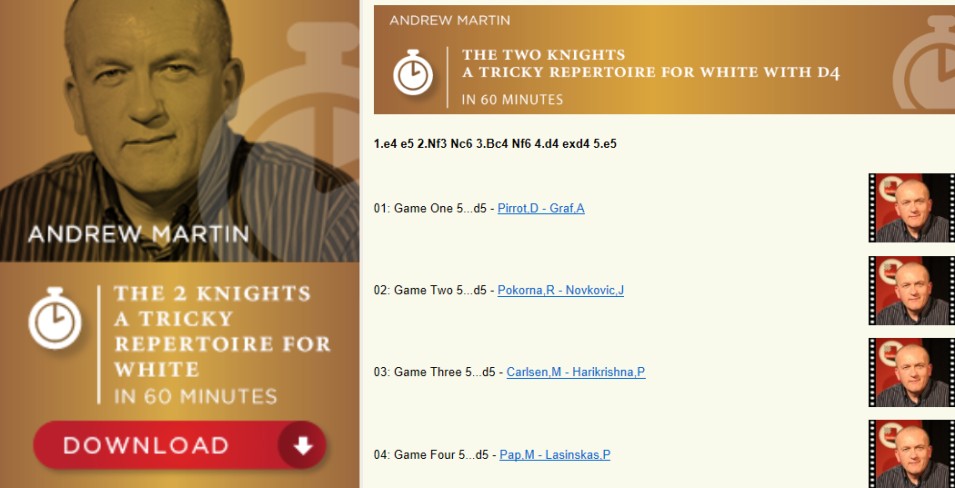
This covers precisely the variation that can also arise from the Scotch Gambit after 1.e4 e5 2.Nf3 Nc6 3.d4 exd4 4.Bc4.
Playable today? At the very top level, perhaps mainly as a surprise weapon – which leaves the other 99.99% of us free to enjoy it in full. The Evans produces exciting chess and teaches the art of attack.
Interested? Watch the free sample video: Introduction
free sample video: Evergreen Game
Volume 1 deals with the Evans Gambit 1.e4 e5 2.Nf3 Nc6 3.Bc4 Bc5 4.b4
The Evans Gambit shares with the King's Gambit the reputation of being a somewhat old-fashioned, wildly romantic opening from the 19th century. That may be true to some extent of the King's Gambit, because what does White achieve if Black defends in a "modern" way rather than in the style of the 19th century? The Evans Gambit, by contrast, has an objective justification. In return for the sacrificed pawn, if Black tries to hold on to it in the long term, White gains a lead in development, the initiative, prospects of a strong centre and open files and diagonals for the pieces. A forced advantage for White cannot be demonstrated, however. In the best defensive lines, Black returns the pawn at the right moment and reaches an equal position with chances for both sides.
Andrew Martin calls the first chapter "Showcase". Here he aims to whet our appetite for the Evans Gambit with interesting games both from the Romantic era and from contemporary master practice, while creating a positive and motivating atmosphere.

The selection includes, for example, games by Fischer, Kasparov, Carlsen and Erigaisi, showing that the Evans Gambit has also been played at world-class level.
Seven chapters of theoretical discussion on Black's various defensive systems follow. The most important defence, 5...Ba5 (after 4...Bxb4 5.c3), is covered in no fewer than three chapters. The variations 5...Bc5, 5...Bd6 and 5...Be7, as well as the Declined Evans Gambit, are then treated in separate chapters.
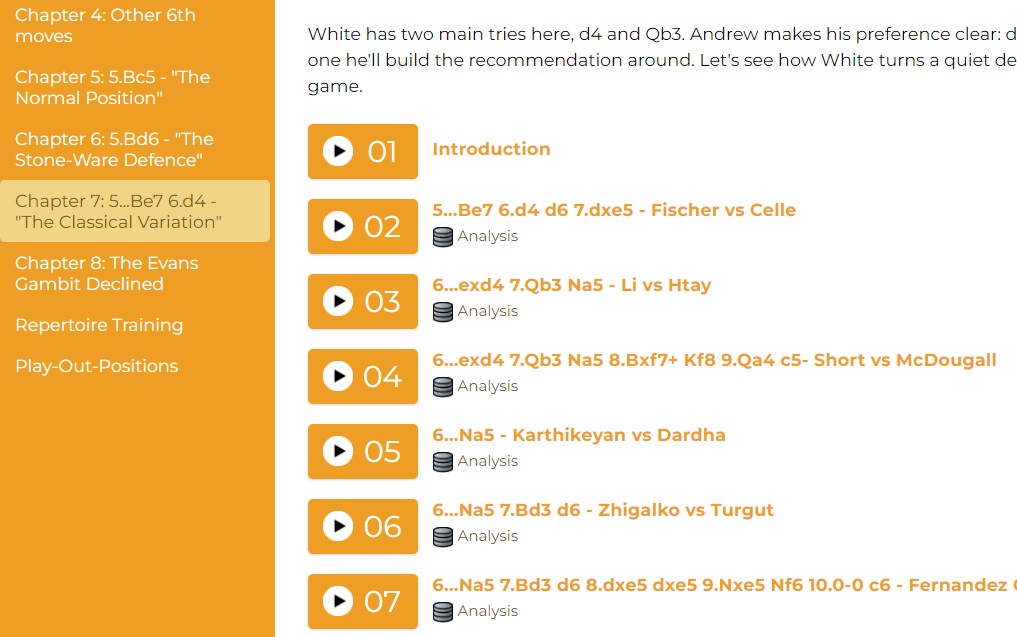
As is typical of Andrew Martin's courses, there is no rigid "variation bashing". Instead, the theory is conveyed in a memorable way through practical master games.
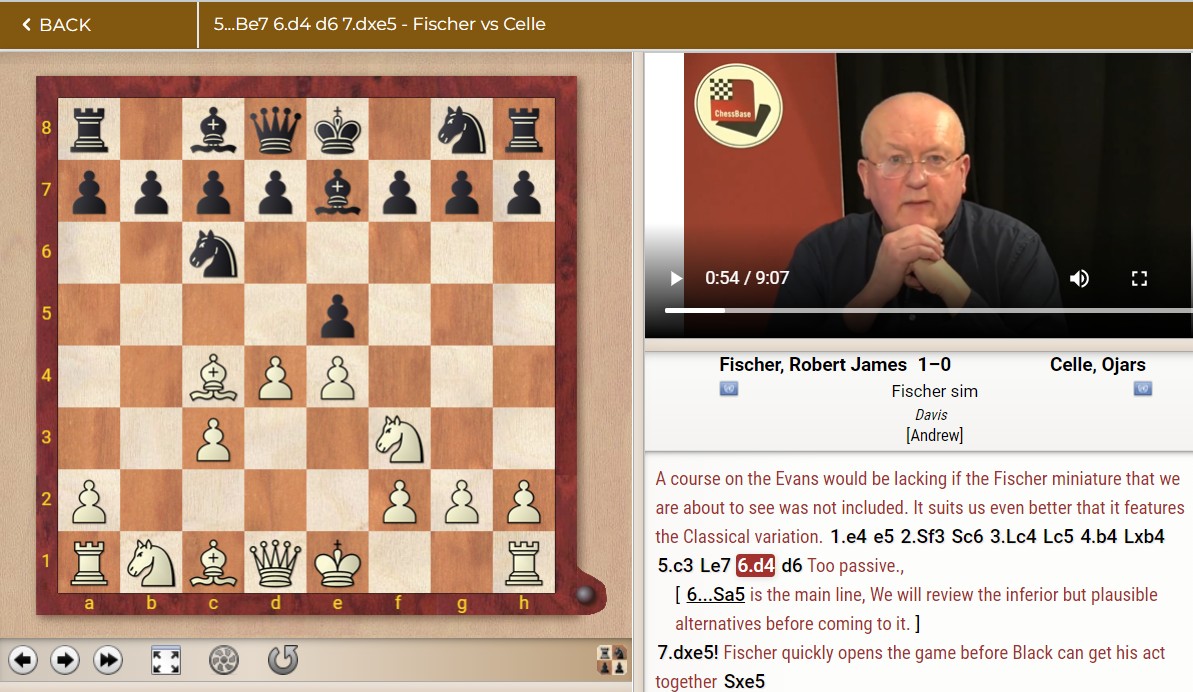
The course is supplemented by the chapters "Repertoire Training" and "Play-Out Positions", which allow users to practise what they have learned on ChessBase Openings and the Fritz App in the browser. Unfortunately, the author did not include interactive test videos in the FritzTrainer format in the first course, which I find slightly disappointing.
Has the Evans Gambit convinced me as a repertoire recommendation? I am still not sure whether the Evans Gambit will become my preferred choice, but I find it very interesting and will initially use it in online and training games. The course has given me a good feel for the gambit and the confidence that it is absolutely playable at amateur level and offers good practical chances.
A gambit is only half a repertoire. Volume 1 armed you with the Evans; Volume 2 covers every Black player who steers elsewhere after 1.e4 e5 2.Nf3.
IM Andrew Martin begins where it matters most: the Two Knights Defense, which you'll meet roughly half the time you reach for 4.b4. His choice here is 4.d3 – the move today's elite prefer. It won't promise an advantage out of the opening, but it produces a rich, closed-Lopez-style middlegame full of pieces and play, ideal for outplaying strong opposition. Little theory to memorize; plans and manoeuvres instead, including attacking schemes where White leaves the king in the centre and storms the kingside.
Watch the free video sample: Introduction
and the free video sample: Two Knights Defence
Volume 2 deals with all relevant alternatives to the Italian Game on moves 2 and 3
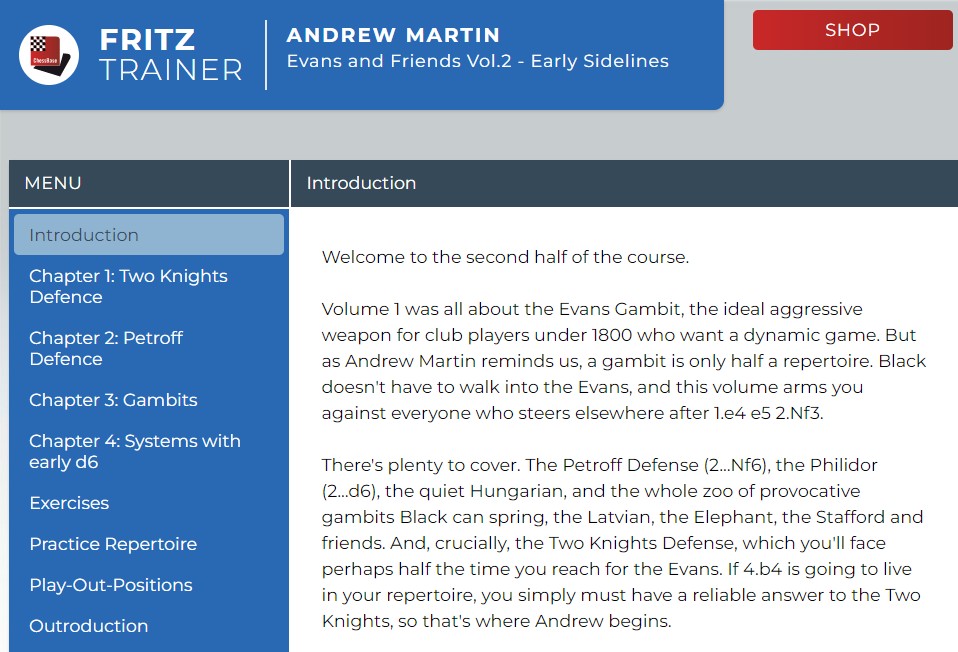
The most important systems here are the Two Knights Defence (3...Nf6) and the Petroff Defence (2...Nf6). These are covered in detail in chapters 1 and 2 through several example games. The Two Knights Defence alone receives an introductory video, twelve extensively annotated games and a concluding summary. As already mentioned in my introduction, Andrew Martin's repertoire is based on 4.d3 rather than 4.d4, as in his book.
Against the Petroff Defence, after 1.e4 e5 2.Nf3 Nf6 3.Nxe5 d6 4.Nf3 Nxe4, the author does not recommend the most commonly played main line 5.d4, but instead 5.Bd3:
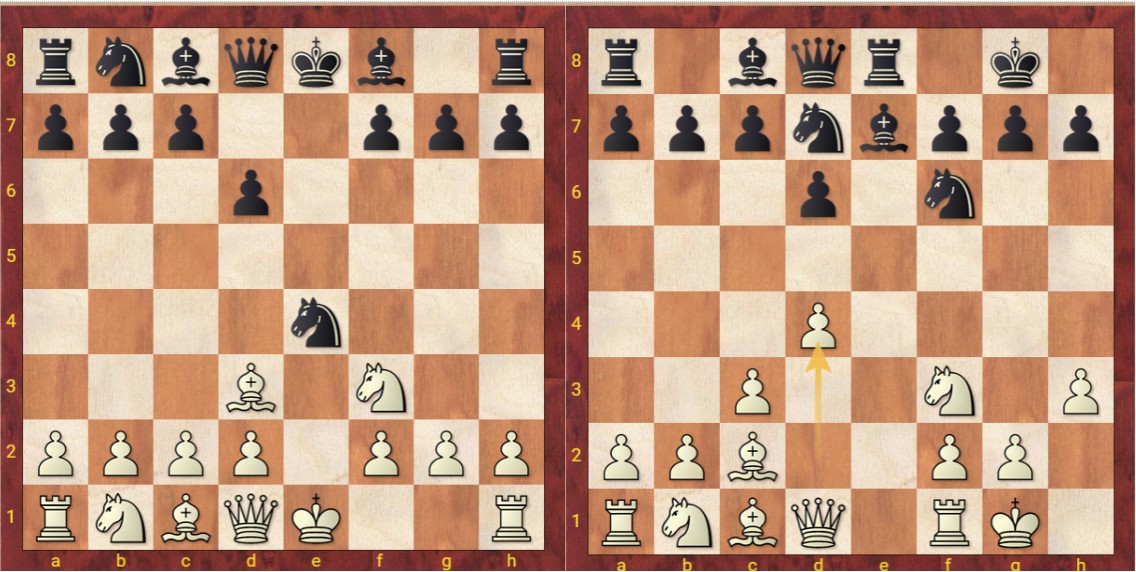
Later, White prepares d4 under favourable circumstances with c3 and Bc2.
In chapters three and four, the repertoire is completed with recommendations against various gambits (the Latvian Gambit, Elephant Gambit and Stafford Gambit), as well as the Philidor Defence, 2...d6, and similar systems.
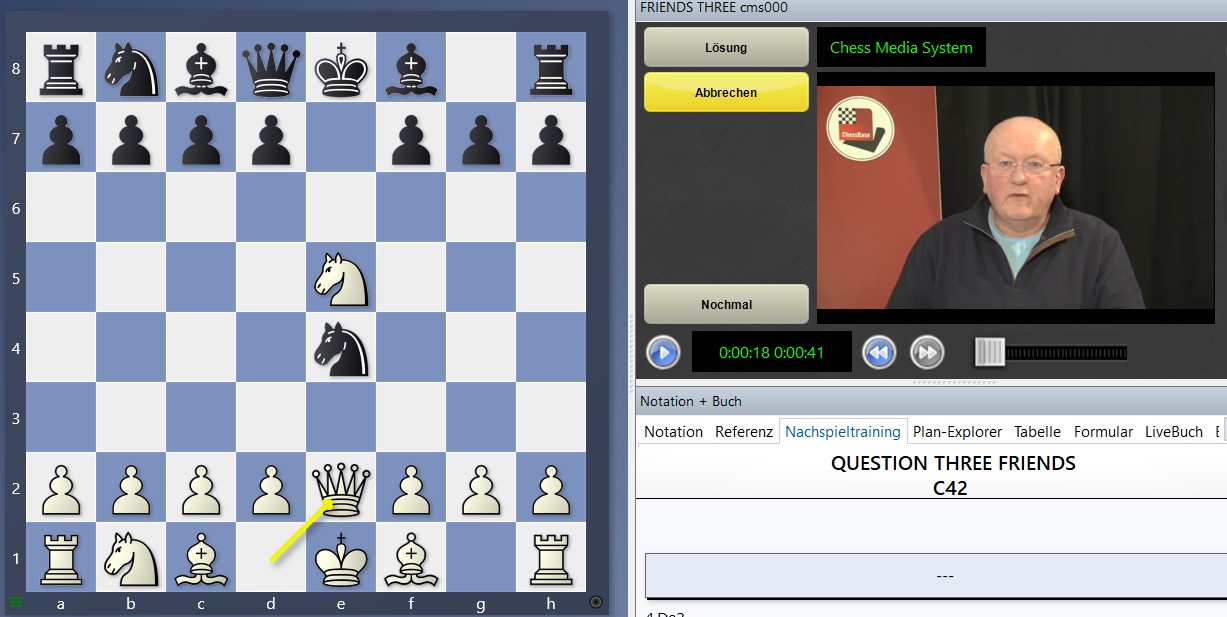
I was pleased that Volume 2, in addition to the "Practice Repertoire" and "Play-Out Positions", includes several test exercises in the interactive FritzTrainer format. This format is virtually a unique feature of the ChessBase FritzTrainer courses and, for me, the icing on the cake:
I think Andrew Martin delivers convincing courses here. He offers club players rated up to around 1800 or 1900 a sensible repertoire after 1.e4 e5 2.Nf3. Against the Two Knights Defence, in my opinion, the more aggressive 4.d4 would have fitted the repertoire better than 4.d3. On the other hand, less common replies are also covered, which really does make the two courses a complete repertoire.
About the author:

Andrew David Martin (born 18 May 1957 in West Ham, London) is an English chess player who holds the title of International Master. Martin has won various international and national tournaments. He has played in the Four Nations Chess League for many years, currently (as of July 2009) for Wood Green Hilsmark Kingfisher, having previously represented Chamberley Chess Club. Martin was awarded the International Master title in 1984. He earned his first grandmaster norm at the British Championship in Brighton in 1997. Martin was a commentator for the 2000 World Championship match between Kasparov and Kramnik.
On 21 February 2004, Martin set a new world record for simultaneous chess. He played 321 opponents at the same time. His result was 294 wins, 26 draws and just 1 loss. Martin is known as a professional chess teacher and head coach of the English junior team. He teaches at eight schools (Yateley Manor, Aldro, Millfield, Sunningdale, Waverley School, St Michael’s Sandhurst, Wellington College and Salesian College). Martin is a chess columnist, chess book author and the creator of various instructional videos. He was the publisher of the Trends Publications series. Martin lives in Bramley, England, is married and has two daughters and two sons.
More products by the author are available in the ChessBase Shop


| Advertising |










.jpeg)

.jpeg)