.jpeg)

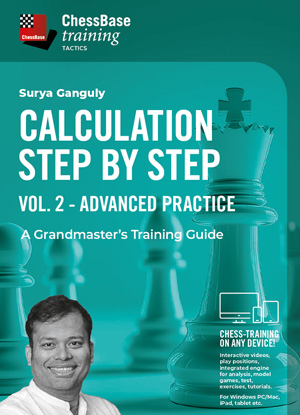
Can you take your calculation to the next level with GM Surya Ganguly?
The core of the second part of Ganguly’s video course consists of three thematic chapters, each with several exercises:
In the final Mixed Test, there are – as in a real tournament game – no thematic hints whatsoever for the solution.
Short vs Miles, England 1984, from the chapter Imagination & Unusual Moves
Why did Nigel Short refrain here from 22.Nb6!, which at first glance seems to win the exchange? Presumably because he had seen the resource 22...Ne2!
Black threatens mate, beginning with …Rc1+. In addition, the rook on d1 is hanging, and 23.Bxe2 Qxd1+ 24.Bxd1 Rc1# does not help either. But White still has one arrow in his quiver, namely the fantastic 23.Qf8+!!. With this powerful move, a black piece is forced to f8. After 23…Kxf8 24.Nxd7+ Kg8 25.Bxe2 +- or 23…Rxf8 24.Nxd7+- White is left with a decisive material advantage in each case.
The stronger and more experienced the players, the more likely they are, according to Ganguly, to discard unusual moves like 23.Qf8+ on general grounds from the outset. „Become a kid“, says the Indian grandmaster, because children still have an open mind.
Short vs Miles is quite solvable, especially since, as a viewer, one knows the name of the chapter 😉. However, it is also one of the easiest positions in the entire course!
Some of the positions are incredibly difficult. As in Volume 1, Ganguly repeatedly urges his viewers to really dig in. No passive learning, no easy entertainment like at the movies – at least not if you want to improve!
"If we want to try to become a better tournament player, we have to push hard."
Ganguly-Wang, Edmonton 2016, from the chapter Mixed Test
White has just played 23.Rd7. How should Black defend against 24.Rxg7+ Kxg7 25.Qxe5+ with a decisive attack on the dark squares? I must admit that I was prematurely quite satisfied with Black’s position after spotting the possibility 23…h6. After all, after 24.Rxg7+ Kxg7 25.Qxe5+ Kh7 the black king appears safe, since the white queen cannot penetrate to the seventh rank. But it was precisely this move, which his opponent also played, that Ganguly had anticipated! 23…h6? 24.Qd2!! simply leaves the bishop hanging! After 24…hxg5 25.Qd5+ Kh7 26.h4
suddenly the rook on h1 decisively joins the action. The black king comes under a decisive attack. But how should Black have continued instead after 23.Rd7? You will find the answer in the appendix.
How "hard" you approach the course is something everyone must ultimately decide for themselves. I set myself a time limit – a maximum of half an hour per position. If, after that time, a key idea in the calculation is still missing, simply watching the beginning of the solution video is often enough to get you back on track.
The two-volume Fritztrainer Calculation Step by Step by Surya Ganguly is aimed at ambitious tournament players, with the level of the training exercises in Volume 2, Advanced Practice, raised noticeably once again. From my perspective, however, it is not about solving everything perfectly, but rather about improving the process of calculation itself. Compared to a traditional tactics book, the explanations provided by the Indian grandmaster in the solution videos offer clear added value.
So, as asked at the beginning, does the Fritztrainer help take your calculation to the next level? Well, I think it can certainly be one building block – everyone will take something new away from the course. And it is enjoyable too, as most of the positions selected by the experienced Indian trainer stand out for their surprising and at the same time elegant solutions. This fits well with the joy for chess that Surya Ganguly repeatedly conveys in his presentation.
About the author:
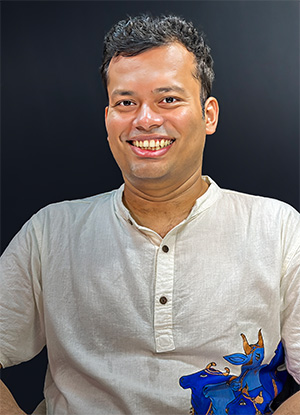 Surya Shekhar Ganguly is one of the most decorated grandmasters India has produced. Among his greatest achievements are winning the National Championship six times in a row from 2003 to 2008, the Asian Continental Championship in 2009, and major open tournaments such as the Fujairah International Open in 2012 and the Belt and Road Open in 2019. He also represented India in six Olympiads and won individual gold twice at the World Team Championship, in 2010 and 2019. In addition, he was part of the team of seconds who helped Vishy Anand to victory in three World Championship matches, against Kramnik, Topalov, and Gelfand in 2008, 2010, and 2012.