



.jpeg)

The following portrait first appeared as part of a review in Karl - Das kulturelle Schachmagazin. Reprinted here in a slightly revised version with kind permission.
"Misha was a genius. That is why he had this kindness. [...] But he was not a particularly easy person". That is how Angelina Tal, Mikhail Tal's widow, described her husband.
Tal was a fascinating personality. A highly gifted and intelligent artist who lived only for chess; for whom money meant nothing, who gave it away without hesitation and never owned a wallet; who was already at university at 17 because he had been able to skip two years at school; who did everything with passion and paid as little attention to his own health as he did to the other "small details" of life; who, despite serious health problems, smoked and drank excessively and was for a time addicted to morphine.
Conventions meant nothing to him. At one point he lived in a flat with his ex-wife, their son, his new girlfriend, his mother and his brother. Angelina Tal recalled that he usually got up at six in the morning and then spent (almost) the entire day on chess.
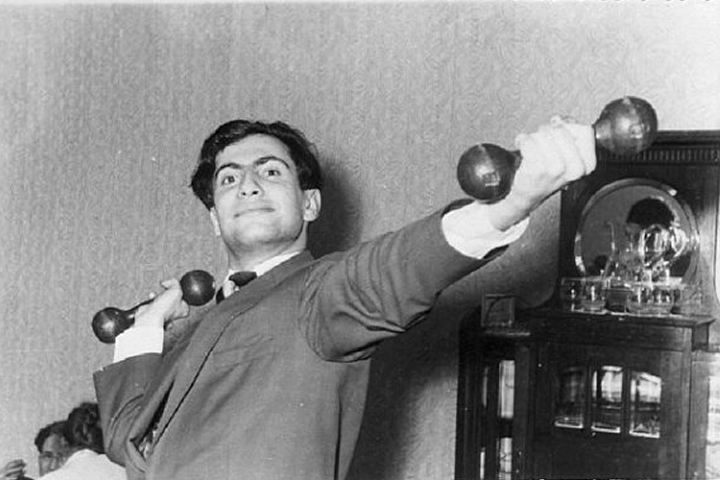
Photo source: Educhess
His games suited such a personality. Again and again, Tal produced fascinating attacks that seemed to come out of nowhere. He ventured piece sacrifices that at first glance looked "impossible", but were difficult to refute. While most players at the time painstakingly tried to avoid even the smallest weakness and clung anxiously to every pawn, Tal played with an unfamiliar dynamism and gave chess new dimensions.
Tal was born on 9 November 1936 in Riga, Latvia, to Latvian Jewish parents. When the Germans invaded Latvia on 1 July 1941, the Tal family escaped only by the narrowest of margins. They just managed to catch the last train leaving Riga, but had to leave all their belongings behind in the city.
Tal learned chess at the age of seven. He was good, but not a prodigy. In 1949, he met Alexander Koblenz, who soon became his coach and close confidant, and remained both throughout his life. Soon after that meeting, Tal's rapid rise towards the world elite began, which he reached at breathtaking speed during the 1950s. His style of play delighted chess fans around the world. The young genius loved risk, played uncompromisingly and boldly for the attack, and even against established grandmasters dared to sacrifice pieces in unclear positions.
His appearance was striking too. His penetrating gaze became legendary: it had something hypnotic about it and hinted at the passion with which Tal played. Yet despite that intimidating stare, Tal was friendly, open and approachable. Even later, when he had already become a living legend, you did not need to be a grandmaster to play, analyse and talk chess with him.
And during his rise to the world elite, Tal was not even a professional player, but was still studying. In 1958, he passed his state examination in "Russian Language and Literature" and then worked briefly as a trainee teacher before finally devoting himself entirely to chess.
It was like a fairy tale: on his very first attempt, the young Tal cleared every hurdle and qualified in 1960 as the challenger to world champion Mikhail Botvinnik, the stern patriarch of Soviet chess, whose secrets of success were hard work and discipline - in temperament, the exact opposite of Tal's artistic existence. But Tal remained true to himself and played double-edged, risky chess. His approach paid off: Tal won the World Championship match convincingly by 12½-8½.
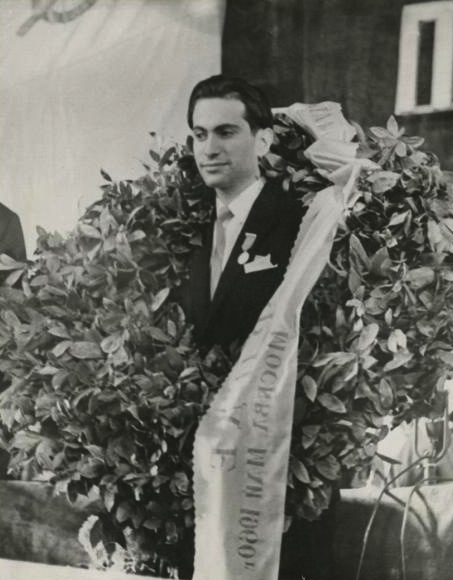
Photo source: Russianphoto
But the miracle did not last long. Botvinnik exercised his right to a return match and prepared for it carefully. Tal seemed not to take the whole matter quite so seriously, and his trainer Koblenz despaired in his unsuccessful attempts to get Tal into the right frame of mind for the match. Tal also did something foolish for which chess lovers can now be grateful: he wrote an unusually candid book about the 1960 match in which he described his strategy, as well as his thoughts and feelings during the games. A gift to every chess lover and a fantastic book - but also ideal match preparation for Botvinnik.

Photo source: sport.ru
Tal was also in poor health during the 1961 return match. When the match was nevertheless not postponed, Tal's magic suddenly disappeared. Botvinnik's discipline, capacity for work and fanatical will to win prevailed: Tal lost 8-13 and became the youngest former world champion of all time - a title he wore with pride.
At times it may seem as though Tal never again reached his earlier heights. But that impression is misleading. Over the course of his life, he became Soviet champion no fewer than six times - something only Botvinnik also achieved - and in 1972-73, when his play had become calmer, he managed to go unbeaten for 86 consecutive games against strong opposition.
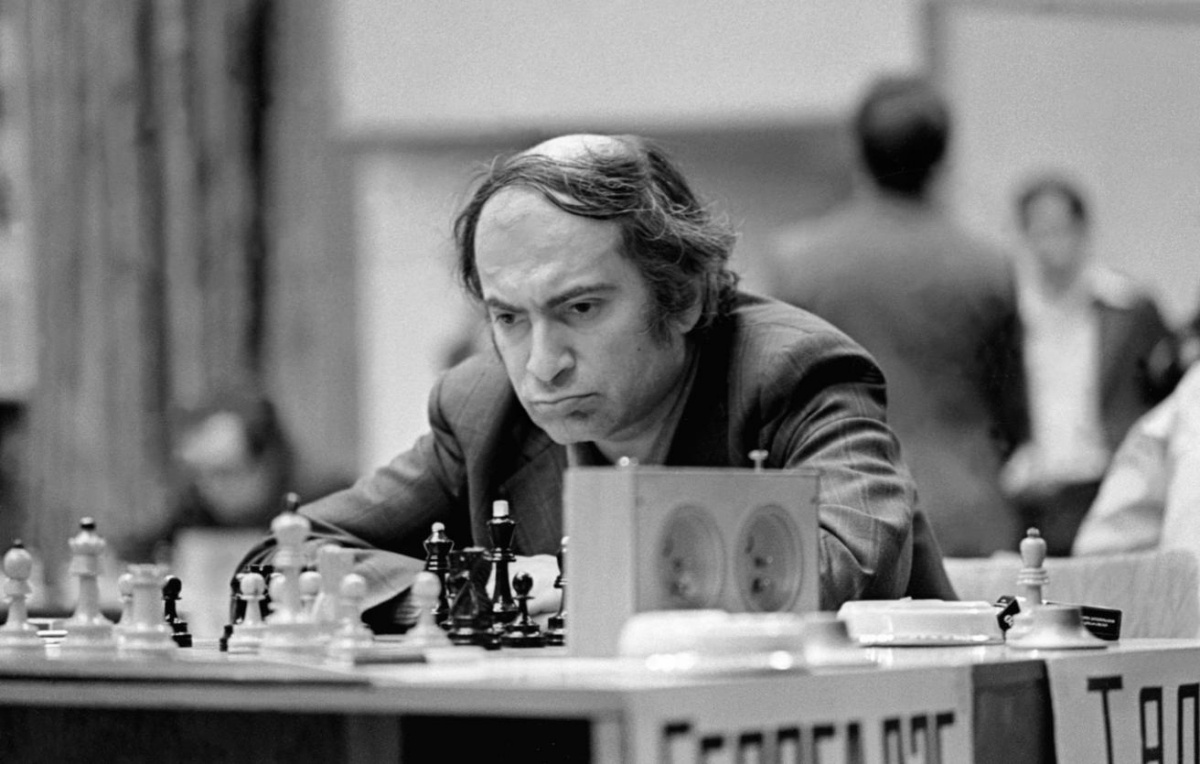
Photo: Tass
And he remained a favourite with the fans. Even though his various illnesses caused him serious problems and led to inconsistent results, he continued to produce wonderful games.
He also excelled as a chess journalist. For ten years he edited the Latvian magazine Sahs, which flourished under his leadership. His lectures and commentary on Russian television captivated even people with little knowledge of chess, and his book The Life and Games of Mikhail Tal is regarded by many as one of the best chess books of all time. In an interview with himself, Tal describes his career, his tournaments, his approach to preparation and his attitude towards chess. Tal's passion for the game is infectious, and the games themselves are a delight. Politics and his private life, however, were left out.
It is understandable that such a character had difficulties with the Soviet system. Tal was harassed by some officials and was occasionally denied permission to travel abroad. Tal probably agreed to assist Karpov as a second in his match against Korchnoi because it meant he was once again allowed to play tournaments in the West.
But Tal's excessive lifestyle eventually took its toll. He repeatedly had to undergo treatment for various illnesses and, already very ill and severely weakened, died on 28 June 1992 at the age of just 55 in a Moscow hospital following the consequences of an incorrectly performed operation. Until the end of his life, he continued to play fantastic chess. Two months before his death, at the end of April 1992, he had still taken part in a strong tournament in Barcelona and defeated Lautier in a brilliant game.
Tal sacrifices a piece in the opening in order to keep the black king in the centre and exploit his lead in development. After a series of brilliant attacking moves, a clearly favourable endgame eventually arises, which Tal wins after a number of inaccuracies by both sides.
Even in the last blitz tournament of his life, which Tal played shortly before his operation, he managed to defeat Garry Kasparov once more. Tal eventually finished third behind Kasparov and Bareev, but still ahead of Smyslov, Dolmatov and Beliavsky.


| Advertising |










.jpeg)

