8/15/2025 – In his youth, Jason Kouchak had two great idols: lyricist Don Black and designer and game inventor Ernö Rubik. He later had the opportunity to meet both of them in person, and all three share a love of chess. Kouchak's two heroes from his youth are now over 80 years old, but they draw a great deal of inspiration and strength from their involvement with chess.
new: Fritz 20
Your personal chess trainer. Your toughest opponent. Your strongest ally. FRITZ 20 is more than just a chess engine – it is a training revolution for ambitious players and professionals. Whether you are taking your first steps into the world of serious chess training, or already playing at tournament level, FRITZ 20 will help you train more efficiently, intelligently and individually than ever before.
YOUR PERSONAL CHESS COACH - Whether you’re taking your first steps into the world of club chess, or already playing at a tournament level: with FRITZ, you can train more efficiently, intelligently and with a more personalised approach than ever before. FRITZ is more than just a chess engine – it’s a training revolution! Whether you’re taking your first steps into the world of club chess, or already playing at a tournament level: with FRITZ, you can train more efficiently, intelligently and with a more personalised approach than ever before.
This is a full repertoire after 1.e4 e5 2.Nf3 focussing on the Evans Gambit as the main weapon.
€59.90
The power of active kings
Stay curious, for every day is a challenge or an opportunity to learn and grow.
Jason Kouchak
Few people have the chance to meet their childhood heroes. Time passes, but in life, as in chess, it is important how one manages it. Jason Kouchak enjoys connecting music and chess with aspects of love in all areas.
In this video course, kings will play a role of strong and active pieces. We will explore how Kings can be helpful in defence and prophylaxis, or even in attack!
Jason Kouchak
When you meet your childhood heroes, it becomes a meeting of minds. Two men have particularly inspired Jason Kouchak throughout his career – men known for their sharp intellect and creative curiosity. They were Don Black and Ernő Rubik.
Don Black
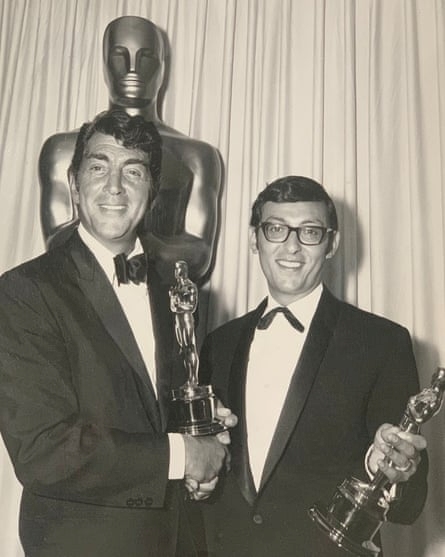
Don Black, whose real name is Don Blackstone, was born in London in 1938 as the fifth and youngest child of Russian-Ukrainian-Jewish immigrants. He entered the world of music as an office boy in a music publishing company. For a time, he was the personal manager of singer Matt Monro and began writing lyrics for him. His first major success was the lyrics for the title song of the James Bond film "Thunderball". Later, he wrote further lyrics for Bond film title tracks – "Diamonds Are Forever", "The Man with the Golden Gun" with John Barry, and "Tomorrow Never Dies" and "The World Is Not Enough" with David Arnold.
Don Black, right, with Dean Martin and their Oscars
The title song for the film Born Free won the 1966 Oscar for Best Original Song and became a hit. At the 1967 Grammy Awards, it was chosen as Song of the Year.
In the following years, Don Black successfully collaborated with John Barry on "The Tamarind Seed", "Out of Africa" and "Dances with Wolves". In 1969, he received a second Oscar nomination for the title song of the John Wayne western "True Grit". More Oscar nominations followed, and he received commissions from Walt Disney. In 2023, Don Black worked with film composer David Arnold and singer-songwriter Sophie Ellis-Bextor on the title song for the Channel 4 and Universal Pictures film Mog's Christmas.
Equally successful is Don Black’s work as a lyricist in the field of musicals. He has written lyrics for countless musical compositions, working frequently with John Barry, but also with Jule Styne, Geoff Stephens, Mort Shuman and Andrew Lloyd Webber. He collaborated with Indian composer A. R. Rahman on the musical Bombay Dreams.
Don Black's lyrics express deep emotions, says Jason Kouchak, and tell beautiful stories. His texts address universal themes such as love, loss and hope.
Almost 60 years later, it was an honour for Jason Kouchak to compose a love song for Don Black's birthday using Don's beautiful lyrics.
Walk Through Holland Park…
We love to walk through Holland Park There's nothing we would rather do Our dreams began in Holland Park It’s hard to walk there without you
With every step I do recall The way we talked till it was dark The last to leave that small café They knew us well in Holland Park
If flowers talked They'd say to me Where can she be Each time I’ve been to Holland Park You've been with me Each walk was like a fairytale
A glass of wine to warm the heart How many times you screamed at me The opera's about to start Our old friends have stopped playing chess It’s time to go It’s getting dark
I always feel so close to you Each time I walk through Holland Park If flowers talked' They’d say to me Where can she be
Each time I’ve been to Holland Park You've been with me I always feel so close to you Each time we walk through Holland Park
- Don Black/Jason Kouchak
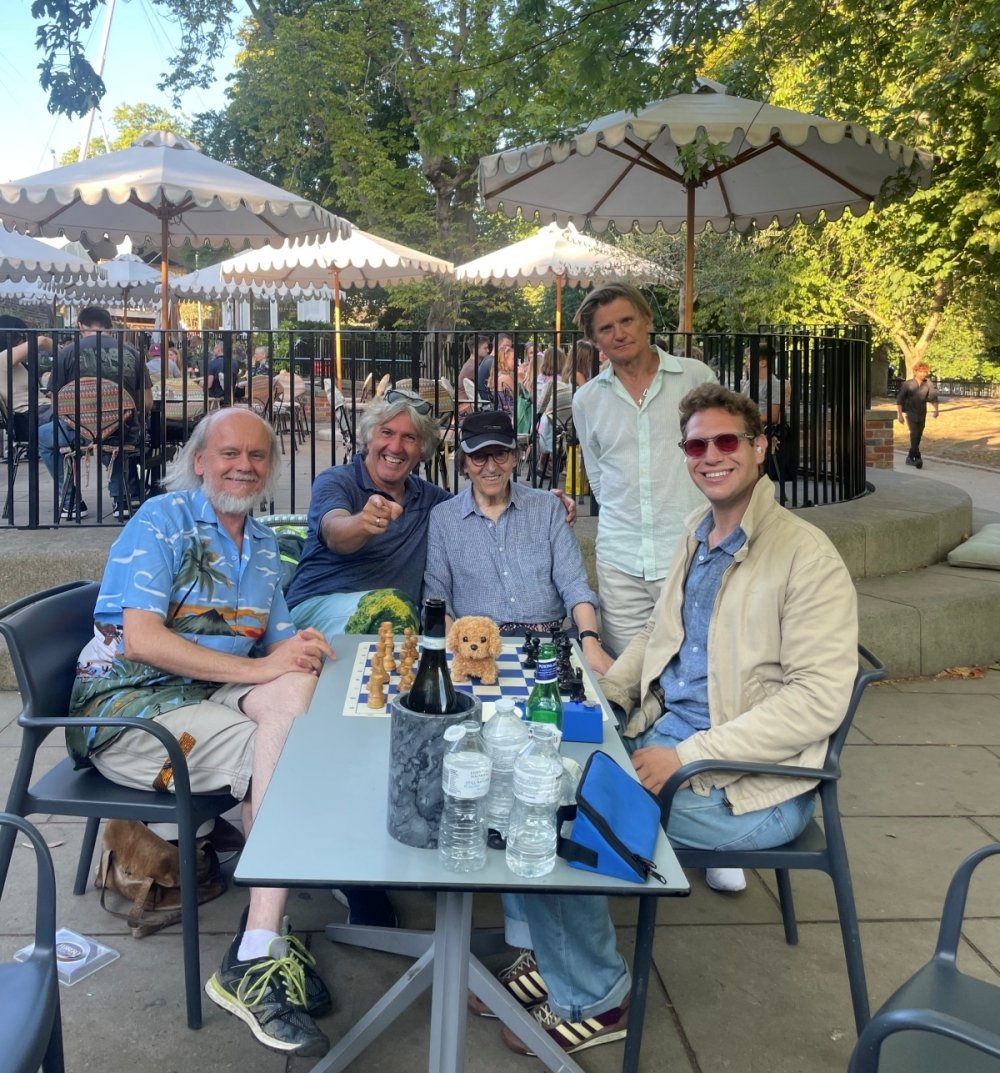
Don Black only discovered his love for chess later in life and now takes chess lessons from his great admirer Jason Kouchak.
Smyslov cultivated a clear positional style and even in sharp tactical positions often relied more on his intuition than on concrete calculation of variations. Let our authors introduce you into the world of Vasily Smyslov.
Jason Kouchak and Don Black playing chess with friends - left: GM Stuart Conquest
Ernő Rubik
Jason Kouchak's second great idol, Ernő Rubik, has a completely different life story. Everyone knows the Rubik's Cube, but Ernő Rubik is, in fact, a designer and architect. He first studied sculpture at the Academy of Applied Arts and Design in Budapest, then architecture at the Budapest University of Technology and Economics, and also interior architecture and design at the Moholy-Nagy University of Art and Design.
Rubik worked as a professor of design and, as a hobby, constructed geometric models. Eventually, he designed a cube composed of 27 smaller cubes. Rubik initially used the cube model in his teaching to illustrate algebraic group theory.
In 1977, the "Rubik's Cube" was marketed commercially. By 1980, 100 million authorised and 50 million unauthorised copies of the "magic cube" had been sold. Countless books were published explaining how to solve the puzzle. Later, Rubik and his design studio created further geometric puzzle games. In the early 1980s, he also published a games and puzzles magazine entitled "...und Spieler" ("...and Players").
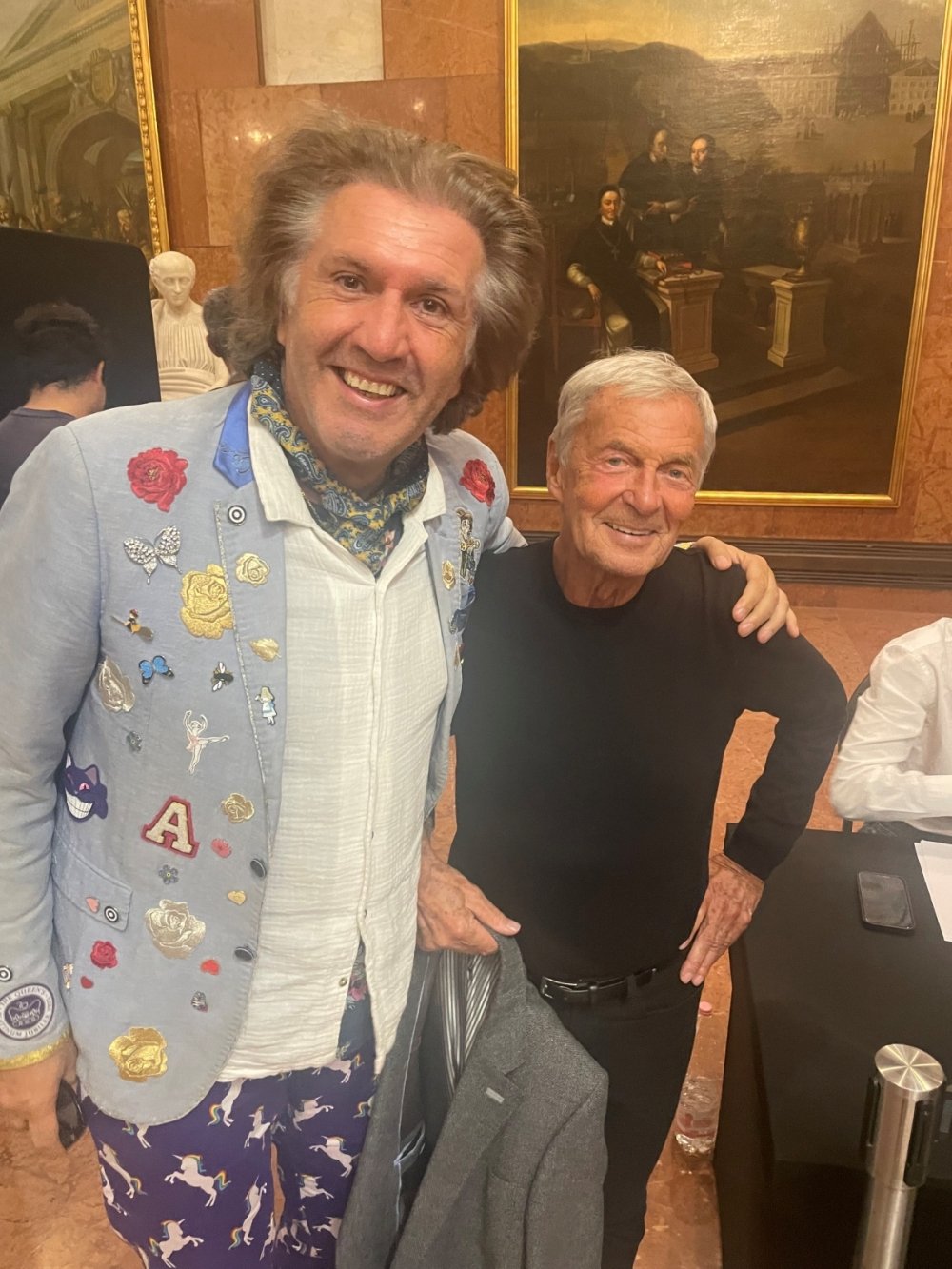
Jason Kouchak and Ernő Rubik
Like chess, working with the Rubik’s Cube improves pattern recognition skills, while also enhancing manual dexterity in a way similar to playing the piano.
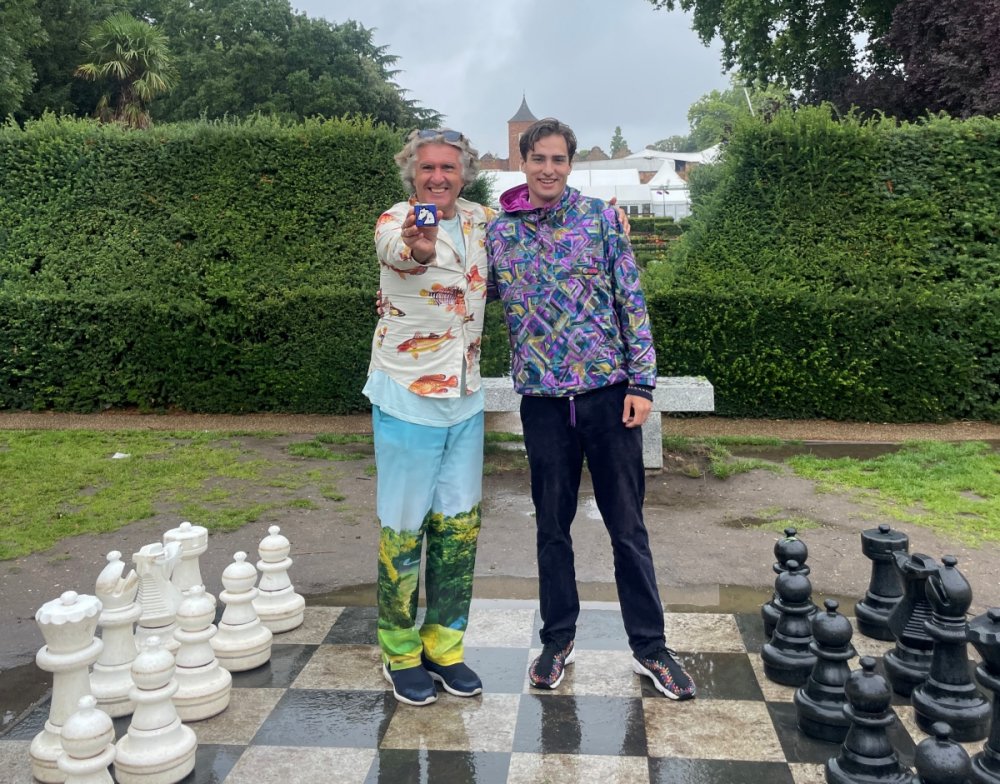
Solving the Rubik's Cube was one of Jason Kouchak's favourite pastimes as a child. When the COVID pandemic restricted public life, he began engaging with it again. At Judit Polgar's Chess Festival in Budapest, Kouchak had the opportunity to meet his idol in person and presented Rubik with a special variant of the cube featuring chess pieces. Each of the six sides represents a different chess piece.
By opting for a fianchetto setup, you embrace unbalanced and strategically rich positions, steering away from predictable theory battles. The Modern Defence (1…g6) is more than just a move – it’s a statement. By opting for a fianchetto setup, you embrace unbalanced and strategically rich positions, steering away from predictable theory battles. This approach allows Black to develop along the long diagonal, patiently targeting White’s strong centre instead of directly challenging it. If you‘re looking to play for a full point with Black, this opening is the perfect addition to your repertoire.
Free video sample: Introduction
Free video sample: King's Indian Links 4.c4 e5 Firouzja vs Carlsen
He also composed the song "Smile" for Rubik's 75th birthday - a song about the joy of overcoming a challenge.
Octogenarians – or kings who love chess!
Reaching the endgame is sometimes seen as the most beautiful part of a chess game, says Jason Kouchak:
The resolution of a story, in which struggles and challenges can be seen as opportunities to learn and grow. Both Don and Rubik share this universal ability to connect their ideas, thoughts, and genius with all generations.
Don Black and Ernő Rubik, both now over 80 years old, have shared inspiration and knowledge over the years. A legacy that future generations will remember. Or as Jason Kouchak puts it:
YOUR PERSONAL CHESS COACH - Whether you’re taking your first steps into the world of club chess, or already playing at a tournament level: with FRITZ, you can train more efficiently, intelligently and with a more personalised approach than ever before.
1.c4 e5 2.Nc3 Bb4!? is an opening idea well worth considering. Black immediately threatens to double the pawns on c3 in the style of the Trompowski or Sicilian Grand Prix attack.
Italian Game Powerbase 2026 is a database and contains 8571 top class games from Mega 2026 and the Correspondence Database 2026, of which 479 are annotated.
Videos: Nico Zwirs discusses the Sicilian with 2…e6 3.d4 cxd4 4.Qxd4 Nc6 5.Qe3 Nf6 6.Nc3. Mihail Marin examines Sindarov’s 6.Ne5 in the Queen’s Pawn Defence. Plus the ‘Lucky bag’ featuring 41 analyses by Berg, Ftacnik, Gupta and many others.
If you're looking for a dynamic alternative to the Slav, Queen's Gambit Declined, or other mainstream systems, the Chigorin Defence offers exactly what modern tournament players need.
Michael Kotyk presents a complete repertoire after 1.e4 e5, built around creative ideas, surprising move orders, and practical weapons designed to catch your opponents off guard.
€69.80
€59.90
We use cookies and comparable technologies to provide certain functions, to improve the user experience and to offer interest-oriented content. Depending on their intended use, analysis cookies and marketing cookies may be used in addition to technically required cookies. Here you can make detailed settings or revoke your consent (if necessary partially) with effect for the future. Further information can be found in our data protection declaration.
Pop-up for detailed settings
We use cookies and comparable technologies to provide certain functions, to improve the user experience and to offer interest-oriented content. Depending on their intended use, cookies may be used in addition to technically required cookies, analysis cookies and marketing cookies. You can decide which cookies to use by selecting the appropriate options below. Please note that your selection may affect the functionality of the service. Further information can be found in our privacy policy.
Technically required cookies
Technically required cookies: so that you can navigate and use the basic functions and store preferences.
Analysis Cookies
To help us determine how visitors interact with our website to improve the user experience.
Marketing-Cookies
To help us offer and evaluate relevant content and interesting and appropriate advertisement.