
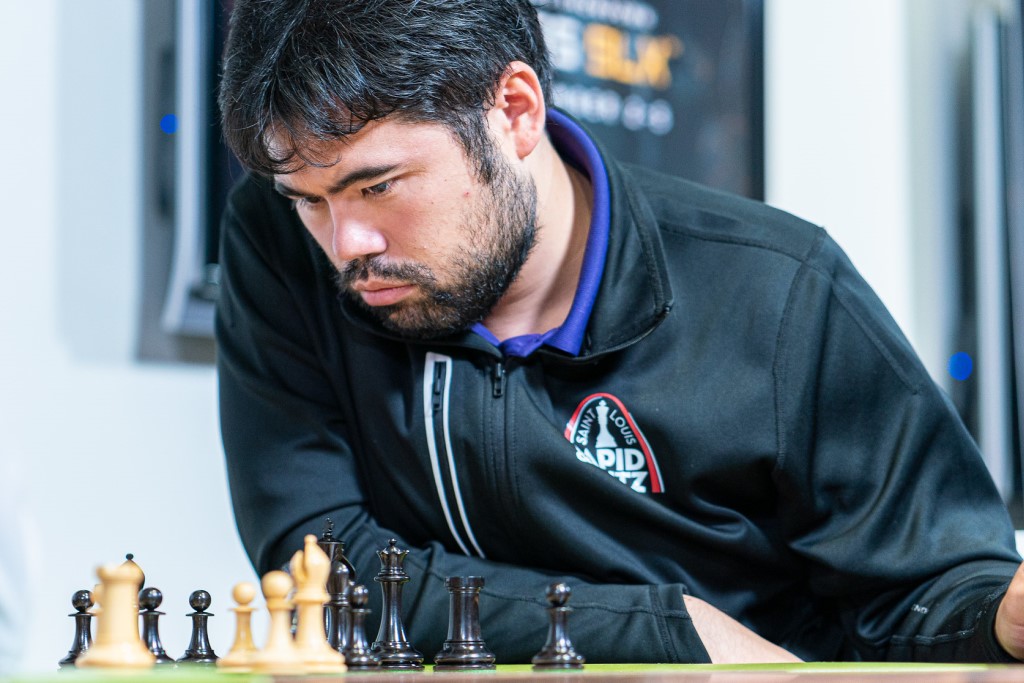

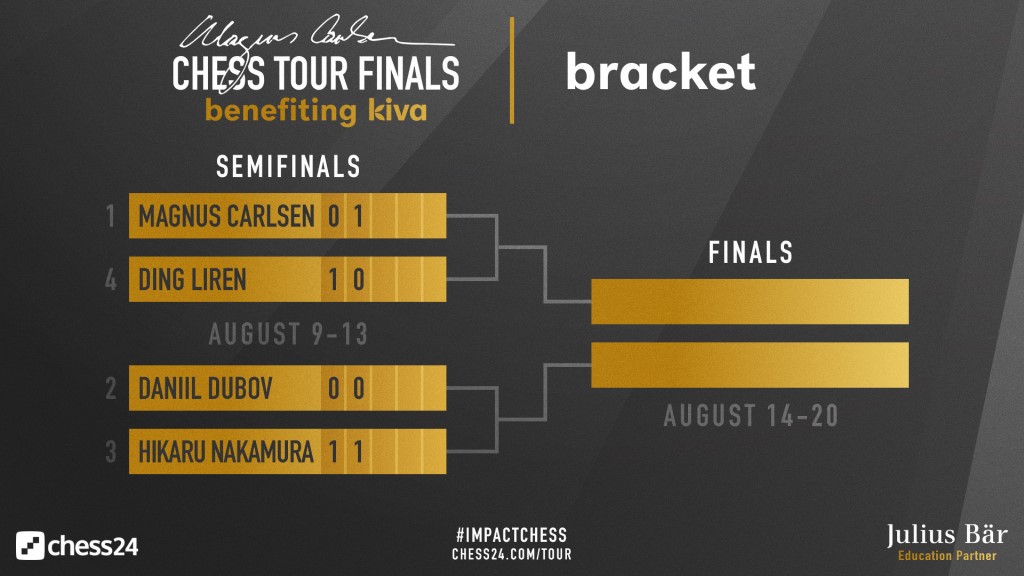
While both matches went to tiebreaks on Sunday, day 2 of the semis saw both confrontations being decided in the four-game rapid phase, with Magnus Carlsen only needing three games to level the score against Ding Liren. A little later, Hikaru Nakamura secured a second straight mini-match victory over Daniil Dubov, getting a 2:0 lead in the overall scoreboard. The American only needs one more win in the three remaining sets to advance to the final.
By now, those of us who have followed the Magnus Carlsen Tour are quite used to the format: each day a mini-match of four rapid games and blitz tiebreakers if needed. More than once in the past, Carlsen himself talked about modifying the World Championship cycle, even at the cost of losing some of the privileges he already had as reigning champion. He mentioned that the world champion should be the strongest player in all time controls, with rapid and blitz a good way to diminish the relevance of home preparation.
In an interview with Tania Sachdev after beating Ding in the second set of his semi, he was asked if he would like to play the World Championship match using the set system (with classical chess included in the mix). The Norwegian responded:
I think it all comes down to what you want to achieve — do you want to have a classical world champion or do you want to find out who the best player in the world is? I’ve always said that, in order to find out the best player in the world, the system that we have now is not very good. I’m sort of fine either way. [...] In [the classical World Championship matches] there’s very little room to prove that you are a better chess player.
This period of online chess, exclusively played with rapid and blitz time controls, might have an influence on how things are done in the future, so we will have to wait and see once the worldwide crisis is over and things return to normal — or not.
Click to enlarge
Game 2 of this matchup was chosen by commentators Peter Leko and Yasser Seirawan as the masterpiece of the day. As Carlsen put it:
This was really a case of finding a plan, executing the plan and winning the game. You don’t obviously get to see that very often.
The world champion also explained that the computer does not approve of all moves played by the winning side. However, from a human point of view it is the kind of game that illustrates an idea in a clear, aesthetically-pleasing way.
Carlsen temporarily sacrificed a pawn, created threats against White’s king and correctly simplified into a better queenless position when he was given the chance:
29...Qf4 30.Qxf4 exf4 31.d4 [31.Ra2, defending the pawn, was called for] Rxa4 32.d5 Ne5 33.Ne7+ Kh7 34.Nxg6 Kxg6
35.c5 bxc5 36.Rb8 and White resigned — Black’s knight, rook and king are too active.
At the outset of the second set, both players failed to squeeze wins from slightly better positions in games 1 and 2 — first Nakamura and then Dubov. Nakamura then won with white out of a Sicilian, patiently creating problems for his opponent while advancing his passed pawn on the b-file:
White is faster on the queenside: 34.b7 d5 35.Na5 Be5 36.g3 Qg6 37.Qc2 Rd6 38.Rdc1 Bf4
39.Qc8+ Rd8 40.Qxd8+ Rxd8 41.Rc8 Qe8 42.Rxd8 Qxd8 43.gxf4 and Black resigned.
Dubov played sharply in the fourth game, but Nakamura was his usual pragmatic self and ended up also winning the last encounter of the day.


| Advertising |