Logic Riddles for Chess Players

by Arne Kaehler
4/20/2020 – Chess players enjoy solving chess puzzles. The moment they understand how to solve a difficult problem is very satisfying for them. I have noticed that people who are passionate about chess, enjoy solving logical puzzles and mathematical riddles equally. In this series, I present to you interesting and famous logic riddles, wrapped up in a chess theme.

Your personal chess trainer. Your toughest opponent. Your strongest ally.
FRITZ 20 is more than just a chess engine – it is a training revolution for ambitious players and professionals. Whether you are taking your first steps into the world of serious chess training, or already playing at tournament level, FRITZ 20 will help you train more efficiently, intelligently and individually than ever before. 

Logic Riddles and Chess

The very first time I met Frederic Friedel, we quickly figured out our shared passion for logical riddles. The comparison to chess puzzles is obvious. We enjoy the challenge and the satisfying feeling when a puzzle or riddle has been solved by us.

Once Frederic and I had established our brain connection, he bombarded me with one logical or mathematical puzzle after another, which I could or couldn't solve.

Funny enough, the puzzles where I had to think around the corner could be solved pretty well by myself, but with the ones which required mathematical finesse, I failed miserably. The connection to my chess games is compelling. I love to spot interesting patterns and be creative in the way I play. As soon as chess leads to deeper calculations, my brain quickly tilts.

Playing 1.e4 with White is often associated with having to know reams of opening theory but this does not have to be the case. There are many unusual but playable lines which give White attacking chances whilst avoiding the well trodden paths. Besides the practical advantage of putting Black on his own resources this gives White the opportunity to play creative chess from early on in the game. On this DVD Davies presents a complete repertoire for White comprising unusual but aggressive lines. His suggested repertoire includes 2.Na3 against the Sicilian, 2.f4 against both the French and Pirc and the Fantasy Variation of the Caro-Kann. Video running time: 4 hours.

I would like to create a series of logical riddles for you to solve. All riddles are bound to a chess related theme, to make you feel at home. Important to note is that there are some rules to follow in the spirit of the game.

The Rules

1. In The Spirit Of The Game

The World Flying Disc Federation (WFDF) has a particular rule system in their "Ultimate" game that places the responsibility for fair play on every player. There are no referees, even in the world championships. Respect for other players is key and the basic joy of playing is the first priority.

There will be riddles which you won't solve easily. Some might take you days or weeks and others you simply cannot find a solution at all. It is part of the game, so to say. Accept it. Don't cheat and look up the solution in the World Wide Web or peek in our comment section. It ruins the whole purpose of training your brain and enjoying the process, and it threatens your own discipline too.

These are all the rules necessary.

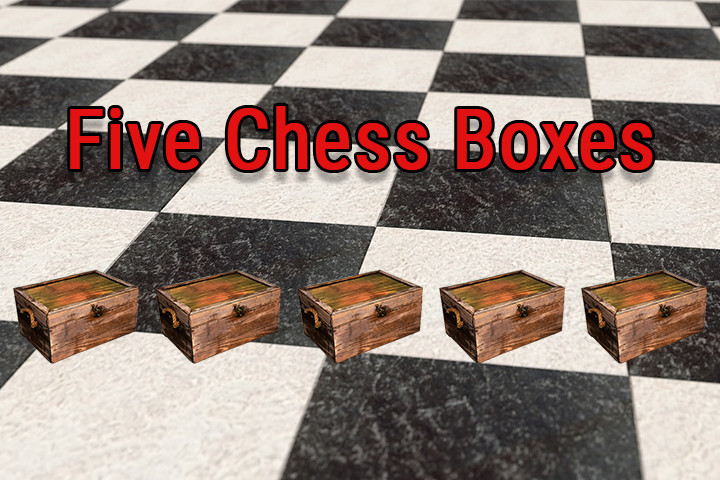
Five Chess Boxes

This is the very first riddle of the series and it is a pretty difficult one. 

As you can see in the title picture, there are five boxes standing in a row. You would love to play a game of chess in one of the next six days, but you know that all the required chess pieces are hidden in only one of the boxes.

What makes things worse is, that you are only allowed to open one box and check if the pieces are inside. Once that is done, you have to wait till the next morning to open another one. Well, in the worst case, you might find the correct box after five days in total, correct?

Unfortunately, the chess pieces awake at midnight, open their box and sneak into the next adjacent box, either to their left or right side. I hate it when that happens.

How can you guarantee to find the chess pieces in the next six days!?

To make things clear, there is of course no trickery involved. You can solve this riddle purely by logic. Yes, a bit of mathematical expertise is also helpful.

Some ideas to start with:

If you pick a similar box every single day, the chess pieces could bounce back and forth in some other boxes, so you might not catch them like this.

If you pick the first box the first day, the second box the second day, and so on until you reach the fifth box on the second last day, the chess pieces might avoid being found. They could be in box number two on the first day and simply move to box number one on the second day. Darn.

The good news is, with the right plan you can catch them on time to play the chess game!

The Solution

Will be given in the next part of this series, so you have a lot of time to solve this one until then.

Did you know this riddle already? You are welcome to post the whole answer in the comment section below. How long did it take you to solve it? 

Talking about puzzles, have you ever tried out our ChessBase tactics section before?


Arne Kaehler, a creative mind who is passionate about board games in general, was born in Hamburg and learned to play chess at a young age. By teaching chess to youth teams and creating chess-related videos on YouTube, Arne was able to expand this passion and has even created an online course for anyone who wants to learn how to play chess. Arne writes for the English and German news sites, but focuses mainly on content for the ChessBase media channels.

Discuss

Rules for reader comments


Not registered yet? Register

arcteggzz arcteggzz 5/11/2020 07:07
How possible is it to get a video explaining the solution?
stanislav stanislav 5/10/2020 08:33
There's an awesome solution with a cellular automata similar to Conway's Life.
lajosarpad lajosarpad 4/24/2020 03:57
@fgkdjlkag

According to my understanding to the problem, there is a single chess set and the pieces are very well-coordinated, they don't like to separate from each-other at all, so they are always all in the very same box, except for their seeking time at each midnight, when they are in transit between the previous box and the new box. We do not know in which box they are at the first day, they might be in any of the five boxes, but, we know for certain that they will move from their current box into the adjacent box at midnight. Since the boxes are not placed in a circular fashion, we can also be sure that if the pieces are at an edge box (1 or 5) at a given day, then, on the next day their position will be deterministic. If they are in box 1, then the next day they will be in box 2 and if they are in box 5, then the next day they will be in box 4. However, non-edge boxes (2, 3, 4) are not deterministic, the pieces might decide to go in any direction in those cases.

So, there is a single set, it's guaranteed to move in a non-circular fashion and it is indeed solvable, I have solved it.
fgkdjlkag fgkdjlkag 4/22/2020 09:34
So to make sure I am understanding this properly, on day 2 the pieces in 5 must be in 4 and the pieces in 1 must be in 2 since they are the only adjacent boxes? Can pieces be duplicated in a box? That is, on day 2, might the pieces from 3 also be in 4, so it would contain what was originally in both 3 and 5? Similarly there is no limit to the number of sets that could eventually be in 1 box?
lajosarpad lajosarpad 4/22/2020 05:46
Hello, fellow riddle solver chess enthusiasts. I believe the best thing we can do here in the comment section to avoid telling the solution, so later visitors will have an opportunity to enjoy the riddles as well.
DrBob64 DrBob64 4/22/2020 04:49
A nice visualisation for this is a checker moving up a 5 by 6 board.
Say that b1 and d1 are White (b1,c2,d3) or (d1,c2,b3) catches any checker starting on these squares.
Any survivor must be on the black squares b4 or d4, so we run the algorithm again, hitting b4, c5,d6 or d4,c5,b6.
JoshuaVGreen JoshuaVGreen 4/22/2020 01:42
@DKRaja, as noted earlier in this thread (by @MadMox), your 4 4 2 2 3 4 and 2 2 4 4 3 2 solutions don't work. For the former, the chessmen could be in boxes 2 3 4 5 4 [3 or 5] and you may never catch them. For the latter, the chessmen could be in boxes 4 3 2 1 2 [1 or 3] and you may never catch them.
varunkulkarni varunkulkarni 4/22/2020 12:47
2,3,4,4,3,2 ?
tehillah tehillah 4/21/2020 09:28
A nice fun riddle. The idea for me was to play around with smaller cases and use the advantage given by the walls which forces the chess pieces to move in one direction. Waiting for the next one!
lajosarpad lajosarpad 4/21/2020 03:03
@Zurubang

Thanks for your answer. It was fun solving this.
DKRaja DKRaja 4/21/2020 02:28
Discrete Mathematics comes into play more then Chess in this case. My solution is as follows

1. 2 3 4 2 3 4
2. 4 3 2 4 3 2
3. 4 3 2 2 3 4
4. 2 3 4 4 3 2
5. 4 4 2 2 3 4
6. 2 2 4 4 3 2
neomorphy neomorphy 4/21/2020 02:43
The secret is that the pieces have to move and that the ends( boxes 1 and 5 ) forces the pieces back on the next move.
Two possible solutions are,

Spoiler
========


2,3,4,2,3,4
2,3,4,4,3,2
stikmat stikmat 4/20/2020 09:33
I've seen the problem before ... on Chessbase. It was a part of John Nunn's Christmas Puzzles.
Erdmundr Erdmundr 4/20/2020 09:12
Solved in under an hour, the trick is to first deal with all the cases where you start in an even numbered box, and then understand how you can force the pieces into an even numbered box.
pviolini pviolini 4/20/2020 05:58
I wrote a small python program and discovered the two different solutions (not considering the other two symmetrical ones), is this considered cheating? ;-)

Of course, it is, but at least I had fun training my brain differently!
JoshuaVGreen JoshuaVGreen 4/20/2020 05:52
I've seen this puzzle — for n ≥ 3 boxes — in (I think) a math competition. I could only vaguely remember my solution from then, so I had to work it out again. I'm ROT13-ing my solution.

Sbe a = 1, jr fvzcyl bcra obk bar.
Sbe a = 2, jr pna bcra obk gjb gjvpr.
Sbe a ≥ 3, jr pna bcra obk gjb, guerr, sbhe, ..., a zvahf bar, a zvahf bar, a zvahf gjb, a zvahf guerr, ..., gjb.
Sbe a = 5, gur nobir erqhprf gb bcravat obkrf gjb, guerr, sbhe, sbhe, guerr, gjb.
milog milog 4/20/2020 03:43
@MadMox: Ah, got me there! Thanks for pointing out, so back to thinking mode ;)
MadMox MadMox 4/20/2020 03:32
@milog: I'm afraid so, your solution is missing something: let's say you try 2-2-4-4-3 and that the chessmen go around like 4-3-2-1-2- and on day 6 they can be either in box 1 or 3...
MadMox MadMox 4/20/2020 03:24
Nice problem, indeed! Observe that it would be impossible to solve it on a ring (that is, if the chessmen could jump from box 5 to 1), the existence of a boundary is a necessary condition to hope to find a finite-time solution. A quick way to solve it is to paint the boxes white and black, alternated, like the squares of a chessboard. Then you know that if the chessmen are in a black box today, they'll be in a white box tomorrow. Now choose wisely your first 3 attempts in such a way as to corral the chessmen in one of the two boxes 2 and 4. The rest is trivial. Thank you for this riddle: it's humorous and deep!
milog milog 4/20/2020 03:21
One must use the ‚zugzwang‘ of the pieces to one‘s advantage, and obviously it makes sense to start with the second box from either end:


——————-
SPOILER ALERT
——————-


4-4-2-2-3-4

or the other way around

2-2-4-4-3-2

and the pieces cannot escape! Or am I missing something? Took me around 4-5 minutes of focusing.
Zurubang Zurubang 4/20/2020 02:48
Hello @lajosarpad.
I am delighted to read, that you are not only able to train your condition, but also your brains at the same time. To answer your question: The chess pieces cannot move from box one to box five or vice-versa. All boxes are standing next to each other, just like in the picture. Furthermore, the pieces are guaranteed to move their legs each night. They simply cannot stay in one box, because they have no rest day. Your "zugzwang" analogy is so good, I am almost sad I missed the opportunity to mention it in the article. Have a great day.
lajosarpad lajosarpad 4/20/2020 01:09
I will think on this while I am jogging today. But I have some questions about it before I do so. Are the vertices between the boxes circular, that is, can the chess pieces move from the first box to the left into the fifth box or vice-versa? Are the pieces guaranteed to move each midnight, or, are they allowed to pass a move, bringing us into zugzwang?
1