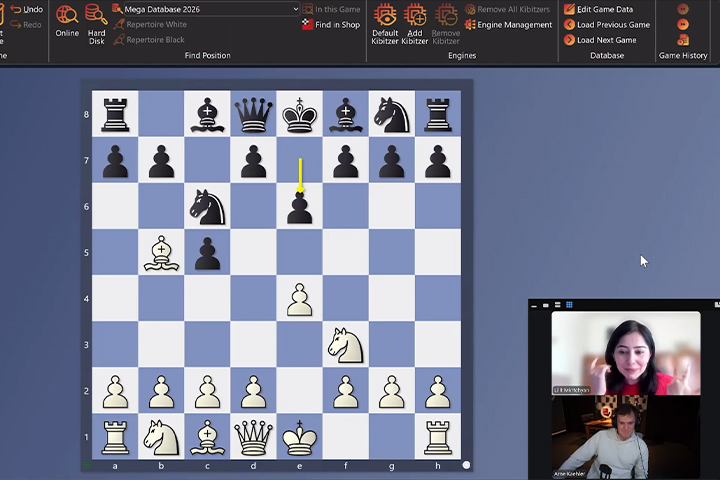
12/24/2025 – This video is a valuable chess lesson by IM Mkrtchian. Watch Lilit walk through a full “real tournament” prep routine in ChessBase 26. Find out how she scouts an opponent in the Mega Database, predict their openings, and steer the game into a line she specifically prepared. The payoff: a sharp Rossolimo move-order trap explained in a super teachable way, plus how she converts the advantage into a clean endgame win.
new: Fritz 20
Your personal chess trainer. Your toughest opponent. Your strongest ally. FRITZ 20 is more than just a chess engine – it is a training revolution for ambitious players and professionals. Whether you are taking your first steps into the world of serious chess training, or already playing at tournament level, FRITZ 20 will help you train more efficiently, intelligently and individually than ever before.
Whether it’s a weak pawn, a vulnerable king, or poor piece coordination, this course will teach you how to pinpoint the critical targets, prioritise your attack, and execute a clear, effective plan.
€39.90
Lilit Mkrtchian’s Best Games of 2025 - Opening Preparation that actually works
Arne reunites with WIM Lilit Mkrtchian after almost three years to revive their popular training format - this time using ChessBase 26 - and asks her to show three of her favourite games of 2025 while explaining her full preparation process.
For episode 1, Lilit chooses a game from round 5 of the Tegernsee Open (Germany) against 70-year-old Klaus Jürgens, which she found inspiring both for the tournament atmosphere and for how strong and consistent his opening repertoire was.
She demonstrates how she researches an opponent in the Mega Database, identifies their habitual setups (Sicilian vs 1.e4, Dutch/Leningrad vs 1.d4), and then uses that predictability to steer the game into a prepared Rossolimo line with a “trap” where the common move …Ng6 is actually an engine-confirmed mistake!
The key instructional moment is her move-order: after provoking …h5 she plays e5 with the point that later tactics (Qe4 and Bf4 ideas) punish Black’s king safety and pawn structure—details that are almost impossible to find over the board without prior analysis.
She also reviews critical practical decisions in the middlegame and endgame (admitting a couple of inaccuracies that gave counterplay), but shows how she converts the advantage step-by-step into a winning knight ending, and closes by praising how impressive it was that her veteran opponent still set active traps before eventually resigning.
0:52 – Why this game: matters Lilit introduces the chosen game from her recent German tournament and explains why the opponent and setting made it special.
4:03 – Real tournament preparation in ChessBase Step-by-step: opponent scouting in the Mega Database: filtering games, identifying opening habits, and spotting long-term patterns.
14:44 – The critical Rossolimo mistake: …Ng6? The key Rossolimo moment where a “natural” and popular move turns out to be an engine-confirmed mistake, and why over-the-board intuition fails here.
28:44 – Advantage conversion & practical decisions: Transition from opening success into the endgame, including Lilit’s honest discussion of inaccuracies, psychology, and how she still converts the win.
EXPAND YOUR CHESS HORIZONS Data, plans, practice – the new Opening Report In ChessBase there are always attempts to show the typical plans of an opening variation. In the age of engines, chess is much more concrete than previously thought. But amateurs in particular love openings with clear plans, see the London System. In ChessBase ’26, three functions deal with the display of plans. The new opening report examines which piece moves or pawn advances are significant for each important variation. In the reference search you can now see on the board where the pieces usually go. If you start the new Monte Carlo analysis, the board also shows the most common figure paths.
Arne KaehlerArne Kaehler, a creative mind who is passionate about board games in general, was born in Hamburg and learned to play chess at a young age. By teaching chess to youth teams and creating chess-related videos on YouTube, Arne was able to expand this passion and has even created an online course for anyone who wants to learn how to play chess. Arne writes for the English and German news sites, but focuses mainly on content for the ChessBase media channels.
12/21/2025 – We take a unique behind-the-scenes look at how top chess masters organize their digital workspace. Grandmasters and trainers reveal their personal ChessBase 26 setups — from meticulously clean desktops to chaotic databases full of ideas. They show us their board designs, current projects, and discuss their favourite or most-used ChessBase functions, offering fascinating insights into how great minds prepare, study, and work with chess every day.
12/10/2025 – Dorian Rogozenco demonstrates how ChessBase 26’s Monte-Carlo analysis can rapidly generate thousands of short engine games to obtain a statistically reliable evaluation of an opening line.
In the example, it becomes clear that a previously promising surprise weapon for Black performs objectively much worse, providing a second, more realistic perspective to decide whether the line is practically worth playing.
FIDE World Cup 2025 with analyses by Adams, Bluebaum, Donchenko, Shankland, Wei Yi and many more. Opening videos by Blohberger, King and Marin. 11 exciting opening articles with new repertoire ideas and much more.
GM Blohberger presents a complete two-part repertoire for Black: practical, clear, and flexible – instead of endless theory, you’ll get straightforward concepts and strategies that are easy to learn and apply.
Opening videos: Sipke Ernst brings the Ulvestad Variation up to date + Part II of ‘Mikhalchishin's Miniatures’. Special: Jan Werle shows highlights from the FIDE Grand Swiss 2025 in the video. ‘Lucky bag’ with 40 analyses by Ganguly, Illingworth et al.
€14.90
We use cookies and comparable technologies to provide certain functions, to improve the user experience and to offer interest-oriented content. Depending on their intended use, analysis cookies and marketing cookies may be used in addition to technically required cookies. Here you can make detailed settings or revoke your consent (if necessary partially) with effect for the future. Further information can be found in our data protection declaration.
Pop-up for detailed settings
We use cookies and comparable technologies to provide certain functions, to improve the user experience and to offer interest-oriented content. Depending on their intended use, cookies may be used in addition to technically required cookies, analysis cookies and marketing cookies. You can decide which cookies to use by selecting the appropriate options below. Please note that your selection may affect the functionality of the service. Further information can be found in our privacy policy.
Technically required cookies
Technically required cookies: so that you can navigate and use the basic functions and store preferences.
Analysis Cookies
To help us determine how visitors interact with our website to improve the user experience.
Marketing-Cookies
To help us offer and evaluate relevant content and interesting and appropriate advertisement.