Sarana wins final two games, clinches title
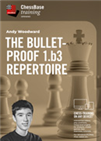 This compact course is designed specifically for practical play. Instead of overwhelming you with endless theory, it focuses on the critical lines, typical plans, and recurring tactical ideas.
Looking for an opening that gets your opponents thinking on move one? Grandmaster Andy Woodward has relied on 1.b3 for years in blitz and bullet, using it to defeat strong masters and grandmasters who underestimated its hidden venom. While many players dismiss the opening as harmless, they often find themselves caught in unfamiliar positions, tactical traps, and uncomfortable middlegames. This compact course is designed specifically for practical play. Instead of overwhelming you with endless theory, it focuses on the critical lines, typical plans, and recurring tactical ideas that matter most when the clock is ticking.
Free video sample: Introduction
Free video sample: King's Indian Setup
Alexey Sarana won the KazChess Masters in Almaty after edging out Alexander Donchenko on tiebreaks at the end of the nine-round event. Both players finished on 6/9, while Igor Kovalenko took third place, half a point behind the two leaders.
The tournament took place from 30 June to 8 July in Almaty, the most populous city in Kazakhstan, which was the country's capital from 1929 to 1991. Organised by the Kazakhstan Chess Federation, the event was a ten-player single round-robin. The games were played with a classical time control of 90 minutes for 40 moves, followed by 30 minutes to finish the game, with a 30-second increment from move one.
The tournament concept paired five established international grandmasters, rated between 2640 and 2672, with five rising Kazakhstani players rated between 2436 and 2551.
Panoramic view of Almaty from the Köktöbe hill, via Wikimedia Commons
Sarana completed the event unbeaten, scoring wins over Mark Smirnov, Aldiyar Ansat and Kazybek Nogerbek, while drawing his other six games. His victories in the final two rounds, over Ansat and Nogerbek respectively, allowed him to reach 6 points, and the tiebreak criteria placed him ahead of Donchenko.
Donchenko recovered from a first-round loss against Kovalenko to join Sarana in first place. The German grandmaster scored four wins and four draws in the remaining eight rounds, including a final-round victory over Nurman.
Kovalenko finished third on 5½/9. The 37-year-old Ukrainian grandmaster remained unbeaten throughout, adding a victory over Nogerbek in round eight to his first-round win over Donchenko. He drew the rest of his games.
Among the Kazakhstani players, Denis Makhnev achieved the best score, finishing on 5/9. He shared fourth place on points with Sam Shankland, while Maksim Chigaev ended on 4½/9 in sixth place. Nurman, the one female player in the field, scored 3½ points and gained 7.3 rating points, climbing to third place in the under-20 girls' live ranking.
 YOUR PERSONAL CHESS COACH - Whether you’re taking your first steps into the world of club chess, or already playing at a tournament level: with FRITZ, you can train more efficiently, intelligently and with a more personalised approach than ever before.
FRITZ is more than just a chess engine – it’s a training revolution! Whether you’re taking your first steps into the world of club chess, or already playing at a tournament level: with FRITZ, you can train more efficiently, intelligently and with a more personalised approach than ever before.
Players and organisers | Photo: Official website
Donchenko 1-0 Nurman
Final standings
All games
Chess is a concrete game. There is no way around training your calculation skills. Improve your visualization, pattern recognition and learn calculation techniques such as reciprocal thinking with this course.
Calculation is at the heart of practical chess. Every chess concept builds on proper calculation technique. Therefore, all chess players should continuosly train the fundamental techniques, concepts and patterns this course will present. The goal isn't only to teach you to calculate, but to give you the tools and insights to keep improving long after the final lesson.
Free sample video: Introduction
Free sample video: Quiet Moves